
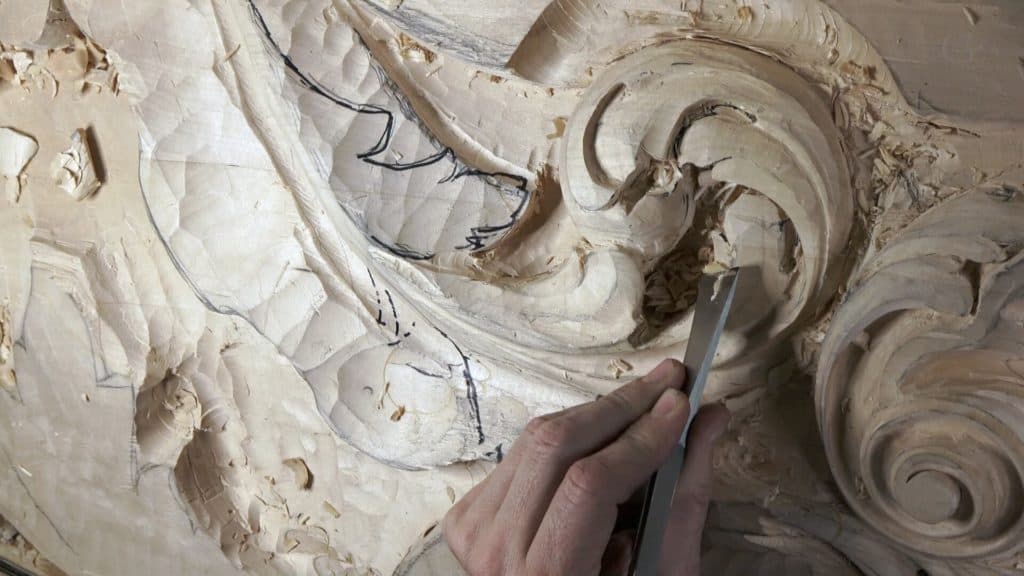
Alexander Grabovetskiy, woodcarver, School of Woodcarving · Published 2020
What does "wonderful" mean when a wood carver says it?
Quick answer: Wonderful is the word I say when a pass or the whole look comes out the way I want it. In part 9 of Venice Room 40 I said it about the overall look, then named an area to bring out with a 1.5 mm number 11, about 1/16 in. The second time, cleanup was left.
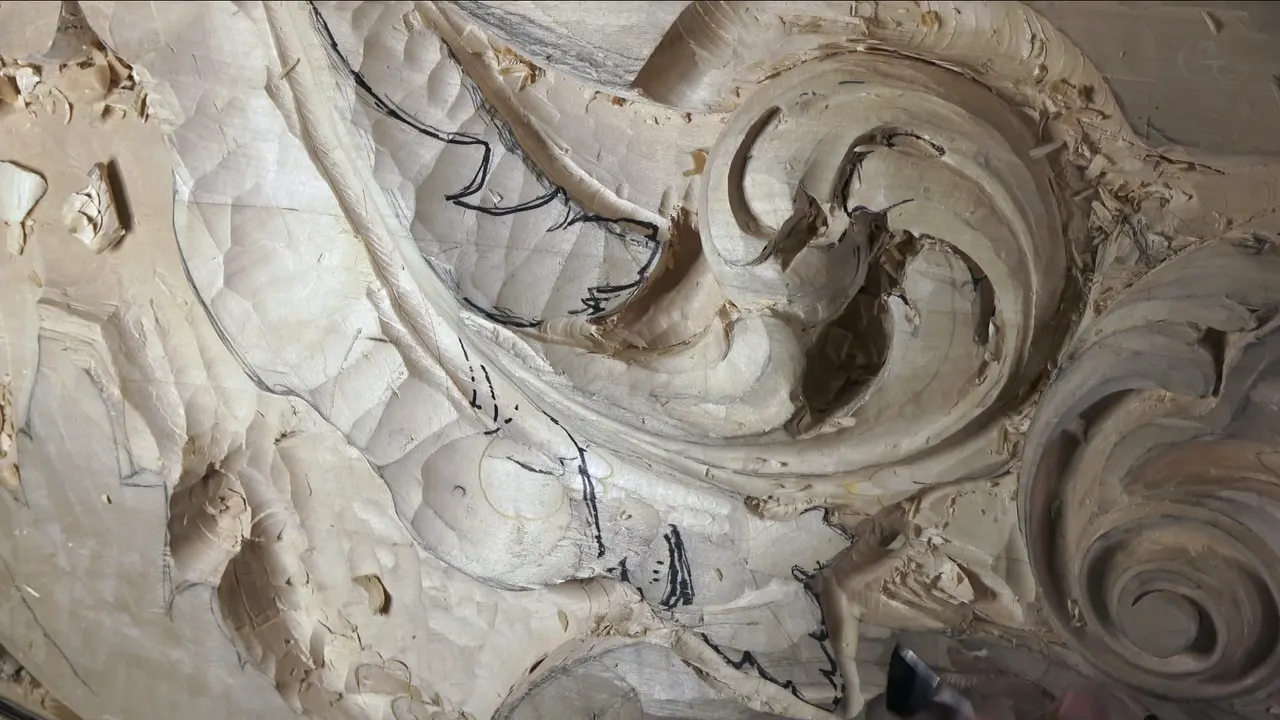

"Wonderful," when I say it over a carving, means a pass or the whole look came out the way I wanted. It came out of me twice in part 9 of Venice Room 40. Both times a job still open followed within a few words, first one area to bring out a little more, then the cleanup.
Have you ever stepped back from a carving and liked it, while one corner still looked rough? Did you still want to fix that corner? Here is part 9 beside other times the word shows up in my wood carving courses, with what I did or planned right after each one.

Wonderful on my boards, in six lines
- Twice in that one part.
- The first time was about the overall look. An except followed, with a small number 11 for one area.
- The second came with cleanup.
- In Venice Room 2 the except came in the same breath.
- The lily box got an although, because one spot right there looked kind of rough.
- A furniture panel got it along with "we have to carve more."
What was wonderful in part 9?
How the whole thing looked. "I'm after just the overall look," and that look was actually really good. Then the stronger word came.
Getting there took a few changes of tool. The part opens on a ridge of my Venetian relief panel, one side done and another convex planned for the other side. The two of them, as I put it, would give me the feel of the pipe. It's not really pipe.

My number five was digging in next, which is not so good, but it's okay. Maybe this tool is a little too big. A flatter one, maybe, and probably a number three. What I actually tried was a skew back bend, and that was a little better, but not exactly what I want to see. So, maybe a straight number one, to blend a little better this way.

Not too happy. But I can live with it. It still needed a better clean, and I said I will. The next convex I could take all the way along, starting gradually, and then here you go, it was going to run right to the separation.

One spot right there wanted a better clean too, and a deeper cut sat right there as well. "I'll take care of it, no problem." Then came the overall look, with the first wonderful of the part.
Which job followed the first wonderful?
An except. Right after the verdict I named one area I could bring out a little. For that job I should probably use a one and a half millimeter number 11, about 1/16 in, and get here underneath. Just like that.

The ridge wanted care again after that. A big number three again, because it gives me a really good clean cut. Just like that. It was looking good, I said.

Plans followed, more than finished jobs. That letter S movement needed cleaning, and I said it twice. I could even go like that and undercut a little bit, and the movement needed to be kind of refined too. After a stretch with no words came the second wonderful.

Did the second wonderful mean the work was done?
It did not. "And that is wonderful, I would say," and in the next breath a lot of cleanup needed to be done. Cleaning inside and taking care of the mess. Not a big deal. I can do that off camera, and what I wanted you to see was the main development, the main idea.
Then I went back to a spot I broke. I also want to clean this, because I broke it and I don't like what I just done. It happened while I was working on the inside, and that's not good. But it's really easy to clean.

Just give a small concave like this, and I can go with this concave down the whole way, which gives a really nice movement too. But I don't really need the big deep concave. Just not what I want to see. Probably like that, with a number three, and it came out nice and long and good.

Except right here, I have to shave a little more. The last words in that part are that is good, not wonderful.
The next part, part 10, has the same pair. "And that is wonderful," and then of course I'm going to clean on the inside, like I said before, but I can always take care of it later. Next came a plan to outline a little bit of this side.
On a furniture panel the word went over the overall look of the acanthus movements. Overall it just looks wonderful, yeah, we have to carve more. I still had to work around the eye and take out that paper, and later on we can do that. In another part of that lesson I could still see some rugged spot. A little fixing, almost forgot, but overall it looks wonderful. Let's attack this section.

Where else in workshop 40 did I say it?
Parts 2, 4, 5, 7 and 10 have it too. Something came just before it each time, and a next job came right after, as the table shows. Some of those jobs got done on camera. Others stayed plans.
| Workshop 40 | What came just before the word | My next job |
|---|---|---|
| Outline, part 2 | Outline it, then this way too | I could start excavating deeper right there |
| More depth, part 4 | A little deeper right here | A number six, to excavate around and get that depth |
| Blend, part 5 | Good, with a blend to the concave still owed | One separation, a little bigger, but not too big |
| Keeping a detail, part 7 | I really did not want to lose the detail I had just made | Go in, and again excavate with number 11 |
| Tight spot, part 10 | I needed probably a smaller tool for one spot | Another way, a number one double bevel |
Later in part 2 I was still not too happy that we got only one division right there. It's okay, I said.
Part 5 is worth a second look, because of the order. It starts with good, except I need to blend to the concave, and the need comes twice. Wonderful follows, and then one separation right there, a little bigger. Not big, though. I'm not going to do too big.

There is a detail in part 7 I really did not want to lose, one I had just made. Okay, wonderful, and then, go in. Again, number 11, and excavate a little more, although I could use probably a number seven instead, not as big, like a quarter inch (about 6 mm), no more than that.
What did Venice Room 2 add?
There, the except came in the same breath. "Wonderful, except this," and I need to outline again, in part 3 of that lesson. I hope you see already some results, I added.

Its part 12 opens with a stop, because I needed to attack from this side. The verdict came, then except I need to outline it better, with straight down cuts. And I don't worry about if it's not that perfect yet.
Much better came first in part 9 there, with a but about this side. I should leave it like that. Right after that, wonderful. So let me move on to the next part. I want to outline probably this, and that way I'll see the overall picture.
A warning came first in part 11. Earlier in it I wanted to go an inch and a half deep (about 38 mm), because I wanted those movements kind of deep. Pushing it there would be a mistake. But here I can go deeper. Wonderful came next, with a plan to excavate this area right here, using the same number nine as the first cut.
In that lesson's part 6 I offered to handle a mess with the smaller number nine. Number 9 or number 11 will work in this case. Then the word, and right after it, now I need to figure out what is going to be a better-looking detail right here, and which one goes above the line.
With part 14, a clean followed it. I need to clean right here, with just a small gouge to get right there, preliminary, because it still has to be lower. That room starts in the first twelve workshops.

Can wonderful come with an although?
It can. On my lily box, lesson 7, the green tape showed me I had left the high spot, and that was good, because that's visible. I called it wonderful. Although right here, it's kind of looking rough.
Then it was time to redraw and reestablish the lines. I'd take a number 11 of 3 millimeters (about 1/8 in) again, to go around those leaves. You can see the whole box in the lily box course.
Earlier on that box, in part 1 of the same lesson, I wanted to make sure no details got lost. All right, wonderful. Next, the mallet and a number 11 were my plan for outlining those movements.

On my furniture panel, lesson 21, one spot was supposed to give me a really nice shadow. I didn't know if it would, but it should. Wonderful came next, and right behind it, I just don't like how it looks, the transition right here. I can always create a blending cut, and right here it has to just kind of die in. And now I'm happy.
On Venice Room 65 the order was good, although a little too much right here, and then wonderful. The pipe was next, to be rounded a little more exaggerated on that side.

What comes next when there is no except?
Another tool, or another section. In the furniture panel course I wanted to make an extra separation cut, like half a millimeter (about 0.02 in) with a number 11 for a little bit of shadow. I called it wonderful. And now I'm going to need an even smaller tool, maybe a number 5 in 3 millimeters (close to 1/8 in).
Earlier in that lesson, in part 1, I was attacking from opposite directions, from both sides. Wonderful, and I do have one more spot right here, so I kind of have to attack right away, again from both sides.
In its part 12 I had to be more careful, because I didn't want to dig inside of my background, but it looks like it works fine, and that is actually wonderful. Let me use again number 11 and the one millimeter (about 0.04 in), and I'll clean it, but not undercutting yet, because it's still a possibility I'll move it.

Over in that Venice Room 65 lesson, in its ninth part, you don't see it right now because of the light source, but it's going to give me a beautiful shadow once I turn off the light. Wonderful. I am ready, actually, to jump on this section, almost done with the main movement, though I still have to work on the ceiling part.
A normal back bent that I reshaped as a skew, to my taste, lets me get a much cleaner cut in part 6. Okay, wonderful. There was going to be a separation, so maybe I could just hit that with the same skew and hope it's not going to break. And it did not break. The room goes on in workshops 62 to 73.
Part 7 of it had me just digging in. That's probably enough. Don't want to do too much. Another spot right here, too, I can probably just right away relieve. After the word, logically, I could actually do right away some extra subdivisions. It does not look too good, I said twice, but I really want to make it look good. Okay, number 11, that's the one I'll use.
The word came doubled in part 2. A number nine was to clean a little more, a little nicer, without destroying it, hopefully, and then wonderful, wonderful. My plan after that was to probably give it a shape, some kind of division, otherwise it won't look nice.
And in part 1, after I said it's probably okay to use a number 3 in this case, the word came four times in a row. Later it was absolutely wonderful. As an interjection it is short, and on these boards it lands right after a pass, before the next job.

Where can you watch it happen?
On the workshop 40 page, with all eleven parts of this workshop, workshop 39 before it and workshop 41 after. Workshops 38 to 49 of this panel are in Part 4 of the room. Every course of mine is one click away if you start here.
How it's done
- Look at the whole thing first. My eye was on just the overall look before the word came.
- Name the except. One area could stand out more, and I named it right after.
- Take a small tool for it. A tiny number 11, to get in underneath.
- Go back to the ridge. The number three again, for a clean pass along it.
- Leave the cleanup for later. Plenty was left, and I said I could do it off camera.
- Fix the spot you broke. A small concave, not the big deep one, then a number three, nice and long.
Frequently asked questions
Is wonderful the same as finished on your boards?
Not in part 9. Plenty of cleanup remained after my second one, inside the work and in the mess around it, and I called that not a big deal. Off camera was where I said I could do it, and then I went back to a spot I broke.
Which tool came after the except in part 9?
The small number 11, one and a half millimeters. With it I meant to bring out one area a little and get in underneath. After that a big number three returned to the ridge, since it gives a really good clean cut.
Does good ever come before wonderful?
In workshop 40 it did, in part 5. Good came with a blend still owed to the concave, and only then the bigger word. Over in workshop 65, part 5, a good arrived with an although about too much in one spot, and the pipe was the next job.
What to carve next