

Alexander Grabovetskiy, woodcarver, School of Woodcarving · Published 2020
How do you get a cleaner cut with a carving gouge?
Quick answer: A cleaner cut is a pass that leaves little to clean afterward. Across my lessons a bigger gouge, a back bend, slicing and the cleaner side of the gouge each gave me one, and in Venice Room 40, part 1, I expected a cleaner result from a bigger tool.
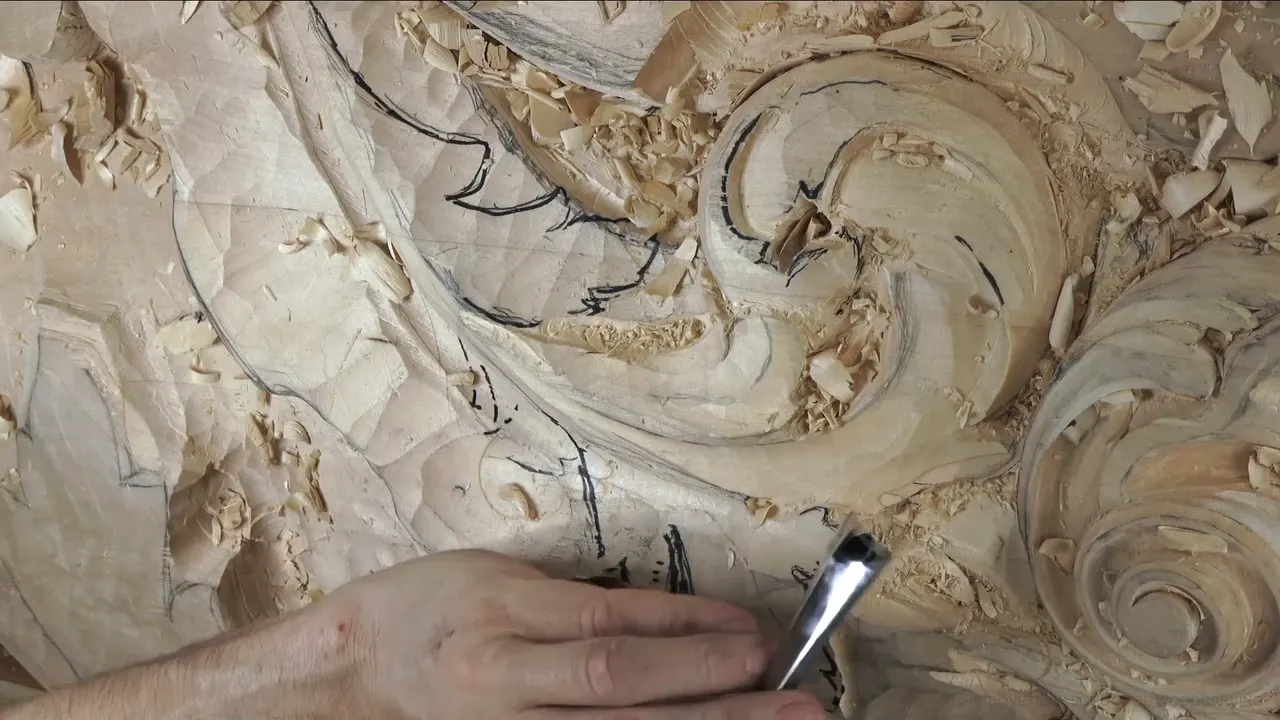

A pass that leaves little to fix afterward is a cleaner cut, and in my lessons it comes from the tool I pick and how I present it. In Venice Room 40, part 1, I try a bigger gouge, expecting a cleaner result "pretty much right away." Other lessons use it for a back bend, slicing and a gouge's cleaner side.
Ever pushed a gouge through a spot and known you would have to go back and clean it? Would it help to see which tools got me there in one pass? We start with one short part of workshop 40 on my Venice room carving, then follow the word into the courses where I say it again, with the sizes I gave out loud.
What gave me a cleaner cut?
- Bigger gouges, in spots that can take them.
- A tool shaped for the job, like a back bend or a number 11.
- A slicing pass, with the tool turned as it goes.
- One side of the gouge, the cleaner one, then a turn to the other.
- A second hand held close to the blade.

What did a bigger gouge do in part 1 of workshop 40?
The part opens mid-movement. "It's gradually just moving this direction and go underneath." I name a number five, "probably," and call it too big. A number three follows. I carve back "this way," and next the surface "goes from concave to convex," and I say let me also clean that little bit.
A spot still bothers me. I'm "still not too happy about this part," and I tell you I could move it that direction: "this is not flipping, but it's just establishing the ridge." It goes this way because it "just doesn't look too good to me yet." I like what develops inside, but "I don't really like how it develops right here." My plan was a really nice pass with the number 11, and maybe the big one too, so the spot becomes part of the movement.

That is more or less what I think I like. I tell you I need a smaller one to get to that area. "Number 11 is what I'm using," I say, "seven millimeters" (about 9/32 in). The inside needs "a lot better idea how it develops," so I plan to keep the ridge I'm happy with, and I go with the same tool, seven millimeters.
Then I stop. "Maybe I should use bigger." Let me try bigger, I say, and my reason is that it's "just going to give me a cleaner result pretty much right away." The size I name is "like 12 millimeters, half an inch." Twelve millimeters is 0.47 in, so the half inch is rounded.

I go that way. Then comes "opposite direction right here." Soon the verdict follows: "And yes, I believe I like that much better." I add "maybe even deeper right here," and the pass "gives me a really nice raised part and really just creates beautiful pipe movement." Blending is still ahead, "of course." The part ends with me about to attack from the opposite direction.
How big was the tool in parts 2 and 3?
Part 2 goes the other way. For one eye I say "Let me use 5 millimeters, number 11" (about 3/16 in) to pre-establish it. Five is smaller than the seven I used in part 1. Part 3 goes bigger again.

I want "much deeper excavation," and I think I should use "a long bent, not short bent." Next comes "even bigger, maybe 10 millimeters," with this reason: "It's going to make a much cleaner cut." Ten millimeters is about 3/8 in. My number three gets a verdict of its own, "it is not going to work, I don't think." So I go to a number five, and number five, I think, "is perfect."
Then comes a slip. Next a spoon gouge, number seven, should work, I say, and then: "See, I just broke this edge, which is not too good." It's okay, I tell you, but I wish I didn't. A smaller tool goes underneath to "give that roundness." Later on, I say, a bigger tool could excavate, "not excavate, but clean a little better."

Does a bigger gouge carve a cleaner pass in other lessons?
Other courses of mine back that up. Roman Acanthus 2, part 3, shows me shaping volutes using a bigger number three, and I tell you that you don't have to use one. "I'm always on the side of bigger tools myself." A bigger tool can work with just its edge, and it takes much more material than a smaller one.
A smaller tool gets "almost the same results," I say, but you face "too many chisel marks. Too many facets." The line follows: "With the bigger tool, each cut is much cleaner." So get as big a tool as possible and get it done with that one. The carving goes much quicker too, and I use lots of mallet cuts there because I can control much better with the mallet.

Later in that part I switch to a number seven, "actually my favorite one," three-quarter of an inch or 20 millimeters (3/4 in is 19 mm). It is unbranded, and my teacher gave it to me. I also tell you to watch both sides at once when a carving is symmetrical.
Hashemi Flowers 12, part 1, adds a warning. The piece becomes more fragile. So I can't make really heavy cuts, and "I can easily break it, and I don't want to break it." Even with the big tools I still have to be "kind of really careful." I'll repeat myself, I say: "bigger tools you use, cleaner the cut going to be. So much less to clean later."

Next I take the opposite side and make "sweeping cuts," rotating the tool. I'm not forcing it. Further on I use a number seven at one inch, 25 millimeters, "to be exact, 25.4," and I call my pass there a rounding cut.
Venice Room 43, part 5, has the same choice. I was able to create that convex feel "gradually," and I really didn't want to see a flat movement. Then: "Maybe I should use a bigger one and clean a little nicer right here." The outcome follows. "See, a bigger tool gives me a much more cleaner surface." I add that "I can always move this way and blend."

Two levels need sorting in Venice Room 44, part 12, and I weigh which part should go underneath which. I need "the bigger No. 11," I say, because "I'll be able to create cleaner and a faster cut." For more control, a mallet is probably the thing to use, "because with the mallet, I'm always gaining a lot more control."
The sizes come one after another in Venice Room 69, part 5. I start at ten millimeters, about three-eighths of an inch, using a number 11. Then: "Maybe I can just use a little bigger one, make it a little cleaner cut, quicker." I repeat "Cleaner and quicker," and settle on 20 millimeters, three-quarters of an inch (19 mm). Careful, I tell myself, and watch out for the grain.

My spoon gouge in Venice Room 41, part 8, is on its side at 10 millimeters, and I tell you "Maybe I could use a little bigger spoon." That would give "a much cleaner and quicker result." And "looks like it does," I say.

Do you need the big tool to get a cleaner result?
I said otherwise more than once, and Carving Vase with Grape Leaves 3 gives it in full. Part 1 has me carving between two ridges I do not want to lose, and right there I have to blend. If you don't feel comfortable with the big tool, I say, you can use micro tools for the same operation, and that is so even though I really like the big tool because it gives me "much quicker and cleaner result." You can use a number eight, I say, or a quarter-inch, or a number nine quarter-inch. A quarter-inch is about 6 mm.

The Hashemi lesson says the same from the other side. A piece can be too fragile for the heavy pass, and the big tool still gets the care. Size is one piece of a clean pass, and the next sections give the rest.
Does the shape of the tool change how clean it carves?
Back bends get a plain answer in Venice Room 26, part 2. I'm using "just a flatter tool and straight tools," and "there is always better tools like back bends." My words: "Back bend would give me much cleaner and nicer look very much right out of the chisel." See how different it is, I tell you. That tool is "excellent to use."

The tool lets me create "beautiful cuts, pretty much, like I said before, right out of the chisel." Going back with the previous gouge to clean it a little deeper is possible, but I really don't need to, because we still have to work on details. Part 3 of workshop 40 has a long bent, which I think fits a much deeper excavation.
The 11 does something else. Part 4 of Venice Room 16 has me say that if you asked me the difference between nine and 11, my answer is about why I use more 11 than nine. "Number nine, it's a half round and I'm digging with the corners. But 11 is more like a U shape, and I'm using one of the sides to clean the upper part." So number 11 gives me cleaner cut, and in that same lesson I'm still using number nine.

A skew helps too. In Carving Hazelnuts 4, part 2, I say maybe it is a good idea to use a skew chisel number one, one inch (25.4 mm). The tool has some radius, and "it just slices much better." My words: "I can get much better, cleaner result." I don't have to use it, and you don't either, and any skew gouge or even just a number three normal gouge will do.
What does a slicing pass do for a cleaner cut?
A slicing pass keeps the edge moving across the wood. Hashemi Flowers 15, part 3, has me reach for a bigger one, a number eight. On almost all of my cuts, I say, I do my slicing, "a carver's cut is how we call it." Even if I feel like I could just push it and get really good results, "I still think slicing will give you a much cleaner cut."

I'm not forcing it, I tell you, I'm just taking my time. After that the opposite side is open to me, or even this side with the edge of the same tool.
The Tray of Blessing, in lesson 6, part 2, gives the angle. I still see the same problem, I tell you. "When they start carving, they pushing like 90 degrees cut, but you always have to present at 45 degrees." The reason I give is a cleaner pass, because "it's gonna be more slicing cut." You don't push it. You create that 45 degree angle. A little later I say I'm carving against the grain, "but my tool is sharp and I'm okay with that."
The Swapping Hands lesson adds a hold. When I don't want to change hands, I keep the same hand and rotate the tool. I also tell you "the closer to the blade you hold your second hand, more cleaner cut is going to be, more control."
Why is one side of a cut cleaner than the other?
I say it in Venice Room 46, part 11, on a line that is almost invisible. I want it gradual and raised, and subtle, "not really a heavy effect." It takes multiple tools, and "any gouge or any veiner, one side is always cleaner cut."

The cleaner side there is the one I name: "this side much cleaner." I rotate and go opposite direction to the edge. Soon the grain changes, so I go the opposite direction again and attack closer to one side. Part 1 of workshop 40 has the same words: I go "opposite direction right here," and near the end I plan to attack from opposite direction.
My own hand is the fact in Venice Room 61, part 3. I am carving concaves between pipes using a number eight, about half an inch, "maybe about 14 millimeters" (1/2 in is 12.7 mm). "One side is always cleaner, which is in my case, it's the right-hand side of a cut." Going back to clean the opposite side is possible, I add, but for now all I need is preliminary.
How did I reach a corner and keep it clean?
Corners come up in Venice Room 6, part 12. My goal is to get to those corners, and a different tool would do it, I say. I show the one I mean. It is for the undercutting, "also really good tool to have." The corners are in reach. "See? I can make even cleaner cut if I need to." I get really, really closer, and the pass "just gives me really clean cut."

Where did each cleaner cut show up in these lessons, row by row?
| Lesson | What the spot was like | What I said about the cut |
|---|---|---|
| Roman Acanthus 2.3 | A volute shaped with a bigger number three | Each pass cleaner with a bigger tool |
| Hashemi 12.1 | A fragile piece, still carved with big tools | Much less to clean later |
| Venice 43.5 | A gradual convex first made with number three | The bigger tool gives a cleaner surface |
| Venice 44.12 | One level taken under another, number 11 | Cleaner and a faster cut |
| Venice 69.5 | Ten millimeters (3/8 in), number 11 | A little bigger, cleaner, quicker |
| Venice 26.2 | A flatter straight tool, then a back bend | Much cleaner, nicer look |
| Hashemi 15.3 | Number eight, bigger than the nine | Slicing, not pushing |
| Venice 46.11 | A raised line that had to stay subtle | Any gouge has a cleaner side |
Each row gives the word the way I said it, in the lesson named in its first cell.
What does a cleaner cut leave you to do?
Less cleaning, I said at Hashemi, and the same thought closes workshop 40, part 3, where a bigger tool is the plan for later, to clean better. Back in part 1 the pass that left a raised part still had blending ahead, "of course."
The lessons linked here show me working through each of these. For my lessons in one place, start here. The workshop 40 lesson and the Venice Room course for workshops 38 to 49 hold the rest of this carving, and the videos come from my Venice Room and other wood carving courses, in millimeters and inch as I said them.
How it's done
- Reach for a bigger gouge. Get as big a tool as possible and finish with the bigger one, as I said, and stay careful where the piece is fragile.
- Slice, do not push. Slicing gives a much cleaner pass, I said, and the tool is presented at a 45 degree angle, not 90.
- Use the cleaner side. A gouge cut is cleaner on one side, I said, so I rotate and turn to the other side.
- Match the tool shape. A back bend looked much cleaner than a straight tool, and a number 11 cleans with its side.
- Plan a bigger tool for the last clean. At the end of workshop 40, part 3, I said I could use a bigger tool later, not to excavate, but for cleaning.
Frequently asked questions
Does a bigger gouge give a cleaner cut?
Where the spot allowed, it did, in my lessons. Each cut is much cleaner using the bigger tool, I said in my Roman acanthus lesson. A fragile piece in the Hashemi lesson still called for care, and in the grape leaves lesson I said you can use micro tools for the same operation.
Why slice a gouge pass?
A much cleaner pass comes from slicing, I said, even when I feel I could just push it. In Hashemi Flowers 15 I took my time. In the Tray of Blessing I said to present the tool at 45 degrees, not 90.
Is a gouge cut cleaner on one side than the other?
I said so in Venice Room 46, part 11, about any gouge or veiner. The cleaner side in part 3 of Venice Room 61 is the right-hand one, in my case. The opposite side can be cleaned afterward.
What to carve next