

Alexander Grabovetskiy, woodcarver, School of Woodcarving · Published 2020
What does "I can live with it" mean when a wood carver says it?
Quick answer: I said it in Venice Room 40.9, about one blend: I was not too happy, and I added that the spot needed cleaning, which I would do. My first job was the convex. In other lessons I used similar words about a hole, wiggling, a break and lost minutes.
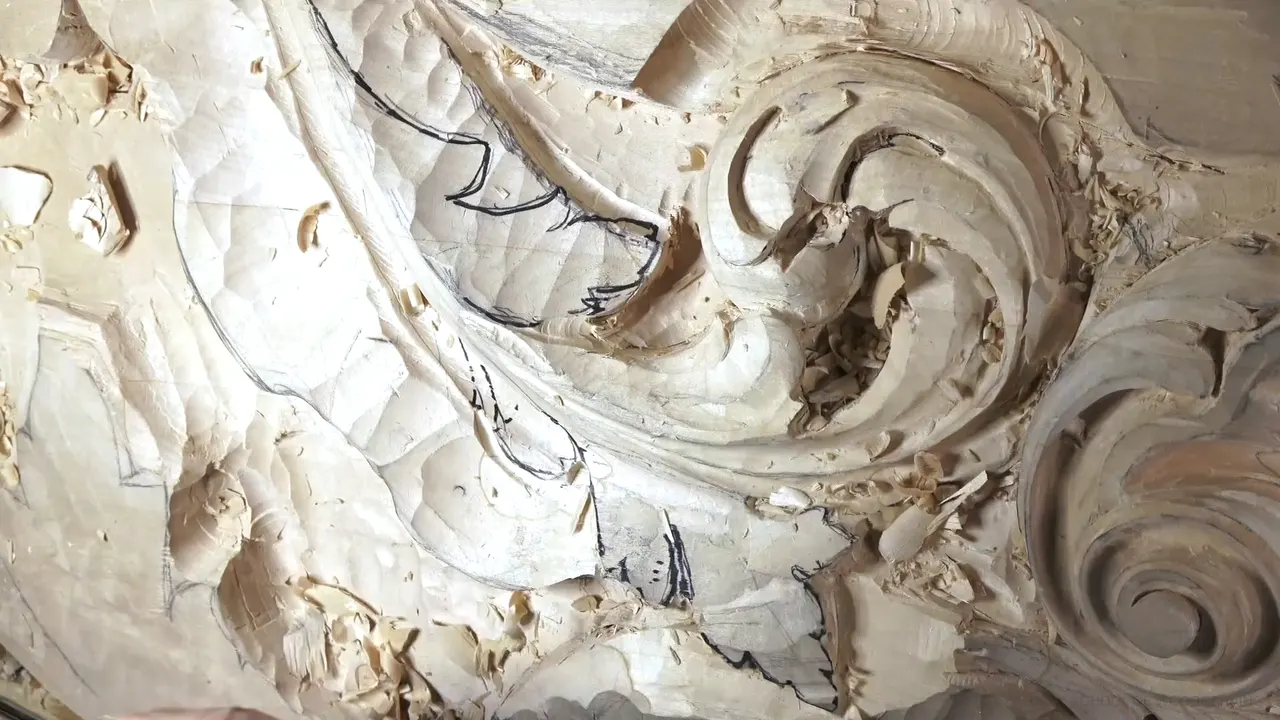

Living with a spot is what I chose in Venice Room 40.9, after a blend that did not look the way I wanted. The same idea came out of me in other courses, about colors, a loose piece, lost minutes and a broken part.
Ever carved a pass that came out wrong? Does the spot still nag at you while you work? Then you know where I stood. Below are the last three parts of workshop 40, and then my words from other lessons.
What did I accept in part 11 of workshop 40?
In workshop 40 I had a quarter inch (6 millimeters) in, "which in this case, I think it's plenty." The leaf was just flipping over. A little deeper was open to me, but I really didn't need to.
Then a shell came up, and "here it's going to be much deeper because it's a shell." "So I can safely go deeper with no problem."

A number seven came out, one inch (25 millimeters), because I needed a better tool in that area. Then: "I have previous cuts, straight-down cuts, too deep." That is okay, I said. I had plenty of material, so I could go much deeper and create a really beautiful movement.
It gave a nice movement from all positions, no matter how I looked at it. One more spot could go a little deeper, because a pipe sat there and I needed something around that pipe anyway.

My plan for the middle line came next. "If that is my middle line, which is going to go all the way like that. So I really want to see convex and the concaves." That meant chopping one side, but not much, and the other side too. That gave me the chance to dig even deeper. "Why don't I do it?" Give it a little better shape, a more three-dimensional shape.
I could go with this number seven all the way. Maybe even deeper. "Why not?" Now a convex was established, which I called good, really good.

Next in line: a number three. Use it, I said, and blend everything, with that middle ridge as the place to work from. But a number seven of one inch was not big enough in sweep. Smaller, then, or deeper. "Not one inch."
I picked 7/8 (22 millimeters) to see if it would work. It did. "It works really good, actually."

The end of the part is plain talk. "I know you don't see overall shape how it's supposed to look." An eye was coming that repeats the first eye, and I would excavate underneath it. Or I don't have to. A pass straight down and one more separation was an option. There is a couple ways, I said, but probably I'd just establish an eye with a number 11 again, and clean a bit where I could see my boundaries much better.
What came right before the words in part 9?
Part 9 holds the line this page is named for. A convex was my job there, and the first tool was not giving me what I wanted.
"I'm digging in, which is not so good, but it's okay." Maybe the tool was a little too big. That one was a number five, and a number three was the better guess. A skew back bend was my next idea. "That is little better, but not exactly what I want to see."

Maybe I would just use a straight number one and blend little better this way. Then came the line. "I'm not too happy, but I can live with it." Yes, it needs to be cleaned a little better, I added. I will. This convex had my attention first.
That convex would reach this separation, I said. A deeper spot sat right there, yet I would take care of it, no problem. Just the overall look was my target, and it was actually really good. To bring out one area I should use one and a half millimeters, number 11 (about 1/16 in), and get in underneath.
Later in that part a lot of cleanup waited. Not a big deal, I said. That could be done off camera, cleaning inside and taking care of the mess. You should see the main development, the main idea.

One spot I also wanted to clean, because I broke it and did not like what I had just done while working on the inside. But it's really easy to clean, just like that, with a small concave. I don't really need the big, deep concave.
Which tool needed attention in part 10 of the workshop?
Part 10 sits beside the other two. I had just said number five, or something like that, for a pass between two lines. Then: "It looks like this tool needs to be sharpened." I changed the words. "Oh, I don't think. I know it has to be sharpened. I feel it."
Then: "Okay, and that is looking awesome." I planned to break the ridge of the pipe right away and asked if you could see it. I'm pretty sure you can, I said.

Earlier in that part, on the middle ridge, I kept off the pencil mark because I really wanted that ridge. Almost invisible, I said, but it will be detectable. I wanted to try the number three again, upside down, for a long pass. I also said I would probably turn the tool upside down and create a concave. "Got to be really careful how I approach it."
Part 10 listed other roads. Use just a number one double bevel and go closer to the ridge, I said, though I did not need that because I used a number three. Another way of doing it. A deeper concave on one side was possible too, to a certain point, because a pipe sat there. Not too deep, but slightly deeper, between those two lines, with a number five or something like that.
Which flaws on the wood did I let stay in other lessons?
Venice Room 62 begins with one line I did not like, and my plan was a higher ridge with one part going underneath. It left a little distraction. "It's like a children's book colorized and got colors all over." Then: "I'll live with that." The eye position would be somewhere right there, and I'd go around. Higher there meant a chance to shave one section lower and get really close to the two inches (about 50 millimeters), which is exactly what I was after.

Greek Acanthus 7 has a blend. Turn it, take that down just like a chisel, and blend it. The spot could stay as it was for now, although I could make my cleaning passes. "Not quite happy yet how it looks overall." Then: "I guess I could live with that for now."
In Maine, on the Grinling Gibbons class, I excavated clear through, and there was a hole. It's pretty close, I said, so gotta be careful, but I would leave it right there. From there I would work on and live with the hole. Then a different number: number eight.

Another lesson of that class brought a break. With a mallet and my tool upside down going in, I broke the thing. "I'm not gonna glue it." I'll live with the break, I said. Not really a change of design, I'll be creative with that. Actually, I kind of like what happened, and it could be an introduction of the wave.
One side of the work moved in Venice Room 122. "I'm going to wiggle. See, this side is moving," and it's okay, I said. All I needed was just the outline, and that part would be lower anyway, so losing some of that stuff did not worry me. Number seven now, I said, and strike straight down like that.

Depth comes up in Venice Room 109. One millimeter, a number 11 (about 1/32 in), could make my shadow really pop. "Does it really matter? Not really. I could live with two-millimeter cut," about 5/64 in, "but I think it would give me better pop." Maybe I just invented a new word, I said.
What got in the way?
My piece wiggled in the vise in Venice Room 87. I apologized. It was super heavy, and no vise on the market can hold it without wiggle. Maybe there is one, but I couldn't find any.
The best tool right then was a number seven of 14 millimeters (about 9/16 in), with little, small passes I could control. I tried to make it a little tighter, and it got a little better. "It's kind of annoying" for you guys, but "it is what it is," I said. "I have to deal with that."

My hands were the topic in Venice Room 54. A shell was getting cleaned with the same number seven, half an inch, 14 millimeters. "Apologies for my hands, but I can't do anything else." You have to live with my hands, I guess. After that I could go a little deeper, and I needed a concave that flips and goes the opposite direction.

Blowing on the wood gets its own apology in Roman Acanthus 16, one of the things every wood carver does. The recording was pretty much live, so I couldn't cut it out. "So please forgive me." A kind of messy spot came next, but no worry, since I can always take the same number 11, three millimeters, and clean that mess out.

Furniture Panel 18 cost me approximately a couple of minutes, and I apologized. My system doesn't work as I wish sometimes. At least I didn't lose hours, so the minutes were something I live with, no problem.
A tool was the topic in Furniture Panel 19. I love my router plane because of how fast I can change my blades. Honestly, the system itself sometimes feels a little flimsy. If you tighten it nicely and solidly, it's holding. The quick release action, and how easy the blade comes out and goes back in, makes the whole world of a difference for me. The other stuff that bugs me, I am able to live with.
Which of them were about me?
Carving Hashemi Flowers 49 has the hard one. In my lessons I have said never to point your tool toward yourself, because you can always cut yourself. True, but lock your hand like dentists do and use micro movements, and it's actually safe. Some people cut themselves even when they never go toward themselves. "I cut myself too, multiple times." You kind of have to live with a cut, as long as you do not completely cut your finger off.

Carving Hashemi Flowers 5 asks for another kind of patience. Forgetting to name a tool at that moment needed patience too. This is not a beginner's project, and most of you who challenge yourselves with it already understand. "Just forgive and live with me."
Venice Room 73 puts the words before a choice. A 38 and 62 split came first, which I called dynamic symmetry, and then my question: should this part go underneath the line, or the opposite? Logically the lower one goes underneath. If I don't like it, then it's a problem, and a problem, if there is one, is mine to live with. My tool was 3 millimeters, number 11, one-eighth of an inch, used carefully, with a big limitation: the right angle was out of reach, because that was already my workbench.

The last passage is about a depth. A check in Venice Room 86 showed me approximately 10 millimeters (about 3/8 in) above my original line. No problem, I said, a depth like that is fine to live with. I do like that slope, and it was going to be a gradual movement downhill.
Which words went with which spot?
Eight of them are in the table, with my words.
| Where I said it | What the spot was on the work | My words |
|---|---|---|
| Workshop 40.9 | A blend that needed a little cleaning | I will |
| Venice 62 | A look like a colorized children's book | A little distraction |
| Greek Acanthus 7 | A look I was not quite happy with yet | For now |
| Gibbons Maine 14 | A part I broke with the tool | Not gonna glue it |
| Venice 87 | A heavy piece that wiggled in the vise | It is what it is |
| Roman Acanthus 16 | Blowing on the wood during live recording | Please forgive me |
| Furniture Panel 18 | A couple of minutes lost to my system | No problem |
| Venice 86 | A depth above my line | Approximately 10 millimeters |
Each row pairs one spot with a few words I put on it.
What do I take from all of this?
In 40.9 the words came with a promise to clean the spot. The convex came next.
Which spot on your own piece would you keep for now, and which would you clean first? My choices are in 40.9 and 40.11, and the lesson 40 page holds the full workshop. For every lesson in one place, start here.
The Venice Room course for workshops 38 to 49 holds the rest of this wood carving. Every figure in millimeters and inches on this page is mine, with the conversion beside it when I did not give one.
How it's done
- Say what bothers you. I told you the blend in part 9 did not make me too happy.
- Say you can accept it. Right after, I said I could.
- Name the cleanup. I added that the spot would get its cleaning.
- Handle the convex first. In 40.9 that was the job in front of me, so the convex got my attention before the cleanup.
- Fix what is easy to fix. Later in 40.9 I broke a spot, and I said it was really easy to clean with a small concave.
Frequently asked questions
Which spot did I keep in 40.9?
A blend where I had said maybe a straight number one would do. The words that followed were my promise to clean it, and then the convex got my attention.
Did I leave every flaw as it was?
In 40.9 the spot needed cleaning, and I promised to do it. In my Roman course I said I can always take the same number 11, three millimeters, to clean a messy spot. On the Gibbons class I said I was not going to glue a broken part.
Is a wiggling piece something I put up with?
My piece in Venice Room 87 was super heavy, and I could not find a vise that holds it without wiggle. I said I had to deal with that.
What to carve next