
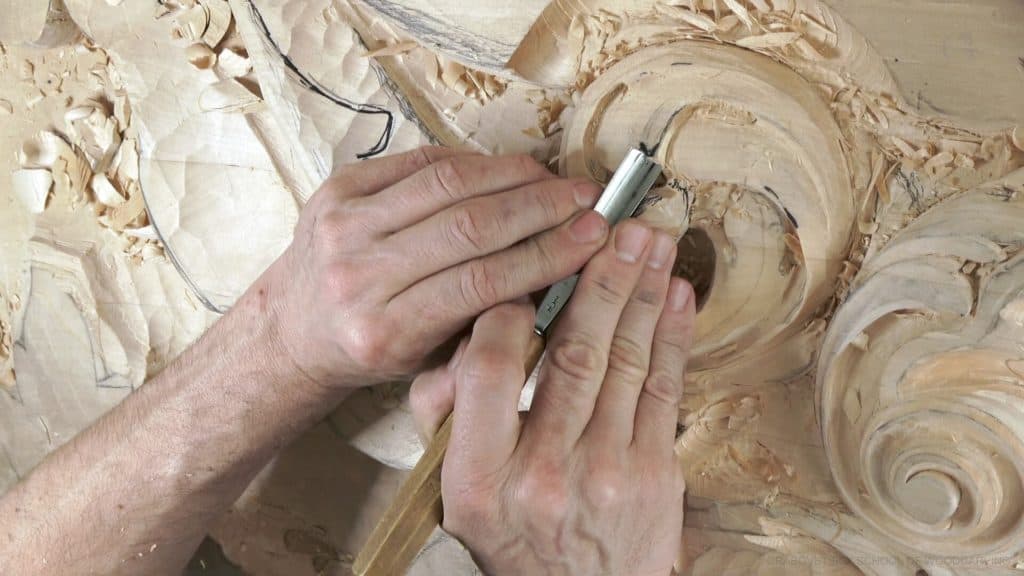
Alexander Grabovetskiy, woodcarver, School of Woodcarving · Published 2020
Is wood carving a matter of opinion?
Quick answer: Opinion is the word I put on a verdict about a carving, and I put it on my own. In Venice Room 69 I said that in a carving, in my opinion, I can say what's right and wrong, and that I would never say it's the only way to carve.
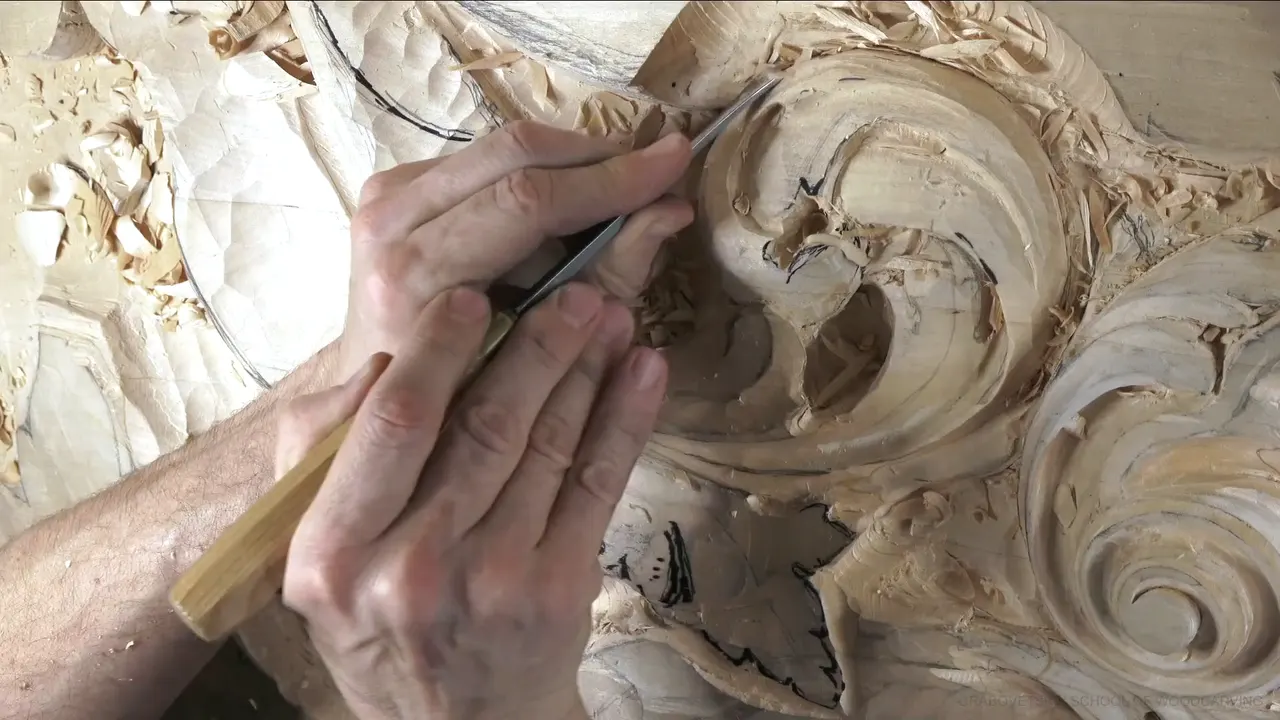

Opinion is the word I put on a verdict about a carving, and I put it on my own. In Venice Room 40, part 5, I put a 1 millimeter undercut at a tiny eye and said it looked really nice. I added that when I say it looks nice, I'm saying it, of course, in my opinion.
Have you ever watched a carver call a spot good and wondered who decided? Did you wonder if a rule sits behind it? A short one, this part 5, a little over seven minutes. So beside it I put the times I said "opinion" across my other wood carving lessons, and I name each lesson as I go.
What I mean by opinion on a carving
- Part 5 had an undercut I called nice, and I tagged that verdict as my opinion at once.
- Workshop 69 holds my plainest line, and it leaves every other way open.
- Small verdicts get the word too, like not bad or a smart way to work.
- The opinion moves while I carve, and workshop 71 shows it shifting.
- Sanding came down to the finish, and for me the tool marks are something I love.
What did I carve in part 5 of workshop 40?

The part opens with a verdict and a fix. That is good, I said, except I need to blend to the concave. Next came a plan for a separation, a little bigger one, not big, just some type of separation, probably with about three millimeters (about 1/8 in), a number 11.

I could give a small eye, actually. Maybe a smaller tool, like one and a half millimeters (about 1/16 in), and a number seven, to give some less finalized shape. A little later I judged the shape as a whole. That is actually really good, I said, except I'm still not too happy about how it looks overall. I wanted this section more round, let's say. Soon after: it's much better.

The eye asked for something else. Since I had created an eye, a small one, but still an eye, I needed some kind of pipe. I didn't want to see it too big, but I still wanted to create some kind of feel to it. The way to do that was almost no concave, but still concave. Right on the side.
I know it's almost impossible to see, I said, but it gave me a ridge. Small, but a ridge. And I did not lose the overall roundness, because I could blend that in.

For the opposite side of the pipe I could do exactly the same, again with almost no concave, almost nothing. All I'm after is just that ridge, I said, just a small ridge. And yes, I did achieve that. The overall shape was still there, and now I had a pipe.

A plan came next. Yes, I could exaggerate the eye, because it would be more readable, or more visible. It's really a tiny, small eye, probably one millimeter or one and a half millimeter, like 1/16 of an inch. A number eight would help me there, and in this case I could use a one millimeter undercut.
One millimeter undercut, and that looks really nice, I said. And now the line this page is about: when I'm saying it looks nice, I'm saying of course, in my opinion. Right after it I said I needed to blend this because it doesn't look right, but I didn't want to be blending too much. It has to be gradual blending.
For that job I was using a number two gouge upside down. I believe this one is about half an inch, I said. Yes, that's 12 millimeters (about 0.47 in). A big shadow there was not what I wanted. I really don't, I said, because I don't need it right there, and it's already nice.
Two ways were open. One was a really nice concave on this side with the ridge raised a little. The other was a concave with a little going down, which would give me beautiful movement, I would say, and even more roundness, I would say. That's what I'm going to do, probably.
Does wood carving have a right way and a wrong way?

Venice Room 69, part 5, is where I stayed general on purpose. No specifics, I said. I'm not going to tell you what I mean by a big mistake, because there are different people watching what I'm doing, with different points of view. My goal in that setting is not to tell you what's right or wrong in life.
The line came next. I can tell you what's right and wrong in the wood carving, I said, in my opinion, of course, because even in a carving it just goes to whatever I think, in my case, what is right and what is wrong. But I never would say it's the only way, and I would never say that is the only way you're supposed to carve.
Workshop 62 holds a smaller case. One side still made no sense to me, and I was not happy about it. Of course, I'm just telling you my opinion, but on another hand, I'm the one who is actually developing it. Workshop 73 had a section I found not too appealing, in my opinion, so it didn't make too much sense.
How do I say a spot looks good?

Plainly, and with a tag. In workshop 67 I said that is not bad, then I said it again with the tag: in my opinion, it's not bad. Workshop 62 had a good development, in my opinion. Next, I called the pipes popping out really good, and then beautiful.

Workshop 70 has the tag twice in a row. I had a really deep cut there, and later two of them were to meet, with a pass-through where the light would hit, and I said I think it will create beautiful movement. Of course, it's my opinion, and I said that twice in a row.
A curl came up in workshop 78. See how beautiful it curls, I said, and I think it's nice, then I should say, in my opinion. Part 8 of that workshop has me holding the piece by hand to finish up. I think it's a smart way to work, I said, but again, it's my personal opinion.

Workshop 82 had a part that was going to roll back. You really don't see it from above, I said, but it's going to be really visible from below. It creates beautiful detail, I think. That's my opinion.
Workshop 66 holds a verdict that I tagged once more: again, that is my opinion. After that I said I could put little nicer details on it, and there would be extra divisions inside, because right now it's just too pointy.
Seven of those verdicts sit below, one per row, each with its tag.
| Lesson | Tag | What I was judging each time |
|---|---|---|
| Workshop 67 | In my opinion | Not bad, I said, then said it once more |
| Workshop 62 | In my opinion | Good development in the part I had just carved |
| Workshop 70 | It's my opinion, I said | Two deep cuts that I planned to meet, for light to pass through |
| Workshop 78 | I should say, in my opinion | Curl I asked you to look at, to see how it curls |
| Workshop 78, part 8 | My personal opinion | Holding it by hand for the finishing touches |
| Workshop 82 | That's my opinion | Part that rolls back and shows from below |
| Workshop 66 | Again, my opinion | A spot that was just too pointy |
The habit shows when a piece is nearly done. One piece in my Byzantine Acanthus course was pretty much, I would say, almost 100% done. I could spend a lot longer cleaning and cleaning, I said, and called that a personal opinion.
Does my opinion change while I carve?

It does, and I say so. One line in workshop 71 was not quite right for me. That doesn't feel natural, I said. It does not. It's just a little too straight, in my opinion. So I had to bring it into a curvature, and I said I think it will look much better that way. And you should agree with me.
Then this. See, that was a good thing that I did not dig too deep from the beginning, I said, because I'm changing my mind on the go.
My own workshop 40 has smaller turns. In part 4 I told myself that 7 millimeters would be a mistake to use for a slightly deeper spot. I should use 5 millimeters (about 3/16 in) or even 4, I said, but let me try 5 first. One spot in part 6 was a little too high. It doesn't look right, I said. It doesn't look bad also, but a little too high, I think. Then: now it's much better.
The start of part 6 has a verdict with a hedge in it. The decision I made was a really good one, I think, and yes, of course, it needs to be cleaned and refined, which is okay. But I'm working on a form first.
Part 6 also had a plan for a little S shape, letter S, going the opposite direction. You should be able to see it, I said. And if you don't see, that's a problem I can't solve.
Part 4 holds back once. I'm not going to touch anymore right there, I said. Who knows, maybe I'll do something, but I got really good development going on right now.
In part 4 I said let me clean all those marks, so I'd see exactly what is going on, because those marks were just distracting. Then: now I can probably see much better.

A looks-good verdict can give way to a fact. On my Greek Acroterion, 1/16 of an inch looked really good, in my opinion. Or should I say, I said, that's how I imagined it at first. Then, when I looked and researched a little bit about acroterions, they also didn't make those roofs really deep, just to make it look outlined. So I needed to go a little deeper right there.
The design stage of my Furniture Panel put a warning inside the verdict. Now it's more unified, I said, well, in my opinion. Once I carve it, I think I'm going to change some stuff, but as of now, I kind of like it. Earlier, in lesson 6, I had said it's better, well, in my opinion, and asked if you see this line.
Whose opinion wins between sanding and tool marks?

Mine is on the record, and so is the other side. In Hashemi Flowers 24 I said you could probably get those results much quicker. Just use sandpaper and whatever tools you could use, make it smooth, really shiny, and you should be fine. For me, I said, I really love those tool marks. And yes, nothing wrong with sanding. It's a different culture and different traditions.
Some customers ask me to make a piece really smooth and sand it, I said, and they even paint over my carving. Some people just don't get it, I said, but as long as they pay, I'm okay with that. And then the sentence with the word in it: honestly, my opinion, tool marks look better.
I was getting a lot of emails asking whether to sand or not. My opinion on the sandpaper video depended on the finish, which was to be applied, and on the application. That piece was to be gold leaf, traditionally done, water gilded, and for that the surface has to be stabilized. I asked how it was done before, in Baroque time, in that mid German Baroque style.
Opinions differ on a question I asked in one of my workshops: is it a trade, is it a craft, is it art? People do have a different opinion, and it could be all of them, I said. Sweden and other countries, I said, would consider it a hobby, so it would be just a craft, and some reach the level of art. In Russia, I said, it used to be considered a skill which you can make money with.
Do you have to agree with my opinion?

Two lines of mine look opposed, and both stand. After the curve went in at workshop 71, my invitation was plain: you should agree with me. Workshop 69 says the other side: I would never claim that one way is the only way you're supposed to carve or do something.

The lesson this page started from is Venice Room 40, in the Venice Room Part 4 course, which holds workshops 38 to 49 of relief carving. If you want to watch part 5 as I carved it, you can start here.
How it's done
- Tag your verdict. Say it plainly: I called the undercut nice, then said it was my opinion.
- Fix what looks off. I needed to blend, because it didn't look right.
- Keep the blend gradual. I used a number two upside down and did not want to blend too much.
- Let the work change your view. A line was too straight in workshop 71, so I gave it a curvature.
- Leave other ways open. My way is not the only way, and I said so in workshop 69.
- Name the finish. On sanding I said it depends on the finish, and I told you I really love those tool marks.
Frequently asked questions
Why do you add your opinion when something looks nice?
Part 5 had me making a 1 mm undercut, and I added the words right after calling it nice. Workshop 69 has my longer line on it: even in a carving, I said, it just goes to whatever I think, and in my case that is what is right and what is wrong.
Is one way of carving a leaf the right one?
Workshop 69 answers that. Claiming one way as the only way is something I never would do. I held back specifics about a big mistake, because different people watch with different points of view. My goal there was not to tell anyone what's right or wrong in life.
Do you change your mind while you carve?
I do, and I say it out loud. A line in workshop 71 was a little too straight, I said, so I gave it a curvature. See, I said, that was a good thing I did not dig too deep from the beginning, because I'm changing my mind on the go.
What to carve next