

Alexander Grabovetskiy, woodcarver, School of Woodcarving · Published 2020
What does a wood carver mean by "like jewelry"?
Quick answer: In workshop 57, part 11, I said "like jewelry almost" about an element I loved, and "small jewelry inserts" while I worked the quarters. Other lessons of mine use the word for a line 1 mm wide, a cut 1/32 in deep, a wiggle from a jewelry maker, and boxes I carved.
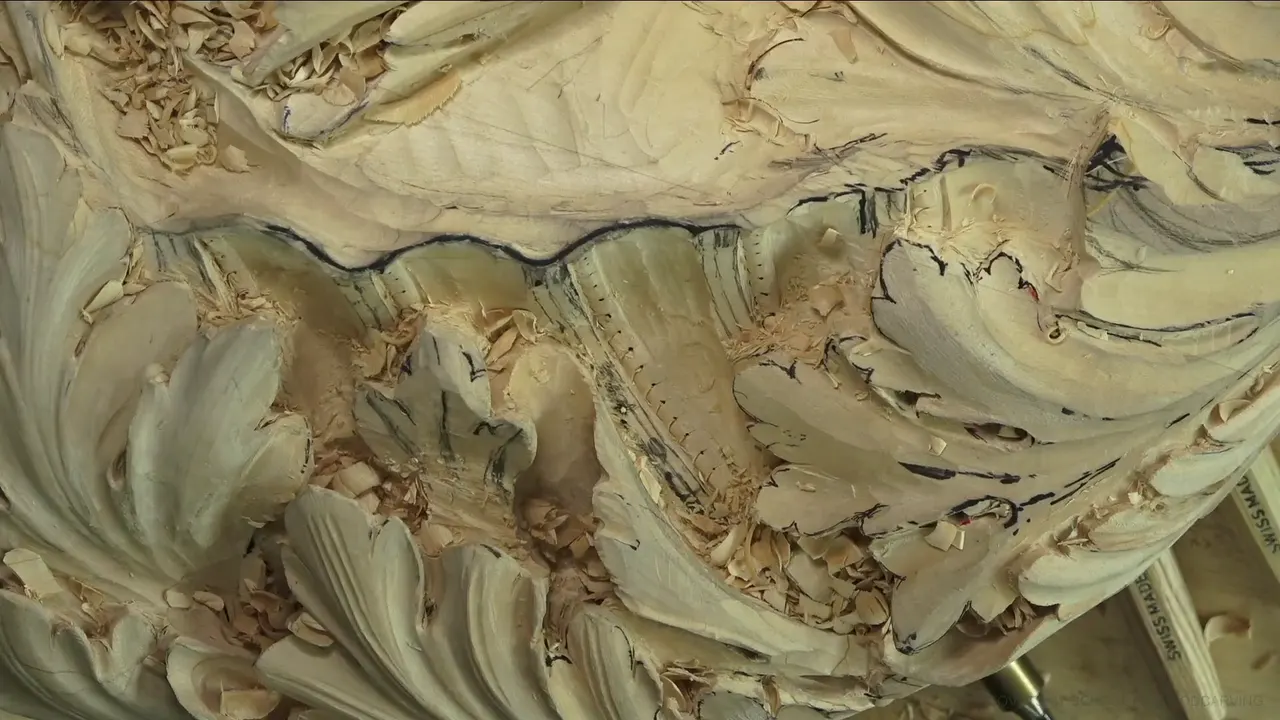

My line from part 11 of workshop 57: "And I love that element. It's like jewelry almost." The word jewelry shows in other lessons of mine, and this page sets those lines beside it, each with a link to its lesson.
Have you ever looked at small beads on a carved piece and wondered how a gouge makes one? Would it help to hear which tool I named and what I said about it? Start with the part itself.
What was I carving when I said it was like jewelry?

After it came "Okay, I've got the upper left corner done, so now I can do the opposite direction." Then: "Lower one. Again, from this same dot, I'll just go that way." Then "All I can do right here too, I start it on the other side."
Next came "And from the same dot, just to get my lower left, in my case, quarter."

I told you what was hard: "And that's little challenging for me not to cover with the hands because I still want to show to you what I'm doing." The frames on this page show hands over the work.
Eyeballing came next: "And why I like the eyeballing, because I did the 6 millimeters apart right here, but I created little more narrow, and about 5 millimeters right here from this point." Six millimeters is a little under a quarter of an inch (about 0.24 in), and 5 mm is about 0.2 in. Then: "Okay. Little smaller."

A plan followed: "And now I'm going to repeat on the right side, but it's going to be this corner."
Why did I show a different tool from the one on the big shell?
I said, "And when I was doing a big shell, I used different tool. And my point why I'm actually showing you a different tool right now, just to drive point home that there is a lot more ways to do exactly the same result or to come to the same result."

"It's not the only way, what I showed you at the beginning." Then came this: "And I do understand not all of you having the same amount of tools like I do, but at least you will be confident that you can do same operation with the tools you have."
Next I named a knife: "And I could do that, all the beads, with just a knife pretty much. I've done it multiple times."
The cut went on: "Okay, I've got the upper right corner, or quarter I should say." Then "the lower right quarter, just like that."

"They are like small jewelry inserts," I said, and after that "Like pearls almost."
What happened when the triangles came out?

"Okay, that is good. Now what's going to happen?" I went on: "If I can just use the same tool, I can actually excavate those corners out." Then: "See that triangle pops out, and that's really easy."
I added "Although don't push too hard if it's not popping out, so you have to go back." Next: "Like for example, it did not pop in one of the spots. I can just recreate my cut just like that, and then boom, pop it."

"Let me do that again. It did not pop, but I still created my cut with the same tool, kind of going in. Some of them flying out. That's okay." Others do not come out, and I said that was all right as well.
Depth came right after: "Because it is better not to do too deep of a cut than do too deep and create too weak of a spot." A moment later: "But see? They all popping out and I already can see somewhat like a final shape."

"Again, right here I have to recreate." About the push: "And I'm not pushing too hard. Like I said, if it's not flying out, I can always recreate the cut."
"Okay, see? It's already giving me those beads feel." Close behind: "But it's not the end yet. By the way, I have to probably go everywhere first and pop those out."

The tool is named here: "Okay. I'm using just number 7, 4 millimeters." Then it goes on: "Little less than 3/16 of an inch." Four millimeters is 0.157 in and 3/16 in is 0.1875 in, so a little less is right.
Near the end came "And right here, I'm not going to worry about too much because I still have to clean underneath of this chunk. Let me concentrate right now on this one. Okay? So the next would be to give a three-dimensional around this." My last words: "I can see that it is around like that all the way, so I can even just continue with my gouge, and I can see that's completely round."
What did the parts before and after say about the same beads?

Part 10 has "Now I have to work on my beads, on the beads itself. Okay, let me think. There's a few different ways I could do them." Then: "we create it with the back bend, really continuous, and the same wide, about quarter inch pipe."
The edge gets a plan in that part. I said I was going to stay away a little from it: "Maybe about one-eighth of an inch, three millimeters." One-eighth of an inch is 3.2 mm. For the spacing: "every quarter of an inch, every six millimeters" and "I'm just eyeballing right now, okay?"
On marking: "And you could use any other tools like calipers if you wish to mark that. I don't need to." And "Eyeballing is okay. And if there's a little bit variation, that's okay, too."

On the angle: "It has to be perpendicular to the surface cut. So 90 degrees to the surface." A line later in that part says "Keep it perpendicular. Okay? Like 90 degrees to the carving." Between those two lines I said "I could take, let me see, about four millimeters number seven. That's a good tool, actually, to use." Four millimeters is about 0.16 in.
Rounding is in part 12: "But also rounded like this, like a dome, but it's not rounding that direction." Then: "See those black dots? Those are connection points between those beads."

More on the dots: "I'm not going to place them everywhere. I usually don't do that at all. I just eyeball it." About how the beads looked: "And that way, you're getting almost perfect beads. You don't have to sand them."
My next step, in my words, "would be for me to excavate a little deeper concave." For a width: "make about 9/16 I would say, not 5/8. Not 16 millimeters but 15 millimeters." Nine sixteenths of an inch is 14.3 mm, 5/8 in is 15.9 mm, and 15 mm is 0.59 in. Then: "Again, I'm just eyeballing."
What did I mean by jewelry when the cut was tiny?

A line about 1 mm is in Furniture Panel 21, part 13: "Number 11 again. To make a separation cut. And that's going to be, like I said, maybe about one millimeter wide. No more than that. So I've got to be really careful how I approach." Next came "It's almost like jewelry." One millimeter is about 0.04 in, and a tool plan followed: "Okay, I'm going to use number one and double bevel."
A second line from that lesson, part 4, says "It's almost like a jewelry cut, by the way. Because we are talking about only 1/32 of an inch deep." One thirty-second of an inch is about 0.8 mm. I added "Still possible."

Little details are the subject in Furniture Panel 17, part 6: "those small details, they fly out faster than the big details, okay? So that's why they're more delicate." After "more delicate" came a comparison that ends in "jewelry work." Then: "Besides, it's just going to look nicer if it's accurate."
Part 7 of that lesson has "Almost jewelry-like." A little later: "We don't want to create any weak points." Then "We don't want anybody to break it." Of the depth I said "I still left approximately 3/32nds right there." In millimeters, 3/32 in is about 2.4.
A tight spot is the subject in Furniture Panel 19, part 16: "because we have no space almost right here. It is like a jewelry work. And I'm controlling just by my fingers." Then a plan: "And little by little, going to round this nicely."

A tool choice in Lily Box 6, part 3, begins with a plan: "Let me use two millimeters on this side." Then comes "I don't want to use a 3 millimeter, see." A cue after it: "There is a lot of micro cracks on inside of this wood." I also said "We're talking about really fragile work right now," and in that same line I brought in jewelry. In inches the sizes are 0.08 against 0.12.
Over in Lily Box 11, part 5, I said "the key here, not to create any force. So we are working on a micro level, almost like jewelry." Then: "Okay, this is too big." Then: "I need to switch to one and a half millimeters or even smaller. And I'll use just the one mil." The sizes are 1.5 mm (about 0.06 in) and 1 mm (about 0.04 in).
Microscopes come next, in that same lesson's part 11: "And yes, some carvers, they actually use a microscope. Not really microscope." The one I meant: "It's actually for the jewelry makers microscope. It's with adjustable arms, and you can hit from different points, and you can look and get details."
What does a jewelry maker have to do with the wiggle?
The story of the wiggle is in part 14 of lesson 21, the one with the 1 mm line. There I said "not all wood carvers would approve wiggling technique, but it works." Then: "So it's actually jewelry-making technique." And "I can control much better. Yeah, it doesn't give me too clean of a cut, but I can always come back and clean it."
Further on came "One of the jewelry maker, he taught me how to do that on the metal. He was working with the gold and the silver, and I kind of liked the idea, and I tried that on the wood, and it works exactly the same." Then, "Just gives me a much more control."
In Lily Box 6, part 6, I said "I know some of the carvers, they really don't like the idea of wiggling the tool like what I'm doing right now." It goes on: "if you're working with the micro cuts, it helps a lot. And that technique is a jewelry maker's technique, okay? When they're doing the small details on a precious metals like gold or silver, it's what they do. They actually create a little wiggle."
Professional is the word in Lily Box 10, part 11: "Some of the wood carvers would say it's not professional, but that's not necessarily true." Next: "First of all, I am using wiggling all the time. Secondly, it's a technique of the jewelry makers, and you can't say they are not professional." And "wood carving is also my 100% profession, my bread and butter."
Over in Furniture Panel 29, part 3, I called it "a piggly wiggly movement, whatever you call it." Then I said "it's gonna give you a lot more control." Then the limit: "So sometimes it works with small tools." And "sometimes, not always, okay, just sometimes."
Does the word jewelry always point to tiny work, or can it mean something else?
The word also names a box in my lessons. In Flower Rosette 5 I said "I actually did some furniture, and I also carved some mirror frames and coffee tables and so on also during that time in jail. But I also carved small jewelry boxes." Next: "Which actually was the most sold product, if you wish to say that."
I was using a knife in that part. In Greek Acroterion 3, part 3, I said "I also did with one knife some small jewelry boxes." Then "You can actually do really nice stuff with a single knife."
In the Flower Rosette course, lesson 3, I said "Again, I have to be really careful here." and then "Almost like working with jewelry."
Metal is the subject in Sharpening V-Tool, part 4. I was polishing the main bevels, and I said "You can see yourself in this polished metal. You can see it's just like jewelry."
Where does each of these lines sit?
Here is each one next to what I was working on. The lessons are named as they are in the school.
| Lesson | What I was doing | The subject |
|---|---|---|
| Venice Room 57, part 11 | The corners and quarters of the beads | Small inserts, pearls |
| Furniture Panel lesson 21, part 13 | A separation cut, a line about 1 mm wide | A careful approach |
| Lesson 21 in the same course, part 4 | Pointing a cut inside, only 1/32 in deep | Possible, still |
| Furniture Panel lesson 17, part 6 | Little details that fly out faster than big ones | Delicate work and accuracy |
| Lesson 19 in that course, part 16 | No space on one side of a round form | My fingers |
| Lily Box lesson 6, part 3 | A 2 mm tool, a 3 mm one not wanted, micro cracks in the wood | Fragile work |
| Lily Box lesson 11, part 5 | A micro level, then a smaller tool, 1.5 mm or even 1 mm | No force |
| Two courses: the wiggle in lesson 21 of one and lesson 6 of the other | A little wiggle of the tool | A jewelry maker's way with gold and silver |
| Flower Rosette 5, part 4 | Small boxes | Jail |
| Sharpening V-Tool, part 4 | Polishing the main bevels of a V tool | A surface like a mirror |
Where can you watch these lessons?
The video is workshop 57 of Venice Room 57, inside Venice Room Part 5. Other courses are one click away if you start here, and the Lily Box course is one of them.
How it's done
- Start from the same dot. "Again, from this same dot, I'll just go that way."
- Reverse the direction. "Now I can do the opposite direction."
- Eyeball the spacing. "I did the 6 millimeters apart right here, but I created little more narrow."
- Lift the triangles. "I can actually excavate those corners out."
- Go back. "Whatever is not popping out, I can go back, recreate the cut, and then it just pops."
- Choose the number 7. "Same tool. Okay. I'm using just number 7, 4 millimeters."
- Give it a three-dimensional around. "The next would be to give a three-dimensional around this."
Frequently asked questions
Is a knife enough for the beads?
Here is what I said about carving all the beads: "with just a knife pretty much." Then "I've done it multiple times." The line came right after I said that not all of you have the tools I do, and that you will be confident with the ones you have.
Is it better to cut too deep?
The words are "create too weak of a spot," and they describe a cut that goes too deep. A shallower cut is better, in my words. That was in part 11, when some triangles flew out and some did not.
Where did I learn the wiggle?
A jewelry maker taught me, I said, how to do it on metal. He was working with gold and silver. I tried it on the wood, and it gives me "a much more control." That is part 14 of lesson 21 in the Furniture Panel course.
What to carve next