

Alexander Grabovetskiy, woodcarver, School of Woodcarving · Published 2020
What does a wood carver mean by "it's got to be"?
Quick answer: In workshop 57, part 9, of the Venice Room, I said it about one pipe, the movement I called most visible, and its curvature. Close to the same words are in lessons from the Venice Room, a furniture panel, a lily box, hazelnuts and butterflies, each with its own ending.
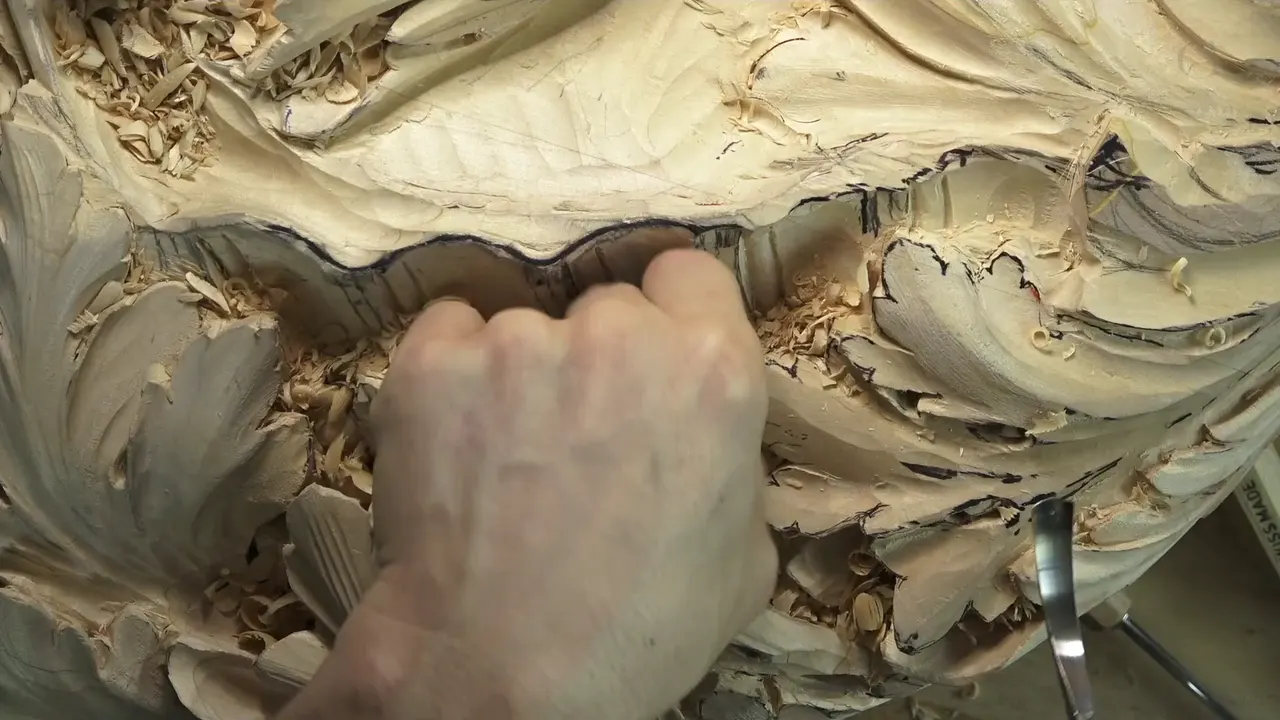

In workshop 57, part 9, of the Venice Room, I said the line about one pipe, the pipe I called most visible. Words close to these are in lessons on a furniture panel, a lily box, hazelnuts, butterflies and more of the Venice Room, and what follows them differs: a tangent, a spot to remove, a depth to stop at.
Ever looked at a line on a screen and wondered whether it really curves? Below is what I was carving in part 9, what I said around the line, and the other lessons where I used almost the same words, each with its place and the ending I gave it.
How did the cut go before I reached the pipe?
The first words: "Again, remember, right-hand side of this tool right now is clean because of the nature of the grain. And a rougher side would be on the left-hand side of the tool on that side. Okay." Then, about the first cut: "And I really don't worry because I'm going to do my first cut up like that."

A few lines on, a sorry: "Sorry that I'm covering with the hands, but see the effect I'm doing? I'm actually getting rid of the side, and I'm bringing my convex a little deeper."
Which movement was the most important one?
This one: "Again, this particular pipe, this particular movement is the most important for me because it's most visible. So I have to inspect and make sure my curvature is almost perfect. It's got to be perfect."
Next came a line about the screen. "And I know, like I said, on the camera, it doesn't look like it curves, but it is. It is. It's actually a really nice continuous tangent movement," and then: "Tangent to overall."

The parts on each side of part 9 have the pipe too. In part 8 I said "preliminary, I would say, pre-established convex," and "It's like a tubing, almost like a pipe, actually." I added: "But now I want to get rid of this ridge on the side." In part 10 I said "All I worry about, just pre-establish the main idea," and "a lot deeper excavation, probably right in the middle." Then, on the beads: "we create it with the back bend, really continuous, and the same wide, about quarter inch pipe." That is about a quarter inch (6 mm).
What was left for a later cleaning?
After "Okay. And that is good," I said of the cleaning: "clean that little later, somewhat final cleaning, I should say." A plan followed, "And let me get a little closer to the line on the right-hand side."

Did I dig the big concave deep yet?
Not too deep, I said: "And I'm not excavating too deep yet," and I named the spot: "I'm talking about this big concave." After a short line, "Really don't need to yet," came the plan: "So I'm saving that to later time."
Where did shadow fit in?
"I apologize that you don't see it, but here. See? All I'm doing actually, just getting rid of this groove." Then, with the tool, "with my tool all the way to the bottom of the groove cut," and an option: "I can actually excavate little deeper groove right here."
Two more lines are a prediction and a plan. The prediction: "It's going to give me a lot more shadow, and going to bring that concave." The plan: "Later on, of course, I'm going to undercut underneath of those beads." And: "But as of now, that's okay."

What did I say about leverage?
"And I've got lots of mess I don't like to see." Then I said I never attack that mess right away: "before I finish the main movements and the main establishments." The next words say why: "But for now, I don't because I really sometimes have to crank against the edges and I really need solid spots for the leverage, for leveraging, I should say."

Which gouge did I name?
Spots came first, "I've got a couple more spots," followed by "Exactly the same operation." Then the tool: "And I'm using number six, by the way. Number six. I could use number seven, and even number five, in this case, would work also."

"See what I mean?" And next: "here is a cranking point or leveraging point. And if I would finish this piece and make it already like really all undercut done and so on, I would easily break it. That would be a big mistake."
What about the junk underneath?
"I've got so much junk going on underneath, and I'll take care of it a little later and clean it." Tools came next, and the first was an option, "Although I could actually attack with a different gouge or even veiner," followed by "But I can attack that with a gouge, let's say number eight, small one." About size: "I don't want to use too big of a tool right here."

And last: "Number eight, and this one is about 12 millimeters, I would say, approximately. About half an inch, and go in." My 12 millimeters is 0.47 in, and a half inch is 12.7 mm.

Where else did the line end on a curve?
What I said in workshop 17 of the Venice Room, part 4, was "So I'm talking about this curvature," and the words ended on "really nice." Then: "And again, let me do cheating. So it's a cheat code, like my children would say when they played some games on a computer." And: "Just use a rasp and create that really nice curvature." Soon after: "But I lost a moment right here, which is okay." And: "But at least now, this line is nice."

Next, Venice Room 25, part 3, has "So which means my shape has to be almost perfect how it works altogether. Okay?" and the words again, with "almost perfect" on the end.
Over in Furniture Panel 17 I said "If it's not consistent, then it's no good." Then I named the curve: "that curvature is not tangent, even if it's invisible." What closed it was "tangent."
For an edge, Venice Room 46, part 1, has "And now I really need to establish the edge." It stopped on "a tangent," and a second sentence followed: "So this edge has to be tangent."

Where did it end on wood that had to go?
In Venice Room 27, part 5, I said "So which means that part needs to be gone." Then: "Well, it's not kind of needs to be gone," and it closed on "gone."

The Lily Box course has "Okay, this one has to go kind of underneath of that one," then a correction of the same sort: "Again, not kind of." That one finished on "go underneath," in part 12 of lesson 11.

A spot to lower is in Venice Room 21, part 4: "I'm still going to keep this somewhat a little higher, maybe just a little bit, not much." Then "But the rest of it," and the ending, "gone." A plan followed, "And I'll use probably just a skew chisel," and: "So it essentially has to go a little lower than this point. Okay?"
Another line is in Venice Room 13, part 2. "So that part is going to overlap." Then: "And I can clean a little bit this side right here." After "So, with that number 3," what followed was "lower."
A removal of another kind is in Hashemi Flowers 12, part 6: "All of that, or most of it, can become a waste. Or it could become a part of..." Then: "Well, no, it can't." It closed on "removed, all that," and a plan followed: "Let me try with the bigger number eight."
Did a size or a depth follow it?
The butterflies course, lesson 11, part 3, gives "Angle is really important." What followed was "no deeper than a one millimeter" (0.04 in), and I added "One millimeter deep cut, that's it." Find it in Plate with Butterflies 11.
Back in Venice Room 4, part 2, I said "Maybe not all the way like inch and a quarter" (31.8 mm), then "but still," and the ending was "deep."
Grinling Gibbons class in Maine, lesson 7, part 3: "Either we're going to create five petals or we can do a double layer." Then "Like I said," and a stop on "a five total."

In Venice Room 24, part 9, I said "I shouldn't say that. I could, but I don't really need it." After that came "strong," and next "just pretty much clean little bit."

Hazelnuts 4, part 2, gives "Don't worry about too much to be exact like on a pattern. But you also have to check and recheck." That ended on "some logic," and without it I said it is going to be a problem.
Did it ever ask for a movement or a place?
The barrel in Venice Room 45, part 10: "That was just preliminary, like a square block is what I did." Its ending was "follow the movement."
A depth and a path are in workshop 46, part 5: "approximately half an inch, about maybe 12 millimeters down, a concave. It's going to be deep concave. Okay?" That one finished on "go around."
A smoother surface is in Venice Room 61, part 8: "Even if I like that shadow it's casting." It closed on "a little smoother."
The dome in Furniture Panel 23, part 6, has "Like a dome." Then "from all of the points of view." The ending was "like it's half around."
Near a bulge, in the Floral and Molding course, lesson 6, part 3: "See that bulging right here? So it's bulging and then goes downhill." The last words were "natural movement."
Back in Venice Room 56, part 8, I said "Obviously, I do have a pipe, but this pipe really doesn't make too much sense." Then "So the main development," and the words closed on "on this side."
And Venice Room 59, part 7, has "Maybe I can just hit little at this direction, too." The ending was "more gradual than that," and after it: "And for me, it does look good."
Did it ever ask for a look?
Elsewhere in Venice Room 13, part 10, the words ended on "beautiful" and then on "really unique," after a plan: "And the way to show it, probably I need to develop it a little more."

Over in Venice Room 16, part 3, I said "So I really don't want to rush this operation right here." Those words stopped on "really beautiful."
Furniture Panel 19, part 16: "My goal is to make it round, okay?" Next, an ending on "organic," and then "So little by little with the chamfer cuts, we're going to achieve that."
Then Venice Room 91, part 3, offers "And let me soften it a little bit," and its last words were "look like it's folding."
Hope it makes sense, I said in Floral and Molding for the Panel 9, part 1, and the ending that answered it was "make sense, right?"
A different kind of ending is in Modern Acanthus 7, part 2. I said "it is absolutely okay to use a sandpaper," and then spoke of customers from different countries. For an Italian customer, the ending was "look like marble," and I said: "Not even one tool mark." For customers from England or Germany: "We want to see all the marks."
Which lesson held which ending?
| The last words | Place and part, in my courses |
|---|---|
| beautiful, then really unique | Part 10 of lesson 13 in the Venice Room |
| really beautiful | Part 3 of lesson 16 in the Venice Room |
| really nice, said of a curvature | Lesson 17, part 4, of the Venice Room |
| almost perfect | From Venice Room 25, part 3, after a remark on my shape |
| a tangent, said about an edge | Venice Room 46, part 1 |
| go underneath | The Lily Box course, lesson 11, part 12 |
| tangent, even if it is invisible, after a remark on consistency | Lesson 17 of the Furniture Panel course |
| organic | Furniture Panel 19, part 16, where my goal was a round shape |
| one millimeter (0.04 in) at the most | Plate with Butterflies 11 |
| removed, all that | The Hashemi Flowers course, lesson 12 |
| some logic | The Hazelnuts course, lesson 4, second part, after I said to check and recheck |
| look like marble | Modern Acanthus 7, part 2, for an Italian customer |
| natural movement | Molding for the Panel 6, part 3 |
| a five total | Grinling Gibbons class in Maine 7, part 3 |
Where can you watch these lessons?
Every lesson named above is inside one of my courses. Workshop 57 holds the video I started from, with workshop 56 before it and workshop 58 after it. The Venice Room course, the Furniture Panel course and the Modern Acanthus course hold more of my wood carving. Start here to watch the full videos.
How it's done
- Look at the pipe. I have to inspect and make sure my curvature is almost perfect.
- Move toward the line. Let me get a little closer to the line.
- Hold the concave. I'm not excavating too deep yet.
- Consider a deeper groove. I can actually excavate little deeper groove right here.
- Keep solid spots. I really need solid spots for the leverage, for leveraging, I should say.
- Leave the junk for later. I'll take care of it a little later and clean it.
Frequently asked questions
Which gouge did I name in part 9?
Number six, I said, and I named number seven as an option and said even number five would work also. For the junk underneath I said a number eight, small one, about 12 millimeters (0.47 in), approximately.
Did I dig the big concave in part 9?
Not yet. The words were: I'm saving that to later time, about this big concave.
What happens if the undercut is finished too soon?
I would easily break it, I said. I called a spot there a cranking point or leveraging point, and finishing the piece with all the undercut done would be a big mistake.
What to carve next