

Alexander Grabovetskiy, woodcarver, School of Woodcarving · Published 2020
What does a wood carver mean by "perpendicular"?
Quick answer: In workshop 57, part 10, of the Venice Room, I told you the cut should stay perpendicular, and I said it in a short plain line. In other lessons the word sits beside the grain, a slope or a line, and I name 45 degrees as another choice.
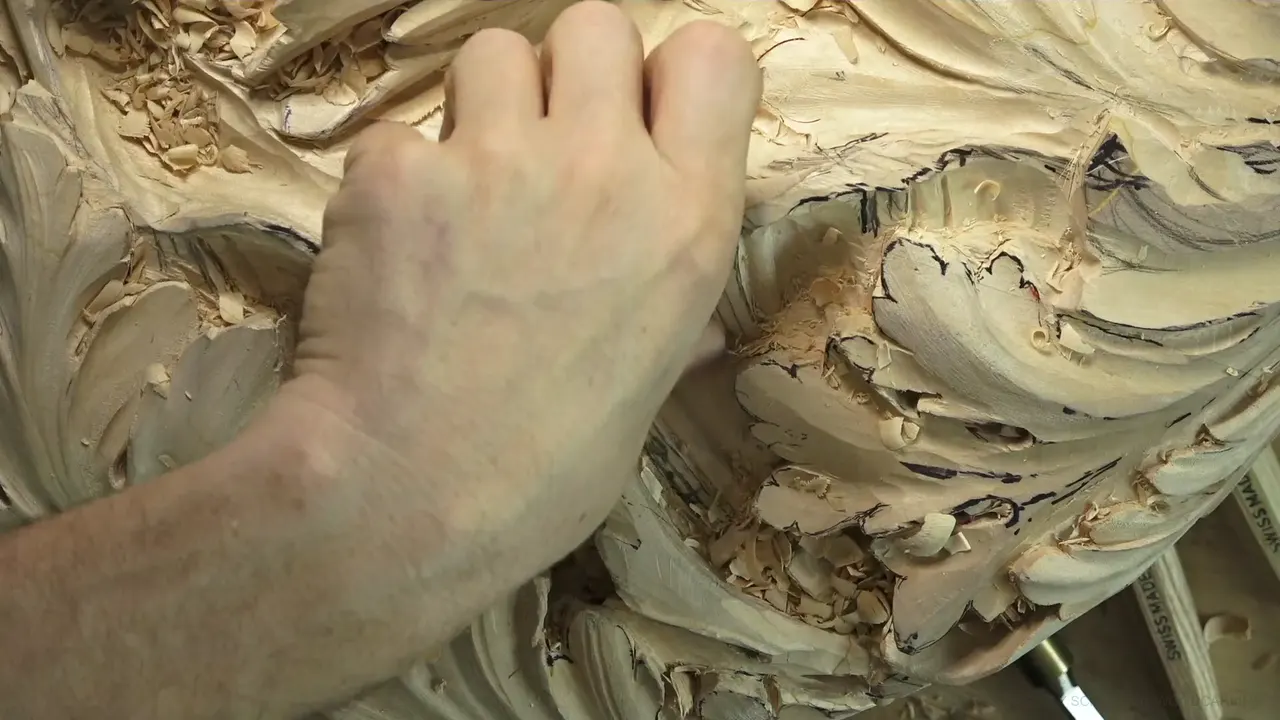

In workshop 57, part 10, of the Venice Room, I laid out a row of beads, made preliminary cuts, and said the word perpendicular along the way. The same word is in my lessons on hazelnuts, a furniture panel, a tray and a rosette, and the grain, a surface, a slope or a line stand beside it.
Ever held a tool over a cut and wondered what angle it should have? Here is what I said in part 10, in order, and then the other lessons where I used the word.
What came first in part 10?
A first line: "Again, I don't worry about cleaning all that mess yet." Later, "a lot deeper excavation, probably right in the middle." On to the beads: "Now I have to work on my beads, on the beads itself. Okay, let me think. There's a few different ways I could do them."
About the pipe: "First of all, please understand, we create it with the back bend, really continuous, and the same wide, about quarter inch pipe." My quarter inch is 6 millimeters (0.24 in).
How far from the edge did the first cut sit?
I did not need to reach the edge, I said: "Maybe about one-eighth of an inch, three millimeters." Everywhere else was "about three millimeters away." That line, I said, was going to be my boundary. On force: "I also don't want to press too much."
How did I mark the beads?
An idea with the tool itself: "I can place one of the edges of the tool inside of this preliminary cut, and I can kind of mark it, okay? Mark it like that, like a step." "it's hard to see," I said. Also: "I need to get a little closer with the lights."

Next, the marker: "I don't see because of the light, and I don't want to cover the camera. So what I'll do, I'll just use a marker where I can see." The spacing: "every quarter of an inch, every six millimeters. I can place that. And I'm just eyeballing right now, okay?"

Did I measure the bead marks with anything, or just eyeball them?
I did not need to, I said. "There's a much quicker way, and I already showed how I did the middle, the big shell. It was a lot quicker way, but I think it's okay." Calipers were an option: "you could use any other tools like calipers if you wish to mark that. I don't need to. Eyeballing is okay. And if there's a little bit variation, that's okay, too."

Which tools did I name for the first cut?
A list of options: "Now I can take either number one, or actually I could use number three, I would say." Then: "Let me see what tool I should use. Or number one double bevel. That's what I mean by number one." And: "Or I could take a number three and start my preliminary cut, just a straight inside, just like that."
Of the cut itself: "this cut is also really important, by the way. Because you can easily break." The instruction: "Press it, but not too hard. Not all the way. You don't really have to."

What did I say about the angle of the cut?
Here: "And follow the logic, okay? It has to be perpendicular to the surface cut. So 90 degrees to the surface." Then: "So it should not be same angle how you attacked it." And at the end of the passage: "So it has to be perpendicular. Or at least try to be perpendicular."
What came after the preliminary cuts?
A plan for the next tool: "the next step would be I could take, let me see, about four millimeters number seven. That's a good tool, actually, to use." Four millimeters is 0.16 in. For the spot: "I'll place right in the middle where's my dot, and I create preliminary cut like that, okay?" And the saving: "I can do everywhere right away. That way I'll save some time."

The last lines of the part: "Again, keep your logic. You have to establish the right angle toward whatever the movement is. Keep it perpendicular. Okay? Like 90 degrees to the carving."

What did part 11 say about the same tool?
Part 11 names it: "I'm using just number 7, 4 millimeters. Little less than 3/16 of an inch." That is 0.16 in. And on the marks: "I did the 6 millimeters apart right here, but I created little more narrow, and about 5 millimeters right here from this point." Six millimeters is 0.24 in, and 5 is 0.2 in. On other ways: "there is a lot more ways to do exactly the same result or to come to the same result." And: "It's not the only way, what I showed you at the beginning."
Is the grain what a cut is perpendicular to?
In the first part of Carving Hazelnuts 1, I made a suggestion on placing the piece on the workbench: "If you look at my position, so I want to remove all of the material perpendicular to the grain. So the grain direction goes like this, and I want to remove it this way from outside toward in."
Part 1 of Hazelnuts 2 names a tool: "number nine and 20 millimeters" (0.79 in). On the cut: "it's better when you're doing a lot of removal, so just go perpendicular," and the next word is the grain. And: "don't create the cut, like I said previously, too deep."
Over in Venice Room 85, part 11, I said "Again, I'm removing perpendicular," then the grain finishes the line. Of that removal: "It is always the safest way." Part 8 of the same lesson has an angle first: "I'm angling a little bit like 45 degrees because of the grain." Then: "so I have to just do it across the grain. It's always better" and "or perpendicular," with the grain last.
In Venice Room 86, part 1, I said "Again, I'm going to do perpendicular," then the grain, then "in this case, looks like I have to just do it this way." Part 11 of that lesson has a change of side: "For me, it would be probably easier to attack from opposite side."

Furniture Panel 38, part 2, gives a limit: "but sometimes you have to do a cut with the grain." A preliminary cut across the grain comes first: "this way would be much safer."
Lesson 1 of the Venetian Flowers Rosette course, second part: "my cuts, they have to be perpendicular," the grain is last in that sentence. Next: "It's the best practice. Doesn't really have to be that way, but I think it's the best practice." Later in that part: "I need to attack that perpendicular. That's always better."
Is it also perpendicular to a surface or a slope?
Furniture Panel 36, part 1: "I'm gonna just get pretty close to the line, 90 degrees toward the surface," and the surface is named once more with the word. A warning: "Make sure you don't grab too much material 'cause it's only 16th of an inch" (1.6 millimeters). And: "just remove little by little."

In part 1 of Floral and Molding for the Panel 7 I spoke of two flowers that each have a slope: "I used just a plug cut with the number nine and a quarter inch" (6 millimeters). Then: "The slope goes like that, and the tool goes perpendicular to that slope." On the other flower: "the tool I presented was perpendicular."

Acanthus over Moldings 2 has an undercut to avoid, in its first part. "My goal is not to undercut," I said. A correction came mid-sentence: "parallel not parallel, but perpendicular over that surface."

In Roman Acanthus 4, part 3, I took "same V tool, in my case, it's number 12, and just drive it down." Then: "Don't undercut, don't angle it." And the word: "Just try to do perpendicular just to make sure just going all the way down."
Greek Acroterion 2, part 1: "I'll place it straight down and just follow my line." Then: "It is really important for me not to angle to the right or to the left." The angle: "So 90 degrees or perpendicular."
Chamomile and Bow Rosette 1, part 2, has a plan for a V cut: "let me create one V cut, just like that." Then: "perpendicular cut like this."
Does the word ever sit beside a line or a movement?
Chamomile and Bow Rosette 3, part 1: "I'm going to create the cut perpendicular," and the main lines come next. "It's going to give me a more interesting look." About historical carvings and a bow: "He created perpendicular cuts."
The Maine class, lesson 8, part 1, has a plug cut with a pointing: "it's actually just in a perpendicular position" toward the main movement. Next: "Please do not do straight down."
Venice Room 155, part 1: "you have to hold it perpendicular just to make sure you got the right distance, like right here. So I have to use logic how it's supposed to go."
What is a perpendicular line in 3D?
The Tray of Blessing 3, part 2, ties the word to a leaf: "you just place that perpendicular line and you hit approximately the spots where that those eyes supposed to end." Then a correction: "that is not true perpendicular. It's a 3D perpendicular line. So it's a little different."

How do I check it besides my eye?
In Venice Room 102, part 7, I named "the truly perpendicular movement" as the one thing to keep an eye on. Then: "Of course, I could just eyeball it. What I'm talking about, the line supposed to be like 90 degrees. Okay? And that's good that I do have my glue line, and I can use that glue line as a reference. So I can put any type of ruler, whatever you have, right on the line, and that's going to give me a really good idea of the movement."

And: "I don't trust sometimes just the eye. I could eyeball it, like I said before, but sometimes it could be really deceiving." Compare the line in workshop 57: "Eyeballing is okay."
Venice Room 111, part 3, has a position and a plan to twist: "the position was just perpendicular almost to the board itself, but now I need to twist a little bit to the left, because I need to hit the spot right here." Of the opening: "that's going to create that airy look."
When do I name 45 degrees instead?
In Grape Onlay 9, part 2, a gouge of about half an inch (12.7 millimeters) went with this remark: Most people, I said, hold the tool at a right angle to the cut. The word is "okay in some cases," and then: "but it's always better to create the angle," and the angle I gave was 45 degrees. The gain: "And it's gonna give you much better slicing."

Acanthus over Moldings 4, part 3, has the tool "if you look from above like an 45 degrees toward the line." Then: "It's going to be a 45 degrees because I don't know what the grain will do." And: "You know just attacked the 45 degrees that way it's safer."
In Hazelnuts 4, part 2, I said "I'll do perpendicular," the grain ending that line too. After it came a rule for breaking the rule: "at least break it with the right direction, about 45 degrees cut. It's still somewhat safe."

A different use of the word is in Furniture Panel 19, part 2, about older furniture: "like a dovetail channel on both sides and insert the second piece, which is parallel, not a parallel, I'm sorry, a perpendicular. So the grain would be running like this, okay?"
Which lesson held which side of the word?
| Lesson and part | What the word sat beside |
|---|---|
| Hazelnuts 1 | Grain, cut from outside toward in |
| Hazelnuts 4 | Grain, then a 45 degree cut named as the rule I would break |
| Venice 85 | Grain, with an angle named first |
| Panel 38 | A limit, and a safer way to make that cut |
| Panel 36 | The surface, 90 degrees, near a line |
| Floral Molding 7 | A slope on each of two flowers |
| Acroterion 2 | Straight up, along my line, not angled to either side |
| Roman Acanthus 4 | A V tool driven straight down, no undercut and no angle |
| Chamomile 3 | The main lines, for a more interesting look |
| Tray 3 | A line in 3D, which I said is a little different |
| Venice 102 | A line, checked with a ruler laid on a glue line |
| Grape Onlay 9 | The cut, where I called 45 degrees better |
Where can you watch these lessons?
Every lesson named above is inside one of my courses. Workshop 57 holds the video I started from, with workshop 56 before it and workshop 58 after it. The Venice Room course, the Hazelnuts course and the Furniture Panel course hold more of my wood carving. Start here to watch the full videos.
How it's done
- Stay short of the edge. Maybe about one-eighth of an inch, three millimeters.
- Mark. I know approximate space.
- Press. Press it, but not too hard.
- Keep the angle. Again, keep your logic, and keep it perpendicular.
- Pick a tool. That's a good tool, actually, to use.
- Establish the angle. You have to establish the right angle toward whatever the movement is.
Frequently asked questions
How did I word the angle of a cut in part 10?
The cut should be perpendicular, I said, and not the same angle how I attacked it. I added: or at least try to be perpendicular.
How close to the edge did the first preliminary cut go?
About three millimeters away from it, I said, and I spoke of that line as my boundary.
Did I measure the marks for the beads?
I said I would use a marker at about every quarter of an inch, every six millimeters, and that I was just eyeballing. Calipers were an option, I said, if you wish.
Which tools did I name for the beads in part 10?
What to carve next