
Alexander Grabovetskiy, woodcarver, School of Woodcarving · Published 2020
What first aid should you keep in a wood carving shop?
Quick answer: Keep first aid, Band-Aids and such, in your shop or whatever you use, I said in part 5 of workshop 57. Sometimes you're working alone, I said, and those tools are sharp. My children, when they were young, knew where to find all the Band-Aids in my shop.
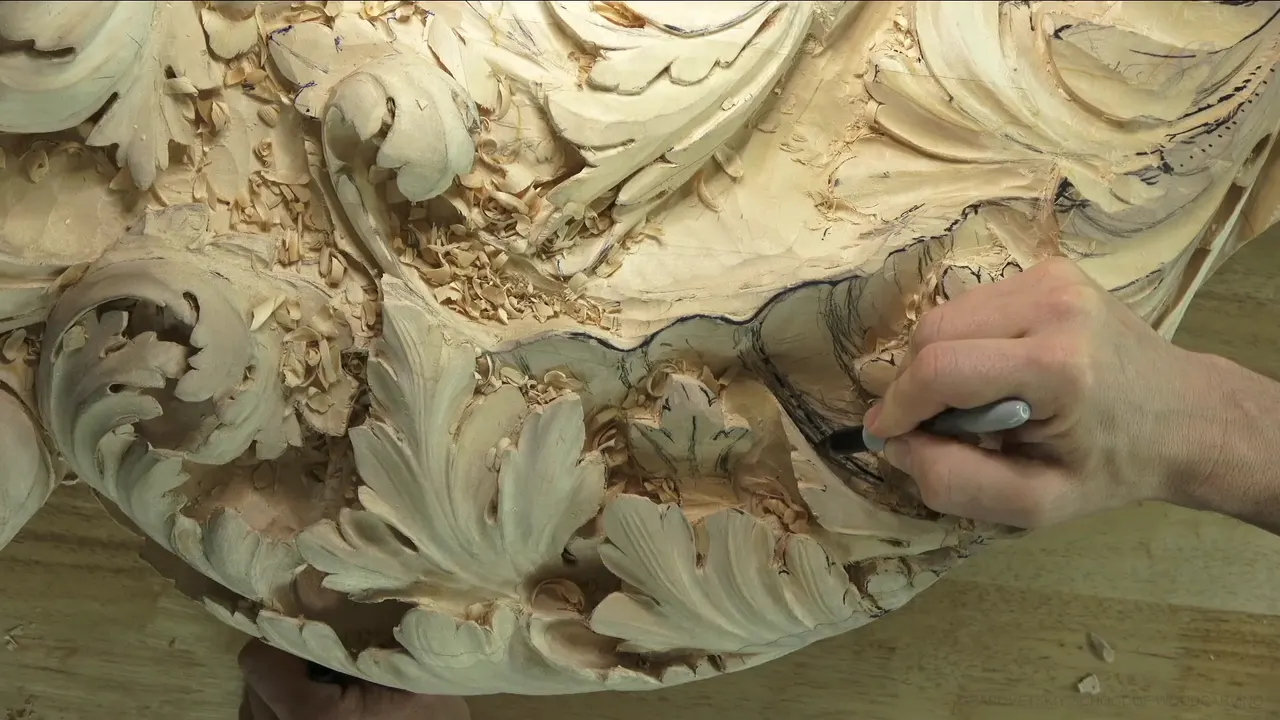

In workshop 57, part 5, I said to keep some first aid in your shop, like Band-Aids and stuff like this. The line came near the end of a part where I was carving toward myself, so I followed it through my lessons.
Is there a Band-Aid within reach of your bench right now? Is anybody standing close to you while you work? Then stay a minute, because I talk about cuts in more lessons than this one.
What do my lessons say about cuts?
- Keep Band-Aids and the like in your shop.
- I make a stopping block with a finger so I don't cut that finger.
- I had to keep my Band-Aids in two spots.
- A locked hand is safe, I said.
- Keep the hand that holds the piece off the cutting side of the blade.
- A safety concern means I won't take the minute it would save.
What was I carving when I talked about cuts?

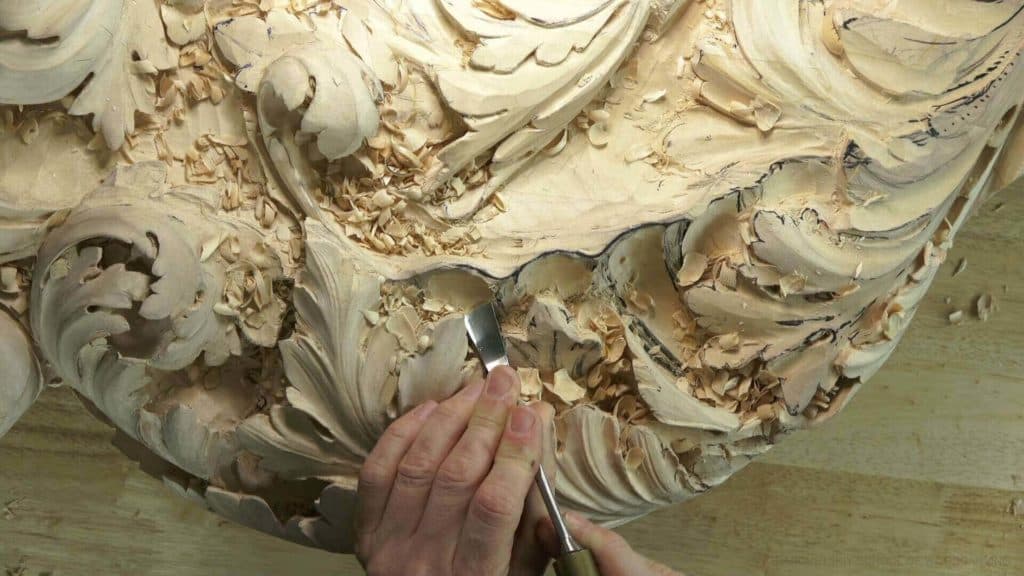
The part opens with me naming what each spot will be. One spot is going to be almost like a pipe, I said, and I will taper another. I added: "But here I'm not doing the right thing. I think I need to make it little wider right here."
I listed the concaves, a concave, concave, concave, and a concave, and said, "Okay, let me start." But I have to keep in mind, I said, that I will have small bits going on inside, exactly the same as what I did on another side, right in the middle. The first step would be just excavation. I do not want a concave that is too deep, because it would create a lot more challenge when I do my beads.

My tool was a number 6, a spoon gouge. I was using about 14 millimeters, a little bigger than half an inch (0.55 in). I said I would go to the right line first, because in this case it carves cleaner there on the right hand. Going uphill, I said, was okay.
The concave is going to be deeper in this section, but not as much at the end, because I don't have too much material right there. I really don't worry about how clean it looks at this point yet. All I worry about is going too deep. That's the main concern I have.

Why did I pick up a straight tool, then put it away?
By the way, I said, I probably could use a straight tool to a certain point, and let me get number seven, also 14 millimeters (0.55 in). I think I'm able to carve some of it. The reason I gave for this direction is that the line on that side carves much cleaner than the one on the opposite side.
Pretty much both lines come out clean, I said, but like I said before, when you're carving with the gouge, it's always one side clean and one side rough, because of the nature of the grain. After that I said I think that's enough with the straight tool.

With the straight tool there is a danger, I said, and you have to stop at the right point. Otherwise you dig in, then you have to clean, and a valley gets created that will not be really consistent. That's no good. A spoon gouge would be probably the tool of choice in this case.

Just a clean little bit, and I think that will be enough. I can't overdo it at this point, because I'm still going to need some material for the beads a little later, or bead movements, I should say.
Why did I work toward myself?

See what I'm doing, I said. I'm using my finger to control, and I place my hand really solidly. Working toward myself is a little bit dangerous, and in this case it's the only way I can excavate.
On a smaller carving it would probably be better to rotate the piece or walk around and attack from the opposite direction. That would be smarter. Safer, I should say. But sometimes I have to deal with huge pieces like that, and I just can't walk around. I would spend too much time.

For me that means I will not make it. "How to say that easier? I do have a kind of deadline. It's not a real deadline, but deadline where I want to get the stuff finished," and if I can save a minute, I'd rather take it and not walk around. Only if it's still safe, okay? If it's a safety concern, no, I'm not going to save a minute.

And here, I said, I already developed the skill of controlling the tool without cutting myself, and I almost never cut myself anymore. It used to be a lot of times, even in one day, multiple times, but now I really don't.
What first aid do I keep in my shop?

Another important topic, I said, or maybe just a little thing to say. Keep in your shop, or wherever you work, at your kitchen table or in a garage, some first aid, like Band-Aids and stuff like this.
Because sometimes you're working alone, I said, nobody's close to you, and if you cut yourself you really have to take care of yourself right away, because those tools are sharp and you can cut yourself really deep. Before anybody can find you, you're going to lose a lot of blood.

It's what I do all the time, I said. My children, when they used to be young, knew where to find all the Band-Aids, and they would come to my shop and look for them. I had to keep them in two spots, because there was a day when I came to look for Band-Aids and they were all gone.
My youngest daughter really loved them, and she would put those Band-Aids on without even a need. She just loved them.
Which extra came in a knife box?
My set of four knives in Furniture Panel 15 came with a second set of gouges. What I like most about what they provided, I said, was the first time I actually saw that, Band-Aids, just in case you cut yourself. A really thoughtful process, I said, when they sent it to me.
My tools course says more about a box like that. They included the most important thing in your wood carving shop, and that's Band-Aids, I said. I never saw anybody else do it. Maybe somebody else does, but I did not experience that.
How many times have I cut myself?
The same tools lesson answers it: "I cut myself multiple times, and I remember a day when I cut myself, if I would count, it would count maybe over 100 times." The nature of carving is it, I said, and it wasn't because I was not careful.
I have a day like that in Roman Acanthus 6 too. Some days I remember I cut myself over 100 times, but it was, of course, complicated carving. I did some beautiful flowers, and you could actually see through the wood, with paper-thin leaves and everything. And that is dangerous.
In Furniture Panel 38 I hold my finger close to the edge, because that gives me much better control, and I said be careful. Sometimes I cut myself. It happens maybe once in a while, I said, but when you're carving all day long, you're not afraid of the tools anymore, and you cut yourself.
Two lines of mine sit side by side. In workshop 57 I said "I almost never cut myself anymore," and in that panel lesson I said "sometimes I cut myself." Over in Hashemi Flowers 25 I said you're probably going to cut yourself anyway, multiple times, until you feel the pain and become really careful with that thing.
Did I ever bleed during a lesson?

In part 10 of Venice Room 23 I said it looks like I got some blood coming from somewhere. I didn't even know, I said, I just noticed that I got cut. I'm not a fan of infusing my blood in it, I said.
In part 12 of the same workshop, after I said I could clean it a little more, it looks like I'm bleeding again. It's not good, I said. I haven't noticed where I cut myself. Sorry.
Right after I talked about rasps in Venice Room 24, part 6, I said I'm bleeding again, sorry, and it's the same cut from earlier today. Later I said, "Let me get rid of my blood." Near the end of that part, I said I'm leaving blood again, and it's no good.
How deep does a cut from a knife go?
In Lily Box 11 I carve a flower with a knife, and I remember the day I cut myself many times, I said. I did not bleed too much, just small micro cuts, and nothing like dripping blood. Still, it's uncomfortable, I said, because you keep poking and creating micro cuts inside your skin.
You could damage yourself with that knife, I said. It's a really dangerous tool, and I am saying sometimes that a knife in your hand is even more dangerous than a table saw. With really sharp tools and movements you don't control, you can cut almost your finger out.
Lily Box 12 adds a warning about the part of a knife that can hit inside of your skin. Micro cuts, I said, not a big deal and not really deep, but still uncomfortable and kind of painful. Especially with some of the age, it's really hard to stop the bleeding. It won't bleed a lot, I said, but still. Safety is really important.
What keeps a cut small?

In that lily lesson I said I'm creating the stopping block with this finger, because I don't want to go all the way through and cut this finger. So important to think about those cuts beforehand.
The first cuts course for beginners has a really important rule: you never place your hand at the front of your knife. The hand should be always away from the cutting side of the blade. Even if you have to hold the piece, it should still stay away. In the kitchen cutting board course I said never place your hand in the way of the knife, because you'll cut yourself easily. And I've done it. I cut myself. The hand that supports the piece has to be away from the cutting blade.
Roman Acanthus 16 puts it shortly: "Never put your hand in the way of a tool." If you place it somewhere in front of you, it still has to be kind of away, because if it slips, you don't want to slip it and cut yourself. I guess you also have to cut yourself sometimes, I said. That way you will understand and learn from your own mistakes.

Can I carve toward myself and stay safe?
The dentist story is in that same Roman lesson. One of my students worked all his life as a dentist, and he knows how to lock hands. He showed me, and I thought it was an excellent technique, applicable for all types of carving. Locked, it's really hard to slip. Almost impossible.
Carving toward yourself is possible, I said. You still have to be really careful, but if the hand is not hanging in the air and it's locked, it is safe. You also have to watch the grain direction.
I repeat the idea in Hashemi Flowers 49. In one lesson I told you never to point your tool toward yourself, because you can always cut yourself, and yes, it's true. But if you lock your hand just like dentists do, on one point, and you're just doing micro movements, it's actually safe. Some people cut themselves even when they never carve toward themselves. I cut myself too, multiple times, and you kind of have to live with it, as long as you don't completely cut your finger off.
In that same Hashemi lesson 25 I placed my finger on purpose on the inside, and it actually works as a stop. I'm creating my support and micro cuts, and because of that stop I have a lot less chance to slip and cut myself.
Toward myself, in Venice Room 67, I said I would encourage you not to, because it's not the safest way. You can slip and cut yourself, and that would be a big mistake.
What did my teacher tell me about speed?

In Venice Room 60 I said you're using your middle finger as leveraging. But don't try to push too hard, I said, because you can actually break your bone if you don't do it the right way. Don't dig too deep inside of the wood. It is a mistake when people try to get too much wood at one time, and it was my mistake too.

My teacher told me, "Don't do that," and I still wanted to be super quick. He said there's a couple of possibilities, and one is better than another. One is that you will damage your piece if you try to be speedy, which is not the worst one. The worst one is that you can cut yourself really badly, because we are working with sharp tools.
Which lesson held which line?
Here are the places side by side, each with my words.
| The lesson | The work I was doing at that spot | The words I used |
|---|---|---|
| Part 5 of workshop 57 | A concave dug with a number 6 spoon gouge | keep in your shop |
| Furniture Panel 15 | Showing a set of four knives and two extra gouges | Band-Aids, just in case |
| Roman Acanthus 6 | A carved piece with grapes and acanthus movement | complicated carving |
| Hashemi Flowers 25 | Micro cuts, with my finger as a stop | a lot less chance |
| Hashemi Flowers 49 | A number 8, then a number 11, pointed at myself | just like dentists do |
| Furniture Panel 38 | A finger held close to the edge of the cut | not afraid anymore |
| Workshop 23, part 10 | A number 11 of 5 millimeters, carefully going deeper | blood coming from somewhere |
| Part 6 of workshop 24 | Rasps, and the master wood carvers who use them | the same cut from earlier today |
| Lily Box 11 | A flower carved with a knife | more dangerous than a table saw |
| Venice Room 60 | My teacher's warning about being speedy | really badly |
Where can you watch these lessons?
This page's lesson, Venice Room 57, sits inside Venice Room Part 5. The other lessons live in other courses of wood carving, and my tools course is one click away if you start here.
How it's done
- Put first aid in reach. Band-Aids, I said, wherever you work, or in a garage.
- Think about a cut beforehand. My finger was the stopping block, I said. So important to think about those cuts beforehand.
- Lock the hand. Lock it on one point and make micro movements, I said, and it's actually safe.
- Keep your hand clear of the blade. Never place it in front of your knife, I said, even if you have to hold the piece.
Frequently asked questions
Where should first aid sit?
Keep it at your kitchen table or whatever you work, in a garage, I said. I keep Band-Aids in two spots, because one day I came looking for them and every one was gone.
Why keep first aid at hand?
If you cut yourself, I said, you really have to take care of yourself right away. Before anybody can find you, you're going to lose a lot of blood.
Do wood carvers cut themselves?
Wood carvers sometimes do cut, I said, and I cut myself multiple times. The nature of carving is it, and it wasn't because I was not careful.
Can a locked hand stay safe?
What to carve next