

Alexander Grabovetskiy, woodcarver, School of Woodcarving · Published 2020
How do you decide where the eyes go on an acanthus leaf before you cut them?
Quick answer: Placing the eyes on an acanthus leaf is a decision I make before carving them. In this video I said it out loud, set the eyes a little closer in, and let one part lap over another. A last glance at the overall shape came first, then the quarter-inch gouge.
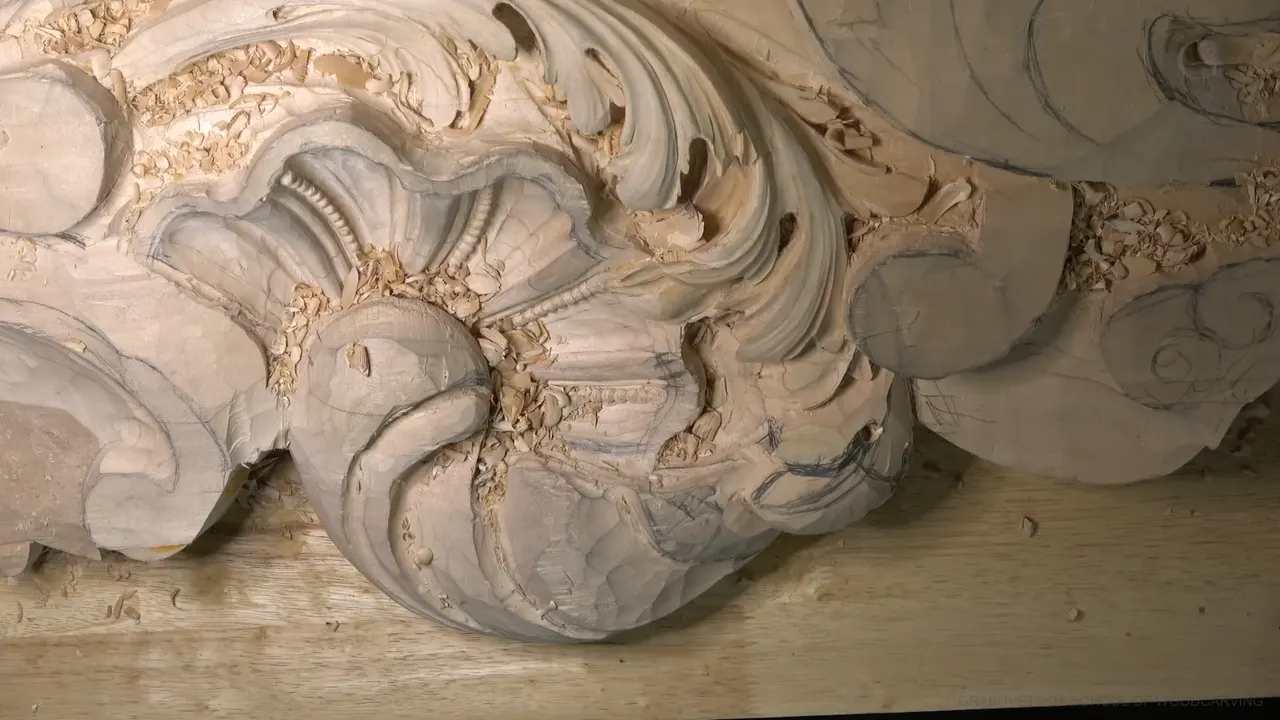
Placing the eyes of an acanthus leaf is a choice I make out loud before the first eye is carved, and it takes about fifty seconds on the tape. This is part 13.2 of the Venice Room workshops. In it I place the eyes, move them in a bit, check how one part will overlap the next, and then carve the first one.
Have you ever carved the eyes of an acanthus leaf, then found the next part had no room to overlap them? Did you look at a drawing and still not know where the second eye belonged? The minute ahead of your first eye is worth slowing down for.
I'm going to be honest with you. The camera looks down from above, and more than once in workshop 13 I tell you that you can't see what I see. The order of my choices is still easy to follow, and I'll go through each one.
What I did with the eyes in this part
I decide where my eyes go.
I bring them in a little more, just like that.
One part laps over its neighbor, and that makes sense here.
I stop and think how it looks overall.
The first eye gets a number nine, a quarter inch wide.
Next, a matching shape goes on the side, so I can find the next movement.

How do you decide where the eyes go on an acanthus leaf?
You decide before any eye exists, with the whole shape in front of you. At 04:05 on the clock, I say I need to make the decision where my eyes of acanthus are positioned. Eight seconds on, I say the eyes could easily come in a little more, just like that. Short, plain, and said out loud.
Then comes the line that does the most work. One part could flip, not flip exactly, but overlap a little bit of the part beside it, and in this case that is going to make sense. I still have to make some divisions. I stop there. Let me think how it's going to look overall, I say, and a few seconds later I decide it looks good.
That is the whole method on tape. I look, I place, I shift, and I check the picture once more. By 04:55 I'm calling for a preliminary cut. If you want to know what an eye is made of before you place one, I explained it in lesson 1 of my Corinthian acanthus course.

What came before the eyes?
A concave, a glue line and one small wait. I start with a number 11, going one direction, and I say I won't work my detail yet. First I have to work on that head of acanthus. Later I say I have to really wait until I get to that detail.
Around 01:37 I study the concave I created and see I can carve it even better, because I've got the glue line of my next layer right there. There is a layer. I go a little deeper, switch sides, and attack from the other direction, which makes that edge a little nicer. After that I round the part off a little. I don't put too many details on it, because I really don't need them.
For the rounding I'll probably use the back bent again, and maybe a little concave right there. The line at 03:19 is that I can always go and clean underneath, but I do have a main idea established. Only then does the number 11 come out for a preliminary cut, which needs sharpening, I guess.

Why bring the eyes in a little more?
The tape gives no reason, and I won't make one up. Right after, I do say that a part could overlap its neighbor. Whether one caused the other, I can't tell you.
Part 13.3 shows the habit again. A little earlier, placing a separation, I say maybe closer, because I want to be authentic to the original. After that I'm not sure whether to put in the big eye or whether a small one will be enough. Maybe the big one, I say, why not, quarter inch. Then I want to make sure I'm placing the eye in the right position, and after a moment I decide it's a good position.

Does the overlap tell you where the eye sits?
In my Byzantine acanthus course I said it in plain words. Asking everyone to look at my piece, which I called a bunch of lines, I said each eye is always a separation point between the leaves. A few minutes later I came back to it. The eye is a starting point, and it's always between leaves, so it will not be confusing.
That was Byzantine. I won't claim the Venice panel follows the same rule. Here in 13.2 the overlap and the eye placement simply come up in one breath. Later, at 06:01, I carve around the next part with that nine, with a future overlap, and I tell you that part will overlap.

Why carve two eyes, one on each side?
The second eye helps me find the next movement. Around 05:01 I tell you I could create the eye, or even both eyes. I take the same number nine, the quarter-inch one, make the first cuts, and excavate deep right there with no problem. Cut number one.
I'm going to do exactly the same on the side, I say, and that way it will be easier for me to identify the position of the next movement. Then the line comes twice, at 05:43: right, two eyes right there.

Which gouge opened the eyes?
The number nine, the quarter-inch one. In part 13.9 I give the metric for it, six millimeters. Here in 13.2 I call it the same number nine, and I reach for that tool again to carve around the overlap.
Smaller tools follow. With the number 3, I say, it's got to be lower. A separation cut comes next, and I can probably hit it with a 5 pretty much right away. I take a bigger number 5 and undercut right away. That part is going to go underneath.
I also mix up my numbers. Near the start, at 00:16, it's number 12, no, number 11, I'm sorry. It comes back at 03:28. Meanwhile 13.4 brings the number 11 back at 4 millimeters (5/32 in). I moved one way and lost some of the material, so I go underneath, because that part's supposed to be all the way in.

How did the other parts of workshop 13 treat an eye?
Each part gave the eye its own small decision.
| Part in workshop | What I did with the eye there | My own words in that part |
|---|---|---|
| Part 13.2 eyes | Two eyes, carved with the number nine | A part could overlap its neighbor |
| Eye in 13.3 | Picked the big eye at quarter inch | I want the right position here |
| Rough eye, 13.5 | Cleaned a rough eye beside a pipe | Pipe looks clean, the eye doesn't |
| Hidden eye, 13.7 | Dug under an almost invisible eye twice | Two millimeters first, then the one |
| Big eyes, 13.10 | Carved two big eyes, then dug deeper | They give a really good shadow |
Back in 13.5, at 05:20, the pipe looks clean, but the eye doesn't. I clean it with just the bevel, then dig a little deeper and longer than before.
In 13.7 comes an eye that's almost invisible. I dig a bit underneath it with the 2 millimeter first, then continue with the 1 millimeter, maybe attacking from the other side. It's impossible to see on the camera, and I ask you to forgive me.

Back to 13.6, where a relief cut goes into the triangle first, using a number nine, 3 millimeters, one-eighth of an inch. I just relieve it, because I don't want to make mistakes. Even then I chop a little bit of the edge, and that is not a big deal.
Big eyes please me in 13.10. It's what they did back then. One goes in, then another, and I go deeper right away, because those eyes are really important. They give a really good shadow that will go around the detail. Over in 13.6 I set a limit. I want to see some shadow, but not too deep.

What do the eyes do on a Greek acanthus leaf?
They start the pipes. On my Greek acanthus leaf the eye is an element of the leaf, and the pipe goes from that eye toward the center line. I counted a really small one, a few a little bigger, and one more, and I said those have to go all the way to the background.
I gave two ways in. I could use probably even a number 11, three millimeters, or a number 9, going in from different angles and digging little by little, and I called that probably the safest way. The chip carving knife is quicker. It saves time, especially on the micro eyes, though the gouge still has to clean up after it. I did not call the eyes finished there. Once we establish the different planes, I said, we're still going to refine those eyes.

Does every eye need a pipe?
My Modern acanthus course makes it a rule. Every time you see an eye in an acanthus, I said, it has to have a pipe, just like a law. A pipe is always convex, a raised part with a concave on both sides.
Over in 13.12 I talk about a pipe that is going to run clear to the back, maybe even onto the backside, and I I say I won't lose the overall movement.

Why did I call the eye a water drop?
In Byzantine lesson 9 I said every eye is supposed to look like a water drop. From each side of that drop the wood goes downhill, this way and that way, and that creates the illusion of the pipe. Three eyes there made three leaves, three sections only. Just concentrate on the eyes, I said, and it's going to be easy. For marking, I said to put a line back between the eyes with a pencil, because a pencil is a lot easier than a marker, like I do.
My Corinthian leaf goes in the other order. In Corinthian lesson 3 I open the eyes first, with a number nine and then a smaller one, because I don't want to lose the location of those eyes once the main form goes in. In 13.2 the detail waits until the head is set. Both are mine, on two different leaves.

Is it a mistake to dig my own eyes?
I said so on tape. In workshop 60 of the Venice Room I was working a number 11 carefully under a pipe. Please pay attention, I said, that I'm not excavating my eyes. Eyes of acanthus, not my eyes. That would be a big mistake. Then I added, sorry, I've got to work on my language.
It is a small joke, and you can watch it there.

Where does this carving come from?
The leaf comes from a real plant, Acanthus mollis, and the acanthus ornament built on it has been copied in stone and wood for more than two thousand years. You also see it on the leafy capitals of the Corinthian order.
My goal in 13.12 is to get closer to the original Venetian style, which I call more curly. You can see Venetian Gothic work in Venice itself, at the Ca' d'Oro on the Grand Canal and at the Doge's Palace. In 13.6 I said I'm trying to be authentic to that particular culture, and that not every acanthus, not every culture did it that way. Part 13.4 admits it looks like a curly altogether, which is supposed to look like that. Look at original Italian designs of that period, I say, and you will find that's exactly the way they did it.

What to try on your own leaf
Take a relief panel with the leaf roughed in, and stop short of the first eye. Say out loud where each eye goes. Nudge them inward a little, as I did, and look at which part overlaps which. Then pick up the gouge you trust for a first eye, and repeat it on the side, so the second eye helps you place the next movement.

It is slow wood carving, and you are just digging, digging, and digging inside the wood.
More eye decisions sit in workshop 19. The workshops around this one are workshop 12 before it and workshop 14 after it, and the rest of workshop 13 is on the lesson page. Every video is inside the tuition.
Would you like your next eye to land where the overlap needs it? Then look first, say it out loud, and carve second. A good ornament starts with that minute.
How it's done
- Set the main idea. Finish the concave and the rounding first, and say that your main idea is established.
- Decide the spots. Study the whole shape, say where each eye goes, and nudge them inward a little, as I did.
- Check the lap. Pick the part that flips over its neighbor, then think about how everything will look overall.
- Open the first eye. Take a quarter-inch gouge, number nine, about six millimeters, and dig deep, since I said that was no problem.
- Echo it on the side. Carve the same shape beside it, so you can read where the next movement goes.
- Work around the lap. Run the nine around the overlapping part. Then use the number fives for the separation and the undercut.
Frequently asked questions
Where do the eyes belong on a carved acanthus leaf?
I settle it by looking at the whole shape and saying it aloud. On this Venice panel I moved both a touch closer in and let one part lap over another. After a last look at the overall shape, I started carving the first one.
Which gouge opens an eye on a carved leaf?
On the Venice panel I used a number nine, quarter inch wide, which I call six millimeters in part 13.9. On my Greek leaf I said a number 11, three millimeters, works too, dug in a little at a time from different angles.
Why make a second eye on the side?
A twin of the first gives me a marker. My point was that matching it on the side makes the next movement easier to place. I counted it aloud, cut number one, and a moment later I said two eyes right there.
What to carve next