
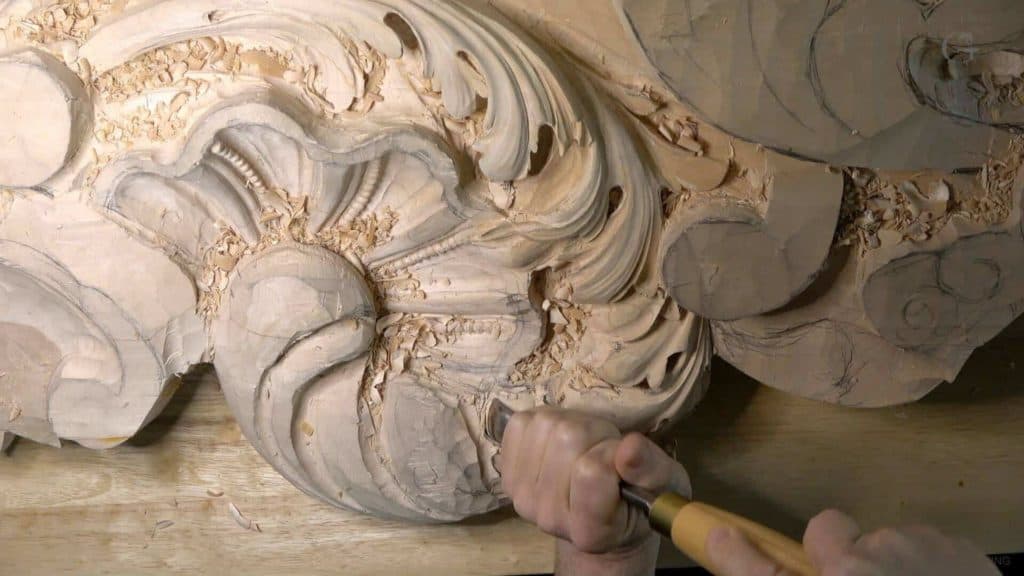
Alexander Grabovetskiy, woodcarver, School of Woodcarving · Published 2020
Does grain direction matter when you carve wood that is going to be removed anyway?
Quick answer: Carving against the grain in wood you are about to remove is a trade I make on purpose. In Venice Room workshop 13, part 11, I called it okay, because that wood would be gone anyway, and I had fixed the overall movement first.
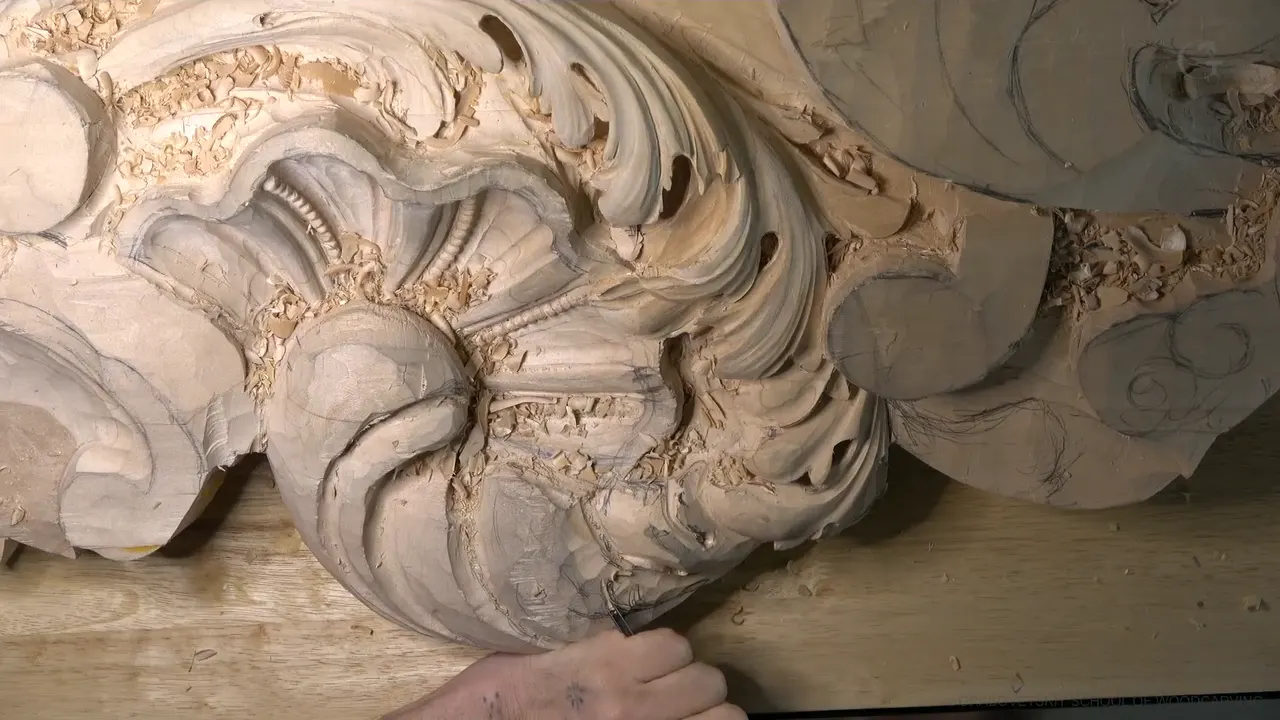
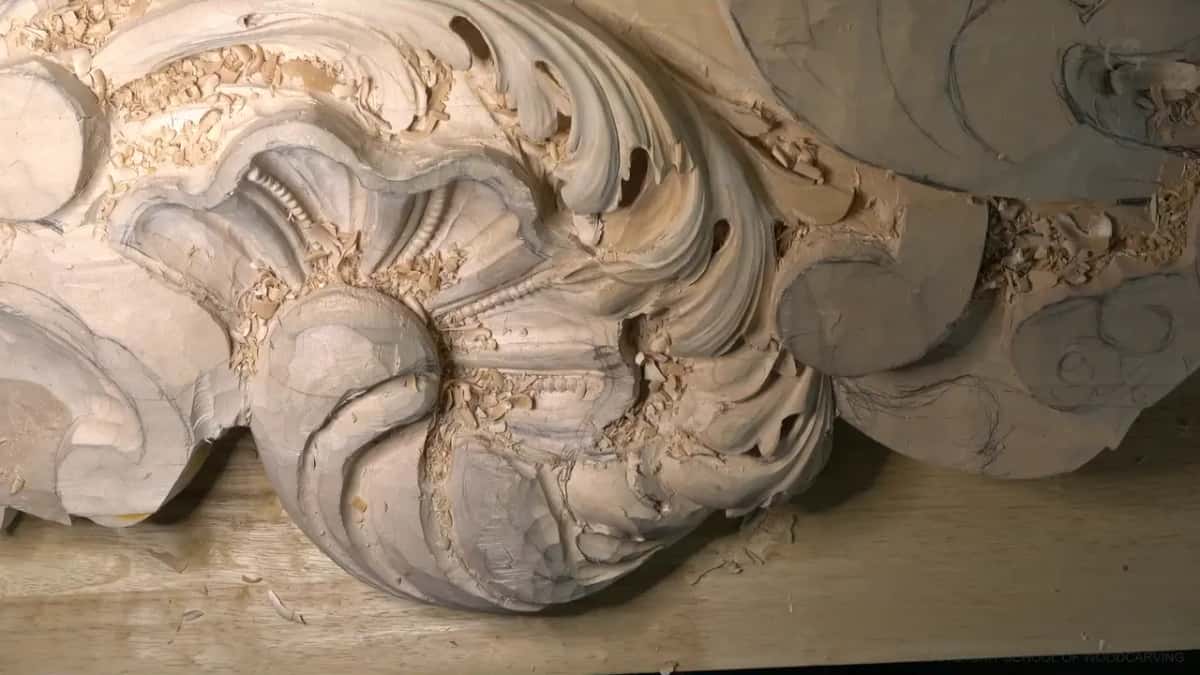
Carving against the grain in wood that is about to be removed is a trade I make on purpose, and in part 11 of workshop 13 I said so while the gouge was moving. My words at 07:15 were "not supposed to, but it's okay, it's going to be gone anyway." A breath later I added that most of it would be gone.
This video is short, about eight minutes. So I went through my other courses and pulled in the places where I said something like it, and each one sits in a public lesson that I link.
Ever felt a gouge catch and start to tear when the fibers ran the wrong way? Did you stop, wondering if you had ruined the piece? Then read on, because the answer depends on where the wood is headed.

What did I do about the grain in this video?
- I carved into the fibers and called it fine, since most of that wood was leaving.
- A flatter gouge came first, maybe number five, to fix my overall movement.
- Excavating underneath began once I knew where the waste would end up.
- Other lessons carry the same words about waste, and one about a part nobody sees.
- Where the wood stays, I ask for a sharp edge, a smaller tool first, and a pass from the other side.
Does grain direction matter on wood you will remove anyway?
In part 11 I carved it the hard way and gave my reason out loud. I was not supposed to, I said, but it was fine, since the rest of that wood would go.
Look at what came right before that. Near 06:05 I picked a flatter gouge to try to fix my overall movement, and the number I named was maybe five. "First of all, I need to fix overall movement," I said, "and then I have to just do something else."
The sentence that explains the order comes at 07:26. "So now I've got a really good idea where that stuff is going to end up." Only then did I start excavating a little bit underneath and make my edge. The transcript ends on "Maybe a little bit of force."
What came before the grain in part 11?
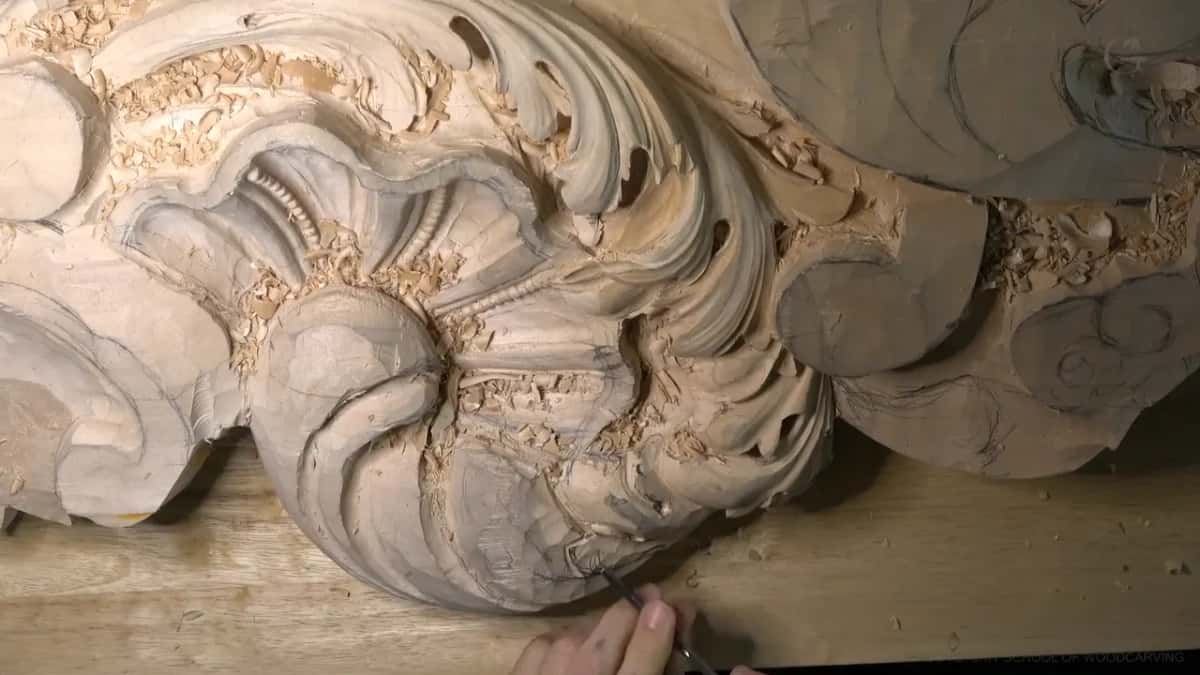
The video opens at 00:10 with "that is how I want to see it. This flips above and that flips above." One of those details needed a better shape, so I outlined it first, using a number 11, 3 mm (about 1/8 in).
By 01:04 another eye was on its way. I thought I probably should flip this one a little bit above that one, and at 01:53 I said it would be a gorgeous, gorgeous project. Then I stopped myself at 02:08. "Maybe I just got too carried away and made that too big."
One line had to move over a little, since it sat just outside of the main movement, the main curvature. It was still a little too big, so at 03:14 I said I would get a bigger tool, like number eight.

Something I had done at 03:31 bothered me. I could probably excavate a little more and get rid of the previous stroke, I said, and maybe finish it like that instead. My verdict, at 04:13, was "That is much better."
Next I wanted to excavate a little more underneath, because that part is supposed to grow from underneath. A moment later I warned myself to be careful, since it was going all the way to the backside.
Then a noise needed an explanation, at 05:05. The sound was probably my landscapers doing the grass, and I could not stop recording, because I really needed to keep moving.

Why fix the overall movement before the grain and the details?
The shape comes first, and at 05:41 I put it in plain words: "I'm just creating overall shape first." Right after that I said I was kind of not too happy, and a flatter gouge came out.
The overall movement was the thing I was fixing. On this panel the movement came first, and the grain line came second.
None of that means I stop caring about a part nobody sees. Over in Hashemi lesson 7 I said I was really not too happy about the overall shape of a leaf. It would be completely hidden, I admitted, but still, something bugged me.

Where else was a risky pass okay because of waste?
A ridge stood in my way in workshop 67 of the Venice Room. I could not make a beautiful pass with it there, so I took just a skew and carved that out. I knew the fibers were fighting me, and I said I don't worry about it, since most of it is waste anyway.
Gradual movement was what I needed after that. Then I could clean it the normal way.

Back in Hashemi lesson 9, a number nine spoon cleaned the inside. By 00:57 I was wiggling, and I said why: the grain was against me. Nothing broke. That part goes like this, I explained, and it was waste anyway, so it would get removed later on. "So don't be scared, I did not make mistake."
Lesson 42 of the same course opened on a number seven, 20 mm (3/4 in), and noted that smaller ones just take a little longer. Near 01:02 I owned up to a grain that fought me and said "that's okay." Next I called the part "invisible anyway", since it "just has to go inside of the socket."

Back in lesson 7, a number five was my pick, near 06:04. "You can see some spots trying to split. That's okay." The back bend would work here, I said, but later on I can just go back and make my final undercut.
That one has a catch. Soon after, I kind of did not like the mess I had made right there, and it did not look too good.

What do I do when the wood stays and the grain is against me?
I slow down and change the order. A long bent number 11 came up first in workshop 66 of the Venice Room, until I changed my mind. Well, actually, I said, a smaller tool can excavate the inside, since the fibers fight that pass, and then I clean with the bigger tool.
How small could I go? Maybe about 10 mm (3/8 in), number 11. "But be mindful," I said, because the pass ran along the grain as well, so I could not overdo it.

Another video of that lesson repeats the plan. A number five back bent got the nod, and I said a tool must be really sharp for that pass, which is still possible. After I get that first pass, I can go from the inside out, with the grain, and clean it using the bigger tool.
Hashemi lesson 19 says it in fewer words. I attacked a spot from the opposite direction and warned myself to be careful. Little by little I removed the waste, and later, I said, a spoon gouge can always clean from this side.

A quarter-inch number nine (about 6 mm) shows up in Hashemi lesson 10. With the fibers against me I was wiggling, so the pass came out unclean. Cleaning it from the backside was still on my list. There, I said, I could clean that with the grain.
Pressure gets a mention in lesson 11. A V tool, number 16 at 6 mm (1/4 in), could handle the wrong direction, but reaching the spot from the opposite side was actually easier. I told you to keep an eye on how much pressure you create, since that part had become more fragile.
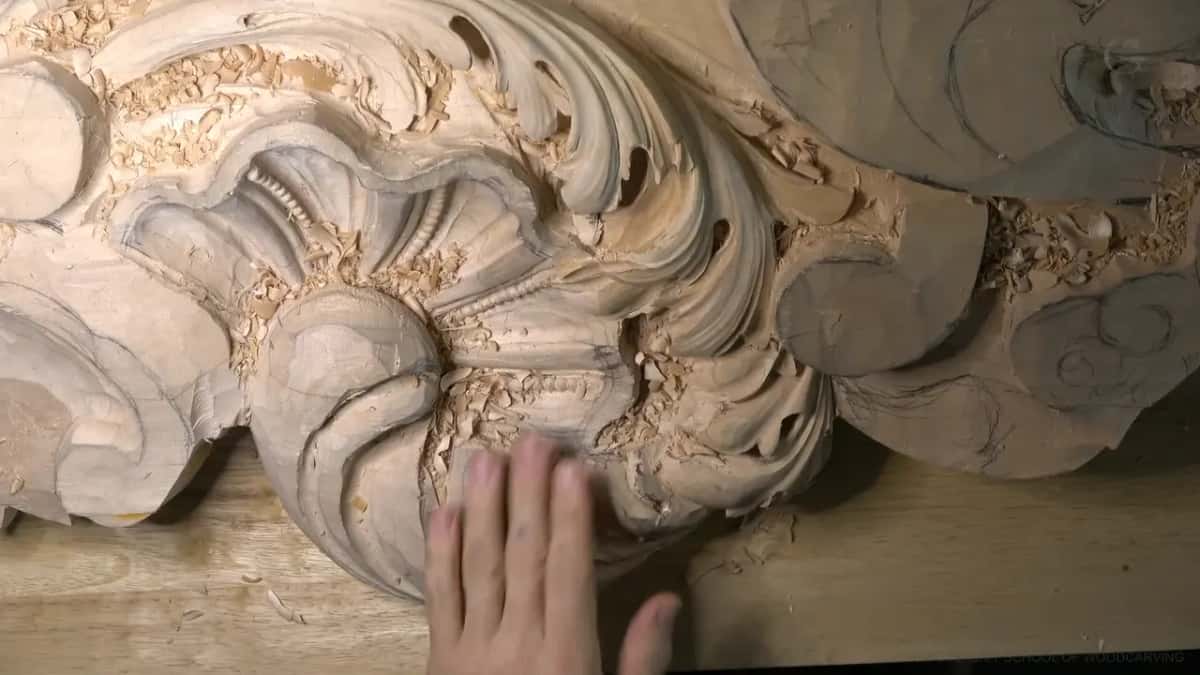
Hashemi lesson 12 gives me two reasons. Part 6 says working the hard way is okay if you do have sharp tools, and the pass was just preliminary. The other video answers anyone who wanted to know why I did it that way: I could not attack from the other side, because my movement was in the way.
In that second video I also held my tool as close as possible to the edge. That way, I said, I can control much better.
Does a sharp edge change what the grain does to you?
It did in workshop 65. At 04:25 I said the grain was against me, which was okay. "My tool is super sharp, and you can see it still leaves a good finish, but I have to be careful."
Two minutes later the edge needed more. I took it to the felt on my workshop. Then, at 06:32, it "just cuts perfectly even" for a grain that fought me, "leaving really good quality cut."

A skew I changed shows up in workshop 72. A really long bevel went onto the back side, and since it is a skew, it gives me much better slicing. Sometimes just a point of it, a corner, is enough. Even when the fibers fight me, it gives me a chance to excavate much cleaner.
A different video of that lesson shows the skew at work. Carving the wrong way did not give me a really good pass, and the other side was almost impossible to reach. But I could fix it with the skew and still create a clean pass.
Lesson 25 of the Hashemi course puts it plainly. Some spots force me to go against the fibers. Slicing the correct way, I said, should not give me any problem.
When does the grain make me slow down for real?
A bad position does it. In workshop 82 I said I had to break all the rules, because I was working uphill, and that position, I said, is actually the worst. "But it is what it is. There's no other way I can attack that."
There I named a 1.5 mm number 11 (1/16 in), then a 3 mm one (1/8 in) upside down, and made my pass toward my previous hole.
A tool that was too small got swapped in workshop 71. About 5/8 of an inch, 15 mm, number 11, of course, and carefully: the fibers fought me, yet it was okay.

A deep spot waited in workshop 74. The wood fought me, "which is okay, I guess," and I wanted a really deep hole. Not a convenient place, I said, yet I wanted that shadow. The tool I named was a 2 mm (5/64 in) number 11.
Over in workshop 78 I gave a plainer line: I had the grain against me right now, "which is not always the best." And workshop 64 had me carve in with a number two back bent, 6 mm (1/4 in), and said "This tool is super sharp, and I should be okay."
Two more are worth a look. In Hashemi lesson 36 the grain did not help, since I worked completely against it, but I could always fix the edge. No big deal. For lesson 13 I named the fix: a small spoon gouge, used carefully, carefully.
A short record of what I said and where
These five moments share one word. My answer sits in the right column of each row.
| Where | What I was doing in the wood | My reason |
|---|---|---|
| This video, 13.11 | Pushing into the fibers on the panel | I said the wood was going anyway, so it was okay |
| Venice 67, part 12 | A skew on a ridge in my way | I don't worry about it |
| Hashemi 9, part 6 | Wiggling a number nine spoon on the inside | That was waste anyway |
| Same course, lesson 42 | A number seven, 20 mm wide, going the hard way | It's invisible anyway, and it goes in the socket |
| Same course, lesson 7 | Number five, wood starting to split | Later I can go back and make my final undercut |
What about your own wood?
Will some of it be gone before you finish? Do you already know where that part of the leaf will end up, long before you finish? Then you have a place to spend a risky pass, and a place to save your best tool.
The part I described is one video of the lesson. Workshop 13 holds the rest, and the course page is Advanced Carving: Venice Room, Part 2. The craft is wood carving, a branch of woodworking, and the fibers I talk about are the wood grain. A gouge belongs to the chisel family, and a strop is a close cousin of the felt I used. A long bevel on a skew changes how it slices. A relief is carved on a flat background, and an acanthus leaf has deep spots that hold shadow. The room is in the style of Venice, and my sizes are in millimeters and inches. And sharpening is its own craft.

Which wood on your leaf is waste today?
How it's done
- Fix the overall movement. My pick in part 11 was a flatter gouge, maybe number five, and I said first of all I need to fix overall movement.
- Learn how the waste will end. By 07:26 I said I knew where it would end up.
- Go the hard way in the waste. I said it was okay anyway, because that part would go.
- Excavate underneath. After that, I began excavating underneath and made my edge.
- Clean what stays from behind. My plan in Hashemi lesson 10 and workshop 66 was to clean the leftover wood from behind or from the inside.
Frequently asked questions
Is it okay to carve when the grain fights you?
I called it okay on wood that was headed out, in part 11 of workshop 13. I still did it there, and I said so at 07:15. Wood I keep gets a slower hand, plus a sharp tool and a smaller gouge before the big one.
How do I know which wood will be gone?
Part 11 had me fixing the overall movement first. At 07:26 I said I had a really good idea where that stuff was going to end up, and only after that did I excavate underneath and make my edge.
What if the wood starts to split?
In Hashemi lesson 7 some spots were trying to split, and I called that okay, since a final undercut could come later. Lesson 11 adds a caution: keep an eye on how much pressure you create, because a part had become more fragile.
What to carve next