

Alexander Grabovetskiy, woodcarver, School of Woodcarving · Published 2021
What does a wood carver mean by "not as deep"?
Quick answer: In video 1 of Byzantine Acanthus lesson 10, I name a number 11 at 3 mm (0.12 in) for an excavation and say it goes shallower, "but still like that." Later I name a number 9 at 10 mm (0.39 in) for the concaves and call them "still concaves."
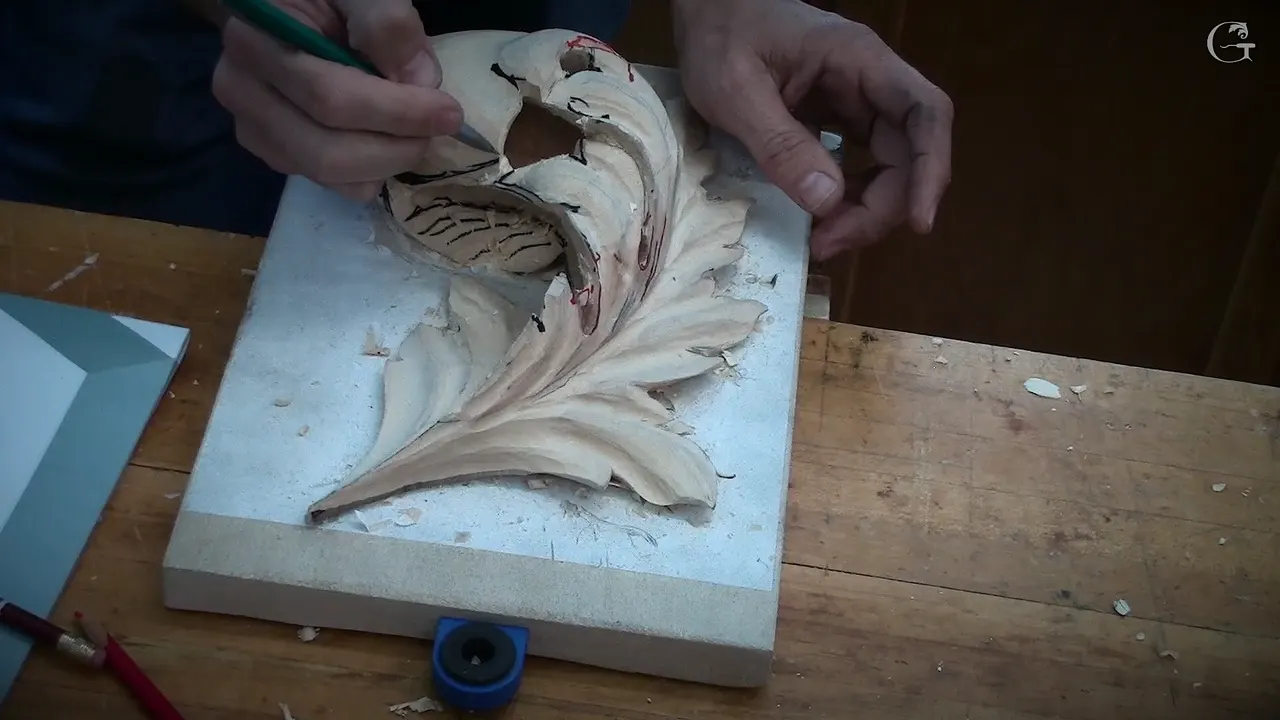

In Byzantine Acanthus 10, video 1, I say a number 11 excavation is "not going to be as deep, but still like that." Other lessons of mine put the same words on a V cut, a concave and a shadow.
Ever dug one cut and found the next one has less room to go? Lesson 10 of the Byzantine acanthus course has that moment in its first video, and each lesson below has a reason of its own.
Where does video 1 say it?
I start with a question: "it feels almost like you have to overlap that one above this one, right?" My answer is "But it's wrong." The flow decides, in my words: "Everything going to just follow the flow, which means this part going to overlap that part."
The tool comes next, "number 11 and 3 millimeters" (0.12 in), and "We're going to start excavation." A bigger part overlaps a smaller one, and I say "overlap the smaller part." Then "Let me dig this section." Next comes "Just a simple cut."

A blend follows, "either with the flat number 2", and "I'll take just a knife" is my other option. The shape needs a change too: "we have to change the shape little bit."
Then a pipe is needed inside the concave: "step number one, but we also need to create a pipe right inside of that concave." I ask "What do we do when we create a pipe" and answer "We create two concaves on the sides." The pipe is "not going to be as thick anymore", and it "still has to go all the way with the same direction."
Then a number 9. "I can take probably number 9 and 10 millimeters", I say, which is 0.39 in. My depth line comes back for those concaves and ends "but still concaves, okay?"

Does the second cut go shallower than the first?
Video 5 of Furniture Panel 20 has a cut continue: "And right here, I'm going to continue my cut." Its depth is set against the other side, "as on this side, okay?" Right after, "everything has to be leaning toward that direction right here from this point."

One side stays shallow in Furniture Panel 15. The reason I give is the first cut: "because I got just the initial cut, so I don't want to get too close to it."
A slip happens in Furniture Panel 17, video 2. "Slipped too quick." The cut is shallow, so "I should not have any problems."
The next excavation in Furniture Panel 27 takes a 5 mm number 11 (0.20 in). Of the tool I say "I can use just the sides of it." My words for the spot are "a deeper excavation in this area", and the background goes deeper than it.

Numbers get checked before an excavation in Furniture Panel 39: "I could do this at the same level as this section." Then "Going to get my calipers and let me check what I've got." The answer: "It's little less than a quarter of an inch." That is a little under 6.4 mm.
Video 1 of Furniture Panel 19 offers an outline with a 1 mm tool (0.04 in). "Just try not to go deeper than 1/32 of an inch" (0.8 mm) is my limit there, and "don't go really, really deep."
Is a shallow carving a kind of its own?
Furniture Panel 12 has the name for it: "shallow or low relief carving." Shallow work still wants detail, and Furniture Panel 4 says "I still would like to get as many details as possible, the tiniest."
The dining table apron course gives me a name for the work: "I call it shallow carving." The numbers come next, "less than five millimeters" (0.20 in) and "three, four millimeters usually, no more than that" (0.12 to 0.16 in). The same video has it again: "It's how I call it. You can give it the name."
What does a V cut need to hold?
A V tool undercuts underneath in Hashemi Flowers 26, so the parts read as "interweaving". The cut goes in shallow for a reason: "because we still have to make sure it does have support." From the high point downhill my figure is up to 3/16 of an inch (4.8 mm), "maybe 3 millimeters, so it would be 1/8 of an inch."
The V tool works around in Hashemi Flowers 44, "as deep as possible." One place is to get less, with a purpose in my words: "Maybe just to create some, again, inner waviness."

What about a concave beside a ridge or a pipe?
Two concaves are planned in Floral and Molding for the Panel 12, video 2, beside a middle line: "I'm going to create concave number one and concave number two." The depth line follows the plan. The flute is to sit in a different position, and I correct the hour: "Right now, my flute's at about 3:00." And "Oh, I'm sorry, not 3:00, 9:00."

Finer work comes in Floral Panel 5: "I'm using only half a millimeter" (0.02 in), a number 11. Then "I don't really need a wide cut."
Floral Panel 6 plans a second concave: "I'm also going to do another concave cut on this side." My aim for the middle: "I really want to see the middle part, the center of that acanthus movement somewhat raised like convex."
A worry comes with a number 5, a quarter inch (6 mm), in Floral Panel 7. "I don't want to create too deep of a cut, but I still have to make that cut no matter what." The wall I leave is 1 millimeter at most (0.04 in).

My plan moves along in Floral Panel 11. "maybe I have to excavate a little deeper right here", I say, and the reason is "I want to make sure it is sloping nicer."
In Floral Panel 9 I plan a look: "that volute is right underneath of that leaf." For the next tool I think I should use "one millimeter or so" on a smaller number 11, which is 0.04 inch.
A way to attack a concave comes in Floral Panel 13: "I can attack from two sides, get my concave." Then comes "And attack that from above and clean it."
Acanthus over Moldings 3 and Moldings 8 each name a flute position by the clock. The first sits "maybe one o'clock", and the cut is at most one and a half millimeters (0.06 in). The second has my flute "just up like 12 o'clock", and I say "I don't need to do deep right here."

Modern Acanthus 4 has a plan for the next shape: "I'm gonna create the convex with the same number 11 using only this side of the tool."

Venetian Flowers Rosette 3 starts with a motion. "Go in and out, in and out." Next, "It's not as deep, but still", and I say "the edge is actually slightly raised." A small knife is another way: "I can also do exactly the same operation by using just a knife."
A third concave stays undecided in Venice Room 47, where I say "Maybe I have to create another concave, maybe I don't." After that comes the tool: "going to use a spoon this case."
Over in Venice Room 55 I use a big tool, "15 millimeters" (0.59 in): "Again, big tool. That's what I'm using." What I protect is the ridge: "I still want to raise this ridge."

An option is named in Venice Room 94, "create another sort of a pipe", with tools named: "I can do that with the number five or number seven or even six." A plan turns around in Venice Room 90: "I wanted to do a deeper cut right there, but do I really want to do it or not? I don't think so." What I plan instead is a concave cut.

What about the shadow?
Beside the depth, the light comes up in Venice Room 97. I name a figure, "approximately maybe about a 3/16 of an inch deep cut" (4.8 mm). The light is "going to strike from this side and it's going to travel on inside", and I say the shadow there is less deep.

Day and night both come up in Venice Room 101. light "going to shoot from this side, and that's going to cast a really beautiful dark shadow in this area." By day "it's still going to create some shadow." By night "it should be more dramatic, I should say."
In Venice Room 89 the aim is a second shadow: "Reason why, I want to see another shadow." Then I say I am going to undercut underneath that line, and "I need that shadow."
How deep is shallow, in numbers?
The outline of a wing detail in Plate with Butterflies 10 goes in at "approximately 90 degrees", and I give a reason for the shallow depth: "it's the detail of the wing".
Butterflies 11 describes it with a knife placed "inside of that concave", and the cut is "about millimeter or millimeter and a half" (0.04 to 0.06 in).
The line in Lily Box 2 is "I'll use a number five, a quarter inch" (6 mm), "and just make my concave cuts." One spot waits: "I want to keep my high point, or I should say high ridge."
Lily Box 3 gives a figure, "I've got only no more than 16th of an inch, maybe less even" (1.6 mm), while Lily Box 7 says "we don't overdo it" and "It has to be there." The tool there is "the half a millimeter" (0.02 in), for "that little shape and ability to create some shadow."

A cutting board lesson, Curly Kitchen Cutting Board 13, starts a cut with "Start carefully." Then comes "about maybe a sixteenth of an inch" (1.6 mm) as the top, and "It could be even less." The reason is a shadow: "It's still going to give us a shadow, what we're trying to get."

Does the first pass start shallow?
A long bend number 11 opens Venice Room 34, about 10 millimeters (0.4 in), and I plan to "start excavating." Farther along, the plan is "deeper and deeper and deeper."

Another tool is named in Venice Room 122, "number 11 and 20 millimeters" (0.79 in), and my first cut is to hit that line. "Although, I probably could go much deeper." Video 5 of Venice Room 101 takes a 10 mm number 11 (0.39 inch) with a limit of "three-sixteenths of an inch, five millimeters."
A lower bevel is planned for a second side in Greek Acanthus 4, "with a little lower" bevel, and I compare it with the first one. My reason: "with the bigger spaces, it can create a really deep hole, which we don't need."

Roman Acanthus 7 brings in the vise: "I could just rotate and see in a different lighting situation how it's going to look under different lights." That helps me "to determine should I carve deeper?"
A flower hangs upside down in Grinling Gibbons Maine class 3. One side is "little deeper", I say, "Because we have a flower which is hanging up upside down." At another spot it "doesn't have to be too deep."
A texture comes up in Maine class 6: "I could go with the number seven", at "14 millimeters" (0.55 in). "I'm not gonna go too crazy", I say of the texture. Of the grain, "I can really see the line." My comparison is the year before: "as what we did last year."
One line of cuts in First Cuts for Beginners 2 runs at about "the same angle", "Although some spots are a little deeper", and the reason is "the space I left in design between those leaves."
Where did I say it, in one table?
| Where | What went in shallower |
|---|---|
| Byzantine 10-1 | An excavation, then a pipe and two concaves |
| Furniture 20 | Its cut beside a deeper side |
| Furniture 27 | A deeper excavation, the background deeper still |
| Hashemi 26 | A V cut that still has support |
| Floral 5 | A concave with a number 11 of 0.5 mm (0.02 inch) |
| Floral 7 | A wall of 1 mm, 0.04 inch, left beside the cut |
| Moldings 3 | Cuts of one and a half millimeters (0.06 inch) |
| Venice 55 | A concave beside a ridge I still want to raise |
| Venice 97 | Cuts near 3/16 inch (4.76 mm) deep, with the light in mind |
| Venice 101 | A first pass, limit 3/16 inch (5 mm) |
| Butterflies 10 | A wing detail, outlined at about 90 degrees |
| Lily Box 3 | Cuts of 1/16 inch (1.59 mm), maybe less |
| Curly Board 13 | Cuts that still give a shadow |
| Apron | A shallow carving, thinner than five millimeters (0.2 in) |
Which of these would you try first on your own board, a V cut or a concave? Every video of this lesson sits inside one tuition plan. The Byzantine Acanthus course page holds all ten lessons, with lesson 10 here. Wood carving and relief wait there, and my sizes come with my own figure first and an inch figure beside it.
How it's done
- Pick the number 11. My plan opens on a number 11 for the first excavation.
- Dig the first pass. The excavation is to start, and the words about its depth come with it.
- Blend the cut. The blend is to go in either with the flat number 2 or a knife.
- Put the pipe in. A pipe in the concave gets two concaves, one on each of its sides.
- Take a number 9. The concaves for the pipe go in shallower, and I still call them concaves.
Frequently asked questions
Which tool opens the excavation in video 1?
The number 11 is sized 3 mm, which is about 1/8 in. A blend follows, with a flat tool or a knife. Later a number 9 takes the concaves, and my words are that it does not matter which tool I pick.
How thin is a shallow carving in my numbers?
On the dining table apron I give three or four millimeters (about 0.12 to 0.16 in). The curly cutting board has a cut of about a sixteenth of an inch (1.59 mm), and I say it could be even less.
Do I give a shallow carving a name?
Yes. In the apron course I say "I call it shallow carving." The panel course, lesson 12, has "shallow or low relief carving" too, and there the final movements of the flowers get decided while I work on them.
What to carve next