

Alexander Grabovetskiy, woodcarver, School of Woodcarving · Published 2026
Can you tell how old a piece of carved furniture is?
Quick answer: Dating carved furniture by eye is not always possible. On my oak table apron I said I couldn't really tell when the original was carved. By the condition of the wood it didn't look really old to me, and its shellac was still in really good shape.
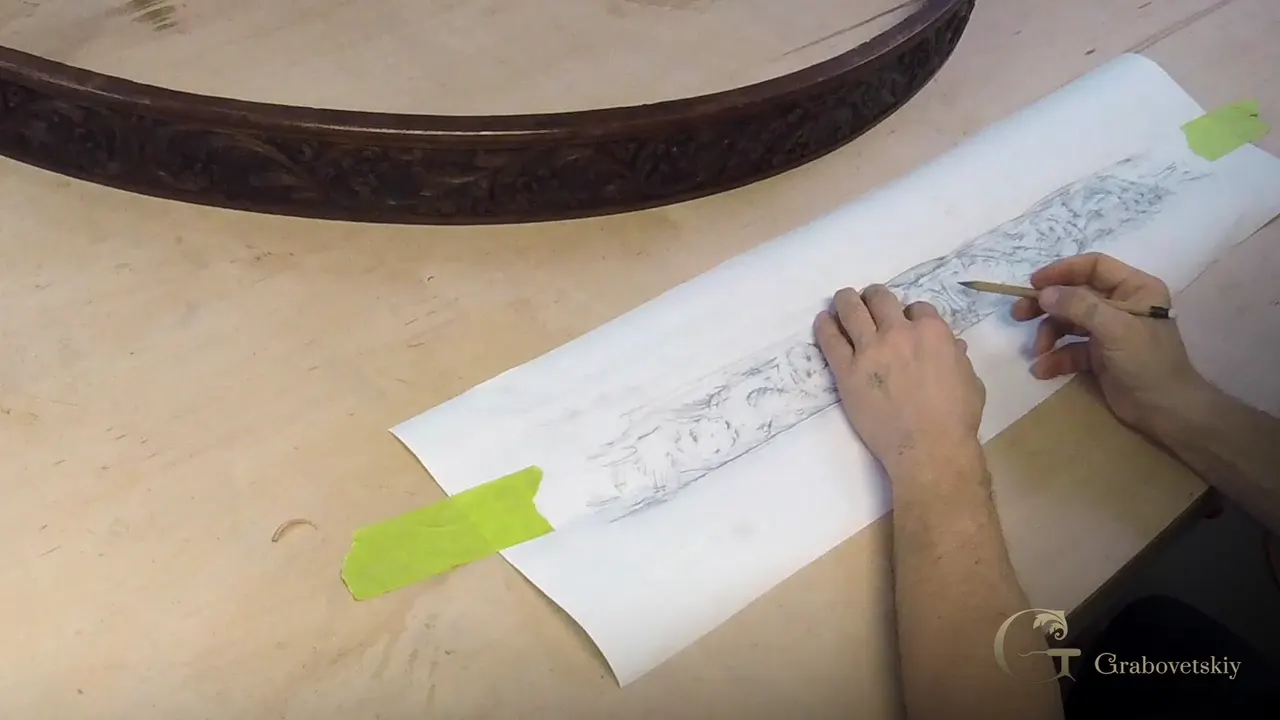
Telling the age of carved furniture just by looking is not always possible, and on this oak apron my eye could not do it. In workshop 3 of Carving Dining Table Apron I had the old oak section on my bench, and I said it plainly. By looking at this piece, I can't really tell when that original piece was done. If you typed how to tell if furniture is antique into a search box, I'll give you what I could read off this one, and where my eye stopped.
Have you ever seen carving on an old piece of furniture? Did it make you wonder how old it was? Me too, pencil in hand.

The short answer from one old apron
- My eye gave me no year for this apron, and I said so on camera.
- Its wood didn't look old to me.
- In the first video I called it antique looking white oak with a past I couldn't trace.
- Old carving shows the hand that made it, shortcuts and all.
- Furniture guides date a piece by its joints, saw marks and finish, and I name their sources below.
- To copy it, what I needed was the old carver's hand.
What did I say about the age of this apron?
Two things, in two different videos. I opened the box on camera before I had seen the piece myself. Does look antique, I said. For a fact, it's white oak, for sure. Then came the honest part. I don't know the true history of this piece.
The family has owned the table a few generations, as I understand, and they wanted it bigger. At the first glance, it's beautiful, I said, and this type of carving is not difficult carving, and we can probably learn a lot from it. It's a really interesting project for me, absolutely different from carving art pieces or Grinling Gibbons pieces. This is a straight furniture carving.

Drawing over my pencil rubbing in workshop 3, with the old curved section lying on the bench beside the paper, I looked at it again. By the condition of wood, it's not really old. I can see it has a shellac, and it's still in really good shape. That was the whole of my reading, about twenty seconds of it, and then I went back to the pencil.

Workshop 2 had the same shellac pushing me the other way. It looks like it's shellacked on top, so it's a true antique, I said there. Both lines are mine, and both stay.

How to tell if furniture is antique, the way the guides put it
Reference pages keep a much longer list than my twenty seconds of looking, and this section is theirs, with every line naming the page it comes from.
Age comes first. The customary definition of an antique asks for at least 100 years and original condition. Joints come next, and the page on the dovetail joint calls that joint an important way of telling periods of furniture apart. Saw marks help too. Circular saws were in common use in American sawmills by the middle of the 19th century, says the article on the circular saw, and mills often left straight marks on one side of a board and round ones on another.
Then the finish. From the time it replaced oil and wax in the 19th century, shellac was one of the main wood finishes in the western world, until nitrocellulose lacquer largely took its place in the 1920s and 1930s. The French polish method, many thin coats of shellac rubbed on with a pad, was developed in the early 19th century. And patina on furniture is the sheen that comes from age, wear and polishing.

Ornament dates a piece the least. The acanthus leaf saw a major revival in the Renaissance and is still used today, and the designs of Thomas Chippendale, who published his Director in 1754, are now reproduced all over the world. So a Chippendale look tells you the style before it tells you the year. Conservators add one warning. The finish coating is part of the history of the object, and once it is removed it cannot be recovered, says the page on conservation of wood furniture.

What does old carving tell you about the man who made it?
His hand, more than his year. When you're working with antique furniture, you can see all the mistakes, I said in workshop 3. Then I took the word back, because I shouldn't say mistakes. Whoever carved that apron took some shortcuts.

Working the darker wood of my furniture panel, I said it more kindly. If you dig a little too deep with a gouge it's not a big deal, but then you have to hide that somehow. And if you look at some antique furniture, you can find all those mistakes the original furniture maker made, until you realize he was also just a human and he made his mistakes also. Right after that I said I wasn't going too deep with the straight down cut yet, because I didn't want to leave any marks before I decided what kind of background I want to see.

Sometimes I follow the old hand on purpose. At a triangle on the floral and molding panel that needed a relief cut, I said I really like number 11s on that project, to be more authentic to the original carvers who worked on a piece like that. Back then they didn't have that V tool. A V tool would be sufficient, I said, and probably nobody would even know. So I grabbed a number 16 V tool and showed it going right inside.

In Venice Room workshop 14 I started to say that chopping a spot and cleaning it is not the way I like to do it, and then I corrected myself. I like to do what the original carvers did. That's what I should say. On the antique style rosette I explained that on antique pieces, the tools for those backgrounds were not always wood tools. Whatever they could find, they would use it. That bubbly background is a stumbling block for lots of wood carvers when they have to make a replica of antique carving. For it I took leather punches.

Why do the corners of old furniture look dark?
A rag never got in there. I talked about it while coloring the lily box, with a small brush darkening the ground between the carved leaves. Patina is more than natural oxidation. Think about antique furniture and the way it's cleaned, usually just wiped with some kind of rag. The rag reaches the upper spots and never gets inside those cavities, so the dust and dirt stay right there and become part of the furniture, like an aging effect.

Just before that, I had taken one spot almost really dark, to make it pop. A little later I said it has to be gradual, and I didn't want to see any lines at all. Darkening new work so it reads old has its own page, how to antique a wood carving.

How did the antique oak carve?
Like butter. The wood for the new pieces came from the old leaves of the same table. Workshop 6 is where I said the wood is really excellent. It's all dry, it's antique, it's an original piece of wood, so it's absolutely dry, and it cuts like butter. A normal gouge after the V tool left a really clean surface on that side.
White oak is described as strong, tough, heavy, fine-grained and durable, and oak in general as a strong, hard wood used for furniture, floors and building frames.

Do you need the date to copy an antique carving?
I couldn't read it off the wood, and the carving still had to match the old section. What I needed was the hand. I have to make sure I do exactly what the original wood carver did, as I put it in workshop 3, and that's always interesting. At least for me. I really like to work on antique furniture. It has some history attached, and this type of project is a really interesting one for me.
Designing my furniture panel, I said we would draw and redraw until we are satisfied, and I wanted a real piece of art in a furniture style. And I believe every furniture maker who is working with antiques, or reproduction of antiques, should probably know the process, how they've done it.
Some of you may want only one kind of carving, the furniture style, and I understand that. The curly cutting board is where I said lots of furniture makers would love to learn how to carve in the antique style, or restoration of antique-style furniture, and we're going to do the really nice Chippendale, almost flat semi-relief carving. Even on that kind of carving, if you learn how to use your knife, it's going to be much quicker and much easier.
Sometimes all I get is a photo. The antique style rosette had to match a picture my customer sent, pretty much just a picture. I love to work from pictures, and I've done multiple carvings from just looking at one, though I prefer to carve my own design. I do this for a living, and whatever my clients want, I have to give to them.

You'll find the same leaves on old pieces. On the Greek acroterion I said you can see a lot of acanthus designs in the old furniture, and I meant antique furniture.
What other old work comes to a carver's bench?
Repairs, now and then. On a live stream in April 2020 I said I do repairs sometimes on antique. When people send me a question like, could you repair that mirror, then yes, I can do that, and it's no problem.
Restoration can mean carving the piece where it already stands. On a restoration project where everything is already in place, I have to actually use a step ladder and just go right there and carve it, I said in workshop 49 of the Venice Room.
Other people build the copies. In another Venice Room video I spoke to those of you who build furniture, the antique furniture reproduction people. And yes, I do have some students in my school who really do beautiful reproduction work, gorgeous Chippendale style and so on. On that same Greek acroterion video I said multiple people in the school are involved in furniture making, and one of you asked me for carved panels like the 18th and 19th century furniture door panels.
Specialty tools come into it too. If you're doing reproduction furniture, or restoration work, or even some unique pieces for your house in that style, it makes sense to have those specialty tools, I said on the furniture panel background lesson.
What was I doing with the pencil while I said all this?
Redrawing the rubbing. Most of that job, the middle start and the 21 inches (533 mm), is told on the final assessment page, so I'll keep it short. I definitely can see the picture, I said at the start, and now I can kind of refine whatever I see.
Small things happened in that drawing. There's a little small detail inside of here, in this cavity, I said, and I wanted it to flow nicely. This curve goes like that. That is a main movement. Twice in that video I said I keep checking the original, and the second time I put it in five short words. I'm always checking the original.

| Which old work | What I said about it on video | Which video | What it tells you about age |
|---|---|---|---|
| Old makers' mistakes. | Look closely, antique furniture shows them all. | Furniture panel. | The maker was human like us. |
| Original carvers' tools. | They had no V tool back then. | Floral panel. | I still showed the V tool. |
| Bubbly antique backgrounds. | They used whatever tools they could find. | Rosette video. | I used punches made for leather. |
| Dark old corners. | Rags never get down inside the cavities. | Lily box. | The dirt there reads as age. |
| Antique oak itself. | All dry and antique, cuts like butter. | Sixth workshop. | Clean surface behind the V tool. |
| Repairs on antiques. | People ask, could you repair that mirror? | April livestream. | Yes, I can do that job. |
| Reproduction furniture work. | Some of my students do gorgeous Chippendale. | Venice Room. | Copies need the old makers' process. |
Every one of those videos sits in the apron lesson, which holds all eighteen workshops. If you've never held a gouge, First Cuts for Beginners comes first. Tuition is on the Tuition page.
Have you got a pencil and an old carving somewhere near you? Can you sit with it for twenty seconds and really look, the way I looked at this apron before going back to my drawing? Then start there.
How it's done
- Look before you plan. I opened the box on camera and looked at the piece before planning anything.
- Read the wood and the finish. I checked how old the wood looked and how the shellac had held up.
- Find the old carver's hand. Old work shows its maker's shortcuts, and this apron had some.
- Keep the original beside you. While I drew, the old section stayed on the bench beside the paper, and I kept going back to it.
- Follow the original carver. I copied the old carver.
Frequently asked questions
Can a woodcarver date a carved table by looking?
On this apron I couldn't, and I said it plainly while drawing the pattern. My eye went to the wood and to the shellac, and neither one gave me a year. Joints and saw marks are what the furniture guides lean on.
Do antique carvings have mistakes in them?
Plenty, if you look. The old maker was just a human too, and you can still find those slips on old pieces. The carver of my apron took some shortcuts, though I said I shouldn't call them mistakes.
Why are the corners of old furniture darker?
A rag cleans old furniture, and a rag only reaches the upper spots. Down in the cavities, the dirt stays. It builds into the look of age. Patina is more than natural oxidation, I said while darkening a spot on my lily box.
What to carve next