
July 25, 2026
By Alexander Grabovetskiy — Master Woodcarver · Founder, School of Wood Carving · 20 min read
Principles of Design in Wood Carving
Design comes before the gouge, always. 10 laws decide whether a carving reads right or reads wrong, and they cover movement, the golden ratio, four golden points, two diagonals, hero and antagonist, grow or fall, space, no repeated sizes, Fibonacci, arabesque and rhythm. My name is Alexander Grabovetskiy, and I have carved wood all my life, so what follows is the order I actually work in at the bench.
Something blunt, before we start.
Every old school guarded a secret, and that secret was never how to hold a gouge or how to hone an edge, because those two things can be shown to anybody in one afternoon. Difficulty lives in the design, and it always has.
"Design connects to your brains."
My daughter is an architect. She finished near the top three of her whole university, the highest level they hand out over there, and then she came home and asked her father for help. Not with drawing. With the logic underneath the drawing, because in all those years nobody had taught her the golden ratio.
Anyway, my goal today is simple enough. Today I want you to see how stuff actually works, one law at a time, in the same order I use at the bench.
Which direction does your carving move?
Every design begins with a question that has nothing to do with wood, and the question is which way your eye travels across the piece. Carvers call this the law of movement.
People raised in different corners of the world read a picture differently, and I know how strange that sounds until you test it on yourself.
Watch how we write. An American writes left to right, while my student Eliyahu, who came to class from Israel, writes the other way, and that habit settles down inside the brain and stays there for life.
Two short lines go up on the board, one tilted up and one tilted down, and then I draw a little bus on them.
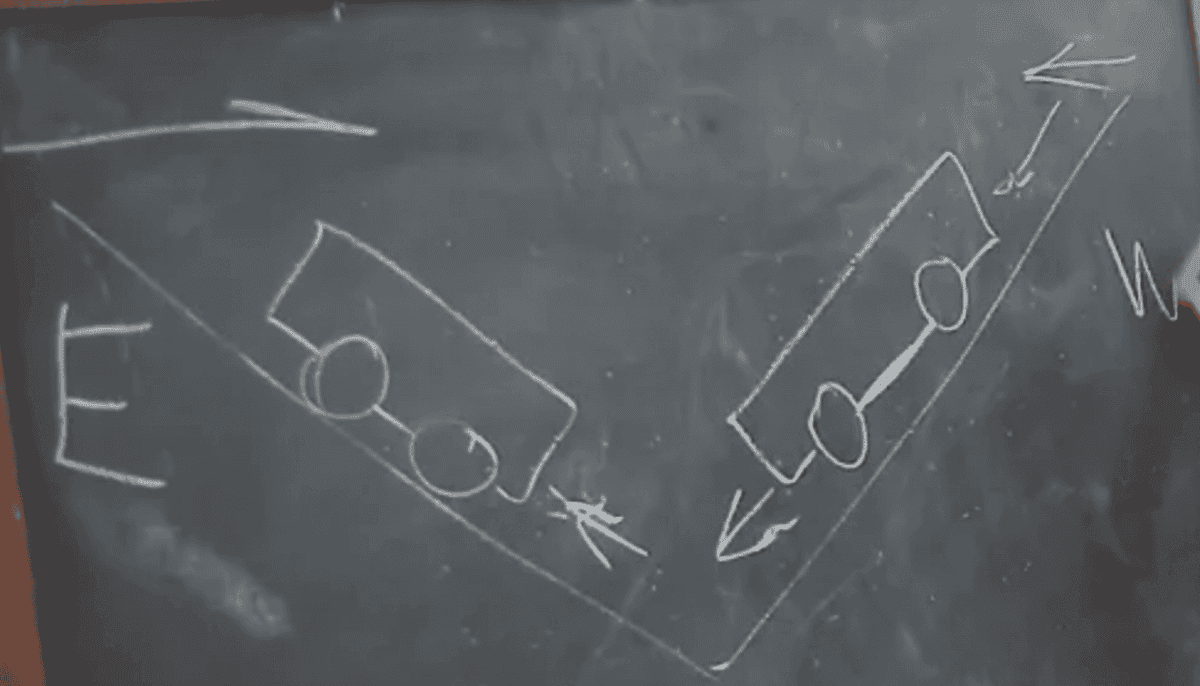
"If you're American, this bus goes downhill and that goes uphill. It's just embedded in your brain. But if you're from Israel, this goes downhill and that goes uphill."
My first question about a commission is never about timber or tools. Who am I designing for? East or west?
Here the story gets funny, because one time I had to design for a married couple where the husband was German and the wife was Chinese, and both of them had lived in the United States for years. You cannot rewire that. Roots sit down in the DNA and they stay put.
So I twisted the whole thing. One diagonal for him, another diagonal for her, and afterward I laced the two together until nobody could find the seam.
They loved the piece. The builder installed it while I was away. And when I finally walked into that house I saw my caving mounted upside down, and I said nothing at all, not one word, because another week of pulling it off the wall was more than I wanted to give.
They still do not know. Now you know too.
How does the golden ratio work in wood carving?
Your canvas has one Main golden spot on it, and your brain reads that spot as the most important place in the whole picture. Land your main element there and the piece looks right without one word of explanation from you.
Golden ratio, golden rectangle, golden section, golden cut. Same animal wearing four names. Call it 1.62.
Take any line and call the full length 100 percent. Your golden cut falls at 62 percent, which leaves 38 on the other side.
Shop work lets me round it off. Sixty and forty. Six parts out of ten, close enough to be beautiful.
Try that on a table apron. Find the middle of the space, then push your point right or left, and which way you push depends entirely on the law of movement.
Build the frame on a square next. Draw your verticals, add the horizontals, then run both diagonals across the corners. We call that whole grid the armature.
All movement in a design travels point to point along the armature, and every crossing hands you another golden rectangle sitting inside the first, so you can keep dividing forever if you have the patience.
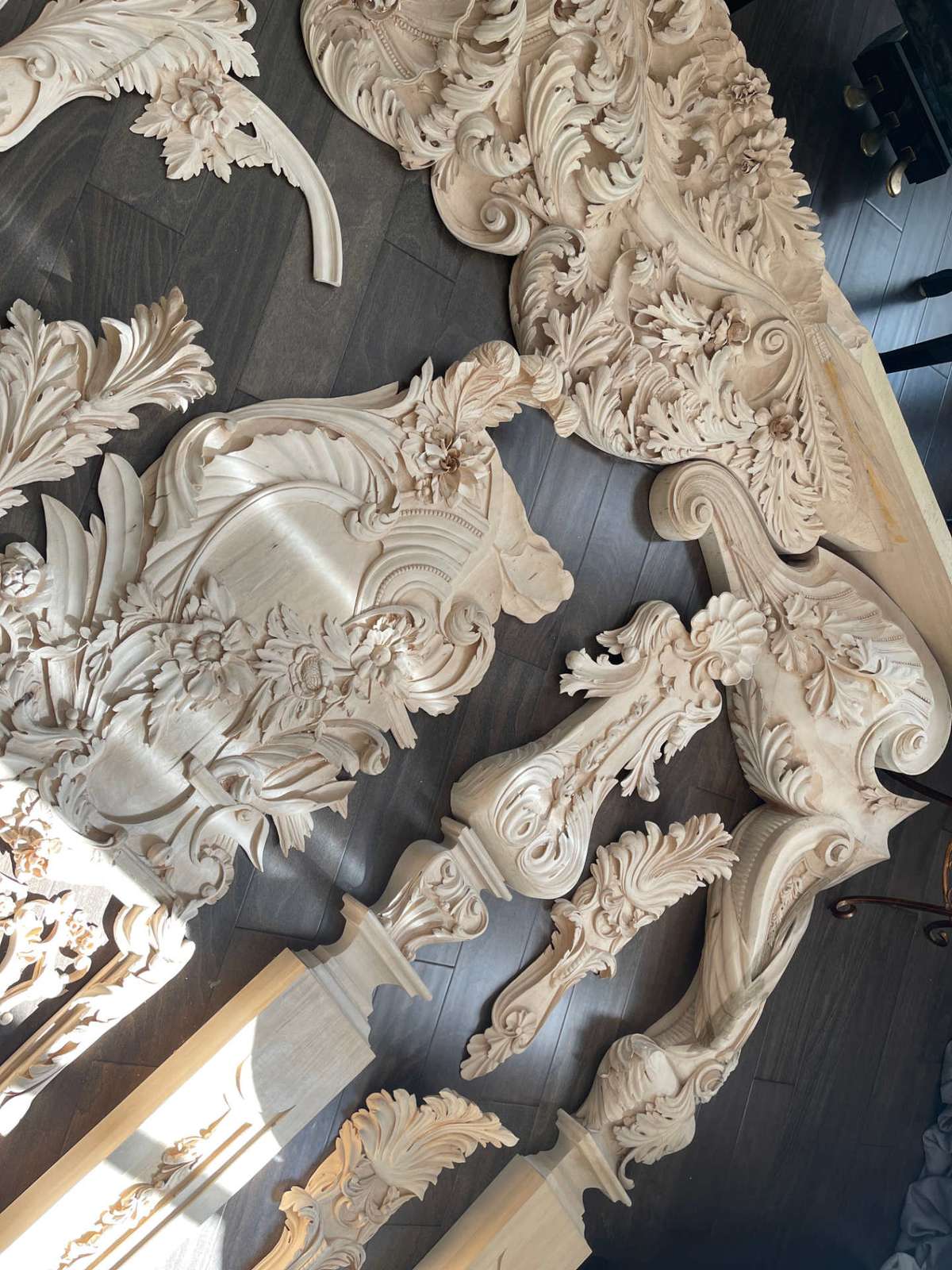
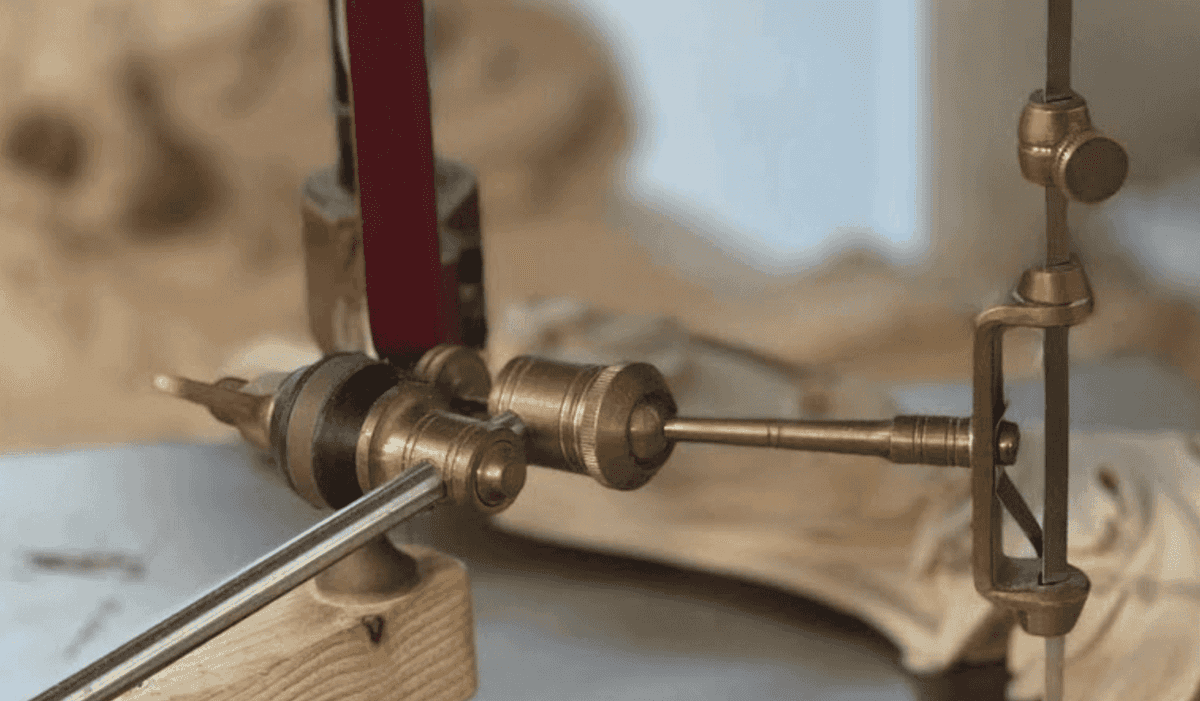
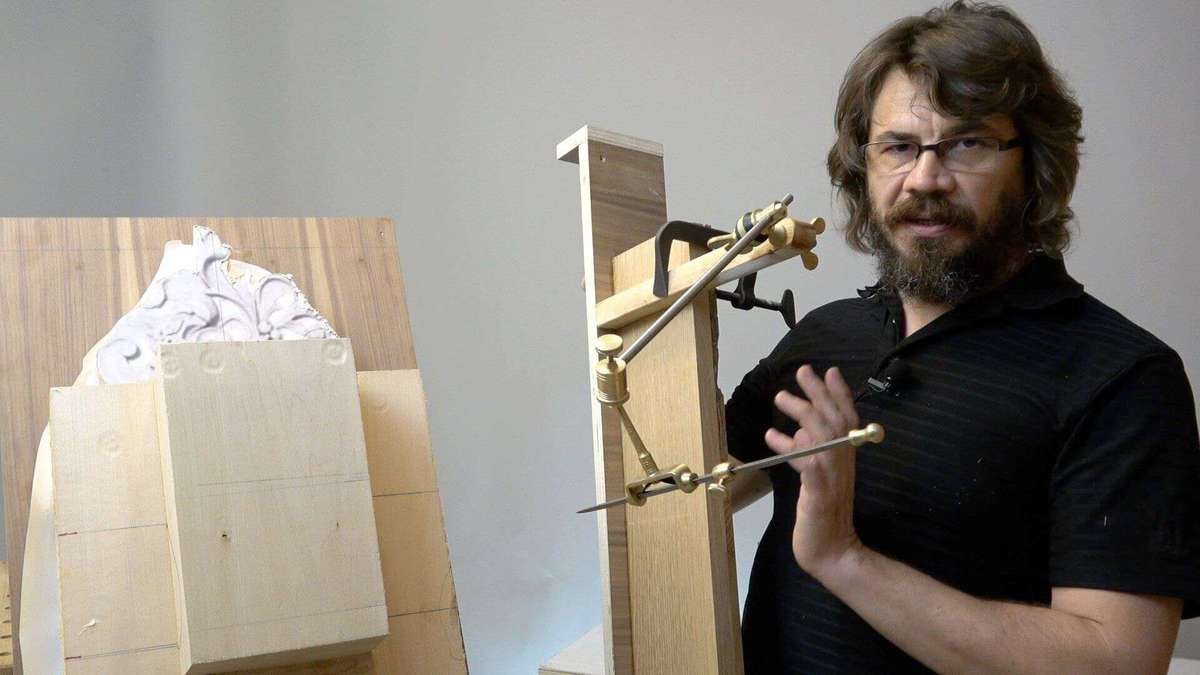
Do you have to calculate every bit of it? Of course not. Buy a pair of golden ratio calipers and walk them across the drawing instead.
Four years ago I taught a full week of nothing but design at the Marc Adams school, and we did every single line by math, pure calculation from breakfast until dark. Math works. It is also slow, and slow is why most carvers quit before they finish anything worth keeping.
Nobody invented this ratio, least of all me. It sits inside your own body. Measure a finger between the knuckle and the tip, then check an elbow against the arm, then the proportions of a face.
"If you don't understand the golden ratio, you really don't understand the act of creation."
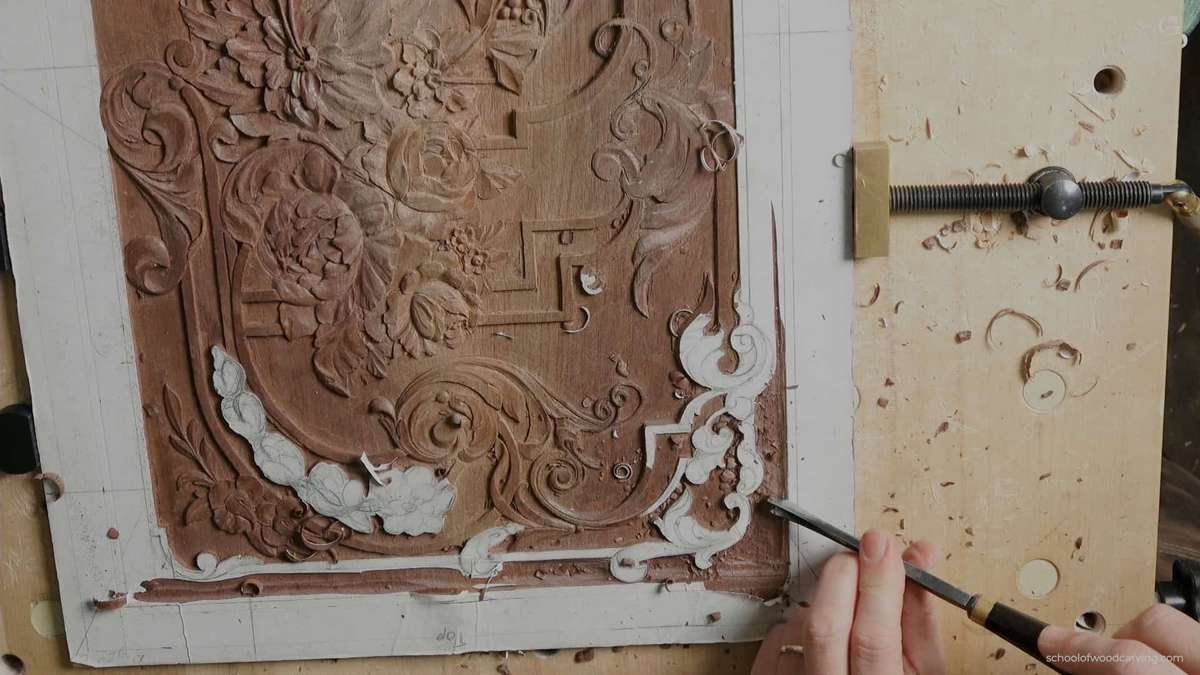
Four golden points sit on every board
One plain board carries four golden spots, not one, because each of the four edges gives its own division. Run the measurement leftward and you get one section, work back the other way and a second appears, and the same thing happens going up and coming down.
That leaves four crossings. 4 golden points on a single plain board. Picking one of them is the next job.
Choosing is the real work of design, and you choose on purpose, in cold blood, before the first chip leaves the wood. By the time my gouge comes off the bench I already know where the eye is going to land.
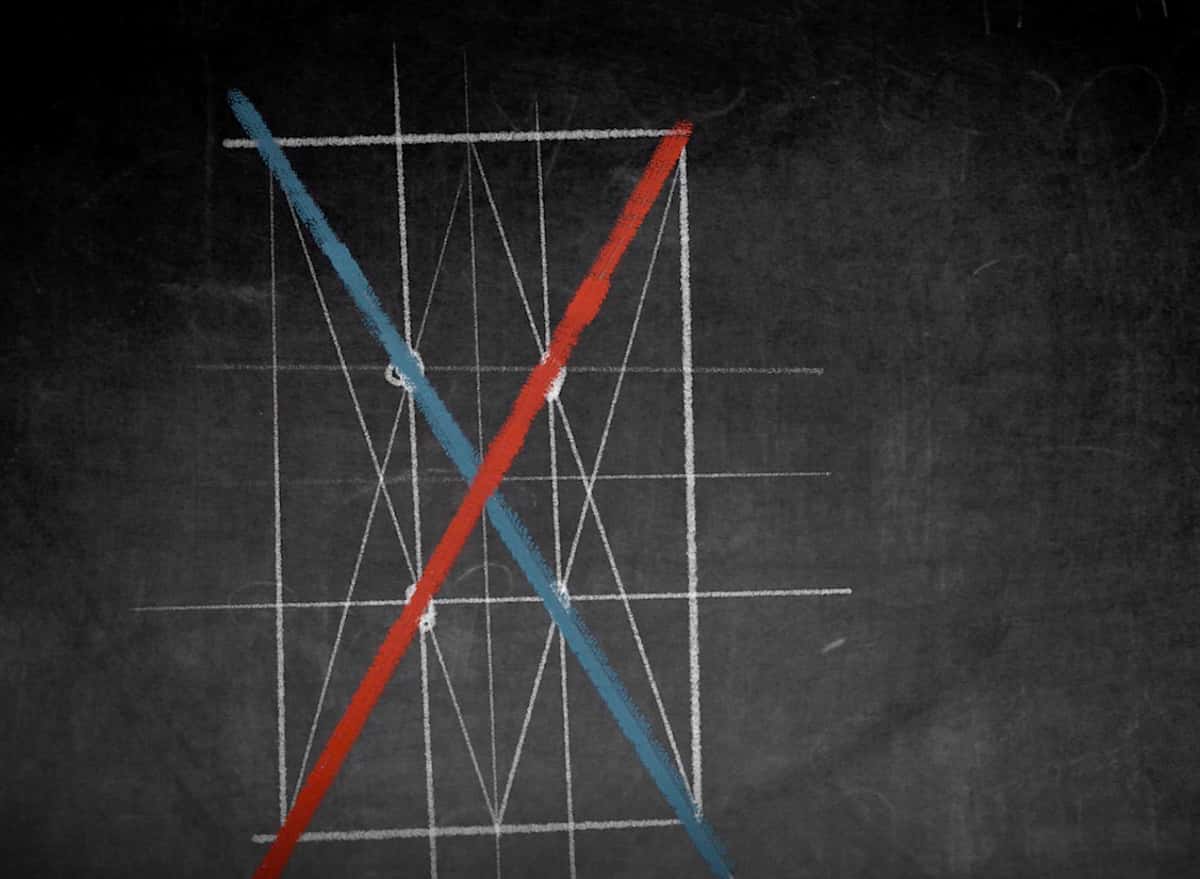
Baroque and sinister, the two diagonals
Every space carries two main diagonals, one called baroque and one called sinister, and neither of them is decoration. Baroque has nothing to do with the Baroque era. Barak simply means right, and in Hebrew that same word means blessed, which I have always liked.
Its twin carries the name sinister. Sinister means evil.
That matters.
Walk through a museum and look hard at real fine art. Good rising movement almost always sits on the baroque line. And when a painting shows you something rotten, some pervert doing something ugly off in the corner, that subject lands on the sinister line nearly every time, because those old painters knew something and they placed it deliberately.
I say this in class as a joke, and I also mean it. Design something on the baroque line for a person you love. If somebody has been unkind to you, hand them a very nice panel built entirely on the sinister line, say nothing about it, and let their brain do the reading.
Every hero needs an antagonist
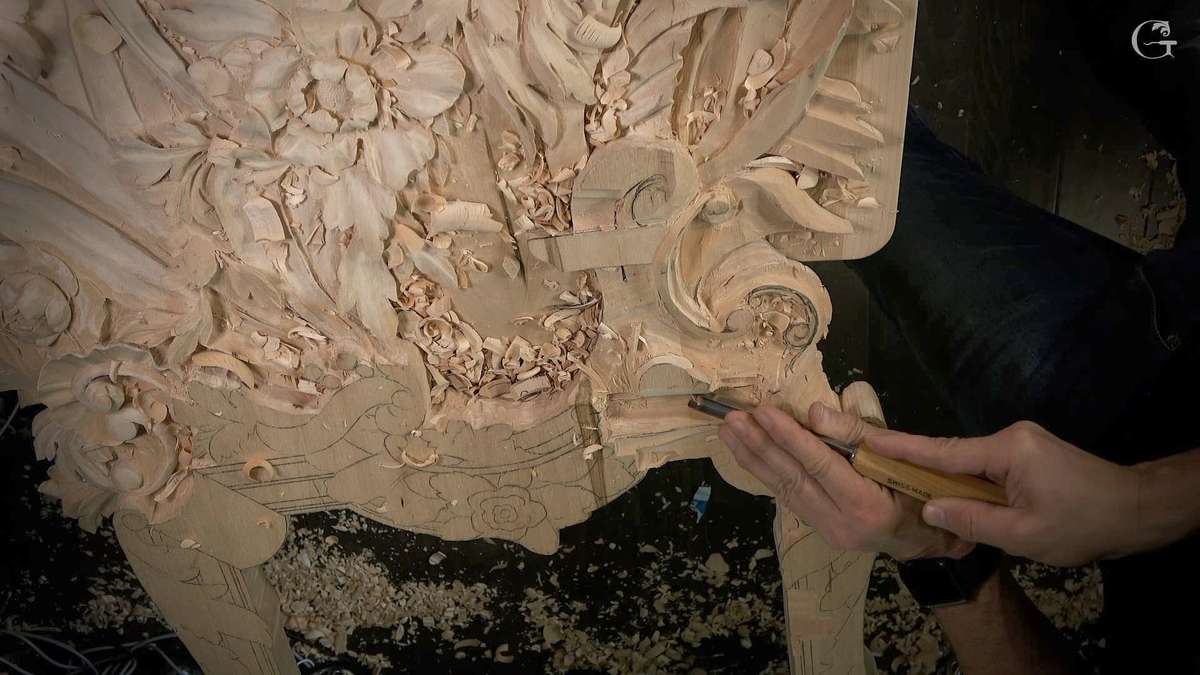
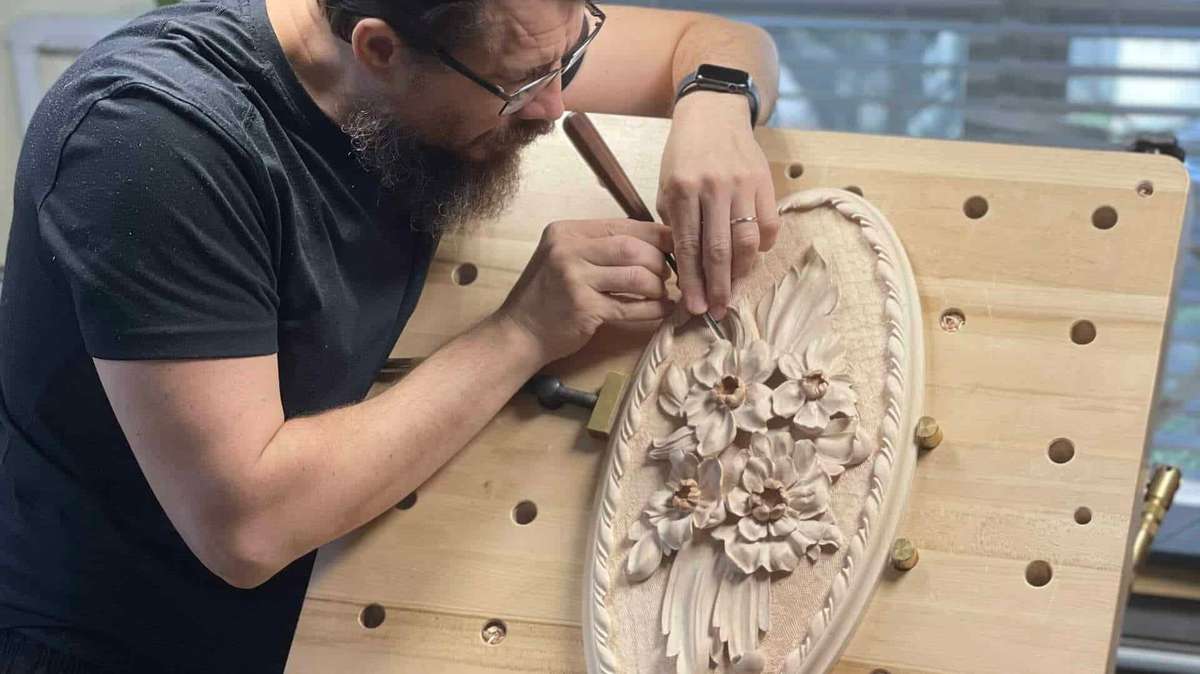
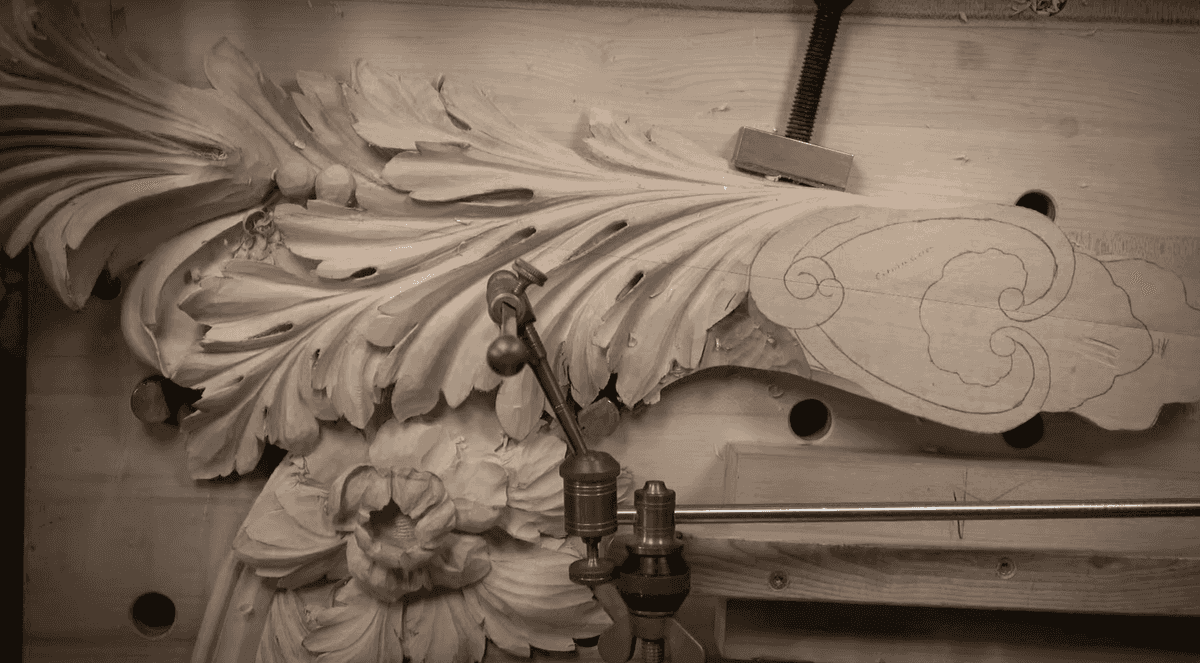
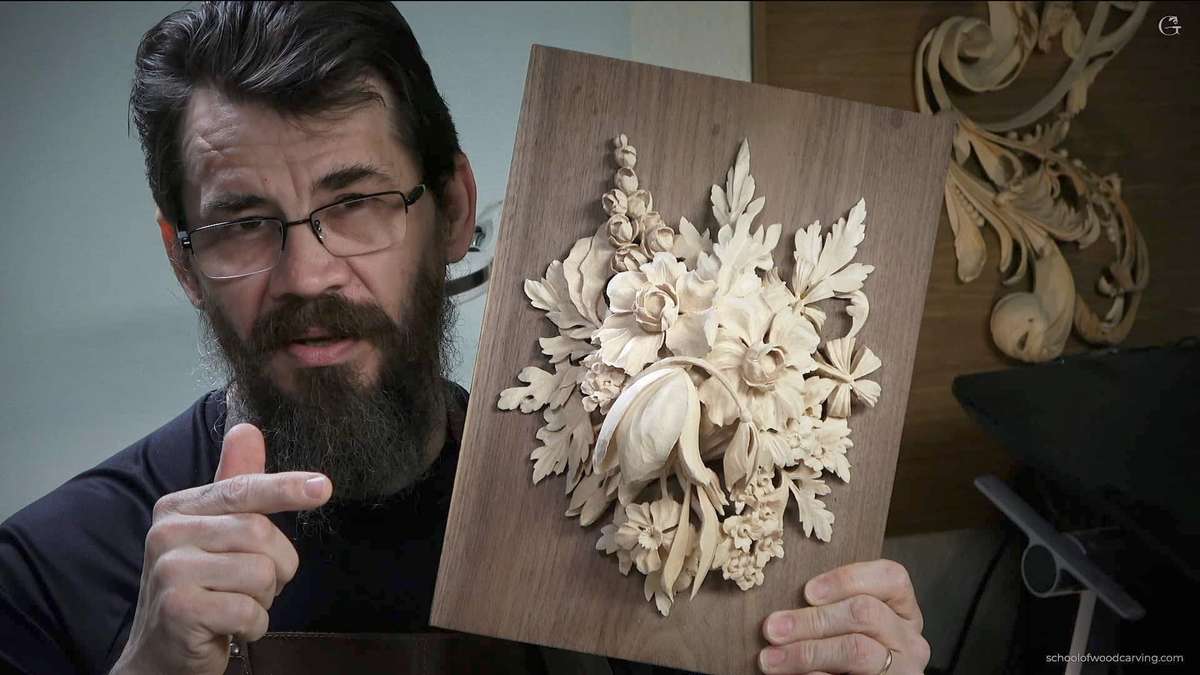
Each design needs one hero and one antagonist, and both of them sit on golden points that fight each other across the board. Study my carved peony panel for a second and tell me which flower is the boss.
Easy, the big one. Put golden ratio calipers on it and the center falls on 1.62.
We call it peony where I live, some folks say pee-OH-nee, and my students argue about the pronunciation in every single class.
Peony is my hero, chosen before the first chip came off the board.
Three golden points are still sitting there, though, and your brain keeps sliding over to look at them, which is exactly why a hero has to be given an antagonist.
Think about a movie. One good guy, one bad guy, and in Hollywood the bad guy is usually Russian. Spies, mafia, hackers now.
Inside a design the antagonist sits on a different golden point, and on my panel that job belongs to the swirl on the opposite side. We name that swirl the loot. Emptiness surrounds it, giving it a real pull of its own, a second superpower on the same board.
Whatever golden points remain will take sides. One of them backs the hero, the other backs the antagonist, and both stay smaller than the two main players so nobody gets confused about who runs the picture.
Masters called this the law of conflict, and nature runs on it.
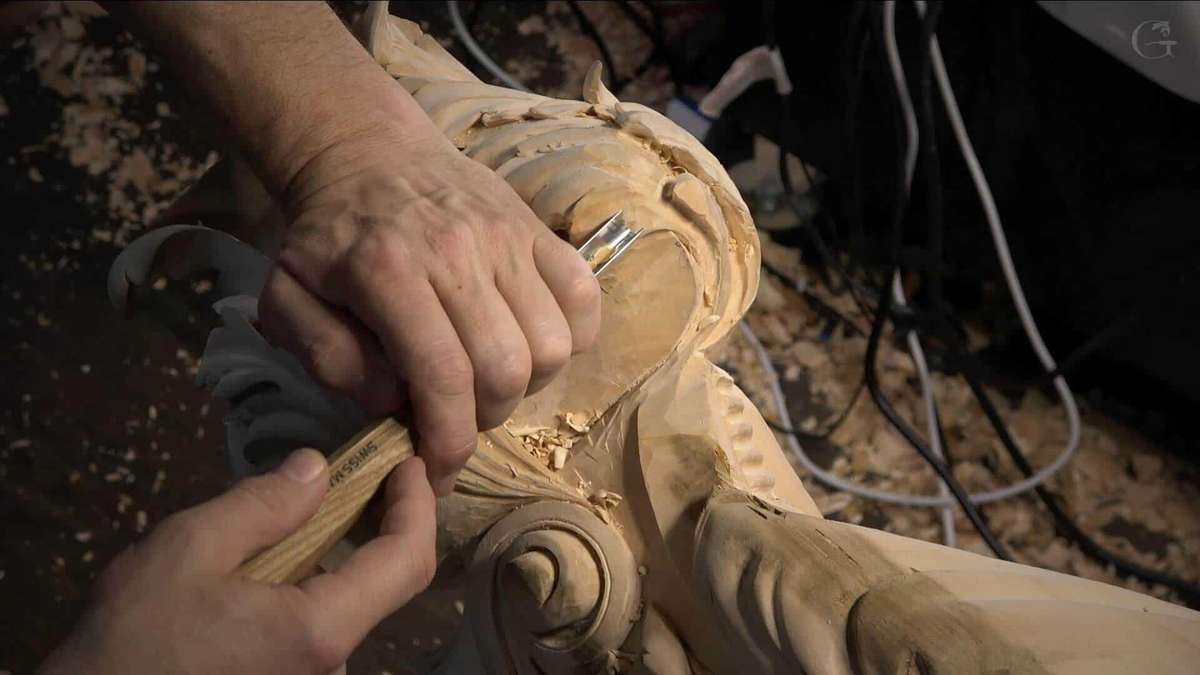
Spalted wood shows you the whole war
Do you know what spalting is? Fungus fighting fungus inside a log.
Look closely at a spalted board and you will see territory with a dark border drawn around it, exactly like countries on a map. Greenish here, pinkish there, sometimes blue.
Whichever fungus is strongest conquers more ground than the rest. He becomes the hero of that board, and the others surround him and hold their own lines.
Neither side crosses the other. That black line is the border.
While the fungus is still alive the border keeps creeping, so dry your wood hard before it goes on a lathe, or the war grinds on until the whole log rots to death.
"If there's no fight, there's no interest."
Without a fight there is no life, and nature has no other setting.
Does your design grow or does it fall?
One half of the board has to rule the piece, and the main movement either climbs or drops away. Upper half rules my flower panel, and I chose that on purpose, because that half had to be the empire.
Watch the main movement, how it starts low and then climbs. Alive, growing, not dying.
Follow the second movement now, which falls, and it does not simply drop straight down either, because the thing switches diagonal on the way and runs out along the sinister line, and that is precisely how it fights the main idea while still holding the whole panel together.
Two parties inside one design. Same country, opposite ideas.
Pointing in opposite directions is not actually required, because two elements can travel the same way and still fight each other for the whole trip, like two political parties here who both swear they want the very same thing.
The law of space, and why size is a lie
Space is not leftover material, because whatever surrounds a shape is what tells the eye how big that shape is. Empty ground does the talking.
Bill's wife walked outside yesterday and set fresh flowers by the door, and she did it because she wanted the house to look better, so those flowers are working as the space around the house.
Let me draw a boat on the board, nothing but an outline. How long is that boat?
Twenty five feet, said one student. Another said 16. Both wrong, and they were wrong because nothing surrounds the drawing yet.
Watch what happens when a tiny fishing boat goes in beside it. Suddenly my boat is 500 feet long, and nobody in the room says 25 anymore.
Then I sketch a much bigger ship behind it, and my boat shrinks back to nothing. Same lines, same drawing.
Chinese painters worked this out centuries ago. Huge mountains, endless trees, then one tiny house with one tiny man walking near it, and the message lands without a single word being spoken. Nature is enormous and we are a speck.
Back to the peony panel, and study what surrounds the main flower.
"What surrounds cannot be the same size."
Set a bigger flower next to my peony and my peony shrinks. Drop two very small ones into that spot and the whole panel goes off, it stops looking organic, and you will feel the wrongness before you can explain it.
My antagonist side is nearly bare, and the small country supporting it is barer still. Crowding flowers into that space would kill the design on the wall.
Yes, my panel is busy. I know it is busy, and I own that. Busy works fine as long as the busyness sits exactly where the golden ratio told you to put it.
Dynamic symmetry, never repeat a size
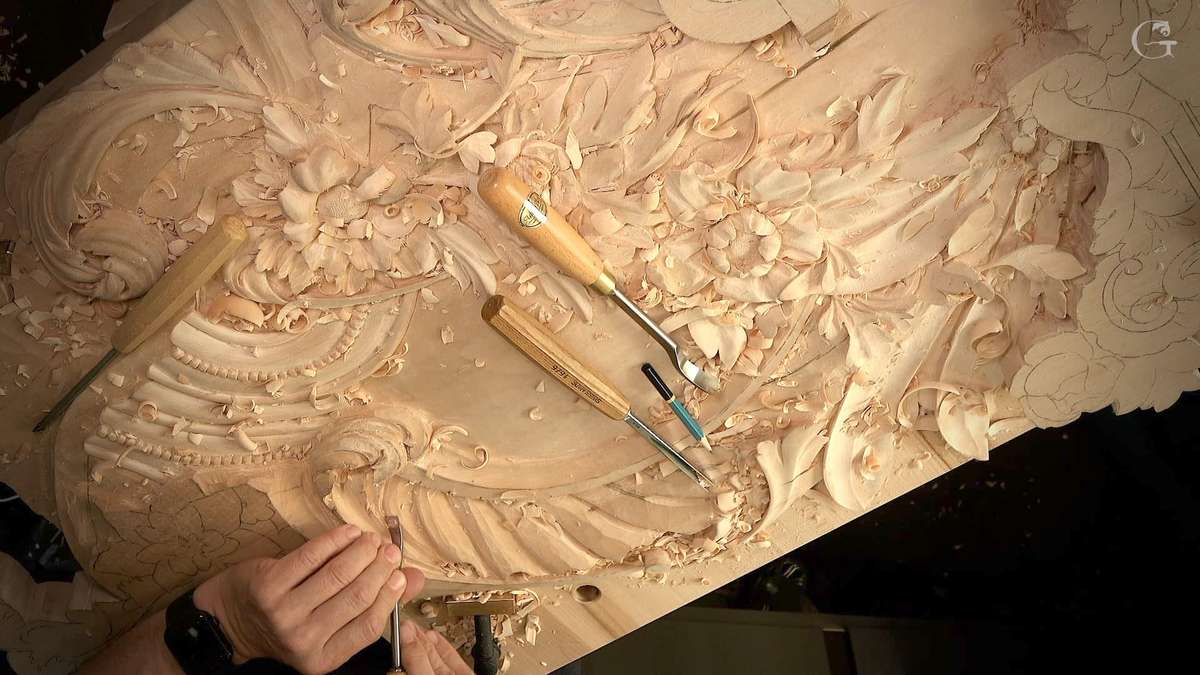
Nothing on your board should match another thing in size, and that rule has no exceptions living under it. Your leaves differ. Flowers differ, and even the little divisions inside one single leaf differ from each other.
Human faces prove it. The left eye is smaller than the right one, everybody walks around with an odd look, and dividing them by square units refuses to come out identical.
Carvers call that dynamic symmetry.
So when three flowers go on a panel, one of them leads and the others fall away in size behind it. Sometimes a flower of 20 millimeters goes in, about three quarters of an inch, then a smaller one, then one smaller still. I call those filler flowers. They fill the space and push the big one forward.
What does Fibonacci have to do with carving?
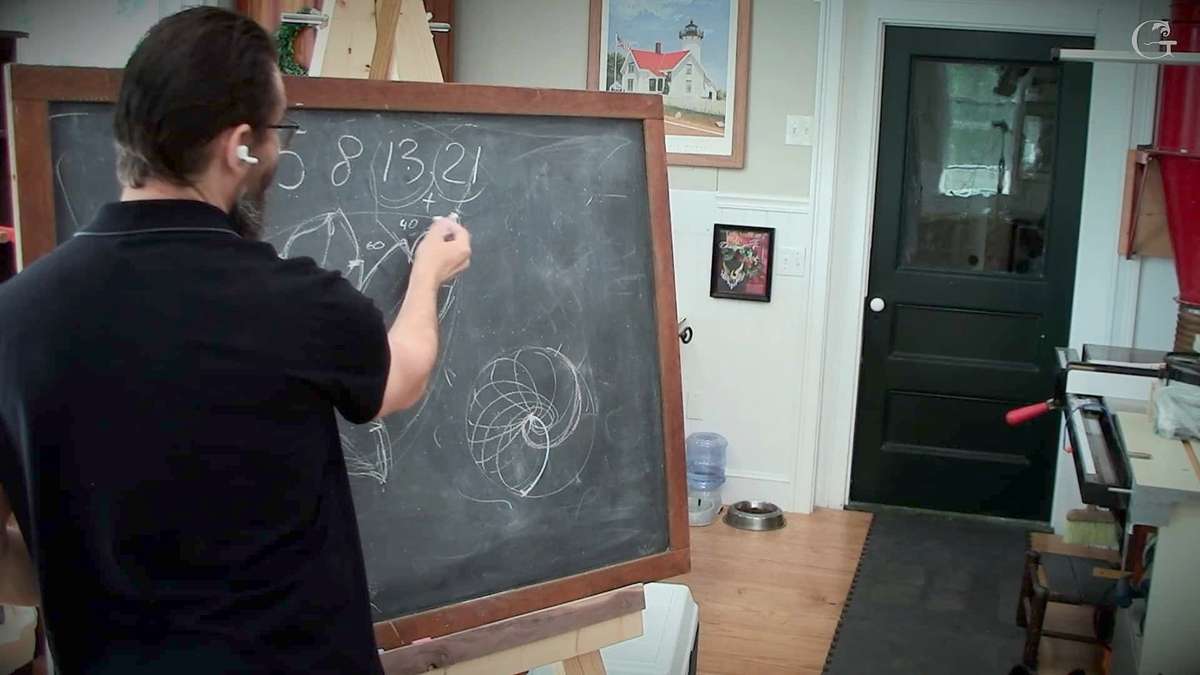
The sequence decides how many of a thing you carve, so petals, leaf divisions and repeats all land on 3, 5, 8 or 13. Fibonacci could not be simpler. One and one make two, two and one make three, then 5, 8, 13, 21, and on it runs forever. Always add the last two numbers.
Count the petals on a flower. Five, eight, thirteen. It lands on the sequence every time.
Cut open a sunflower head, count the seeds, and there it is again.
Notice how those seeds sit in the head. Their shape is a diamond, never a rectangle, and the rows spiral one direction while a second set of rows spirals the other way, and measuring one spiral against its opposite hands you 1.61 all over again.
Acanthus leaves work the same. Count the main divisions on any good old carving.
Three or five. Never four, and never six, because the sequence decides it.
Deeper in, every division holds three more, and their spacing falls on a golden cut.
Here is a detail almost nobody teaches. Draw the invisible frame around an acanthus leaf, make one side of it 10 inches, and the far side comes out at 1.618 of your unit. That hidden frame is the whole reason a good leaf looks calm instead of nervous.
A student once asked which book covers this. George Walker and Jim Tolpin wrote By Hand and Eye, and I think it is a good book, yet it still does not carry the sequence down to this level. Very few books do, and most masters simply never wrote any of it down.
Italian division or French division
Inside the leaf you have to choose your split. Take the center line of a division, and Italians push that split so one part reads 60 while the rest reads 40. Frenchmen flip it the other way around.
Both choices stay inside the golden ratio, both of them look beautiful, and they say completely different things to the eye.
I follow the Italian logic.
Arabesque, and why there are no T stops
No line in a design is straight, and every one of them has to connect to every other. This law is short to say and hard to obey.
"Nothing in nature is straight."
Rhino is what I draw in, and every line in Rhino is called a curve, even a perfectly straight one, which has always made me smile.
Look at my flowers and find me one straight line. Not one.
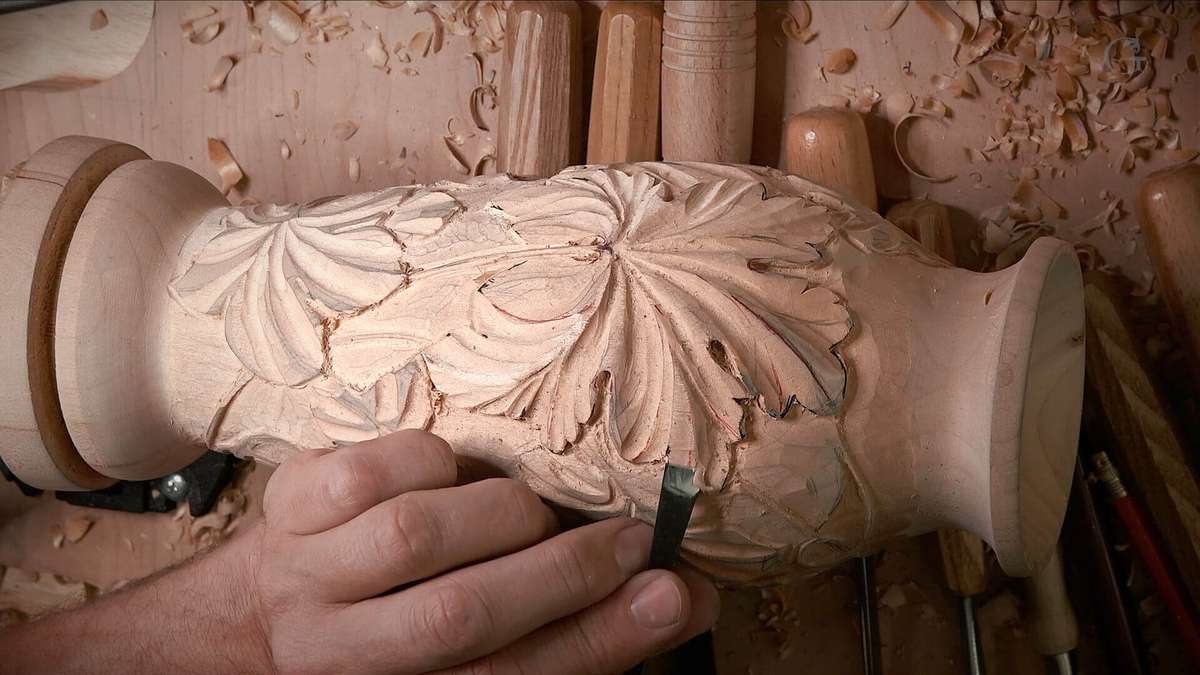
Swirls end every movement, and they bring it back around. Follow any stem past the place where it disappears behind a leaf, and it still returns to the big picture, and when a curve refuses to connect I change the curve rather than argue with it.
Then there is the T stop. When one line dies against another at a right angle the brain reads it as a mistake, and it reads that way even when the crossing happens out in empty space where your eye sees nothing at all.
Now the letter S. See the arc I cut inside that acanthus section, the one carrying the main movement forward and quietly telling the eye where it is supposed to go.
Because of that single S, I know the leaf is growing. No stem needed. Any leaf, any style, and the S does the same job every time.
Rhythm, and why size does the work of volume
Repeating the same movement at a different size is what rhythm means, the way a musician plays one phrase at different volumes. Repetition is easy to say and very easy to get wrong.
I have one main arc running along the baroque diagonal, and that arc has to repeat somewhere else on the piece, the same movement in a different place, never parallel to the first, and it has to taper out of the same origin point, because in nature everything grows from one place.
Think about music for a second. Pum pum pum, pum pum pum. The same phrase keeps coming back, but a player leans hard on some notes and barely touches others, so volume does all that work.
Wood gives us no volume knob. Size changes instead.
Therefore the same arc repeats five times, and every one of them ends up a different length. Measure one curve against the next and you land near 60 and 40 again. Check the next pair and you land there again.
Five repetitions. Fibonacci. Not one matching size among them.
Flowers on my panel repeat too, and I never cut two of them at the same size, and if one side gets eight then the other side gets five. Depth comes out of that difference.
"Repetition is a mother of knowledge."
We said it that way back in Russia, and I will run the whole list past you again in a minute, in order.
Why does classical work still look right after 500 years?
Classical work holds up because it was built on these laws, and I have never seen a billionaire's house furnished any other way. I work for very wealthy people. Not millionaires. Billionaires.
Never once have I walked into a modern house at that level. Maybe I have not seen every house. But I have walked through a lot of them, and the answer is always classical.
You find columns whose form is 2,500 years old. Arches just as old. Somewhere in the place there will be a Corinthian capital.
Modern and glossy shows up in the beach condo they visit one week a year. Where these people actually live, it is classical.
Yesterday I wore a shirt with a brand across the chest, and I built that man's library. You probably washed your kids last night with a shampoo whose owner I have also carved for.
Inside one of those houses I found two carved staches on the original woodwork. Only two carvers in all of history became famous by name. Grinling Gibbons is one, and before him, back in the 15th century, came Tilman Riemenschneider of Germany.
Those two staches were Riemenschneider's own work, and I got to stand there in a private house and look at the real thing.
Fifteenth century pieces still look beautiful. Sixteenth. Seventeenth. Objects two thousand years old still hold up just fine.
Set that beside modern art now. A banana taped to a canvas sold for 127,000 dollars. Some man in New York works in chewing gum and sells for two million. Somebody hangs a blank white canvas and calls it a cow, and when you ask where the cow is, she is home, and the grass is gone because the cow ate it, and now the cow is gone as well.
Emperor's clothes, all of it.
Design is a law, not a taste
Laws you can measure with a caliper run a design, not taste, and that is why express yourself is such bad teaching. When my daughter was small I took her to a fine art teacher and paid good money for the lessons, because I believed then what I still believe now, that you find a master, you serve as an apprentice, and after years of that you become a professional.
She lasted maybe two weeks.
Home she came one afternoon, and I asked to see her work, and she showed me a few splashes on a sheet of paper, so I asked what the teacher had actually taught.
Express yourself. Just put something on the paper. Express yourself.
There is no such thing as express yourself, baby.
Build on the laws of creation and you are expressing the law itself. Throw those laws away and you are expressing ego, which is a completely different position to stand in.
Calling the designer a Creator is something I do on purpose, because building all of this without logic is impossible. Spacing between stars falls on Fibonacci. Seeds in a sunflower. Even the letters of the Hebrew alphabet.
Straight, plain furniture is everywhere you look these days. Nothing in nature is straight.
Ten questions I ask before I carve
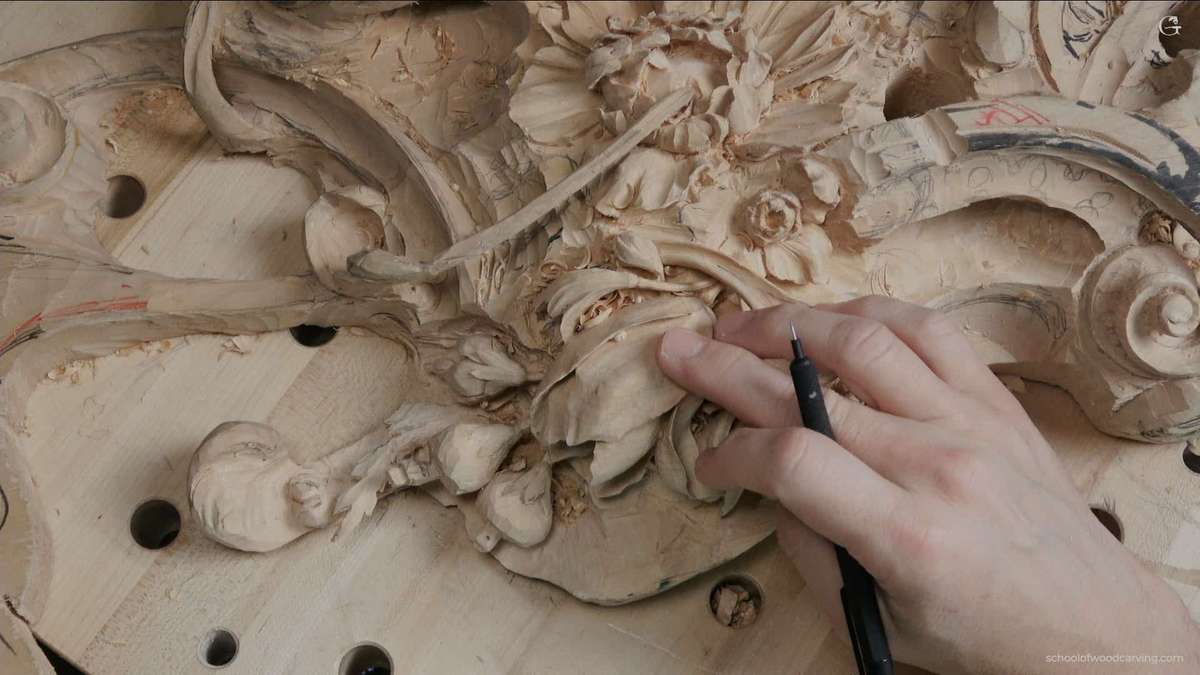
A blank board is sitting in front of you. Work through these in order.
Direction. Left to right, or the other way? Who is your client, east or west?
Diagonal. Baroque or sinister?
Grow or fall. Which half dominates the board, and does the main movement climb or drop away?
Golden points. Four of them are waiting. Which one carries the main idea?
The hero. One hero, never two.
The antagonist. Which of the remaining golden points fights your hero?
The supporters. Last two points pick sides and stay smaller than the players they back.
Space. How big are the shapes surrounding your hero?
Arabesque. No straight lines, no T stops, and everything connects to everything.
Rhythm. Repeat the movement at a different size, on Fibonacci counts.
Answer those ten and the picture is already standing in your head. After that you can carve acanthus, carve flowers, carve whatever you want.
Frequently asked questions
What is the golden spot in a carving design? The golden spot is the place on your board where the eye wants to land. It sits at roughly 62 percent along a line, or 60 percent if you round it off for shop work. Put your main flower or your main leaf there and the design reads as beautiful with no explanation.
How do the baroque and sinister diagonals differ? Both are diagonals of the space you are working in. Barak means right, and the baroque diagonal carries the good, rising movement. Sinister means evil, and that diagonal carries the falling or darker idea. Old master painters put ugly subjects on the sinister line deliberately.
Why does one board have four key points? Each of the four edges gives a division, and the crossings produce 4 golden points. One becomes the hero, one becomes the antagonist, and the two that remain support them at a smaller scale.
What division count belongs on an acanthus leaf? Three or five, never four and never six, because the count follows the Fibonacci sequence. Inside each main division you usually cut three more, spaced on a golden cut.
Do I need to calculate every measurement? You do not. A pair of Fibonacci Gauge: A Golden Ratio Measurement Tool - Golden Mean Calipers lets you check the spacing as you draw. Pushing the accuracy further will make the piece better and will also cost you time, and that trade is yours to make.
Does any of this apply outside wood carving? Painting, furniture, architecture and music all run on the same numbers. The main point in a piece of music tends to land on the same 60 and 40 split.
Shall we carve?
Nobody handed me these laws in a book. My master gave them to me one at a time, the old way, apprentice to master, and most of them have never been written down anywhere at all.
Now you have them. Go find the golden spot on a scrap of basswood.
Then draw. Carve after that.
Full course: Principles of Design in Wood Carving
Alexander Grabovetskiy is a master wood carver and sculptor, named International Woodcarver of the Year, and the founder of the School of Woodcarving, a 501(c)(3) non-profit. Tuition supports orphans and widows.
Filed under
- 3D design for wood carving projects
- 3D modeling for wood carving
- 3D relief carving
- Alexander Grabovetskiy wood carving school
- Aspire CNC wood carving
- Blender for wood carving
- CNC carving projects
- CNC wood carving design
- digital sculpting for wood carving
- how to learn 3D design for wood carving
- learn 3D design for wood carving
- learn wood carving design
- relief carving design
- VCarve for wood carving
- wood carving classes
- wood carving design software
- wood carving instruction
- wood carving patterns
- wood carving project design
- wood carving templates
- woodworking design software