
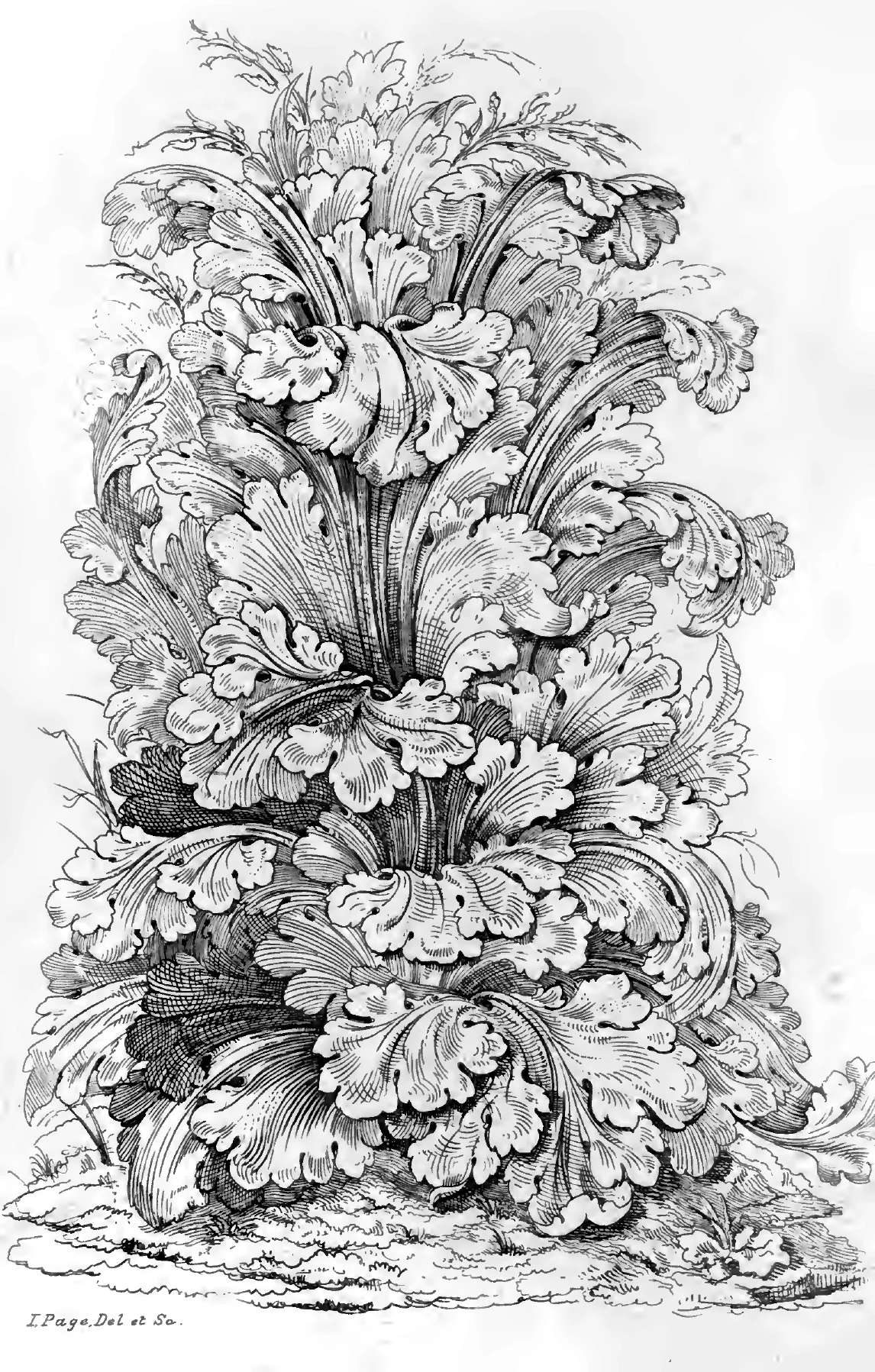
July 29, 2026
By Alexander Grabovetskiy — Master Woodcarver · Founder, School of Wood Carving · 20 min read
Acanthus wood carving: draw the leaf before you touch the gouge
By Alexander Grabovetskiy, master carver, International Woodcarver of the Year · Updated July 29, 2026 · 18 min read
Quick answer: Acanthus wood carving is relief carving of the stylized acanthus leaf, the foliage that caps a Corinthian capital and keeps showing up in Baroque and Rococo ornament. You build the leaf on one center line, with a base half as wide as the leaf is tall, six divisions across that base, and a stalk running between every pipe.
Get that skeleton right and the gouge work gets easy. Skip it, and no amount of sharp steel saves you.
Most people meet acanthus the hard way. You find a photo of a capital you love, you clamp a board, and forty hours later the thing on your bench is busy and dead and you cannot say why. I got lucky and met it the other way around. At sixteen I was the only apprentice of a fine-art master in Russia, and the first thing he made me understand was that design is not drawing on paper. It is the laws of space, rhythm and repetition, and thinking like the tool in your hand.
So the fix is older than both of us. A London draftsman named I. Page wrote it down for students in the 1840s, and it comes to four rules with a compass and a pencil. Learn them and the same leaf comes out right at two inches or four feet, in Greek or Roman or Byzantine dress, flat on a panel or rolling around a molding.
Below: where the leaf came from, the four rules with the original plates, why the stalk matters more than the curl, what wood to use, and the nine questions students ask me most.
Key takeaways
Draw the leaf before you clamp a board. The construction takes four rules and scales to any size.
Base width is half the height. Six equal parts across the base, five parts and one more fifth up the vertical.
Between every pipe runs a stalk, which I. Page calls the stamina. That stalk is what makes a leaf look alive.
Shadow lives in the eyes, the small hollows where lobes meet. Shallow eyes read flat from across a room.
American basswood. Construction pine tears out in exactly the places acanthus needs to be sharp.
Greek, Roman, Corinthian, Byzantine and 1903 modern are five different leaves on one skeleton. Learn one cold before you touch the next.
Those numbers are not mine. A man named I. Page wrote them down in London for students at the School of Design, and Bernard Quaritch reprinted his book in 1886 with over two hundred wood-cuts and fifty-three copper etchings inside it. I have a scan of that book open on my bench right now. Somebody at the Reese Library in California penciled the number 66613 inside the front cover a long time ago.
Where did the acanthus leaf come from?
It came off a grave at Corinth, and Vitruvius wrote the story down about two thousand years ago.
A young woman died at Corinth. Her nurse gathered the little things the girl had loved, put them in a wicker basket, set the basket on the grave, and laid a roof tile on top to keep the rain out. Under that basket was an acanthus root. Spring came. The leaves pushed up and wrapped themselves around the basket, and the tile made them curl back on themselves at the top.
A sculptor walked past. Vitruvius calls him Callimachus. Page spells it Calamacus and says the Athenians nicknamed him the Industrious one because of how fine he worked marble. He stopped, looked at that accident, and carried the shape home. Later he capped his columns at Corinth with it.
So the Corinthian capital is a grave marker that a plant climbed.
I think about that more than I should. A girl's basket, a broken tile, one man paying attention on a walk. Two thousand years later half the courthouses in America wear her leaves and nobody inside the building knows her name.
Is the carved acanthus the same plant you see in a garden?
No, and this trips up more students than any tool problem. The carved leaf is an invention with laws behind it; the garden plant only started the argument.
The plant is Acanthus mollis. Old English books call it bear's breeches or brank ursine. Page also mentions the spiny kind, which people called dock leaf. Go look at a real one in a nursery. The thing is soft, floppy, and honestly kind of a mess. Nothing about it says architecture.
What Callimachus did was harder than copying. He took a real plant and gave it laws. Rhythm, repetition, and a grid you can build on at any size, whether you are working a two inch molding or a four foot capital. A plant sits on one side of that line and an ornament sits on the other, which explains why every carver who sets out to invent a better leaf ends up back at this one.
Page says it plain. Many men tried to replace this foliage, and a substitute has never been found where such freedom and beauty exists. Some attempts are good. They all drift back into the original shape anyway.
The four rules for drawing an acanthus leaf
Four rules build the leaf, and they come straight out of the 1886 book in the order Page gives them. Get paper. You do not need wood yet.
Step 1. Set the height and the base
Draw one vertical line, a to b, as tall as you want the leaf. Then draw your horizontal base line. Make it half the height. Page tried other proportions and settled on half. A leaf two feet tall gets a base one foot wide.
Step 2. Divide the base into six
Six equal parts across that base line. One part out from the center line on each side gives you where the cone shapes start. Those cones become the pipes, the tube shaped sections of the leaf, and in Page's own vocabulary they are pistules.
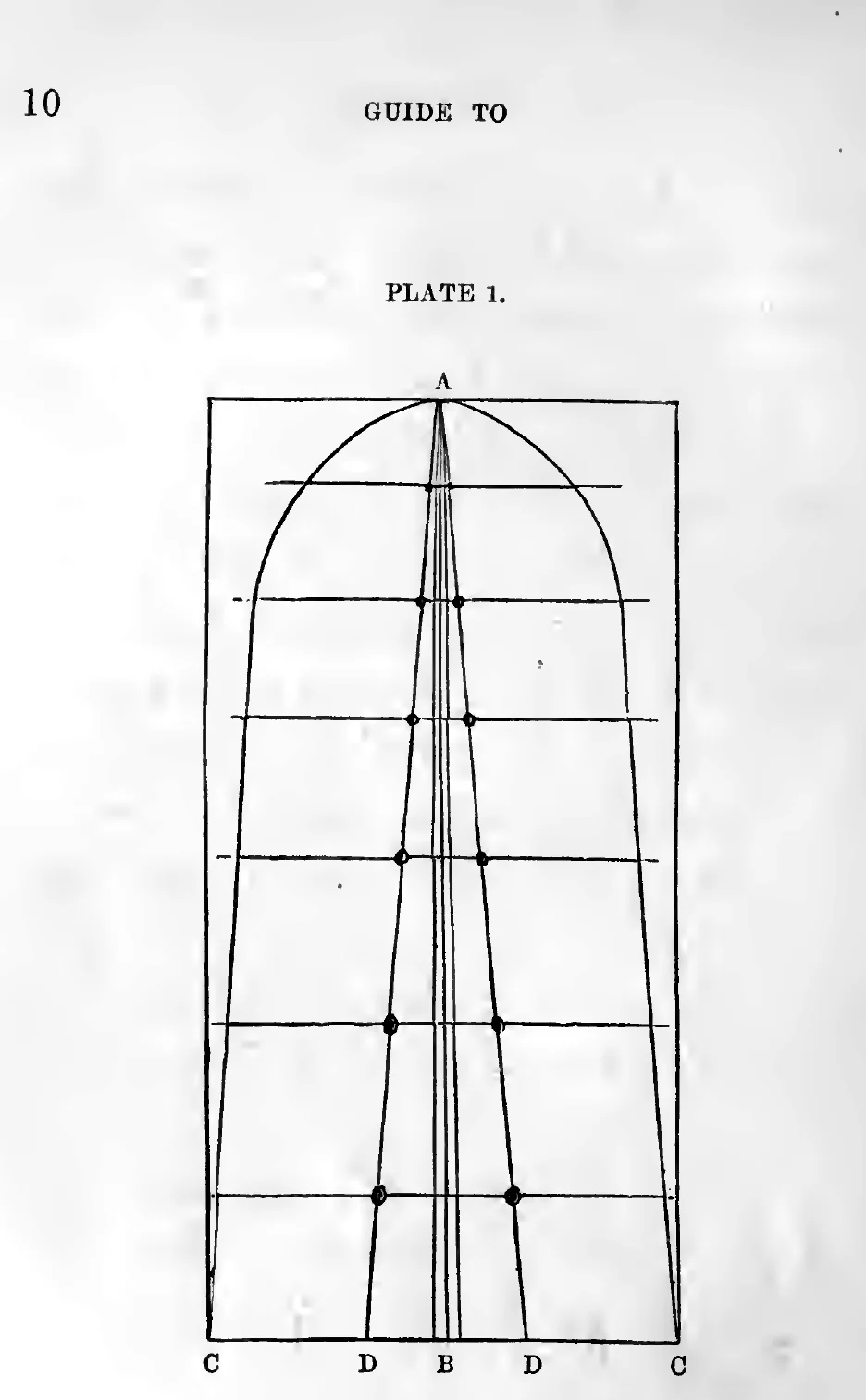
Rules one and two, drawn out. A at the top, B at the bottom of the vertical, C to C is the base at half the height, and the two D marks are one sixth out from center. Nothing here is decoration yet.
Step 3. Find the springing point for the head
Divide the vertical line into five equal parts, and then one more fifth. That mark tells you where the head starts, meaning the round curling part at the top. Draw a line there parallel to your pipe line. In his second plate he divides the vertical into four instead and shows two springing points, so the number moves with the job. Learn the first one cold before you play with it.
Step 4. Split each lobe into three, then three again
The first division of three tells you where the center stalk ends. That stalk is the stamina, and it runs between every pipe, like this: pipe, stalk, pipe, stalk, pipe, stalk, all the way down into the stem. A second division of three finishes the leaf.
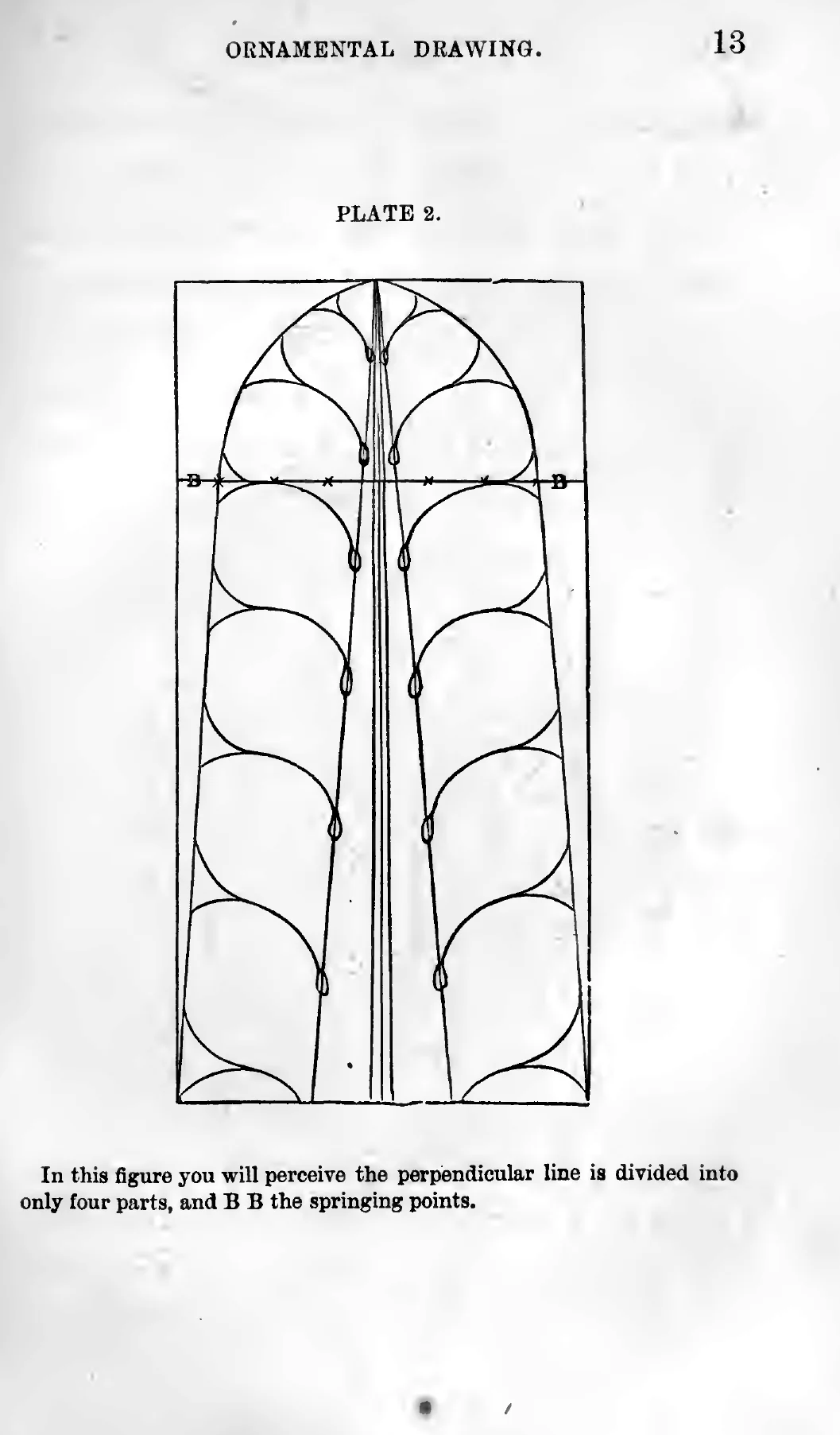
The same leaf with the lobes blocked in. Page cuts the vertical into four parts on this one instead of five, and the two letters B on the crossbar are his springing points. His own caption says so, under the plate.
Four rules, and you have the whole foundation. Everything else in Baroque, in Rococo, in Grinling Gibbons, in a Chippendale mirror frame, is a variation sitting on top of those four moves.
Why does the stalk between the pipes matter so much?
The stalk carries the direction of growth, so it is the one line that decides whether your leaf looks alive or dead. Page writes a single sentence about the stamina that I have been quoting to students for years. On this alone depends the freedom of the foliage.
The pipes are not what does it. Neither is the curl. It comes down to the stalk between them.
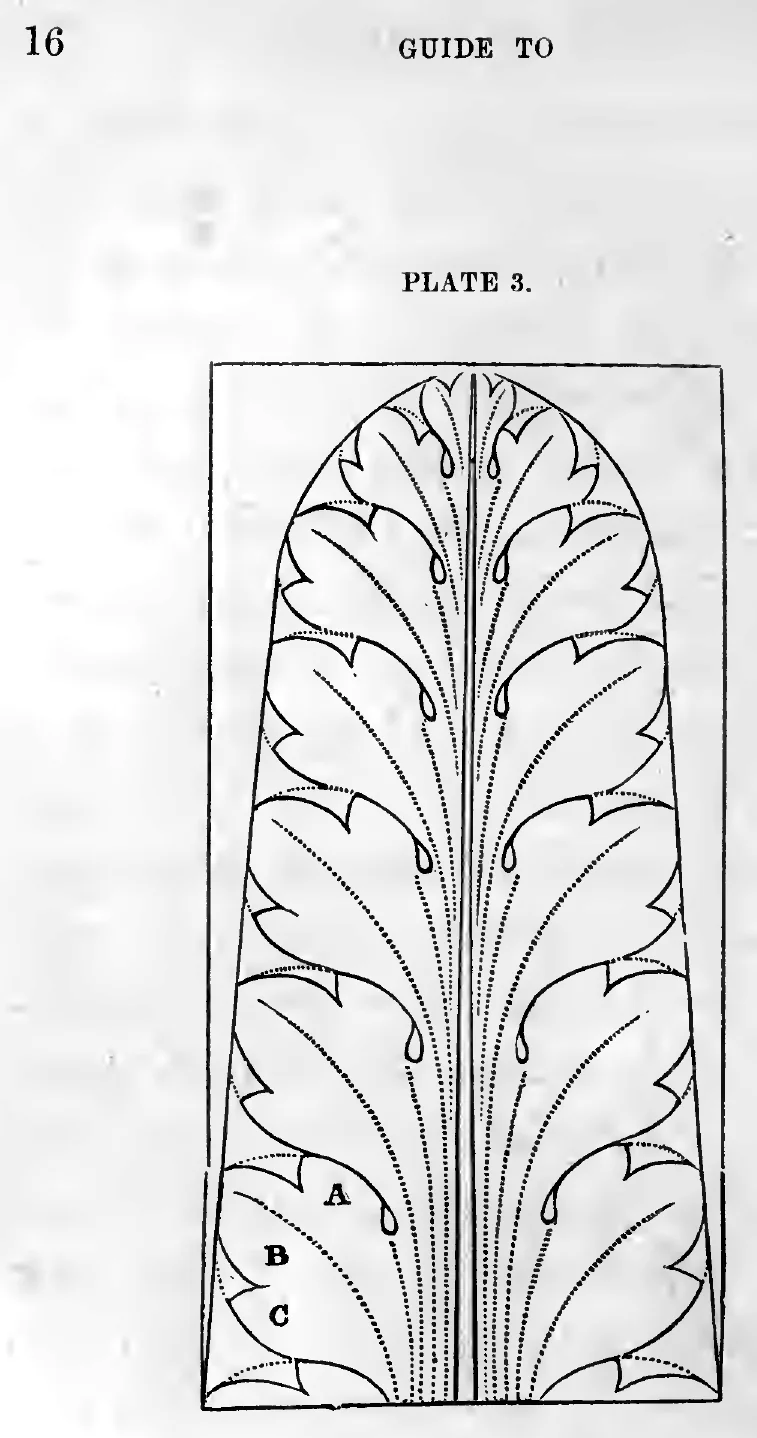
Dotted construction lines still showing on plate 3. Follow any stalk down and it lands in the same stem. That is the thing Page says the whole freedom of the foliage depends on.
The reason is botanical, and Page spells it out. A leaf is part of a plant, and a plant grows from a root, so every fiber has to come out of the base and travel somewhere. Trace your stalks back to one origin and the eye follows them without being told to, and the leaf breathes. Draw pretty pipes and then guess at the stalks, and you get a shape that looks fine on paper and dead at six feet.
I have watched good hands make that mistake for a whole year. Clean carving. Crisp gouge cuts. Still lifeless, and they cannot say why, so they start blaming their tools.
It is the stalks. Almost always the stalks.
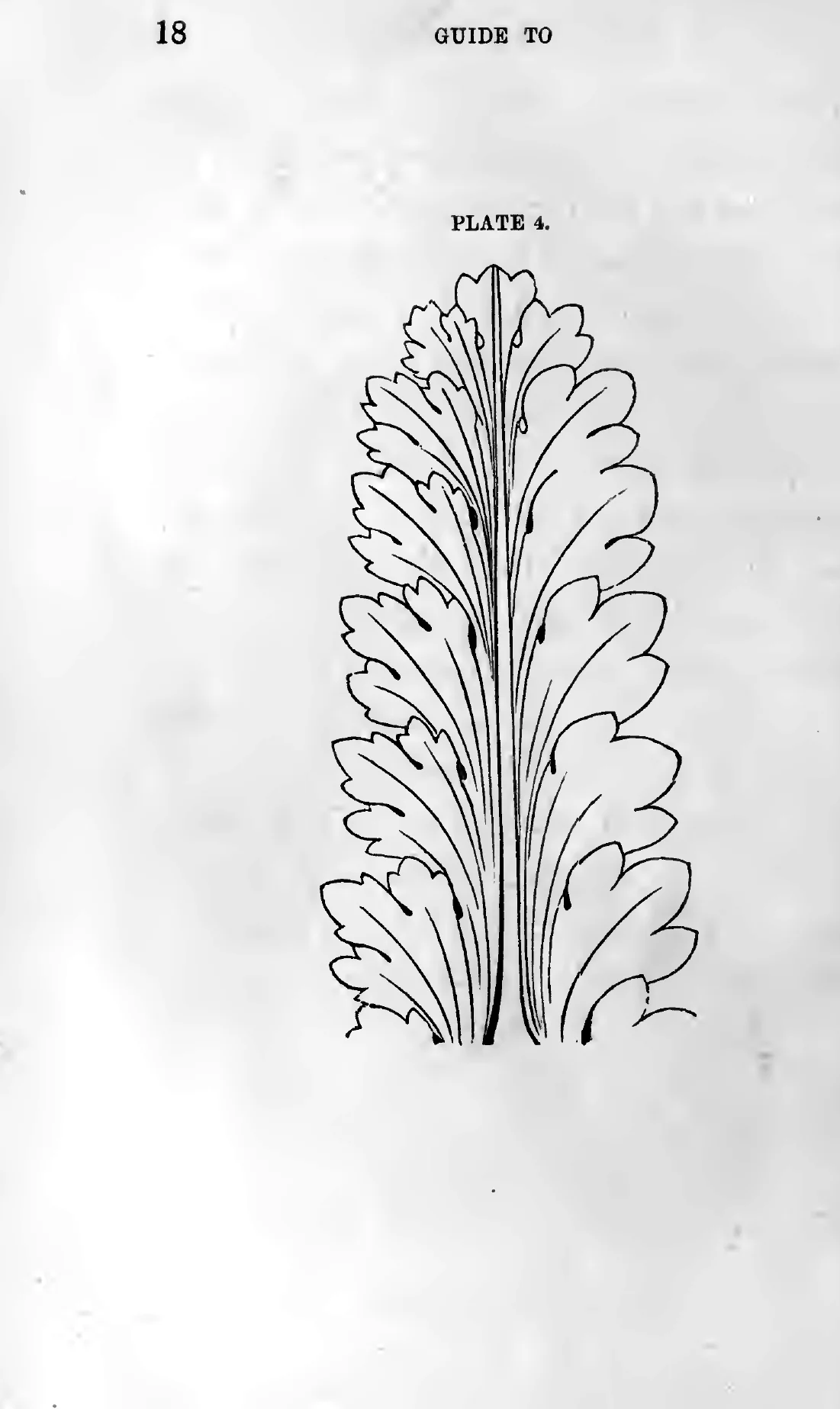
Every guide line stripped away on plate 4, and what is left is a leaf. Same drawing as the one above it. The rules got you here.
How does light turn a flat leaf into a deep one?
An eye is the small hollow where two lobes meet, and the shadow it holds is the only depth a carved leaf really has. Carvers argue about pipes and curls, but the eyes are what your work reads by from across a room.
Wood has no color contrast to help you. You are not painting. Every bit of drama in a carved leaf comes from a shadow you cut on purpose, which means you are carving darkness as much as wood. A shallow eye gives you gray. Cut it deep and undercut it and you get black, and black is what makes a leaf jump off a panel.
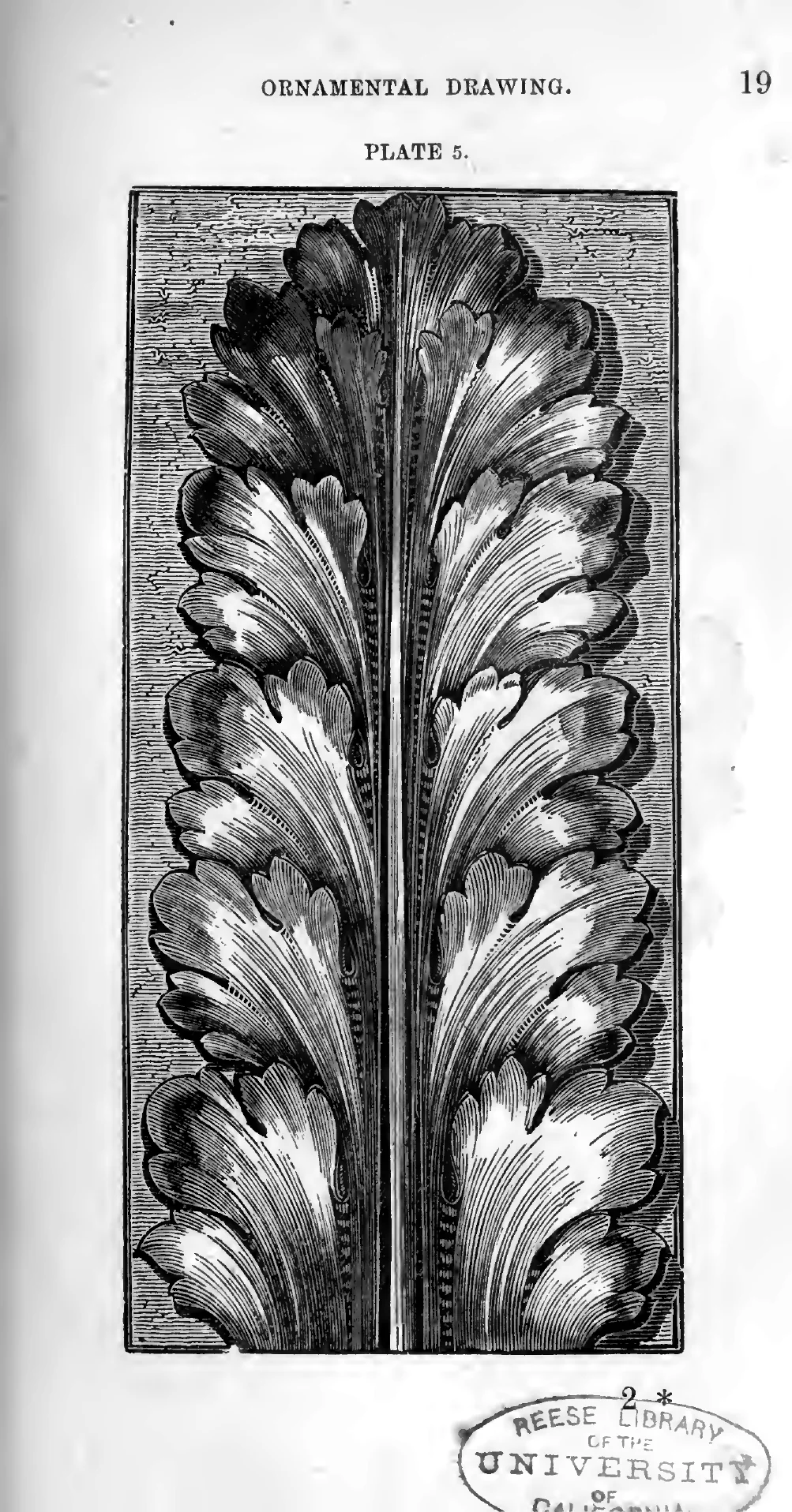
Modeled at last, on plate 5. Look at the little black notches where the lobes meet. Those are eyes, and they are the only reason this reads as deep instead of flat. The library stamp at the bottom came with the scan.
So before you cut a single eye, find out where the light in that room comes from. Side light across a panel does most of your work for you. Flat light from the front kills a leaf no matter how well you shaped it, and that is worth knowing before you spend forty hours on a frieze that will hang above a window.
How do you run acanthus around a scroll?
You run it off one continuous stem, with every leaf and every fiber springing from that stem and nothing left floating loose. The single leaf was your alphabet. Now you are writing with it.
Page devotes a whole chapter to what he calls starting points, and he insists that every one of them has its particular use, name, and character. Some sit in a basin, others in a cup, and a few spring straight off a stem with nothing under them at all. He knew that sounds fussy. His argument is that a scroll with the wrong start reads as an accident, and once you see it, you cannot unsee it.
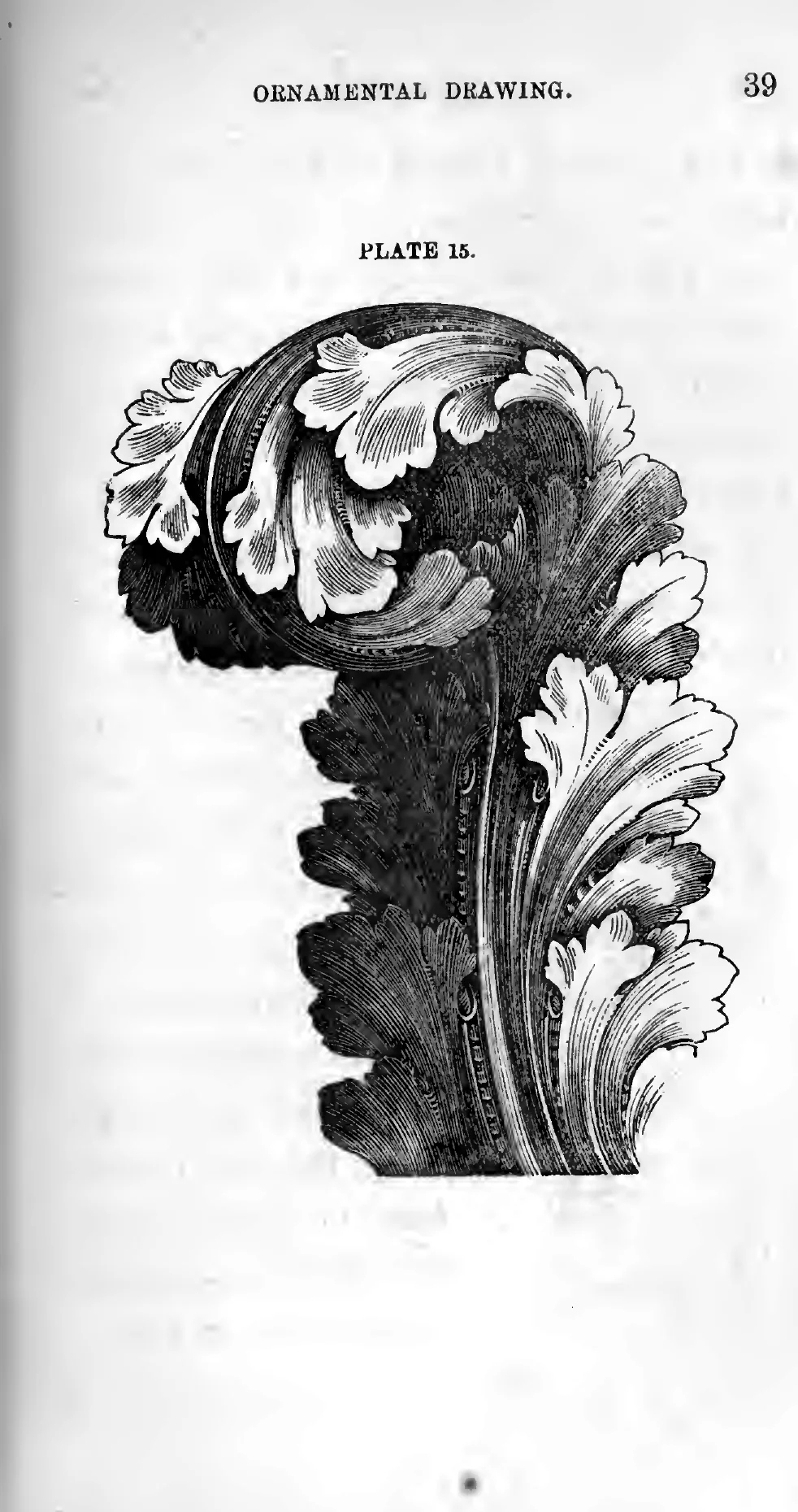
A bent leaf on plate 15, which Page calls the first variation from the perpendicular. The stem still reads as one line under all that rolling.
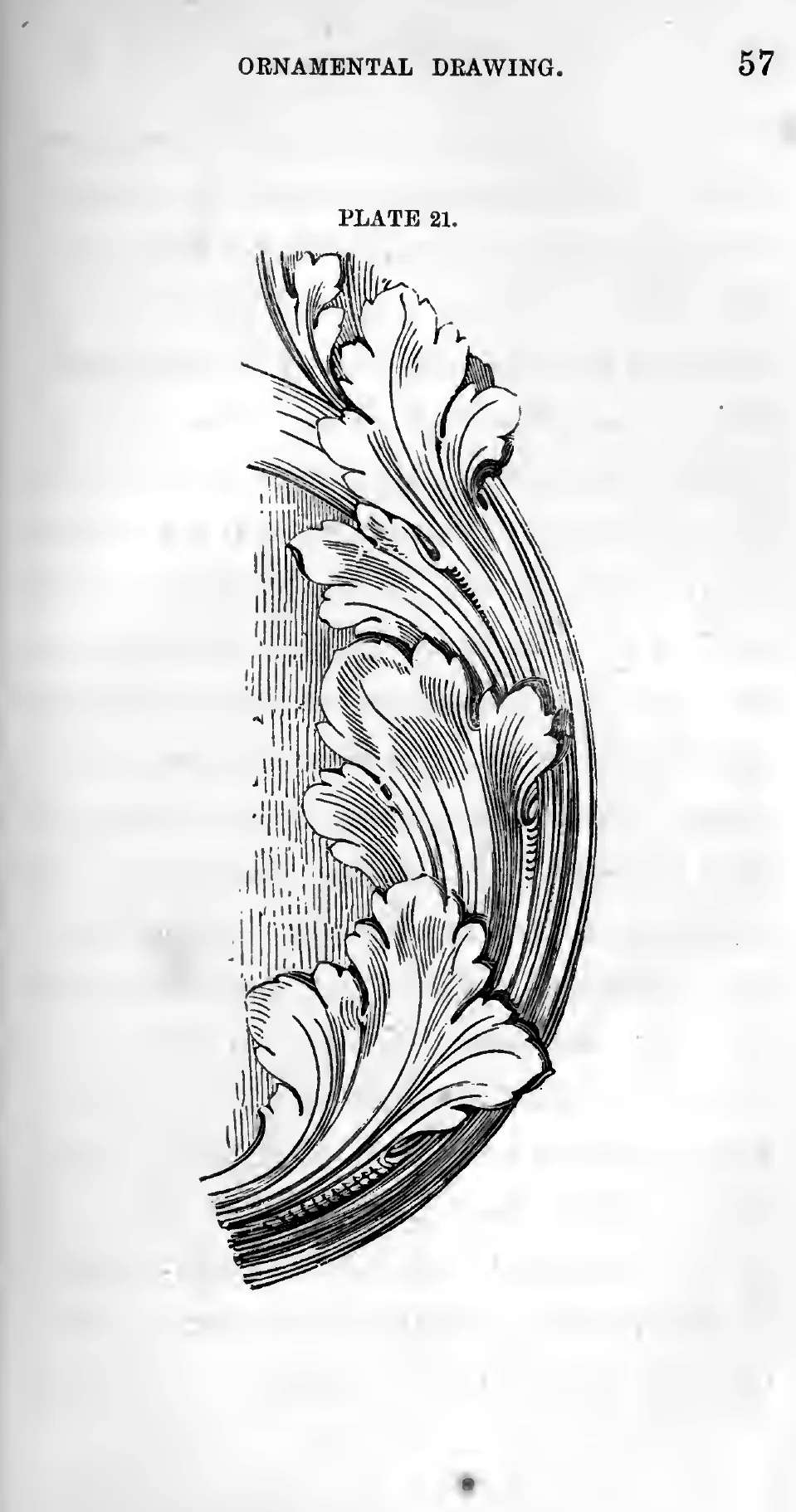
Plate 21 is the one Page singles out for running scrolls and frieze borders. His words: continue that figure on its own and it makes a good running scroll, and it leans Roman rather than Greek.
He also tells a short story I like. He once knew a young man who called himself a designer, and who really was original, because his talent was jumbling every kind of foliage into one mass. Perfectly original, Page says. Very ridiculous.
Same rule as the single leaf, then, only bigger. One continuous stem, every branch and every fiber arising from it, no leaf floating unattached. Get that and your scroll flows. Miss it and you have a pile of nice leaves on a board.
Why does good carving turn to mud when you hang it on a wall?
Distance changes everything: a frieze twenty feet up needs fewer cuts, deeper shadow and bigger masses than the same design at arm's length. The bench lies to you. Nobody ever looks at your work from the bench.
Page saw this in the 1840s and it made him angry. Designs worked to the greatest nicety, he says, then set up high, where they turn into a confused jumble, and the architect takes the blame for it. A frieze twenty feet up needs fewer cuts, deeper shadow, and bigger masses than the same design at arm's length.
So answer three things before you start. How far away will the person be standing? Where does the light come from? Will this live under a ceiling, on a door, or in somebody's hands?
Answer those and half your design decisions are already made for you.
Old carvers knew this so well they broke their own rules for it. Rome had the Torre de Nerone with columns six feet across, which Page mourns as one of the rarest specimens of antiquity, torn down about a century and a half before he wrote, out of pure greed. Over at the Baths of Diocletian the carvers swapped the usual scrolls for ram's horns. Jerusalem's capitals were palm, not acanthus at all.
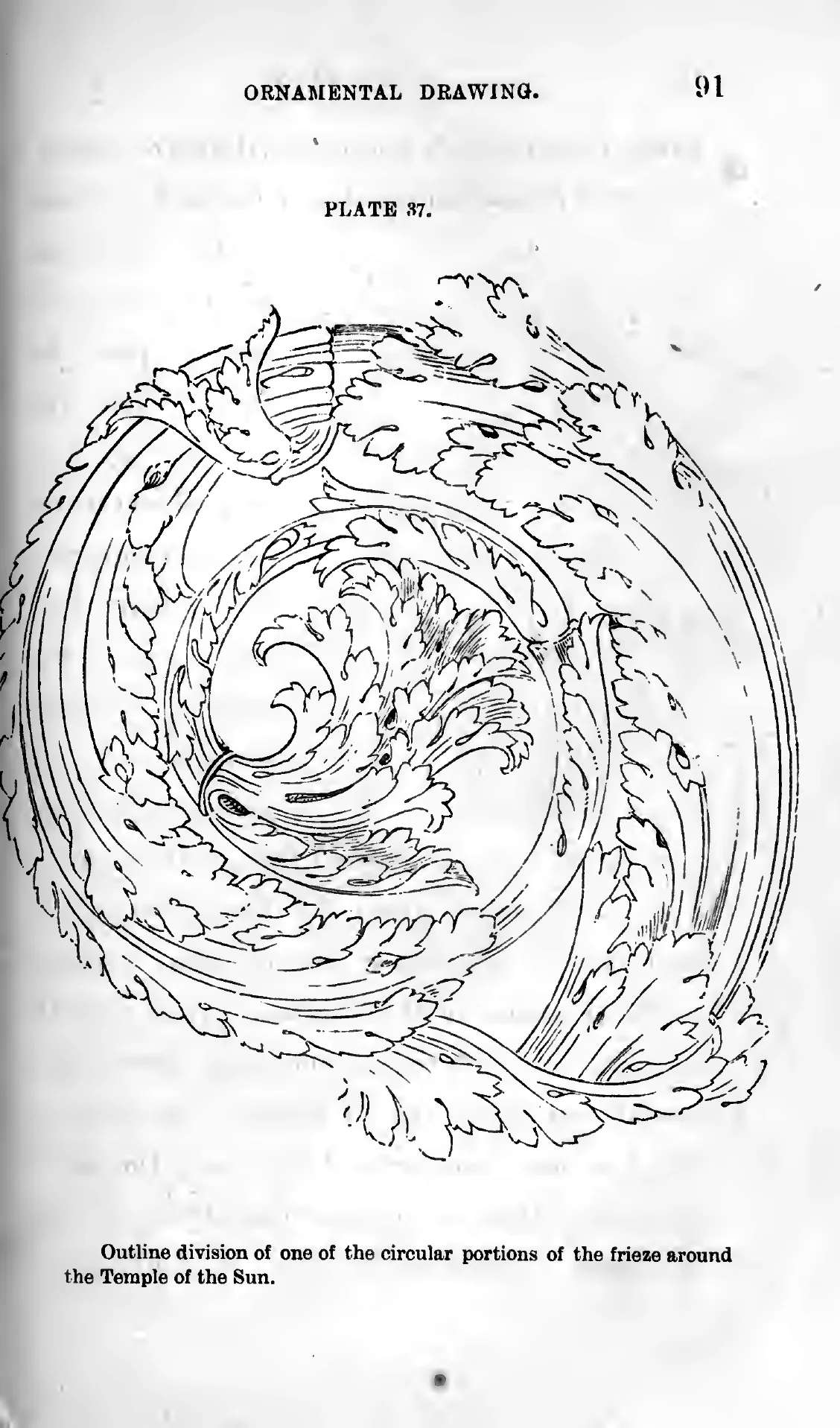
One circular section of the frieze that ran around the Temple of the Sun, drawn in outline on plate 37. Page notes the leaf here is richer than ordinary Acanthus mollis, with more raffles and a deeper reach from the centre stalk to the pipes. Repeat this section and you have the whole band.
Look at what he did not draw. There is no shading here at all, and the eyes are left open. At that height the design has to survive as a shape first, and the shape is what the plate records.
Can you mix Greek, Roman, and Gothic acanthus in one panel?
You can, and it will look ridiculous. Page thought so too, and I agree with him.
His line is worth memorizing: whatever style of ornament you commence, adhere to that, and no other. It would be rather ridiculous, he adds, to erect a Grecian temple with Gothic pinnacles.
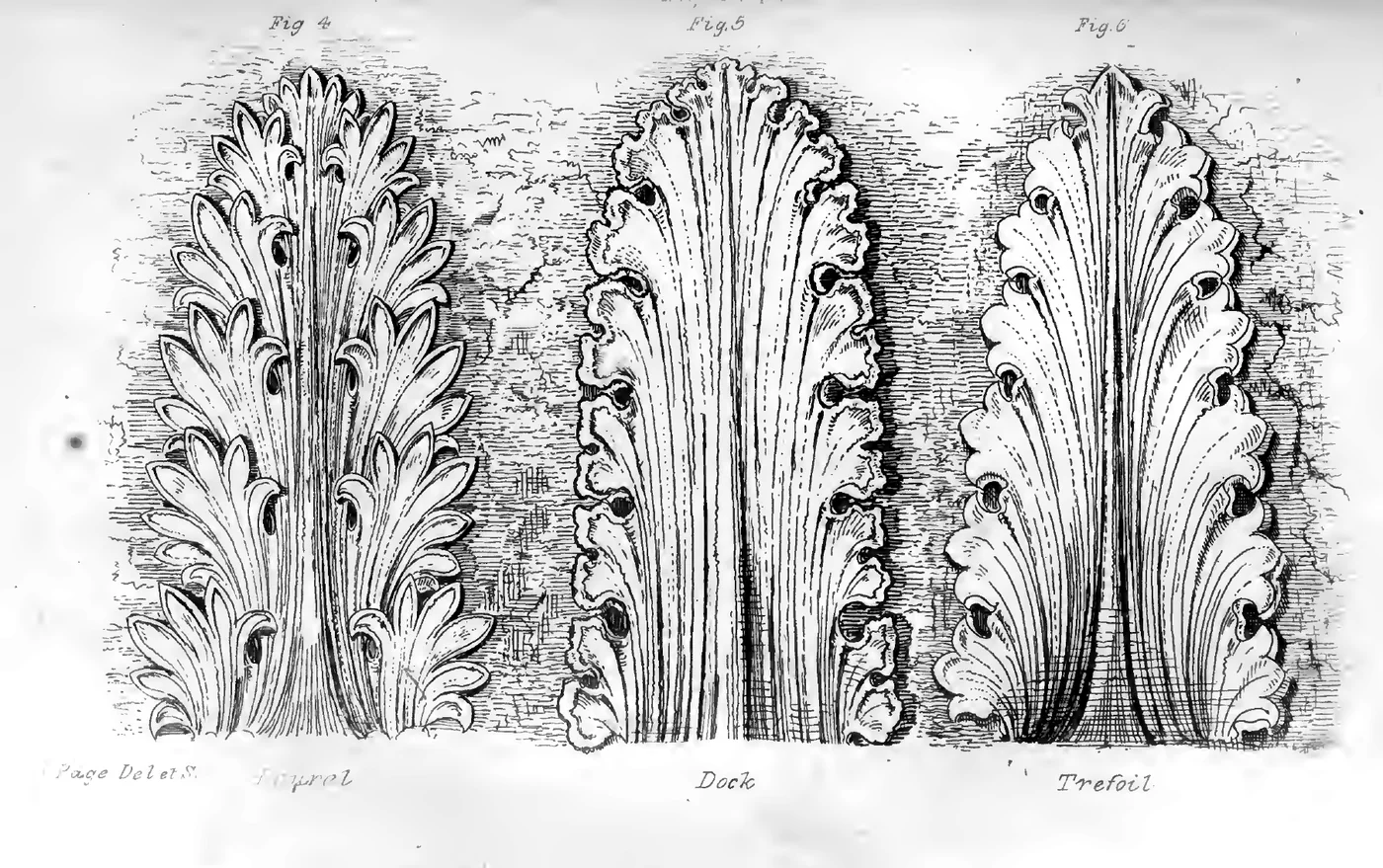
Three leaf characters, side by side, drawn and cut by the same hand. Page names two of them Dock and Trefoil. Same construction underneath all three, and yet no one would confuse them.
The families differ in the lobe and in the eye, and each one asks something different of your hands.
Family | Lobes | Eyes | What it asks of you |
|---|---|---|---|
Greek | tight, spiky, geometric | shallow | discipline and clean points |
Roman | wider, rounder, more meat | rounder and deeper | modeling the mass |
Corinthian | stacked in tiers on the capital | deep between the tiers | keeping every tier readable |
Byzantine | flattened | dark drilled holes | pattern more than modeling |
Modern, around 1903 | loose and running | soft | flow instead of rules |
We built a separate course for each, because they are separate skills, and mixing them early is how people stay confused for years:
Acanthus over Moldings, which is the one that hurts, because now the surface curves under you
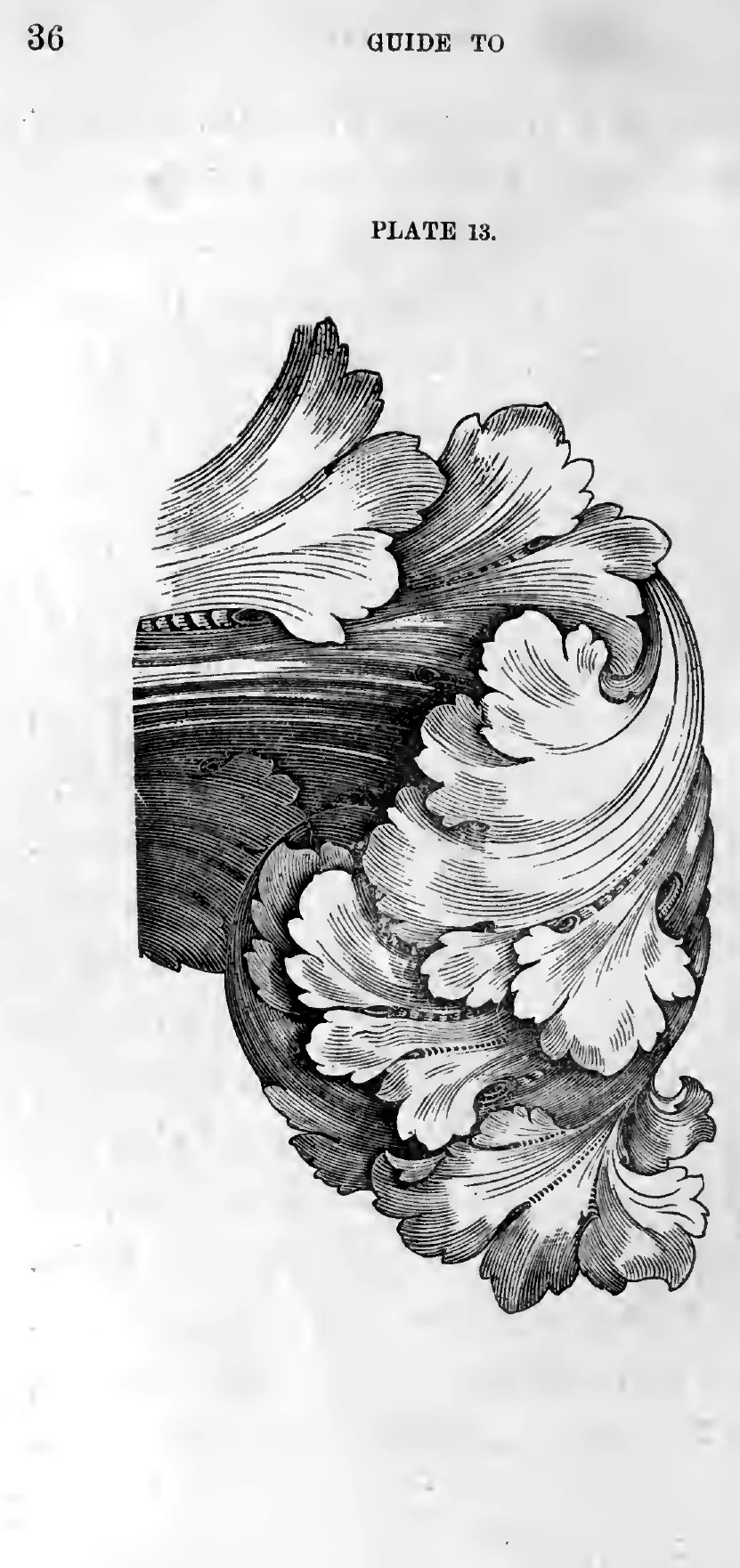
Foliage turning a corner on plate 13. The moment a leaf has to wrap a molding, your flat drawing stops helping you and you find out whether you understood the stalks.
Pick one. Carve it four or five times. Then move.
How do you turn the head of the leaf so it looks alive?
You build the roll with a compass instead of by feel. Strike a circle where the leaf bends and it tells you where the center stem falls as the head rolls over. This is the part where students quit and start copying photographs.
Page refuses to guess. He strikes a circle at the point where the leaf bends, and that circle tells him where the center stem falls as the head rolls over. From there he takes the arc between two points, divides it into eight parts, and reads the off-side raffling off those divisions. A tangent to a second circle gives him the far side of the stem.
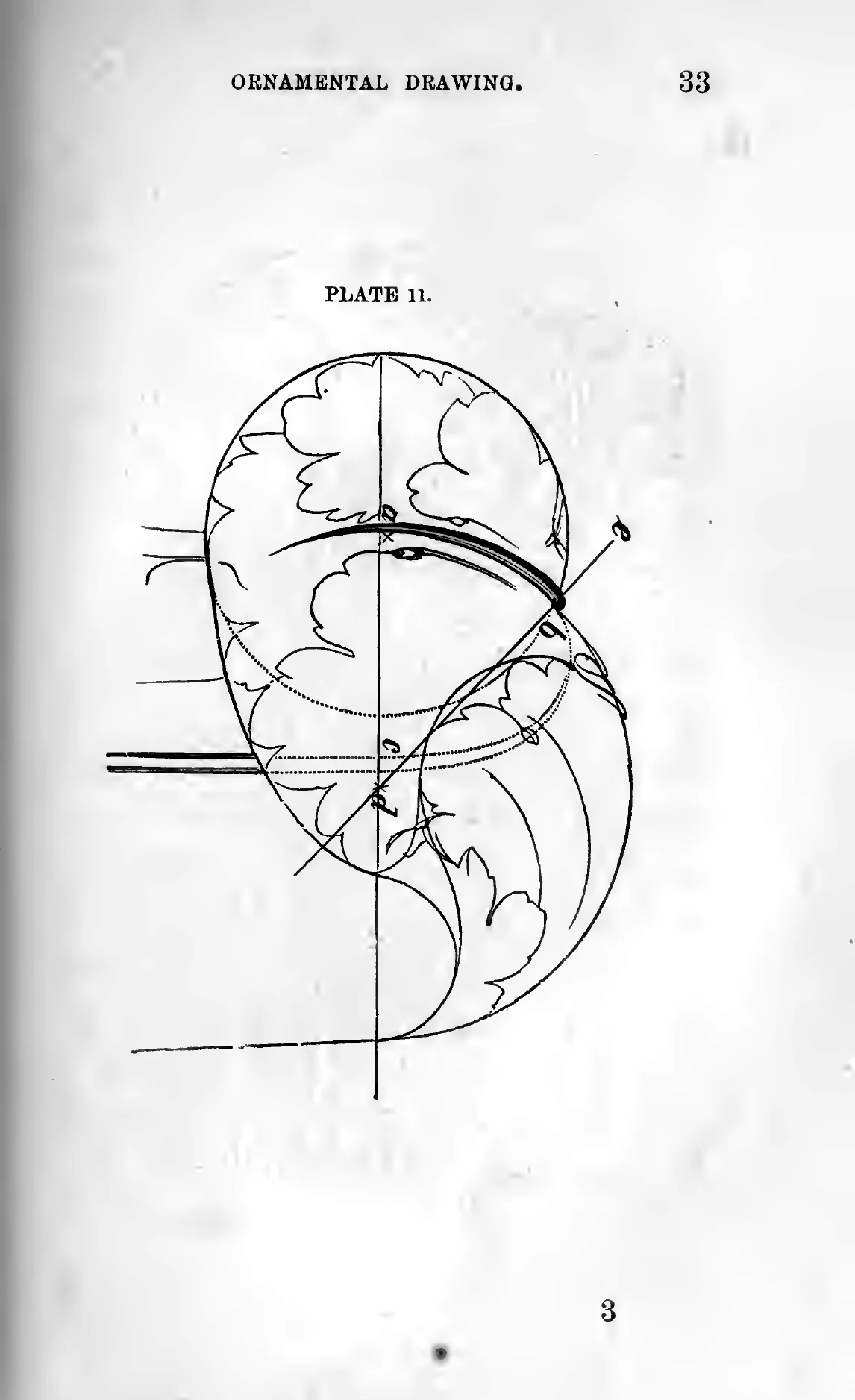
Circles doing the work that guessing cannot do, on plate 11. You can still see the compass arcs running under the foliage where he laid them down.
Circles and divisions. Not feeling.
His reason is blunt: the beauty of every description of foliage depends entirely on the gracefulness of the curves. Since that is true, he will not leave the curves to luck. He builds them with a compass, and only once the rule is in his hands does he let himself push a line a little for beauty.
Read that order twice. Rule first, freedom second, never the other way.
What wood and what gouges do you need for acanthus?
**American basswood, Tilia, or limewood and lindenwood in Europe.** The old shops used it for fine foliage and so do I. It cuts clean across the grain, it holds a crisp eye, and it does not fight you. The wrong board will beat you before your skill gets a chance, so here is the whole shelf ranked by the one thing that matters, whether it will hold an eye:
Wood | Holds a crisp eye | Cost | Verdict for acanthus |
|---|---|---|---|
American basswood (Tilia) | yes | moderate | start here, and probably stay |
Limewood, lindenwood | yes | moderate | the European equivalent |
Butternut | mostly, a little woolly | moderate | fine, sand the fuzz |
Black walnut | yes, if your steel is sharp | high | handsome, hard on edges |
White oak | no, open pores blur the eyes | moderate | slow and unforgiving |
Construction pine, a 2x4 | no, it tears out | cheap | do not |
Do not carve a 2x4. I mean it. Construction pine tears out in exactly the places acanthus needs to be sharp, it dulls your edges fast, and you will end up frustrated and blaming yourself when the board was the problem the whole time. Good wood is not cheap. You have to be real about that.
Tools, honestly, fewer than you think. A #7 gouge does most of the shaping. Use a V-tool for the stalks and the deep separations, a couple of narrow fishtails to get into the eyes, one mallet, and a strop.
Then comes the skill nobody wants to hear about. Sharpening. It takes years to really get, longer than the carving itself, and a man with one properly honed edge will out-carve a man with a rack of dull chisels every single time. My first chisel came from my grandfather when I was six years old. I took it straight to a brick to carve a face, and I destroyed the tool completely. Nobody had told me anything about steel yet. The passion started right there anyway.
What should you actually do this week?
Do you have a pencil and a sheet of paper? Got twenty minutes tonight? Then everything you need for step one is already on your table.
Draw the leaf. Not from a photo. Build it.
Vertical line. Base half the height. Six divisions across. Fifths for the springing point. Threes for the stalks. Do it again tomorrow at a different size, because the rule is supposed to scale, and you will only believe that once your own hand proves it to you.
Seven drawings before you clamp a board down. I know that sounds slow. Truthfully it is the fastest thing you will ever do, because seven drawings cost you paper and seven ruined carvings cost you basswood.
One more note about the book, and it has nothing to do with you. When Page's guide came out, a reviewer at the Polytechnic Journal praised the rules and then complained that he wished Page had written more about the vine leaf, since the ancients used it so much. Somebody in 1846 wanted a chapter that never got written. It makes me laugh every time.
That whole book sits in the public domain now. The Internet Archive digitized it back in 2007, so you can read every plate for free, and if you would rather build a shelf of these old sources we keep a library of 226 free carving and design books for exactly that.
Frequently asked questions
Is acanthus too hard for a beginner?
No, and the reason is that the hard part is the drawing, and drawing is free. Most of our acanthus courses are marked beginner on purpose. What makes it feel impossible is starting on a curved molding or a full capital instead of one flat leaf.
Do I need to know how to draw before I carve?
You need to know how to construct, which is a different thing. Nobody is asking you to sketch like an artist. Divide a line into six parts and you can build an acanthus, even if you cannot draw a horse.
How long until my acanthus looks like the old work?
A correct leaf on paper takes about a week. Something that reads well from across a room takes a few months of steady work. Work that could sit beside Grinling Gibbons takes years, and that is a fair trade for an object your grandchildren can hand to their grandchildren.
Why do my leaves look flat?
Two usual causes. Your eyes are too shallow, so you have no real shadow. Or your stalks do not trace back to one root, so the leaf has no direction and the eye slides off it.
How big should my first leaf be?
About 6 to 8 inches tall, on a board at least 3/4 inch thick. Smaller than that and the eyes get too tight for your gouges. Much bigger and every mistake takes an hour to fix.
Do I need a lathe, a power carver, or a rotary tool?
Nothing in my shop for this work plugs into a wall. Gibbons carved his limewood without a single machine, and those pieces are still standing after three hundred years.
What is the difference between a pipe and an eye?
The pipe, or pistule, is the tube shaped section of the lobe. The eye is the small hollow where lobes meet and shadow gathers. Page builds the pipes off the six divisions in the base, then lets the eyes fall where the stalks terminate.
Can I carve acanthus in oak or walnut?
Yes, and it will be slower and less forgiving. Oak's open pores blur the fine eyes. Walnut behaves better, costs more, and is harder on your edges. Learn the shape in basswood, then move up.
Where can I see the whole path laid out?
Our lessons map shows every course as a branch, with the acanthus group gathered in one place, so you can see what comes before it and after it. Never carved anything at all? Start here instead.
One last thing
God gave you a pair of hands, and if you have read this far, some pull toward the three dimensional world. That is not an accident and it is not meant for scrolling. Our tuition also feeds orphans and widows through the school, so the leaf you learn to draw pays for somebody's dinner on the other side of the world.
The girl at Corinth got a basket of her favorite things and a broken roof tile. Out of that we got the Corinthian order.
You have paper and a pencil. When the drawing stops fighting you, the Greek acanthus leaf is where the wood starts.
Alexander Grabovetskiy is a master carver and sculptor, named International Woodcarver of the Year. He carves architectural ornament and furniture for private commissions and teaches at the School of Woodcarving. His in-person classes fill in about eight minutes.
Filed under
- acanthus wood carving
- acanthus wood carving
- architectural ornament
- baroque ornament
- baswood carving
- byzantine ornament
- carving design
- carving tutorial
- classical ornament
- corinthian capital
- foliage carving
- gouge work
- greek acanthus
- leaf carving
- ornamental carving
- ornamental carving
- relief carving
- rococo ornament
- roman acanthus
- scroll carving
- woodcarving
- wood sculpture