
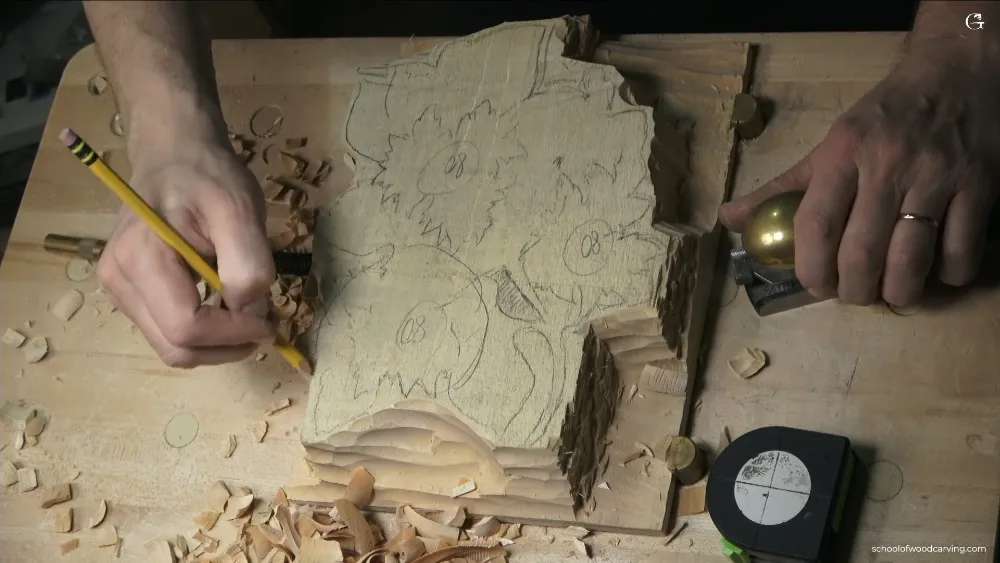
July 23, 2024 · Updated August 15, 2026
By Alexander Grabovetskiy — Master Woodcarver · Founder, School of Wood Carving · 14 min read
What Causes Wood Warping and Cupping?(WOODCARING)
Key Takeaways
- Humidity changes make wood swell or shrink, causing warping and cupping.
- Drying patterns predict warp direction so you can orient your wood strategically.
- Thicker panels add stability, and laminating with flipped grain prevents warp in large pieces.
- Quarter-sawn wood moves less.
- Carve with the grain where force pulls toward center to control and minimize movement.
By Alexander Grabovetskiy, School of Woodcarving · Updated July 29, 2026
Quick answer: Wood warping is any bend a board takes on as its moisture content changes, and cupping is the version that curls it across the width. Wood shrinks about twice as much around the growth rings as it does across them, so a flatsawn board cups away from the heart every time.
You put forty hours into a panel. It goes up on the wall in October, and by February the edges have lifted and there is daylight behind one corner.
The wood was dry when you bought it. You did everything the video said. Nobody warned you.
Here is the part the video skipped. Your board is never going to hold still, and no finish on earth will make it hold still. What you can do is find out which way it wants to move before your first cut, then arrange the work so its movement does not matter.
Let me tell you a story. When I was inside, I carved furniture with a 10mm knife I made myself and a tiny gouge made from a nail. My pay was one boiled potato a day. Nobody in that place controlled the humidity, and the winters ran minus forty with no heat, so I woke up covered in frost. I could not fix the room. So I learned to read the wood instead.
Below: why boards move, how to call the direction off the end grain, which species move least, and what to do with a panel that already cupped.
Key takeaways
Wood shrinks and swells with the air. Roughly 0.2% along the grain, about 4% across the rings, about 8% around them.
That two-to-one gap is what cups a board. Every growth ring in it wants to straighten out.
Stand the board on end and read the grain. It cups away from the heart, so the face that grew nearer the bark goes hollow.
A 12 inch basswood panel changes width by a hair over an eighth of an inch between a humid summer and a heated winter shop. Its length changes by nothing you could measure.
Quartersawn stock takes a third off that in basswood, and about half in sugar maple or white oak.
Finish the back of a carved panel, not just the carved face. A raw back is the most common reason finished work cups.
Why does wood warp and cup?
Wood warps because it shrinks by different amounts in different directions, and cupping is what you get when the two crosswise directions disagree. Every board in your shop is doing this right now.
Wood is hygroscopic. It pulls water vapor out of damp air and hands it back to dry air until it matches the room, and the number for where it lands is called equilibrium moisture content. Kiln-dried lumber ships at 6 to 8 percent. A heated shop in January can pull it down to 5. Leave that same board in a July garage in Indiana and it climbs to 11.
Now the part almost nobody explains properly. Wood moves in three directions, and the three numbers are nothing alike.
Along the grain, over its whole range from green to bone dry, wood shrinks about 0.1 to 0.2 percent. Forget it. Across the rings, radially, about 4 percent. Around the rings, tangentially, about 8 percent.
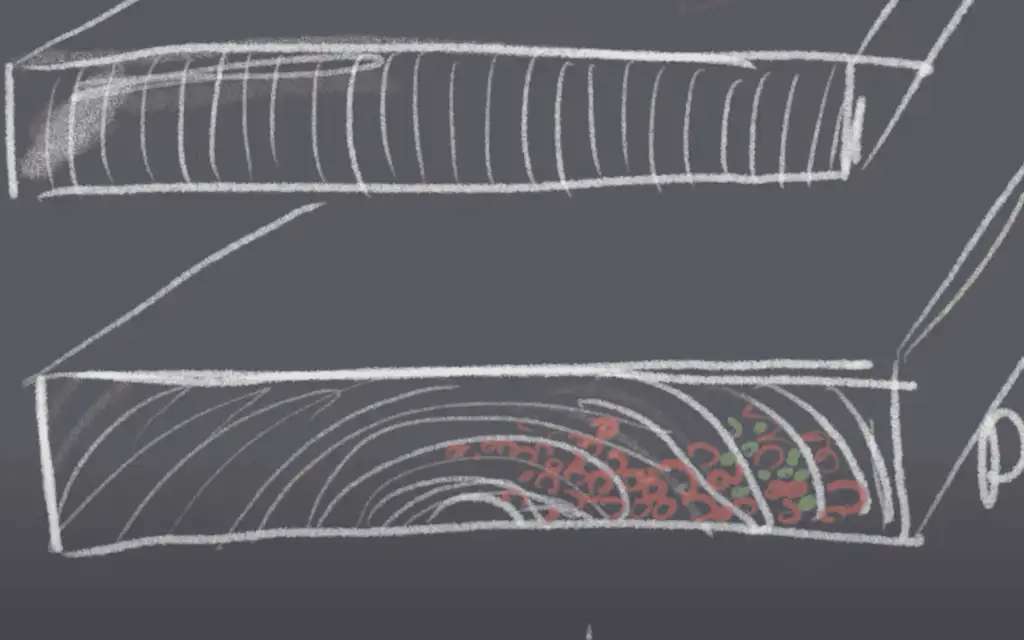
So on a flatsawn board, one face is trying to get shorter than the face behind it. Look at the end grain and you can see why it bends instead of just getting narrower, because those rings sit there as arcs and arcs flatten out. Your board goes hollow.
Uneven drying does it too, and that is the cause most articles give you. Lay a board flat on a concrete floor and the underside stays damp while the top gives up water, and it bends toward the wet side. Both things are real. Ring geometry is the one that gets you even when you did everything right.
Five things go wrong here and they have separate names. Mixing them up is how people end up treating the wrong problem.
Defect | What you see | What caused it | What to do at the bench |
|---|---|---|---|
Cup | Edges lift, the face reads like a shallow trough | Tangential shrinkage beating radial, flatsawn stock | Read the end grain, buy quartersawn, seal both faces |
Bow | The board arcs end to end like a banana | Uneven drying along the length | Sticker the stack so air reaches both faces |
Twist | Two corners lift off the bench in opposite directions | Grain running at an angle to the length, often near an old branch | Put the board back. Twist rarely comes out |
Crook | One edge curves along the length while the face stays flat | Sawn near the pith, or from a leaning log | Choose quartersawn, and saw the crook off before layout |
Torn grain | Fibers rip and lift instead of slicing | Cutting uphill against the grain, or a dull edge | Turn the cut around, strop the gouge |
Walk away from twist. I have never made a twisted board behave.
Which way will my board cup?
Stand the board on end, look at the growth rings, and it will cup away from the heart, which means the face that grew nearer the bark is the one that goes hollow. The rings are arcs. Arcs flatten.
That one look tells you which face to carve and which face to glue down. Four seconds at the lumber rack.
Which carving woods move the least?
Total shrinkage matters less than the gap between the two crosswise numbers, because the gap is what actually cups a board. The USDA Forest Service publishes these figures for every commercial species in the Wood Handbook, measured green to oven dry, and the last column below is the one carvers should be reading.
Wood | Radial | Tangential | Volumetric | Tangential over radial |
|---|---|---|---|---|
Mahogany (Swietenia macrophylla) | 3.0% | 4.1% | 7.8% | 1.4 |
American basswood (Tilia americana) | 6.6% | 9.3% | 15.8% | 1.4 |
Butternut (Juglans cinerea) | 3.4% | 6.4% | 10.6% | 1.9 |
Black cherry (Prunus serotina) | 3.7% | 7.1% | 11.5% | 1.9 |
White oak (Quercus alba) | 5.6% | 10.5% | 16.3% | 1.9 |
Teak (Tectona grandis) | 2.6% | 5.2% | 7.2% | 2.0 |
Sugar maple (Acer saccharum) | 4.8% | 9.9% | 14.7% | 2.1 |
Eastern white pine (Pinus strobus) | 2.1% | 6.1% | 8.2% | 2.9 |
Put basswood and pine side by side, because the comparison upsets what people repeat. Basswood moves twice as much overall, 15.8 against 8.2. But its two crosswise numbers sit close together at 1.4 apart, while pine's sit 2.9 apart. Basswood swells and shrinks a lot and stays reasonably flat while doing it. Pine barely moves and curls hard when it does.
Which is a large part of why basswood has been the carving wood of Europe and America for six hundred years, and construction pine has not. Our guide to the best wood for carving walks through the other species.
Now put a real number on your own bench. Basswood's 9.3 percent covers a 30 point moisture range, so call it 0.31 percent for each point. Three points of swing, summer to a heated winter, gives 0.93 percent. On a 12 inch panel that is 0.11 of an inch.
A hair over an eighth. Across the width, while the length does not move at all. That eighth of an inch has to go somewhere, and your job is to decide where.
How do I keep a carving panel flat?
Buy the right cut, let it settle, and seal every face, in that order. Nothing below is clever. All of it gets skipped.
Step 1. Buy quartersawn when the piece has to stay flat
On quartersawn stock the rings run roughly straight through the thickness, so the width of the board moves on the radial number instead of the tangential one. In basswood that takes about a third off. Sugar maple and white oak give you closer to half.
Carving a figure in the round? Skip this one and save the money. That block moves in every direction anyway, and nobody reads its edge against a straight line.
Step 2. Let the board live in the room before you cut it
Sticker it with scrap so air touches all four sides, and put it in the room the finished piece will hang in, not the garage where the door opens onto July. Then check it with a moisture meter and wait until two readings, several days apart, give you the same number. Two weeks is common for one inch kiln-dried stock. Forget the calendar. Your meter is the only thing here telling you the truth.
Step 3. Reject the pith, and reject the twist
If the pith runs anywhere through your board, that board will crook and it will split. Put it back. Same answer for twist, and same answer for a board whose grain runs off the edge at a steep angle.
The late Gothic shops knew this and dealt with it by hollowing the backs of their figures out, cutting the heart of the tree away entirely. Limewood sculpture from around 1500 is still standing partly because of that decision. There is more on how those shops worked in our piece on Riemenschneider's unpainted limewood.
Step 4. Go narrower and glue up
Four 3 inch quartersawn staves cup far less than one 12 inch flatsawn board, for the plain reason that each stave has only 3 inches of width to misbehave in. Same total panel. A quarter of the movement in any one piece.
Step 5. Decide honestly about alternating the rings
Shop lore says flip every other board, heart up, heart down. That gives you several small cups instead of one big one, so the surface goes slightly washboard and reads close to flat overall. Match every board the same way and you get one large cup, which looks worse but planes out in a single pass.
Pick by whether you can restrain the panel afterward. If you cannot, alternate them.
Step 6. Finish the back
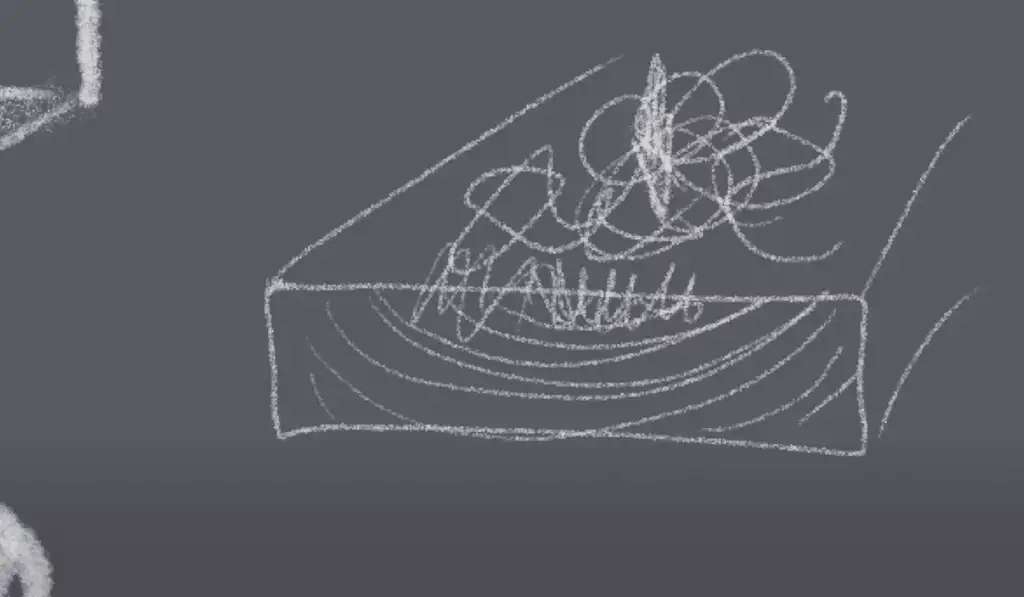
Here is the one that ruins finished work. You oil the carved face, the raw back keeps breathing at a different rate, and inside one season the panel cups toward the sealed side. Whatever goes on the front goes on the back. Same product, same number of coats.
Step 7. Let it float
Never glue a wide panel rigidly into a frame across the grain. Screw battens through slotted holes, or seat the panel in a groove with room left at the edges. Give that eighth of an inch a place to go and it will go there quietly.
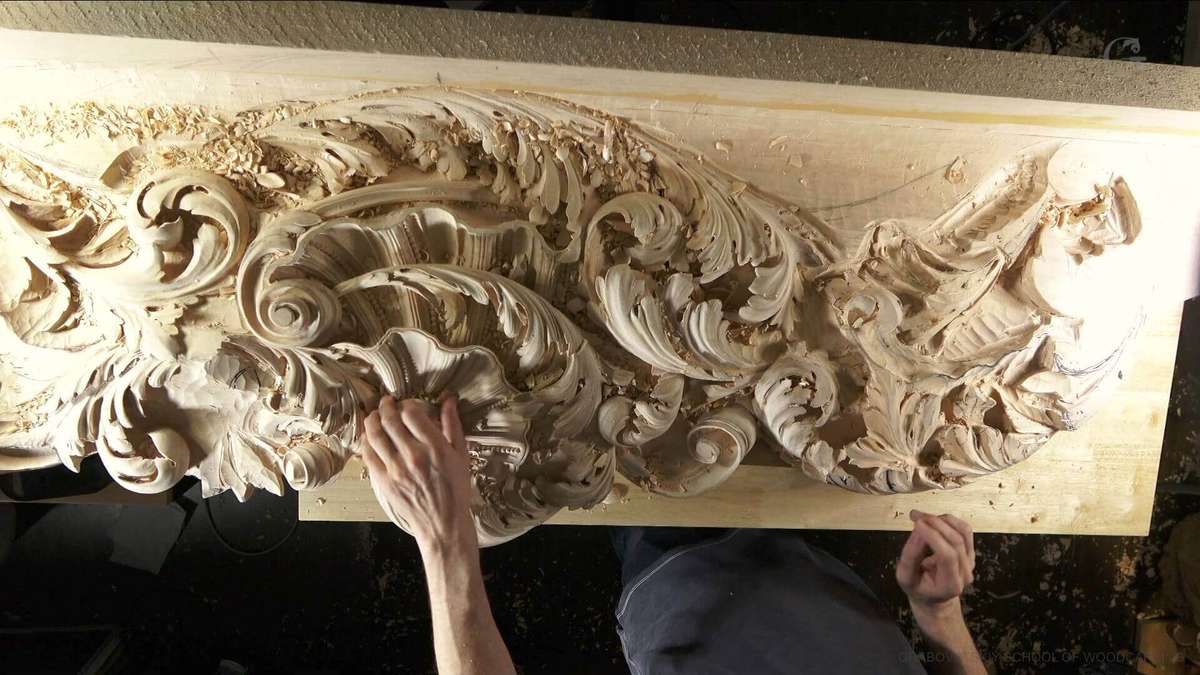
Does carving with the grain stop warping?
Carving with the grain does not change how much a board moves, and any article telling you otherwise has it backwards. Grain direction controls whether your cut is clean or torn. Moisture controls whether the board is flat. Two different problems with two different fixes.
They touch in exactly one place. Torn grain leaves lifted fibers and an open, ragged surface, and open surface trades moisture with the air faster than a sliced one does, so a badly torn panel dries unevenly right at the skin and can check. Cut downhill, with the fibers running away from your edge, and strop often.
Really, really important. Sharpness first. A dull #7 gouge will tear basswood no matter which direction you push it, and everything else in carving sits downstream of that.
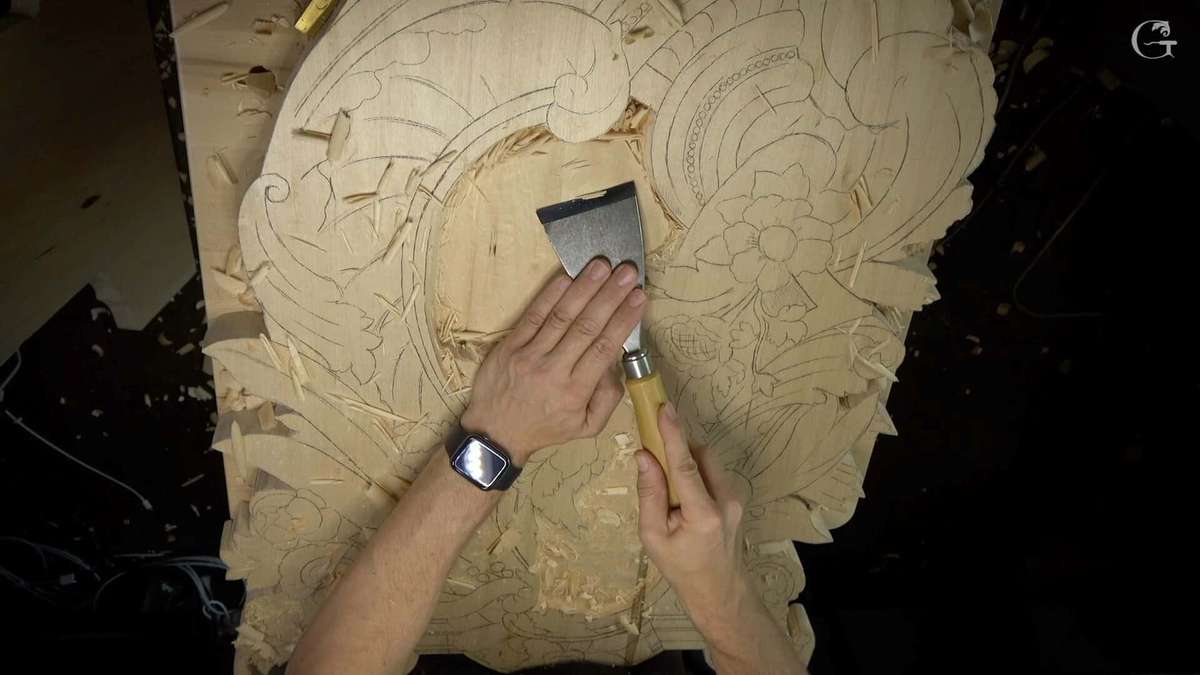
What do I do with a board that already cupped?
Find out which cause you have first, because one of them comes back and one of them does not. Students ask me this after the fact, and the honest answer splits in two.
Cupping from uneven drying is mostly reversible. Sticker the board so air reaches both faces evenly, leave it a week or two, and it will relax most of the way back. Some people speed that up by wetting the hollow face and setting the board in the sun, hollow side down. It does work. Be warned that it raises grain badly, and it is a blunt instrument.
Cupping from ring geometry is not reversible. Plane it flat and the new flat surface will cup again on the next humidity swing, because planing changed nothing about the rings.
So for a carved panel that has already cupped and already has your hours in it, stop chasing flat and go for restrained. Battens across the back, screwed through slotted holes so the panel can still change width. Or take the curve, and hang the piece where nobody reads its edge against a straight line.
Frequently asked questions
Why does wood warp in the first place? Wood warps because it shrinks unevenly, roughly 0.2 percent along the grain against 4 to 8 percent across it, depending which crosswise direction you measure. Damp air puts water back into the board and the board gets bigger. Dry air takes water out and the board gets smaller. Since the crosswise directions do not shrink by the same amount, the board bends instead of simply getting narrower.
Which way will a board cup? A board cups away from the heart of the tree, so the face that grew nearer the bark becomes the hollow one. Stand it on end and read the rings as arcs. They try to straighten, which lifts the edges on the bark side. Four seconds of looking saves a ruined panel.
Can I stop a carving from cupping completely? Nobody stops wood from moving, though you can send that movement somewhere harmless, which in practice comes to the same thing. Use quartersawn stock, let the board reach equilibrium with the room before you cut, keep panels narrow and glued up rather than wide and solid, and finish both faces identically. Then hang it so it can still change width.
How long should wood sit in my shop before I carve it? Until a moisture meter gives you the same reading twice, several days apart, which for one inch kiln-dried stock usually lands around two weeks. Thick stock takes longer. Air-dried stock straight off an outdoor stack takes much longer than that. The calendar is not the test, the meter is.
Does carving with the grain help with warping? Grain direction decides whether your gouge slices or tears, and moisture decides whether the board stays flat, so the honest answer is no. The link between them is indirect: a torn surface is open and trades moisture faster than a cleanly sliced one, so it dries unevenly at the skin and can check. Cut downhill, keep the edge sharp, and that variable goes away.
What is the difference between warping and cupping? Cupping is one kind of warp, the kind that curls a board across its width. Warping is the family name for every shape a board can pull itself into, including bow along the length, twist at the corners, and crook along one edge. All of them come from the same root, which is uneven shrinkage.
Is quartersawn worth the extra money for carving? For a panel that has to stay flat, yes. Quartersawn cuts crosswise movement by about a third in basswood and roughly half in sugar maple and white oak, which is real money on a large relief you plan to hang on a wall for the next fifty years. On a figure in the round it buys you nothing. Movement goes every direction at once there and nobody sees it.
Who is telling you this
I am Alexander Grabovetskiy, International Woodcarver of the Year, and I carve architectural ornament for a living. Acanthus, high relief, Baroque, furniture to match Chippendale. My great grandfather worked mahogany in the Chippendale style, so wood is in my blood, and my grandfather put a chisel in my hand when I was six years old. I took it straight to a brick and ruined it.
One thing about this subject no chart is going to teach you. The carvers who lose finished work to cupping are almost never careless people. They are the ones who trusted a kiln sticker instead of standing the board on end and looking at it.
Every shrinkage figure above comes from the USDA Forest Service Wood Handbook: Wood as an Engineering Material, which has been the reference for these numbers since 1935.
Shall we carve?
Do you want to put forty hours into a relief and still have it flat in five years? Have you ever set a board back on the rack because its rings told you to? Would you rather understand the wood than keep replacing it?
Then come and work with us. Reading grain is the same skill you build in carving the Greek acanthus leaf, where one torn lobe shows from across the room. Our Access plans open every lesson we have, and the tuition feeds orphan and widow charities.