
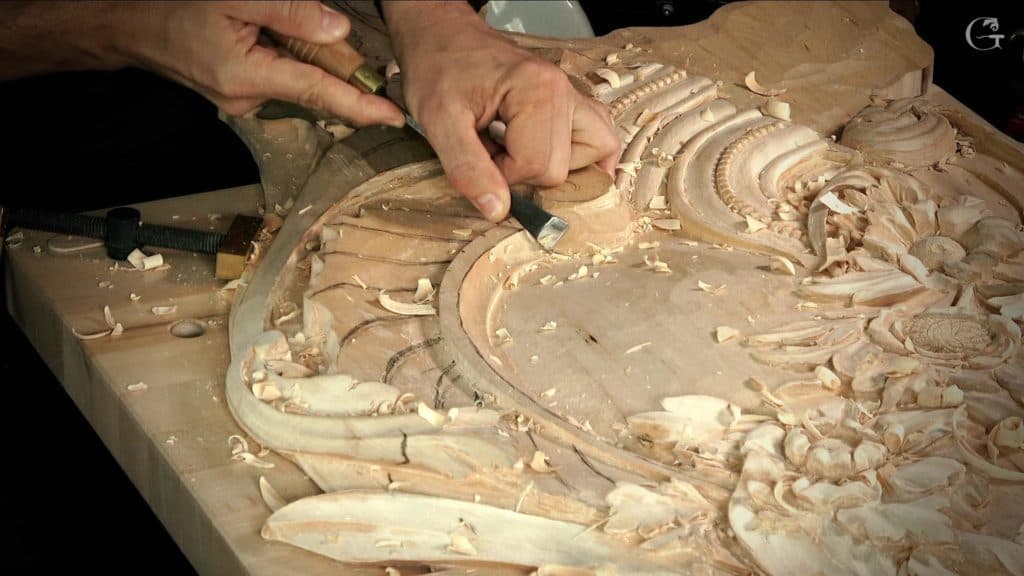
Alexander Grabovetskiy, woodcarver, School of Woodcarving · Published 2021
What does a wood carver mean by "six parts"?
Quick answer: In Venice Room 142, video 2, I said I would take two points on a lower section, move about six parts out of 10, and call it a golden ratio. Other lessons use the words for middle lines, high spots and eyes, and one video for a plate divided into six.
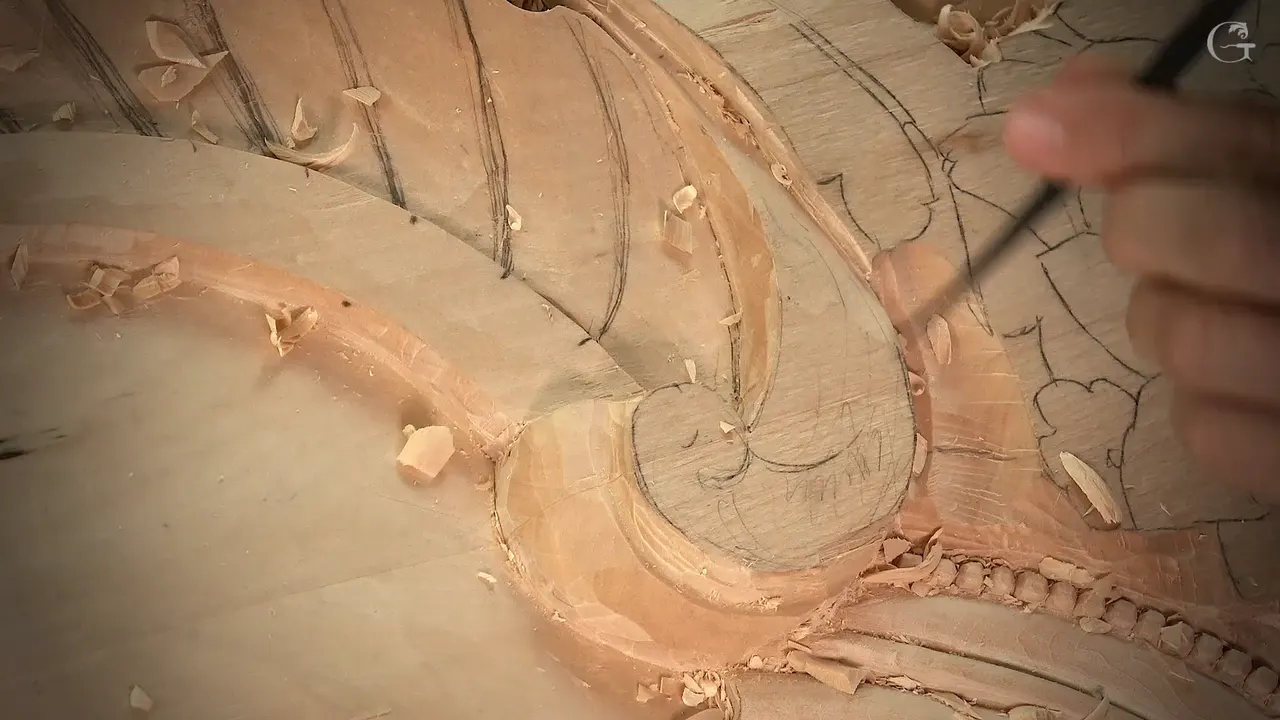

In the second video of Venice Room 142 I planned a line across a lower section, with a move of six parts, and named it a golden ratio. That count turns up in my Venice Room, Furniture Panel, Grape Leaves, Hashemi and Roman acanthus videos. There it marks a middle line, sometimes a pipe, and in one video a plate got six divisions. The lesson itself comes first below, and the other lessons follow in groups.
Ever found the middle of a line and then slid your pencil a little to one side? Did that new spot look better to your eye? Then you know the move, and below is each place I made it and how I counted.
Was the rule kept in the first video of lesson 142?
One video earlier, the lesson sets the rule aside. "I moved slightly to the sides my division lines, and I did not follow 60/40 rule in this case. I just think it's going to look better that way." Next, "I just played around and decided to lower down the overall depth on this side. I popped a little higher those beads, and in overall, it looks much better."
Why so careful at the start of video 2?
The second video opens with a short warning to myself. "Have to be careful," I said. "I touched a couple times my almost finished surface. It's not really finished, but still." After that came "I have to keep an eye on what I'm doing, okay? Without rushing." And: "That would be a really big mistake if I would rush it."
How did I divide the lower section?

A note on the grain came first: "And again, that is against the grain, but it's okay." Then: "Now, right here. Okay, this section. That part is going to be lower anyway, so I'm going to divide that as a molding." My plan: "Again, I'm going to take this point, that point, move about six parts out of 10, a golden ratio, and that's going to be going all the way, just like that."
Which tool? Of the lower part I said "much lower, so I safely could probably take some kind of gouge, like number seven." I added "Number seven or number five will work, but I'll take number seven" and "right away take out some of that material because I really need that depth."

Where did a double movement come in?
"Okay, so that is somewhat the look I'm after." A concave and a convex were "a part of a movement right there," I said: "Double movement." I said "Why don't I just take care of it right away?" "Again, I'm just trying to be as close as possible to the golden ratio, and yeah, I'm eyeballing it. I really don't need to measure it, but if you feel you really need to measure, just go ahead and do that."
The number 7 was back: "I'll take the same number seven, what I used before. In my case, it was about an inch" (25 mm).

What happened at the marriage line?
"Okay, here's a marriage line, so have to be careful how I attack that." Of the spot: "So that is my stopping point, at least that direction." I planned to stay "maybe about three millimeters, no more, from that line right here" (about 1/8 in). The shadow was a plan: undercut "a little later to create a shadow at about one-eighth of an inch to the final surface" (about 3 mm).

Passes came next. "Let's do a couple passes." After that: "I'll walk around and attack from the opposite side against the grain." On slicing: "I really have to slice" and it is "still possible to make a really nice and smooth cut." The second side got the same tool, with "I'll just go all the way to the marriage line" then "Take my time" and "Not to push too hard."

"And I'm always slicing, by the way." On the tool: "You can see I'm starting on one side of the tool, and then my movement is going like that, in this case." At the line itself: "here is my marriage line, and all I have to do, just blend in. There you go. It's blended, and it does look good."
What was left for the head of the element?
At "Marriage line again" I said "Let's marry it" and "blend it in. Wonderful." Then "So now I've got pretty much my main shape." A little later I planned to go "a little deeper, maybe about one millimeter deeper on this edge" (about 1/25 in). The undercut waits too: "undercut a little later, too, but that's later."

"So now I have to concentrate on the head itself." "Let me make this side a little more roundy," I said, followed by "I'm not sure if I should say that word or not, but that is exactly what it is." The tool was still ahead: "I'll take number three, and little by little" I would "chamfer that in or feel it and create that shape."
How did I explain the count in Venice Room 72?

In Venice Room 72, the count comes out loud. "If I take approximately this point right here and take that point right there, and let's put a line across, invisible line." My words were "I don't need to do that all the time" and the rest was a split by 10. The count went in two halves: "Five parts on one side, five parts on another side" and you move six parts "either to that direction or that direction." I picked a side: "In this case, I move that direction because it makes sense." I fixed a figure out loud ("I'm sorry") and landed on "62 out of 100 to be exact."

Later in that video, the same count placed concaves. "Same old, same old. Same concaves." I was "just eyeballing the position of them, but by now you should know logic behind." The move went "to the left" and the other side got the same. Then came "I am not after perfection. I'm not going to estimate with the ruler am I really on a golden ratio or not."
Which middle lines got the count?
The first middle line sits in Venice Room 65, video 10. "If you know the logic of the middle line I put behind, it's always supposed to be like by the golden ratio." The plan was to count six parts from one point and move one way. "I just eyeball that. I'm not counting really, I'm just eyeballing." My cut was a number 11 at 7 millimeters (1/4 in).

The Venice Room 61 tenth video has the main middle line shifting "to the left. To the bottom, actually. It's the way you look at it." That left "this is four parts" and six for the other side, "just eyeballing." And: "I'm trying to stick to this rule or law everywhere I can."

The middle came first in video 7 of Venice Room 49, with a five and five split. Next, "I move slightly, little bit, just eyeballing to the side." The line: "my middle line of this design."
What does the count do for a pipe or a convex?
A pipe sat between two lines in video 9 of Venice Room 53. My plan was to "do my pipe right between." "Maybe just a shift" came first, then "closer to Fibonacci sequence." And "I moved that little bit to that direction" and next I was going to lean my tool a little on the left-hand side and start my concave.

Convexes show up in video 1 of Venice Room 127. "Concaves and convexes. That is not convenient for me to carve, but I can show you." The center line: "I want to shift that little bit to the lower part." And the first convex would "start somewhere right there."
Did the count help with a high spot or with an eye?
A high spot came up in video 15 of Furniture Panel 19. One option was to "shift my high spot little closer right to this line," or "even let me use the golden ratio." Split a line in ten and find six tenths of it, and that would be my high spot, with the movement going "downhill this direction." The next line was "I don't want to be exactly the same on the same leaf."
In video 2 of Furniture Panel 14, a line "falls approximately to the golden ratio" between two points, and it would be "a little lower section." Later came "right there, it's a golden ratio" with my eye there. The flipping motion was still ahead: "start my flipping motion from this separation."

Roman Acanthus 5, video 1, has "a really good representation of a golden ratio or golden rule." Divide a line "in 10 parts like we did before" and count "six parts down from these points." Then: "the edge of the eye will be exactly at the six points right here. So that's actually really good." An easy way followed: halve the line and "just move down a little bit."

The Hashemi Flowers 38 video, number 3, makes it a habit. I wanted "to establish the center" and I said it would not be "right in the middle of it." Last, "I usually go about six" and "I just eyeball it. I don't measure it." And: "if it's just slightly off-center, usually that means it's good."
When did I skip the ruler, or the count?
Grape Leaves 1, video 2, has "if you know a little bit about Fibonacci, you know its golden ratio." If I take "my caliper, which is a golden ratio caliper" and "measure pretty much from this point to that point" then "I've got my golden center somewhere right there." In Furniture Panel 5, video 2, there is a way around it: "The easiest way would be probably just to take a piece of paper, mark it, and carry this to that side." Then "That way I don't have to use any ruler or measurements."

In one video, the six was not a move at all. In Plate with Butterflies 12, video 1, I thought about how it was supposed to look. "I could divide that in eight parts." Seven came to mind too. "But I made a decision to divide that into six parts." Then "I'll just use the calipers and I'll subdivide it in six, in six parts." And: "I think it's going to flow much better."
Where does each count show up?
The table keeps one row for each video, with what the count placed and the detail I gave.
| Where I said it | What the six parts placed or divided | Detail I gave |
|---|---|---|
| Venice workshop 142, video 2 | Line dividing the lower section, with the number 7 | Number 5 would work too |
| Workshop 141, video 1 | First line on a side, put there by eye because my calipers got too big | Divide by 10 |
| Lesson 72, video 1 | Concaves moved slightly toward the left, after five parts and five parts | Not perfection |
| Venice 65, video 10 | Middle line beside a pipe, counted from one point | Number 11, 7 mm (1/4 in) |
| Room 53, video 9 | Pipe between two lines, closer to the Fibonacci sequence | Concave to follow |
| Workshop 61, video 10 | Main middle line of the overall movement, four and six | Just eyeballing |
| Lesson 49, video 7 | Middle of a design, moved slightly from five and five | 62 parts of 100 |
| Venice Room 118, video 1 | Concave number one and number two beside the line | 7 mm or 10 mm (1/4 or 3/8 in) |
| Room 127, video 1 | Line shifted to the lower part, with convexes after it | About golden ratio |
| Venice 139, video 2 | Spot that lines up with the rest of the movement | Grid to follow |
| Venice workshop 99, video 7 | Head of two acorns, 60% to one side and 40% to the other | Same on the second |
| Furniture 14, video 2 | Eye at a separation, before the flipping motion starts | Right there, golden ratio |
| Panel 19, video 15 | High spot on a leaf, with the movement going downhill | Split it in ten |
| Furniture 30, video 2 | Line for a leaf with a convex and two concaves | 62% against 38% |
| Grape Leaves 3, video 9 | Place of a lavender color in a blend of colors | Opposite direction |
| Hashemi Flowers 38, video 3 | Center line set a little off-center, by eye | I don't measure it |
| Roman Acanthus 5, video 1 | Edge of an eye, counted down a line divided in 10 | Six points right here |
| Plate with Butterflies 12, video 1 | Division into six parts with calipers, after eight and seven came up | Not perfect |
Which line on your bench would you move first? Every lesson named here opens with access to the school, paid monthly or yearly and renewed automatically until you stop it. The Part 12 course page holds lesson 142, with lesson 141 before it and lesson 143 after. Wikipedia has plain definitions of the golden ratio, volute and wood carving.
How it's done
- Watch the work. I told myself to keep my eye on what I was doing, without rushing.
- Divide the lower section. Two points on that section, a move of six parts, then a molding to follow was the plan.
- Take out wood with a number 7. A number 7 or a number 5 would work, I said, and I needed the depth right away.
- Be careful at the marriage line. The spot was my stopping point, and I said to be careful how I attack it there.
- Slice from both sides. From the opposite side I said I still had to slice, and a smooth cut was still possible.
- Blend in at the line. All I had to do there was blend in.
Frequently asked questions
How far from the marriage line did I plan to stay?
About three millimeters (about 1/8 in), no more, from that line. The undercut for a shadow was a plan for later, at about one-eighth of an inch (about 3 mm) to the final surface.
Did I measure the golden ratio on the Venice panel?
My answer was that I was eyeballing it. Measuring is your call if you feel you have to, I said, so go ahead and do that.
Which number gouge took the first wood from the lower section?
A number 7, with a number 5 named as one that would also work. In my case the number 7 was about an inch (25 mm), and I said I really needed that depth.
What to carve next