

Alexander Grabovetskiy, woodcarver, School of Woodcarving · Published 2020
What does it mean when a wood carver says he is not afraid to carve deep?
Quick answer: Saying I am not afraid is how I mark a deep cut that may lose the sides, a line, or even a picture. The sides may go in workshop 37, part 11, and my reason follows at once: I can always dig deeper. The reason changes from video to video.
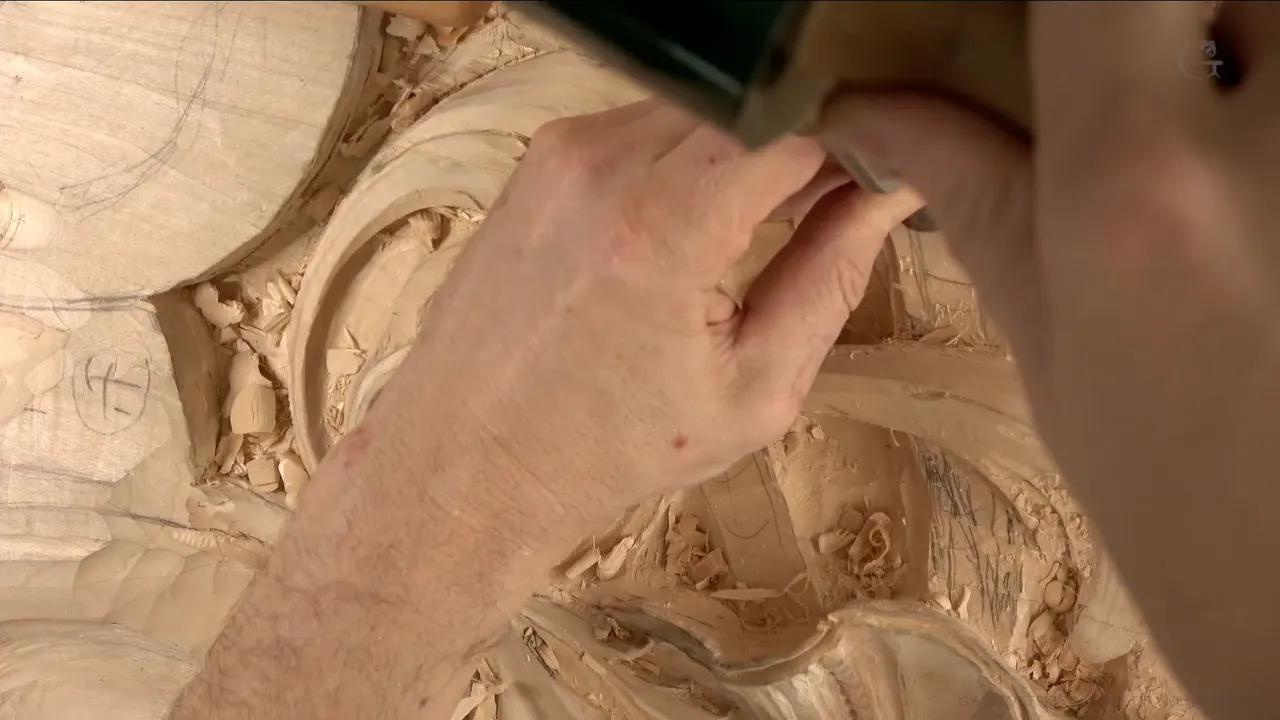

Not afraid is my phrase for a deep cut that may lose something, such as the sides, a line or the picture, and a reason it is safe usually sits right beside the words. The phrase goes with a convex in workshop 37, part 11. Other videos of mine use it too, and I set them beside this one below.
Ever dug into a carving and felt your hand stop, because the next pass could lose a line you liked? Here is what I said each time, and what I gave as the reason.
What do I say in this part of workshop 37?
The part opens with "Now we can develop a convex." Soon I say there is "a really big convex on inside," and I fix my own words: "Preliminary convex, I should say." Its size is "like that size, which is going to go all the way."
A tool comes up as a plan. "Maybe I should just do a quick way," I say, and then "just use back bent." Later, "maybe I should do right here, too."

Now comes the line this whole page is about, said in a plain way. "And no, I'm not afraid of losing the sides." One breath later I add, "That's absolutely okay. I can always dig deeper." The reason follows three seconds after the words.
What I want is a shape, and I trip over the word. "I want to see really good concave-- convex, I'm sorry. Convex. All right." It must go around a spot, I say, "right here," and "this way also."

My own first pass gets a rating. "It's not the perfect cut, but at least it gives me some idea." A plan follows, "let me clean it and then continue with the cut," and I name a tool: "Number 11, that's what I'm using," I say. Then, "clean the sides."
The wood looks rough after that, and I say so. "Oh, it looks messy. But it's okay. It's supposed to look messy at this stage." My aim is "I really want to see that convex beautifully developed."

More plans come soon after. "Let me clean on that side also a little more," I say, and "I think I should attack that from opposite direction and use just a straight number 11 right here." A caution sits beside them: "I have to be also careful on this side because I'm really close to that part." That last part of the line comes again ten seconds later, by itself.
Near the end, the pass pays off. "I can see my convex coming alive." After that, "I feel like I'm working with a shovel almost." And then, "Just digging toward myself."

Close to the last lines I say, "Here you go. I've got to another level, and there's a glue line." A moment later, "And with that, I can attack it with the number 11." The number 11 is the last tool I name.

Does the wood itself make a deep cut safe?
Thickness is one of my reasons. I reach a big concave in part 2 of Carving Byzantine Acanthus 8. If you have a big one, I say, three-quarters of an inch (19 mm), it is a really good idea to use it.

Then comes advice. "Don't be afraid. We have a lots of meat," I say. Next, "we have thickness." This is why, I say, "we didn't get the first layer all the way through." Not long after, "don't be afraid to be too deep," and my reason is the look, since it is "supposed to have a three dimensions," and "we are after all the shadow we can get."
A question carries the idea in workshop 60, part 12. "I need that three dimensions," I say, so the excavation I am doing is deep. Then I put a question to myself, out loud. "Am I afraid of it? No, I'm not." Next comes what backs it up: "I have plenty of material right here, so I don't really worry about it." Earlier I say I could probably use a 30 millimeter number 11 (1.18 in) to remove some of that stuff.

Will a later pass take that wood anyway?
Carving Hashemi Flowers 43, part 6, gives a plain case. I tell you to excavate that deep, because "later on, we're still going to excavate that really deep." The final excavation, I add, will be deep too.

In part 4 of Carving Flower Rosette 5, I take away the background with one knife, "whatever I can reach." I say the same about a bumpy, wavy surface, because "we're going to use later the background punch for this rosette."
A skew is next at workshop 39, part 5, to "give it a little more shape." A chip gets the idea too, and it "still has to go down because I have this detail," and "below that detail."
The Lily Box course has a line like it in part 3 of lesson 13. "Those ones, they still have to go down here later on." So I say it again, this time about touching a part with the knife. A thought comes after that, to "lower down pretty much right away."

Can the line come back?
Some lines are meant to go. In part 1 of Carving Floral and Molding for the Panel 2, I say a spot looks like no more than a quarter of an inch (6 mm) deep, and "to be safe" I can mark about 10 millimeters (0.39 in). I plan to go to that line, I say, and a line may be lost there, but "I can reestablish."

Another middle line sits in workshop 59, part 2. There I say I can get "much deeper in this area without touching my molding," and "there's a middle line. I got to keep it." If the wood comes out, I say, "I can always reestablish it." Sometimes I actually have to change, I add, "because of the excavation I'm doing right now."

A whole picture can go too. Venetian Flowers Rosette 2 has this in part 1: I say, "Now I need to establish a three-dimensional form, and it's time when I'm going to lose most of the picture." Then, "I'm really not afraid of the losing." What backs it is "I do have a printout, so I can always draw that right on a board." With flowers, being exact is not needed.

The Tray of Blessing 2, part 1, goes further. I call it "extreme excavation" and bring in "a back stepping cut," which means "step back, cut, step back." The phrase I use is about "losing the picture." It holds "as long as I'm pretty close on this line, I can replicate later this side." Each step, I plan, is "approximately half an inch" (13 mm) or so with the slicing motion.

Furniture Panel 16, part 2, has me say that if you asked whether I am afraid to lose how deep I've done in other areas, "not really. I'm not, because I can always check that back and readjust that. It just doesn't take too much effort."

Original lines get the idea too in workshop 53, part 1. What matters more to me is "overall look, overall development," since the piece will be seen "from the bottom." Asked about outlines, I answer "Absolutely not. I am not." This sits in part 2 of workshop 96.
Does going a little deeper give me the shadow in a carving?
"I got a little too deep right here." The case starts that way in Carving Greek Acroterion 3, part 6. Then, "But I can easily fix it." In the same part I am "not afraid if I'm going a little deeper than I was planning to." Behind it is "it creates the shadow line, and this shadow line is a really important element."

The Hashemi course has a second case, in lesson 35, part 2. I take a number nine at 5/8 of an inch (16 mm) and say "just excavate as much as possible." A deep spot gets it as well, because it is going to give "a three-dimensional look." And "I can actually go as deep as I wish."

Advice comes in Hashemi lesson 6, part 2, and the message is to exaggerate. Even if you try to replicate the nature, I say, you "have to exaggerate some movements, some shadow lines." The result I name is "more 3D look."
Part 8 of workshop 74 says "the main goal is exaggerate the future convexes." Then comes the middle: "I can actually create one cut right in the middle." To lower the middle section in workshop 62, part 5, "otherwise, it's not going to look as nice," I plan a number 11 at 7 millimeters (0.28 in) as my plan. About the middle there I say "That is absolutely okay."

A first outline in workshop 53, part 3, gets the idea too. The tool is a number 11 at 12 millimeters (0.47 in), my plan, and the cut will be deep. "Hit much stronger" and "chop it" are the phrases tied to it.
Is another spot deeper than this one?
The neighbor is the reason in Furniture Panel 18, part 6. Extra depth is fine, I say, "because it's much deeper carving right here," and I mean the background. Right after, "I should be absolutely fine."
A little hit with the same tool is my plan in workshop 56, part 7, and I say the idea again. The shell "is going to be deeper than those leaves." Hitting "a little harder" is fine, I say, with care still needed, "but not as careful."
A spot on the opposite side turns up in workshop 66, part 5. "That spot was kind of deep, so it's a counterbalancing," I say. Cleanup with the skew is my plan, and I am not worried about how clean the pass is, since "I still will have to develop some concaves, convexes."

What am I still careful about?
Care and nerve go side by side in my videos. Workshop 68, part 7, puts it this way: "I don't want to hit that middle line, and I don't want to hit my eye." So I "take my time" and start the excavation "little by little." Right after that comes "go deeper."

Over in workshop 51, part 5, I would like to excavate a hole with a number nine, a quarter inch (6 mm), and deep, "that way, you'll see a lot more shadow." The wall is no worry, "because it has to wrap anyway on inside," and more important is "to keep away from this ridge because it's fragile."
A careful line sits right before the one about outlines in workshop 96, part 2. "I still have to be careful how much material removing from this section." Then, "I'm still safe, but I got to be careful."
A ceiling gets in the way in workshop 62, part 5: "now I've got the ceiling in the way."
Is the phrase only about depth?
Depth is not the whole story. Carving Greek Acroterion 2, part 1, uses the idea for a knife. "That is a soft wood," I say, with "just a cheap carving knife for now."
In lesson 16 of that course, part 5, the worry is a line in the background. Some people do not like seeing that line, I say, and "that's understandable." On the other hand, "nothing wrong if you'll see that line," because it will "make it look like you actually did that by hand with the gouges and chisels."
And in the stropping class the idea goes to the edge of a tool. The line is about "rounding my edges if I'm stropping from two sides."
| Where it came up | What the word sat beside, in my own plain words | What I said with it |
|---|---|---|
| Workshop 37.11 | The sides of one big convex inside | Dig deeper |
| Furniture Panel 16 | How deep I went in other areas | Readjust it |
| Hashemi Flowers 43 | Excavating this deep before the final pass | Later pass |
| Byzantine Acanthus 8 | A big concave in a first layer | Meat, thickness |
| Workshop 60, part 12 | A really deep dig for three dimensions | Enough material |
| Floral Molding 2 | A line the deep removal might take | Reestablish it |
| Venetian Rosette 2 | Most of the picture, lost on purpose | A printout |
| Venice Room 56.7 | A harder hit with the same tool | Deeper shell |
| Acroterion 3, part 6 | A slip deeper than I was planning | Shadow line |
| Venice Room 51.5 | A hole worked close to the wall | It wraps |
What do you check before the idea feels true?
A few questions come from the table, and here are three I would ask. Is there wood left under the cut? That Byzantine lesson had thickness, and workshop 60 had material to spare. Will a later pass take the wood anyway? Hashemi 43 said it would, and two courses said a lost line can come back.
Then look at your own wood carving. Is there a spot where the next gouge pass is on your mind? While I dig toward myself like a shovel in part 11, the convex comes alive. For my whole run of videos, start here.
How it's done
- Name what the cut may take. Part 11 named the sides on a convex, and workshop 53 named original lines.
- Name the reason. Part 11 gave a short one, digging deeper. Across my other courses the reasons were enough material, a later pass, a deeper shell or a printout.
- Say what you still protect. Workshop 68 kept the eye and the middle line clear, and workshop 51 kept the ridge clear.
- Look at the pass when it is done. Part 11 has me call my first pass not perfect, but it gave me some idea. After that I planned to clean it and continue.
- Know what the extra depth gives. That Greek lesson tied the extra depth to the shadow line, and Hashemi 35 tied it to a more three-dimensional look.
Frequently asked questions
Why could the sides go in part 11?
I called it absolutely okay, and a reason came in the same breath: digging deeper stays possible. I said it of a really big convex on inside, which I called preliminary.
Can a carver lose a line and put it back?
Two courses say so. In one I could reestablish a line, and in workshop 59 I could reestablish the middle line if it came out.
Does the phrase mean the carving gets less care?
Not in these videos. I wanted to miss an eye and the middle line in workshop 68, so I took my time. At workshop 51 I wanted to keep away from a ridge, because it's fragile.
What to carve next