

Alexander Grabovetskiy, woodcarver, School of Woodcarving · Published 2020
What does it mean when a wood carver says "I doubt" about a gouge or a spot?
Quick answer: The phrase "I doubt" is what I say when I think a tool will not fit or a plan will not work. In the tenth part of workshop 37 I floated a large number seven, said I was unsure it would fit, added "I doubt," and then planned a smaller spoon to begin with.
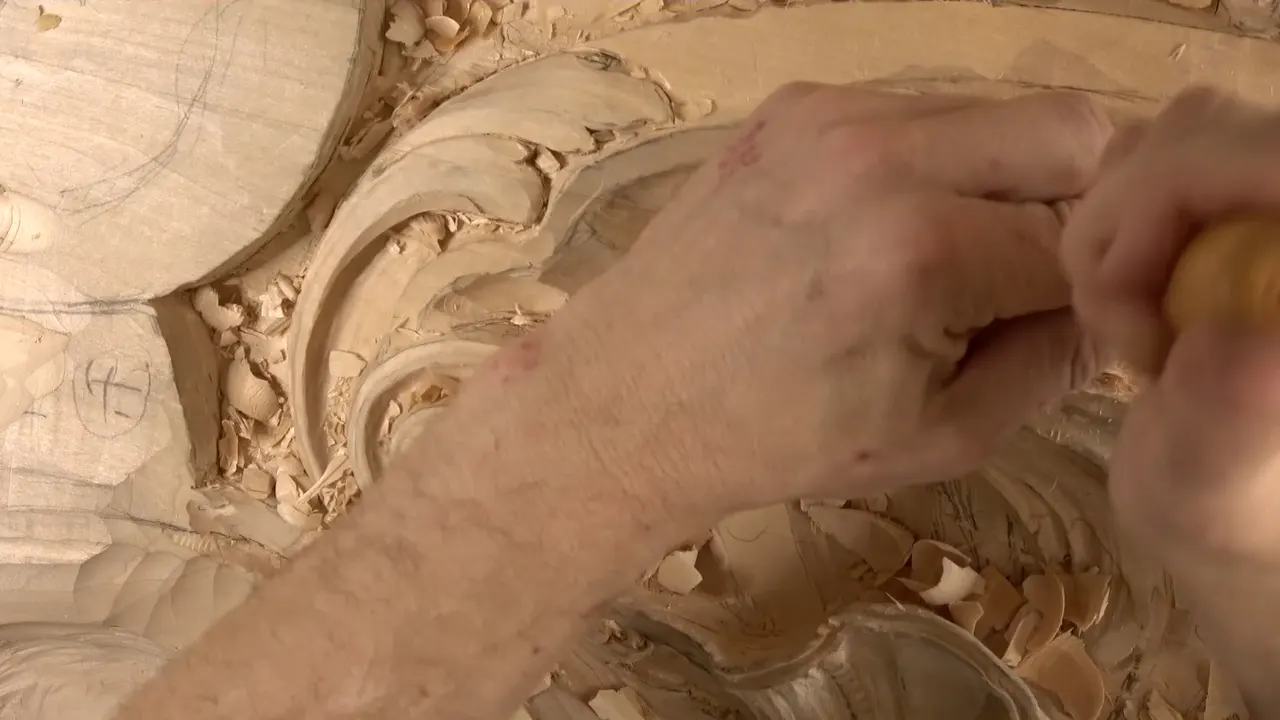

"I doubt" is how I say the odds look poor, and in my videos it sits beside a tool, a size or a plan. Part 10 of workshop 37 has it right after I wonder about a number seven. Other lessons of mine use the same two words too, and this page puts them side by side.
Ever stood over your work with the biggest gouge you own and felt it would not fit? I said so out loud and named a smaller spoon instead. What follows is that part first, and after it thirteen other lessons where the same words come up.
What does "I doubt" mean in part 10 of workshop 37?
The part opens in what I call "a little challenging area, to be honest with you," and I say even circling in there with that tool is hard. Then comes a slip: "See, I just broke a little part of previous shell. Got to be more careful." I call it "not good," say I have to lower that spot and take care of it, and add that it's "not a big deal" and I can still fix it, "but it is something I don't like to see."
First I plan "more excavation on this side also." And here is the line. "Maybe I should use a big number seven." What follows is "I'm not sure if I'm going to be able to fit in it or not," and then the two words that name this page, "I doubt."

The reason comes next: "The ceiling part is in my way." A wish comes with it, "if I would have a three-inch spoon" (76 mm), "it would help me," and then the limit, "I don't think anybody makes it." Even so, I give myself a way forward, which is a smaller spoon "for beginning."
The second side comes after that. I say I "also have to recreate kind of deep excavation, just to match this side," and I leave myself room: "if I need to dig a little deeper, I will." It all depends, I say, on the sides of the convex. The inside has the same job, and "it has to match this part."

My next worry is a number 11: I say I need a smaller one, since that one "would be little too big," and the plan is 7 millimeters (0.28 in). I remind myself to be careful around my acanthus movement. Next comes "let me try to use number seven and attack from the side, which actually works just fine," though "I still have to be really careful."
Then the space closes in: "this area, everything is in my way." A fresh plan follows, maybe a smaller number seven, and with it a smaller spoon and a rule for myself: "just take my time." Back comes a number 11, and I warn myself again, this time "not to crank too much against this edge."

Near the end I look back. "Maybe that was too early that I created my cut on this side. I should wait probably a little longer." My reason is that I wanted to show you "somewhat it's supposed to look like." And then, "that is somewhat what I want to see." The last two lines repeat each other: "about the same depth on both sides."

The parts around it fit. Part 9 has me saying I "almost don't see at all what I'm doing," so maybe I have to stick my head on the other side. Over in part 11 I say, "I'm not afraid of losing the sides," and "I can always dig deeper."
More of the same shows up in that part. It begins, "Now we can develop a convex," and I call it a "preliminary convex." Maybe I should just do a quick way with a back bent, I say. After a pass I say, "it's not the perfect cut, but at least it gives me some idea." Then comes a plan to attack a side "from opposite direction" with "just a straight number 11," and a reminder that I am "really close to that part." Later I say, "I can see my convex coming alive."
Does "I doubt" mean I will not try?
Not in my videos. In Carving Hazelnuts, lesson 6, part 1, I talk about a hazelnut husk that is "supposed to go all the way down, although I doubt I will be able to because it's kind of high." Then come the words "But I'll do my best."

Hashemi Flowers 44, part 6, is about connecting one dig to another. "Not always possible, but we'll see," I say, and then, "I don't have to connect it because, like I said, it's going to be invisible." Whether it connects is the doubt: "which I doubt, because it's a tiny spot." If it did work, I say, "the light going to travel in and it's going to create a beautiful light and shadow effect."

Furniture Panel 38 puts it in a tighter place. On the outside I want "a little deeper cut," because "my cut is not as deep," and I "really wanna keep the detail, really sharp points like just replicating this side." I get a tiny one next and say, "I doubt I can get it in, but some of the sections I probably could. At least I could start." It ends on "We'll see," and none of the three stopped at the doubt.
Each of them sits beside a best try, a "we'll see," or the plan for a tiny tool.
What do I do when a tool is too big for the spot?
I look for the next size down, and I say the numbers out loud. In Furniture Panel 21, part 4, I plan a number 11 at 1 millimeter, then "just a half a millimeter" (0.02 in), adding that I'll do little at first. The doubt follows: "I doubt I should use it half a millimeter because my undercut should be even less than that." So "I should probably use just number one," and a few lines later, "just a number one and double bevel," with "1/16 of an inch" (1.6 mm) after it.

In Venice Room 63, part 2, I have a number 11 at "three millimeters, one-eighth of an inch" (0.12 in). I plan to go "all around with this concave," and I draw a line for the tool: a straight one is "okay" at this place, but it is "not okay" when it goes upward. Another try comes with the line, "Let me try to go this direction," and a doubt that I'll use "too much of it." Right after that comes "I need to switch to a spoon, three millimeters."

In the Lily Box course, lesson 2, part 11, I give the smallest figure. I work with a tool of that size and plan "little deeper channels," and then say even that is "kind of too big of a tool." The line follows: "but I doubt they make smaller than that." The next job is to lower a side, and I plan "just number three" for it.

| Where I said it | What I doubted, in my own plain words | What came next |
|---|---|---|
| Workshop 37, part 10 | That number seven might not fit, with the ceiling part in the way | A smaller spoon |
| Panel 38, part 3 | A tiny tool might not get in, though some sections probably could | We'll see |
| Panel 21, part 4 | A half millimeter, since the undercut should be even less | Probably a number one |
| Venice 63, part 2 | A direction I doubt I can use much of | A 3 mm spoon |
| Lily Box 2, part 11 | A tool smaller than that one, one I doubt they make | Lower a side, number three |
| Hashemi 44, part 6 | A tiny spot that might not connect from the other side | Light, maybe |
| Hazelnuts 6, part 1 | A husk part set high, all the way down | My best |
| Lesson 28, part 3 (Hashemi) | A custom tool you probably do not have | Number eight |
| Workshop 42, part 6 | Taking the opening further right then, a question I put to myself | Later, 1 mm |
Which tool did I doubt anyone has?
A spoon I don't think anybody makes was my wish in part 10, I said. In that lily lesson I doubted that a smaller tool exists. In Hashemi Flowers 28, part 3, it flips around, and the tool is one I own that you probably do not. First I plan a number eight "because it's much smaller flowers," and that "if you've done spoons before, it's exactly the same technique." Then: "By the way, I do have a special tool, which I doubt most of you have."

It was made for that exact job, I say, to "dig out the whole thing, the spoon or a ball," and it is "custom made for me." I also say I'm not going to use it "just because most of you probably don't have it," and "you really don't need to get that specialty tool." So I won't use it.
Can I doubt an idea, and not just a tool?
Yes, and the clearest case is Venice Room 42, part 6. I say I'm creating "a really interesting opening right here," and then I ask myself: "I could take it more if I wish. But my question is, should I or should not? The answer is, I doubt I should."

The reason follows: "Because I can take one millimeter later on and excavate even deeper right here," which would help "if I would just attack it from the right positions every time." Then I say that is "probably how" I'll leave it, "at least for now." So here the doubt is a call, and a deeper dig of one millimeter waits for later.

Venice Room 25, part 3, uses the words on a movement. It is probably a good idea, I say, to undercut right away, "pretty much underneath right here," to make it "even more rounding on inside," unless I want something else, "just get the extra movement this direction," and I doubt I want to do that. It comes up again, plainly: "I don't think I want to do it." Next I say I'll take a straight number 11, "probably 10 millimeters, 3/8 of an inch" (0.39 in).
In Venice Room 47, part 12, the words are about old work. A lot of stone carvers and wood carvers left the wall, I say, and "they did not undercut." Then, "They did maybe little bit, but not much." There is a debate, I say, about why they did it, and some call it "just a more classical look." I doubt that, "just in my opinion." It still looks good, I say, "but it's much quicker not to go in and extremely undercut."
Carving Vase with Grape Leaves 4 takes the words off the wood and puts them on paint. I squeeze some colors out, and a spring green is "too bright," so I say I don't think I'll use it. Gold is okay. Then, "That spring, I doubt I'm going to use it. Just too not natural." The plan is some gold, a little, "right to the stems."

Did I ever doubt the person watching?
Yes. Hashemi 28 above doubted the tools you own, and this one doubts what you can do. In Carving Plate with Butterflies 3, part 1, I say I'll use "just the corner of my tool" and make sure I'm "not forcing." Then: "I mean you could try to present the full body of the tool, but I doubt you able to."

Lily Box 13, part 4, puts the words on waiting. I talk about super glue and a spot "right in the middle," and say I'll put the piece away and let it dry. I plan to check another one, "if it's ready or not," and add, "I doubt because you still have to wait. Even if it's a super glue, you still kind of have to wait." That piece will be glued to the main surface, where I plan "a different type of glue."

What do the doubts have in common?
Three things come up beside each doubt. The first is a size or a spot: a spoon in part 10, a tool in the lily lesson, a husk in Hazelnuts 6. The second is a smaller plan right behind it, such as a spoon "for beginning" or "just number three." The third is a call to wait, to match, or to try anyway, and some of it comes out as "maybe."
The shell in part 10 broke first. Later in that part I said that making my cut on this side may have been too early, and that I should wait a little longer.
Now look at your own board. Is there a spot where your biggest chisel or spoon might not go? And a plan you doubt, with a smaller one waiting behind it? Say it before the first pass, the way I did in part 10, then take the smaller tool and match the second side to the first. For the whole run of my videos, start here. The workshop 37 lesson and the Venice Room course for workshops 26 to 37 hold the rest of this Venice room, and workshops 35 and 36 come right before it.
How it's done
- Name the tool you are eyeing. Part 10 had me float a number seven, saying I was unsure it would fit.
- Say what blocks it. The ceiling part stood in my way, and a spoon of three inches would have helped.
- Plan the smaller tool. A smaller spoon came first for the beginning, then a number 11 of 7 millimeters.
- Match the second side. Both sides at about equal depth was my goal, with room to dig more.
- Go slowly near the edges. I told myself to take my time and not to crank against the edge.
Frequently asked questions
What did I say after naming that number seven?
A ceiling part blocked the way. A spoon of 3 inches (76 mm) would help, I said, yet I don't think one is made. My plan became a smaller spoon to begin with.
Did anything break in part 10?
I broke a little part of the previous shell while circling in with that tool. Not a big deal, I said, though I don't like seeing it. I would lower that spot and fix it.
How deep did the second side go?
Close to the first. My closing lines, said twice, put both sides at about equal depth. Earlier I had left room to dig more if the convex needed it.
What to carve next