

Alexander Grabovetskiy, woodcarver, School of Woodcarving · Published 2020
Is the size marked on a carving gouge really its true size?
Quick answer: A gouge's marked size is a label, not a measurement. The fifth part of Venice Room workshop 37 holds my answer, and I added that a stated figure can be off. Elsewhere a mark of 6 millimeters looked like 5 to me, and one quarter inch was smaller.
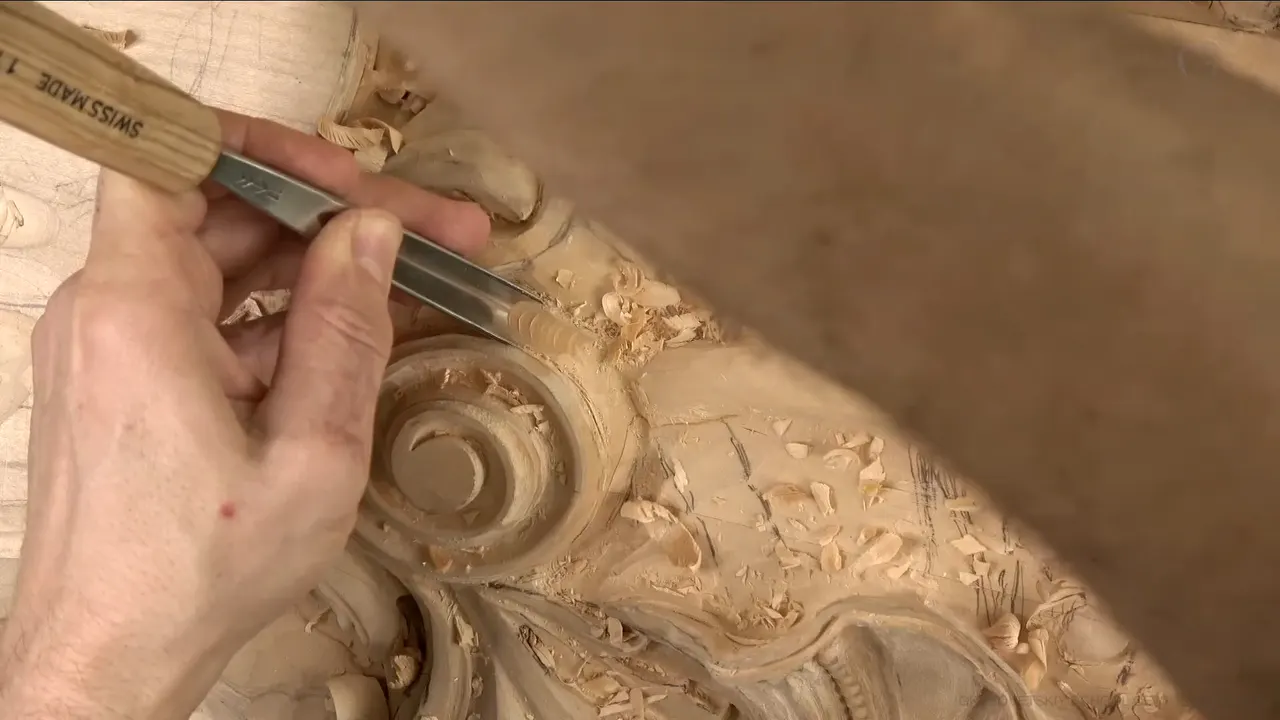

The number on a gouge is a label, and in part 5 of workshop 37 I said it in my own words: "it's never a perfect measurement." The video is short, so this page sets that line beside twenty-four other lessons where I said the same kind of thing about a tool, a figure or a rule.
Ever read a number on a gouge and wondered if your ruler would back it up? Below is part 5 first, then the parts on both sides of it, and after that the other courses.
What did I say about the size of my tool in part 5 of workshop 37?
The part starts in the middle of the work. "Take care of this side a little bit more," I say, and a moment later, "Beautiful." I name the tool next: "Again, I'm going to take the same number, 11 and 12 millimeters." A half inch follows, and I soften it right after: "about."
The reason comes right after. "Because it's never a perfect measurement." I explain that I'm talking about "when they say that's half an inch, that's not necessarily" so. Twelve millimeters is 0.47 inch.

Back at the wood, "Just like that," I say, and later, "that is actually really nice. Really, really, really, really nice." My next plan is "let me attack from this side," and the blending has a reason: "because I don't want to lose the feel of it." Going underneath right there matters too, "otherwise, it's not going to make too much sense."
After a little more cleanup comes "let me draw a boundary." That line is going to be my movement, part of the volute. My shell, I say, can go right underneath of it, "which means I have to excavate deeper." Then the limit I set: "Deeper, but not too deep, not too extreme. But still deep."

Next I think out loud about a secondary bevel. "I also could leave a secondary bevel also, just to give the same idea as what I have right here to this volute." I tell myself I think I should do that, and then, "Why not?" A little later I add, "So we are developing a really beautiful detail," and that I can give a secondary concave.
The acanthus has to go underneath too. How deep? "Well, I don't have to go really deep. That's deep enough, okay." Still, I probably have to start all the way from here. At 05:32 I double-check from below how it looks, and it's "important not to lose the overall feel."

Near the end comes another look from below. I can "always recreate the eye," I say, it's "not a big deal at all," and I still have the position for it. Last, I'm happy with how it feels overall, and "now I probably should chop with the bigger tool on inside."
What sizes did parts 4 and 6 of workshop 37 name?
The figures in part 4 run just as loose. I'll use the same number five that is on my bench, and what I left on the wood is "about quarter inch, I believe, about six millimeters" (0.24 in). A bit later I could use number nine, "or actually, I could use just the number 11," to take the majority of material out.

The sixth part opens with a bigger tool: "20 millimeters, number nine, and chop majority of it." That is 0.79 in. A big tool, I explain, is "just much quicker." Later comes "Three inches, that's what I'm using right now. Okay? Three inches, number seven. Huge tool." Three inches is 76 mm.

Is it worth it? "Absolutely," I say, "if I want to get quicker results, yes." Near the end I name one more size, maybe number five, "I would say one inch." Then: "Well, actually, you know what? I still need to fix this." One inch is 25.4 mm, and that figure belongs to a tool I only planned.
Which marked sizes did I say were off?
Four come from the Furniture Panel lessons. Furniture Panel 16, part 6, finds me with a smaller tool for a close spot: "It's marked as a quarter inch, but it's not really quarter inch," I say, and the tool is "smaller."

In lesson 20, part 1, I grab number seven, "same number seven that we used before." I call it "quarter inch, which is not true," and add that it isn't a real quarter inch "even if it shows six millimeters." That thought ends in Furniture Panel 20 with "In reality, it's not."

Lesson 22 has the same thing twice. Part 3 has a tool at "quarter inch, 6 millimeters," yet it is "not really" a quarter inch, only marked as one. A number seven in part 9 is "just marked" that way, and I say "not necessarily." Six millimeters falls a hair short of a quarter inch, at 0.24 in. Both are in Furniture Panel 22.


Hashemi Flowers 21, part 4, adds a why. I choose a smaller tool and say "just 5 millimeters," then fix myself: it is "actually less." It's a number seven, "marked 6 millimeters, but it's not." By the size of it, I tell you, it's "more like 3/16 of an inch, like 5 millimeters" (3/16 in is 4.8 mm).
Makers get a line of their own: "So manufacturers, when they mark the tools, they're not too accurate about it." And right behind it, "But it doesn't really matter as long as it works, and if it's small enough right now, in a case like that, should not be an issue at all." I finish on "approximately 5 millimeters, although it's marked as a six."

A label can miss the other way. In Carving Hazelnuts 4, a hazelnut lesson, the first part has me saying I can use a smaller tool, maybe a number nine or even an 11. "Same 11 and 10 millimeters," I say. Then: "Although I don't know why is it called 10 millimeters, because in reality it's much wider."

Roman Acanthus 16, part 5, has me calling a number eight "approximately 10 millimeters, although not necessarily true it's 10 millimeters." One maker, in my words, "never marked tools," and I give a reason: "it's not always the same how wide they make." Machine-made or handmade, it makes no difference. "They can mark 10 millimeters, but it could be only 9 millimeters."
The Greek lesson sets a V tool beside its stamp. In Greek Acanthus 14, part 4, I take "number 15 and 6 millimeters" and say, "It marked 6 millimeters. It's number 15/6, but it does look bigger. It looks like 8, but whatever." A bit later I tell you "I guess they know better." My last word is "Maybe not eight, but like seven, I would say, for sure."
The shortest one sits in Venice Room 75, part 12. A plug cut would help me, "maybe about 2 millimeters or so, or 3 millimeters." The line that follows: "It says 3 millimeters, but it's no way 3 millimeters, okay? It's absolutely no way." And last, "It's less." I don't say what "it" is, and the pattern holds.
The general word for a size given by name is nominal size, and the figures below are that kind of size.
| Lesson and part | What the figure said when I named the tool | My words |
|---|---|---|
| Venice Room 37.5 | Tool named by two figures, 12 millimeters among them, then called about right | Never perfect |
| Furniture 16.6 | Smaller tool for a close spot, carrying a quarter inch mark | It's smaller. |
| Panel lesson 22.9 | Number seven I described as just marked quarter inch, nothing more | Just marked. |
| Hashemi 21.4 | Number seven showing 6 millimeters, though by its size closer to 3/16 of an inch | About five |
| Hazelnuts 4.1 | Number 11 that is called 10 millimeters, and I said I don't know why | Much wider |
| Greek 14.4 | V tool, number 15 and 6 millimeters, judged by how it looks | Looks like seven |
| Floral 10.1 | Straighter gouge named as 12 millimeters, which I called close to a half inch | Pretty close |
| Floral 1.2 | Pressed mark that I guessed to be a half inch before taking the measurement | Slightly less |
| Lesson 21.13 | Number eight at approximately 14 millimeters, another one I named a half inch | Whatever fits |
When did I call a figure "about" and move on?
More than once, and out loud each time. Floral and Molding 10, part 1, has me cleaning the opposite side of what I carved, where any straighter gouge will do, "maybe about number two, number three will work." I give it 12 millimeters and call that about a half inch. It's "not exactly" that, I say, but "pretty close."

Floral Panel 1, part 2, goes a step further, because I took a real measurement. First I press a mark and guess it at a half inch. "But I can measure it." After the measurement it comes out "slightly less," maybe about 1/32, "but half an inch would be close enough."

In Floral Panel 7 I call a center part roughly a half inch. I tighten it a little: "about maybe 12 millimeters or so." Each time the figure is close enough to work with, and I tell you it is not exact.
Now I turn the idea toward you. Back in Furniture Panel 21, part 13, I use probably number eight "again, whatever fits," roughly a half inch, "approximately." I would say "about maybe 14 millimeters." And then: "It does not have to be 14 millimeters. Whatever fits."

My reason is plain: "Because yours is going to be maybe slightly different. I mean, I'm talking about your panel." That 14 millimeters comes to 0.55 in, while the floral lessons said 12. A half inch is 12.7 millimeters, so my figures land on each side of it.
Workshop 4 of the Venice Room has a go at it too. In lesson 4, part 9, I plan a smaller number nine because "I do have a lot of movements." Just about a half inch is the plan, "approximately 14 millimeters is what I'm using." Then: "Again, it's approximate."

Angles get the same treatment. Ask what angle I'm holding in Plate with Butterflies 11, part 1, and I say "It's almost like 90 degrees," then "not necessarily exactly 90 degrees, but almost." That is a right angle, or close to it. And in the First Cuts for Beginners course, workshop 1, I plan to subdivide at "three quarters exactly. Or you can use 20 millimeters," and add, "Of course, three quarter is not exactly 20 millimeters, but still very close."
One lesson does give the exact figure. In Roman Acanthus 2, first part, has me using "number eight again and one inch or 25 millimeters, 25 and a half to be exact, 25.4." An inch is exactly 25.4 millimeters, and I say so.
Does "not necessarily" stop at the numbers?
It follows me everywhere. Over in Hashemi Flowers 33, part 2, I use a number five a lot, and some of you may think it is my favorite tool. "Not necessarily," I say. It can become my favorite today, and on the next project "it will be absolutely different tool" that I'll use a lot more.

Roman Acanthus 2 also says, "It's not necessarily the tools I'm using you have to use. So just use whatever tools you have as long as if it works." A specialty tool in lesson 16, part 5, is one you are "not necessarily" going to use every day, I say. If you do reproduction furniture or restoration work, I say, it makes sense to have it.
A small skew knife, number one, works the sharp ridges in Furniture Panel 34. My reason is "just to prove the point," that it is "not necessarily up to the tools." There are "multiple ways actually to do that."
In Venice Room workshop 4, part 1, I talk about gouge thickness. "When you want to get to the final destination, it is better to use not necessarily smaller gouge, but thinner metal." I explain that "if you have a big gouge with a thin metal, it is better because it's not creating as much stress inside of the fibers."
My way gets the same line. Floral and Molding 13, part 1, gives my goal as teaching techniques of approach to woodcarving, "and that's my way, of course. Not necessarily the only way." There is more than one way, I tell you, and I have said so "multiple times." A different course says it too: Venice Room 52, part 10, has me showing one way to attack a spot, telling you there are several, and mentioning people working in a classical design who "really don't like excavate deep."
Even a pattern of mine gets it. In Furniture Panel 19, part 5, I say, "my waviness is not necessarily set in stone, so you can just try your own waviness."

Rules get it too. In Roman Acanthus 10, part 4, I check my edge for a wire, then re-strop or resharpen it, multiple times daily. Some people say the best wood is a soft wood and your tools shouldn't get dull, and "that's not necessarily truth." It is soft wood, I say. But "your tools, for some reason, still get dull, and really quickly sometimes."
In Hashemi Flowers 24, part 3, a V tool is "almost number one tool on your workbench," and some people think it's the hardest one to sharpen. "It's not necessarily true. So you can actually train yourself to sharpen this." And Venice Room 9, part 5, passes on what my teacher told me: "there is no such a thing as a bad wood. There's just dull tools." A catching pass, I say, absolutely does not necessarily mean the wood is bad. It means the tool is not sharp.

What did I do with a marked size when I carved?
Hashemi 21 has me using the number seven anyway, mark and all. In Furniture Panel 21 I said "whatever fits." Back in workshop 37 I took my 12 millimeters, said a figure like that is not necessarily right, and went back to the carving.
Does a number on your gouge say one thing and your eye another? Part 5 shows the figure said, called "about," and the carving going on. For the whole run of my videos, start here. The workshop 37 lesson and the Venice Room course for workshops 26 to 37 hold the rest of this Venice room.
How it's done
- Give the figures a soft word. Part 5 had me state my tool in millimeters and inches, and call the figures about.
- Say the figure is not exact. I told you the figure is not necessarily what they say, and I gave my reason.
- Look at the tool itself. In Hashemi 21 a tool with a 6 millimeter mark looked closer to 5 to me.
- Let the work decide. I called a small enough tool no issue, and in lesson 21 of that course, whatever fits.
- Go back to the wood. After that line my plan in part 5 was to attack from this side and blend, so I don't lose the feel.
Frequently asked questions
What tool did I name in Venice Room 37.5?
I named my tool by its figures in millimeters and in inches, then called them "about." Soon after, I said a size like that is not a perfect measure.
Which marks did I call too high?
A number seven with a 6 millimeter mark looked closer to 5 in Hashemi 21. A tool in lesson 16 carried a quarter inch mark and was smaller than that.
Was a mark ever too low?
In Hazelnuts 4 I said a number 11 tool, ten millimeters by name, is much wider. Over in the Roman course, lesson 16, I said a 10 millimeter mark could be only 9.
Does a wrong mark stop the tool from working?
What to carve next