

Alexander Grabovetskiy, woodcarver, School of Woodcarving · Published 2020
What does it mean when a wood carver says you can't see what he is doing?
Quick answer: When I tell you the work is hidden, I mean a spot you cannot see. In Venice Room 38.10 I still say what I am after, a nice line, like a tangent line. In other videos my hands, the inside of a piece, or a shape still to be carved are what stays hidden.
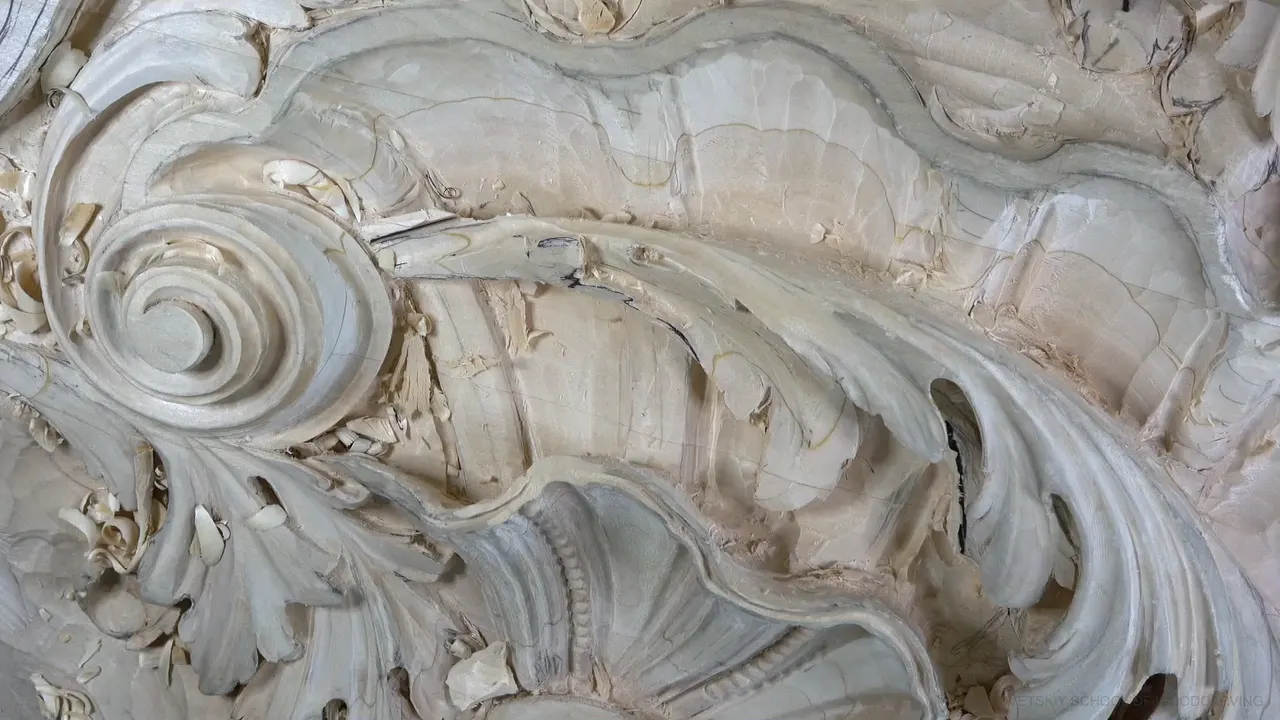

If I tell you the spot is out of view, I still say what I am after. In Venice Room 38.10 it comes at 06:33: "I know you don't see what I'm seeing right now, but what I'm after is just to give a nice line, like a tangent line."
Ever watched a gouge slide behind a hand and wondered what happened to the wood? Several of my courses have a moment like it, and the reason changes. This part runs only 427 words, so I set it beside other videos of mine: more Venice Room workshops, and my Furniture Panel, Floral and Molding, Lily Box, Maine and acanthus courses.
Where does part 10 of workshop 38 begin?

Right in the middle of a carving. "And, of course, I need to chop that underneath of here," I say at 00:27. I name the question you may be asking, at 00:51, why I did not go all the way in. I have this part and I do not want to damage it. "So that's why I have to keep an eye, all of my cuts, how deep I'm going with them."
Then comes the shape. It is much better at 01:31, I say, and I need to round it. "Not kind of, but make it round." At 02:11 I say it has to feel completely round, growing from underneath, and flipping in one direction.

Reach is the problem after that. "I need somehow to reach the bottom of it," I say at 03:04, and not every tool is going to be sufficient. Number one back bend will help me a lot, I say. A little bigger one is needed, "like 10 millimeters" (0.39 in), and it is absolutely flat, like a chisel, at 03:33. Handy tool also, I add at 03:40.
"Maybe I can attack that from this side," I say at 04:25. My plan is a number 11 spoon gouge. "But not big." About two millimeters (0.08 in), I say, and then a limit of my own: "No more than that." Then come the words "go underneath" and "excavate a little deeper." A limit comes at 05:31: my goal at this point is not to take too much, because it would be a mistake.

Near the end there is one more area. I could fix the movement with a bigger tool, I say at 06:03, and I check if number two is too big. "And it is." A smaller one, like number five, comes up next, and my verdict is "That's not going to work." Number three follows, and then the line you read at the top. The line needs to be tangent in the three-dimensional world also, I say. From the camera view you may see it or not.

Does the rest of workshop 38 say it too?
Part 8 does, at 01:15. You probably can't follow my work, I tell you, but I am "just creating the idea of the pipe." Next I plan a flatter side of the tool, closer to the concave, and a blend to almost nothing. A different kind of hidden turns up at 03:03. I could give extra movement to the inside, "which you really don't see." Not now, I add.

Part 11 follows a result. "It just gave me a more shadow, or more deeper shadow, I should say," I tell you at 06:11, after saying you probably have not noticed what I just did. Twenty seconds later: "Sorry, you don't see. I barely see myself." And I don't want to see the concave right at the edge.
Part 9 holds a related thought, about a spot nobody will look at. A better separation there is not really needed, I say, because it will never be visible. This side faces the ceiling. Even so, at 02:20, I still say, "a little deeper."

When do my hands cover the work?
More than once my hands are in the way. Part 11 of Venice Room 81 has me thinking I may have to change the position I carve in, because it is not really convenient. "I'm just covering with my hands," I say at 04:04. Ten seconds on, comes this: "And yes, I'll get much deeper."

Room 64 repeats the apology at 06:05: "Sorry that I'm covering with the hands." Most likely, I say, the work is lost to you. "My apologies. But hopefully, you can detect right now." I created the shape of an uphill movement, I say. A wall comes next, one that I need to eliminate, and for it I plan a number two back bent, 6 millimeters, quarter inch.

Part 7 of Furniture Panel 22 makes the apology wider. "I am trying my best, but sometimes it's just impossible not to cover." Next I plan number three, with a gradual start, to make a part lower, because I really want to see it going underneath.

Another apology adds my head. "And also apology if my head was again in the way," I say in Venice Room 51, part 10. The tool there is one millimeter. A division is coming, then another micro division, and then the curl I am after.

Distance counts too. In room 132, part 2, when it is too close, I say, my work almost disappears from your view, and it is "almost impossible sometimes to get an idea even what am I doing." I plan a number 11 of 5 millimeters (0.2 inch) for "all that mess."

Why did I call it working in blind?
Lily Box, workshop 2, part 6, gives the reason in full. "I do apologize if I am sometimes working in blind, which I mean that you don't see what I'm doing." I was getting used to a new system that saves me a lot of time on editing. I was live recording everything. A problem came with it. If I am concentrated on the surface I am working on, sometimes I can't see what my cameras are shooting.
A lot of projects are going on, I say, and shooting everything and editing it takes so long that I am not as productive. "But I have to be productive in projects for my clients and for the school." The apology ends with this promise. "Next video is going to be even better."

Lily Box 4, part 6, tells you what my fingers do in a real production setting. "I try to get the tool as close as possible with my fingers." Doing it that way right now would hide the work from you, I say. The work there is a concave, with a number eight.
Which spots hide under the wood?
Floral and Molding, lesson 11, part 1, names the place. "Unfortunately," I say at 02:38, what I do underneath is hidden from you. The overall flow line is the thing I am establishing. There is no way I can show that to you with the camera. "But just to guess, I'm just making that really smooth transition downhill." A little earlier the tool is a spoon in number three, a small, tiny spoon.

Inside a piece is the subject in Venice Room 10, part 2. At 02:48 I say that what is going on in there is hidden from you, but essentially it is nothing special. "It's just lots of waste." Then I take it back: "I shouldn't say that. I'm not wasting material at all." The tool is number 11 again, going from the bottom up, and a number nine or number eight would do also, I say.

Venice Room 64, part 8, has me joining two spots underneath. Yes, I say, it is hidden, "but I'm just trying to dig out underneath whatever." Then a spoon, maybe number four, and a bit long bevel. I say it slices through the fibers really easily.

The Grinling Gibbons class in Maine, lesson 14, part 3, splits the view in two. The inside stays out of sight, I say, but "you do see. This wall," and the wall is visible. Undercutting it a little better is next, and I say I can probably use number 12.

Chamomile and Bow Rosette 3, part 2, has a bowl worked from underneath. "Even if" my work stays hidden, I say, I'll take a number 11 for an even deeper undercut. After that I plan a small tool, like number three, for a slight cleanup of two other parts.
Room 18, part 6, adds a sound. At 06:31 I apologize. The job is a full edge on the inside. At 07:03 I say even I cannot see the spot, "but I'm listening." I am listening to the sound of my tool, in case I'm doing something wrong, and I say I can use a mallet to get a little more inside.

How does a shape look before it is carved?
At times the missing piece does not exist yet. "I know it's not carved yet," I say in Furniture Panel 8, part 4, and the leaf curls like this. When I put my eyes and the pipes in, I say, it will make all the sense.

Part 12 of Venice Room 7 puts the wait in one sentence at 06:57. "But later on you will," I say. A number 11 of 7 millimeters (0.28 in) is my plan first, the same one as before, then "maybe even smaller," 5 millimeters (0.2 in).

The wait is longer in Venice Room 15, part 2. "But you will later. But not now. I don't want to stop just because I want to show it to you." I want to show it, "don't get me wrong, but at the right time." Then comes "But see, it casts beautiful shadow."

Room 69, part 7, shows the reason together with a plan for the eyes. "I know it doesn't make sense yet," comes at 03:53. A division is coming right there, I say, with an eye and another eye. For now I am doing those eyes a little closer, which in another case would be a little farther.

The Furniture Panel design lessons widen the point. In Furniture Panel 14, part 1, I say that "when you look at the overall picture," my aim is easy to miss. For me it is really important to follow the main movement, "the flow."

Why does a small tool look huge on your screen?
Floral lesson 12, part 3, answers it in millimeters. "It looks really, really huge on your screen, but I'm using only 5 millimeters veiner" (0.2 in). "You see a lot bigger than me, which is okay." I will not leave it like that, and I plan to clean it. Then number seven, 14 millimeters (0.55 in).
Acanthus over Moldings 4, part 3, names a limit of the room. It is a limitation of angles. I have plenty of cameras, but I can't "put 20 cameras" in this room. Then I plan the number 11 again, the same one as before, or maybe two and a half millimeters (0.1 in).
The October 2020 livestream gives the cause in fewer words, at 47:56: "because the position of the cameras." Over in Venice Room 28, part 3, my approach comes first. "That is wrong direction," I say. I need to attack that from this side. After that comes the apology for what you could not follow.

A lower angle, about 45 degrees, shows up in Furniture Panel 38, part 2. The whole section has to be lowered gradually, I say, and I will get a number six, a quarter inch (about 6 mm). Room 159, part 3, has me after a profile close enough. For that I plan 12 millimeters (0.47 in), number 11, to dig a little deeper.

What comes next in these videos?
Ten moments sit side by side here. Each one names what I could not show, and then I go on.
| Source | What the screen could not show | My next words |
|---|---|---|
| 38.10, Venice Room | The nice line I was after | Tangent in three dimensions, then the camera view |
| Part 8, same workshop | The idea for the pipe, which you probably could not follow | A flatter side of the tool, blended to almost nothing |
| Part 11, same workshop | A deeper shadow I had just made | A blend, and no concave to be seen along the edge |
| Room 81.11 | My work, hidden behind my hands | And yes, I'll get much deeper |
| Room 64.11 | Hands over the work | Number two back bent, 6 mm (quarter inch), for a wall |
| Furniture 22.7 | Impossible not to cover | Number three, starting gradually, to make a part lower |
| Floral 11.1 | Work underneath, with no way to show it | A smooth transition downhill |
| Room 10.2 | Inside a piece, lots of waste, as I called it | A correction |
| Room 15.2 | Something you will see later, but not now | Beautiful shadow |
| Floral 12.3 | A small veiner that looks bigger on your screen | Number seven at 14 mm (0.55 in) |
After the apology, all ten go on about the work and not the camera. Two rows point at a nice line and a pipe. In three more I say I will go deeper, plan a tool for a wall, or point at a shadow.
Where does this leave you at your bench?
In the ten videos above, the words after the apology go back to the work, and that is the part you can follow at your workbench. The work hides behind a hand, a wall of wood or a hollow underneath, and the wood carving goes on.
My workshop 38 lesson shows part 10 with the other parts of that workshop. The course page for workshops 38 to 49 holds the rest of this room, and the other courses I named have pages of their own. For my lessons in one place, start here.
Every size on this page is mine in millimeters, with the inch figure beside it where I gave only one of the two.
How it's done
- Watch what I name. In 38.10 the thing I name is a line that has to be tangent.
- Look at the wall in view. The Maine class hides the inside, and the wall is visible.
- Wait for the shape. In Furniture Panel 8.4 the leaf has not been carved.
- Hear the tool. In room 18, part 6, the sound of the tool is my check.
Frequently asked questions
What did I name at the end of this part?
A line that must be tangent in the three-dimensional world too, I said at 06:33. You may or may not see it in the video.
What went wrong with my cameras?
In Lily Box 2.6 a new system that saves editing time was still new to me. My focus stays on the surface in front of me, so sometimes I cannot see what my cameras are shooting.
What tool did I plan for going underneath in 38.10?
Number 11, a spoon gouge, not big, about two millimeters (0.08 in). My words were, no more than that, and I wanted to go underneath and dig a little deeper.
What to carve next