
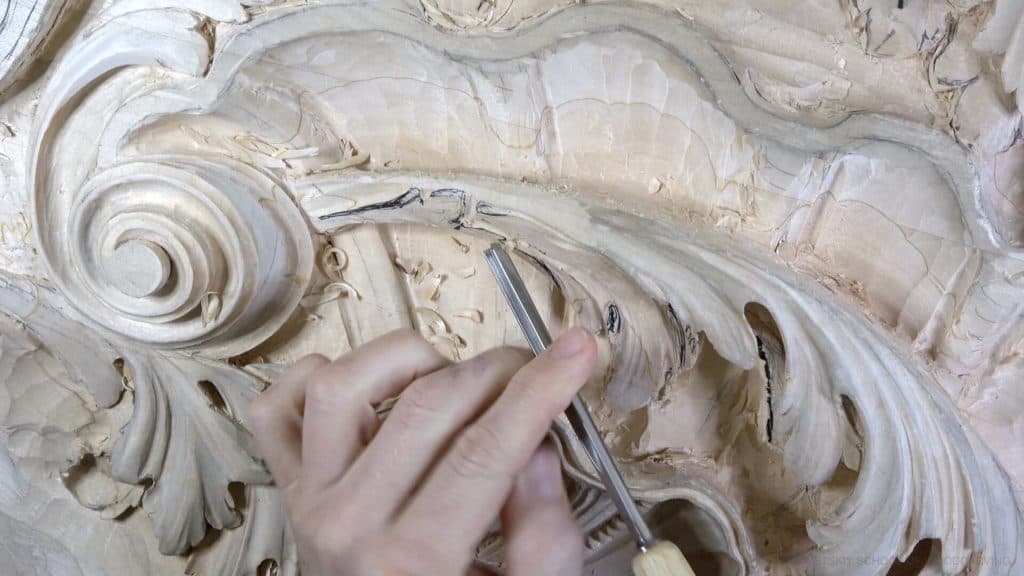
Alexander Grabovetskiy, woodcarver, School of Woodcarving · Published 2020
What does triple mean when a wood carver says it?
Quick answer: "Triple" is the word I used in Venice Room 38.4 after saying two separations would get by: "But I still like to see triple." In other lessons it goes with leaves, flowers, concaves and movements. Two was possible, I said, and that was okay.
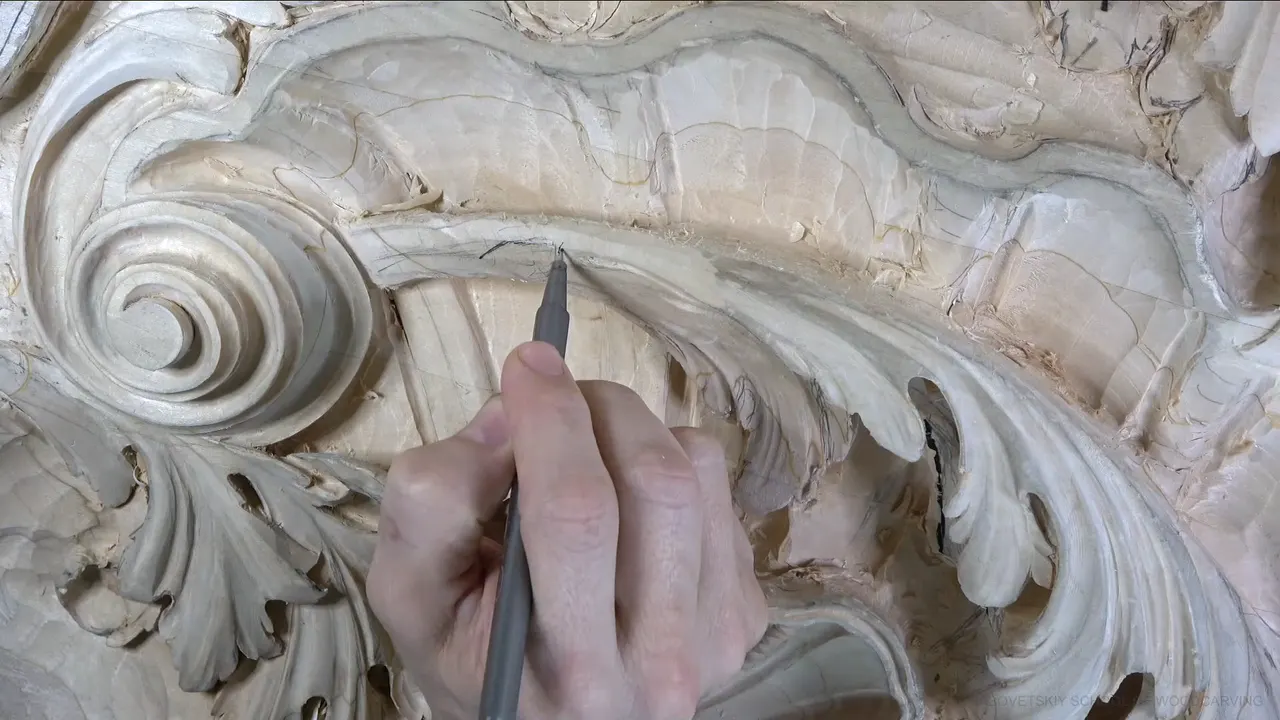

In Venice Room 38, video four, I said two separations would get by and I still liked triple. In my other courses I use the same word for leaves, flowers, concaves and movements. If only two fit, I said that was okay.
Ever stopped at two parts on a leaf? Did two look finished, or did your eye ask for one more? Here is where I say it, in the Venice Room workshops, the Lily Box, the Furniture Panel lessons, the butterfly plate, the beginner board and the Roman acanthus course.
What do the triple lines in these videos show?
- In 38.4 I wanted a third separation even though two would do.
- A lily flower, I said, comes in sections of three.
- My word goes with leaves, flowers, curls, concaves, a division and movements, as the lessons below show.
- A double in workshop 51 was okay too.
- On a furniture panel it also meant three different depths.
- I used it for checking measurements too.
What did I say before triple in video four?
The video opens on a section of the leaf that I had left alone. "I didn't work on that, on this section of acanthus movement until the end, until I get that area done," I say. "Although it's not done yet, I still have to work just to give the details," and now I can give "a really interesting movement detail."
My plan was to bring "just a small section upward," going "from almost nothing all the way." I changed my mind there. "Well, actually, I could actually do something like this. Even more interesting like that."

The count starts here. "And yes, I will need to get another separation," I said, and from underneath came "another separation and another separation" that would rotate. That part would be undercut underneath, and "that is going to be an eye."
One part I did not like. "The only part I don't kind of like is this one." Looking at that bit of the movement, I said I kind of don't like what I see, and I planned to change it that same day and give "an extra eye right there." The concave beside it was "a little too deep," and it "doesn't look too good." I would work on "this one," then "move to something else."
The tool came before the first mark. The first tool would probably be "the same number 11 to outline it," at 5 millimeters (3/16 in). "And let me do that. I'll just outline it."

"Obviously, it's supposed to look like that part is underneath, below this one." Then a rule, "So see how important it is to keep extra material for the later times." Details like that, I said, "you can always work on a little later."
What was the little separation I did not want to lose?
"Yes, there is going to be a little separation, and I don't want to really lose it." I added "Which I could lose with no problem," and said I could "get by, actually, with just the two, this one and that one."
And then the line. "But I still like to see triple, that's kind of more accurate, I'd say." I went on with "And go around this, and carefully," and one more separation was coming.

That would give me "a really beautiful movement, I believe." Still ahead was a deeper concave, and before it I wanted to rid myself of "what I don't like right here." I did not like that bit "in this context in the overall design." And it would also give "a more open spot for a shell."
Then the tool again. "I'm going to attack that with the number 11 and 5 millimeters, which is 3/16 of an inch, and go in." Cleaning would follow, with "a 5-millimeter, so also number 11 spoon."

What comes just before and after video four?
Video three, just before it, has me on the sides of the main convex. "I'm using four millimeters, small one, and little by little, removing on the sides of that main convex." Four millimeters is about 5/32 in.
Video five opens with "it gave me opportunity, actually, to lower down a little bit the shell part," "because it doesn't look too right." Then comes "Let me do this separation, this side, again, with the same number 11 and 5 millimeters." For the big concave I named "Number nine and 13 millimeters, half an inch."
Does triple mean three flowers on a furniture panel?
It does in my Furniture Panel design course. Video one of workshop 12 has "Going to create triple flowers, like three flowers altogether." I called the next part a "really important rule." With three flowers close to each other, I do not want to repeat the same size of it.
The sizes would run down. "If this one is the biggest one," the next would be "a little smaller" and the last "even more smaller." That would be "my flowers, the main cluster," and I would "like to get some more flowers" too.

The second video of that workshop has the leaves. "Maybe I can create absolutely different type of leafage, like triple leaves, just like that. And I can always change it." The center line would stay, because "it's going to repeat my center movement."
In workshop 14, video 6, I put it to the panel as a thought, "some kind of triple leaves." Then, "No, it doesn't look good," and a line later, "It doesn't look good."
Which parts of a lily come in triples?
Nature comes up in workshop 10 in the Lily Box, video 8. "Like I mentioned before, when you look at the real-life flower, a lily flower, it's just divided in two sections. Two triple sections." I counted three parts in each one.

Here is how I put it: "for some reason, in nature how it's created." Later in that video: "If it would be different type of flower, I really wouldn't care." But "in a lily, it's a no-no." The rule in plain words is that a lily is supposed to be divided in triples.
Two other videos in that course use the word. A triple leaf appears in workshop 7, "So I do have a triple leaf," and a small leaf would sit below it. I planned to outline with number 11 at 3 millimeters (1/8 of an inch).
Over in workshop 9, video 2, one detail was "a little too big now." My idea was to divide it in a couple of details, make one part "a lower movement" and create "the upper movement right here." "So that would be part of those triple detail, right?"
How do I treat a spot where only two fit?
Lily Box 13 has two sets. "Sometimes it takes longer to do alephs than some of the flowers," I said, and then "I've got two sets, and there's a double and there's a triple."
Lily Box 9, video 3, has the plain answer. I usually like a triple division, I said, but this time "I do have only double." One separation gives two details, and "usually I like three, but that's okay."

Venice Room 51, video 6, has a double too. "I could create another separation going like that," and I said it would be only a double separation, "which is okay." Then "I like triple, three parts. But in this case, I don't want to separate down."
Can a concave be triple too?
The twelfth video of workshop 57 answers yes, and I said I would do some of it offline. The next step would be "to excavate a little deeper concave," and "a triple concave. Okay, exactly the same what I've done in the middle." I would make "a quarter-inch concave, another quarter-inch concave" (about 6 millimeters), and in the middle "a little wider concave."

"So it's a triple concave. That's going to give me a more dimensional look." For the line, "Let me place the line." Then "Of course, it's a quarter right there, but less right here, about five millimeters at the end because I really need to see tapering." Five millimeters is about 0.2 in.
The shorter version is in workshop 58. "So I've got a triple concave, although maybe I should do a little deeper concave on this side." That was a maybe.
Is a triple movement three waves?
At workshop 83, video 12, "I've got one, two, three, triple movement like that," I said, counting three of something. Next, "I can actually unite that in one chunk." A marker would show it "for you to understand much better," with "one leaf on top of another one."

Workshop 97 goes another way, in video one. "I'm going to create another eye," I said, with "a leaf underneath," and the one empty spot would be this one, so "more logical." Then came the word, and then "I do change on the fly, which I think it's okay."
Over in workshop 98, video 7, I drew first. "So let me establish the outline first, and I'll clean everything." Then "That is the main triple movement," and "a secondary wave" and "a little wave on this side right here," and I counted them to three.
My butterfly plate has two lines of the same kind. The second video of workshop 10 has "So the next one, I probably should do same idea what I've done right here," then "We're going to do it also like in the triple. We're going to do some changes." The change would be "more true to the overall design." Workshop 12 has the same detail "like I've done on the inside, like triple movement."
Do I use the word on a knife carving?
I do in my beginner course. In Curly Kitchen Cutting Board workshop 6, video 1, "there is volutes, like triple volutes right here on the tail." After that, "Just follow those lines that we have drawn," and "now I can make this cut deeper."

Two more come in the second video. "On this wing, I just did triple curls or triple volutes." And "you can see I have a triple leaf, one leaf, two leaves, and three leaves, but I need to make sure this wing is popping out." My bevel would be "as low as possible," with "few passes."
The knife is in workshop 5. First, "this is not flying out, so that means I need to refine this cut." Then "nothing wrong to come back and make a double cut or triple cut, but you can see the results are really good."
Is triple also three checks or three depths?
Triple checking is in workshop 1, video 6. "If you make mistake right now, even just the one millimeter, two millimeters, later on, it all adds up." So I was "measuring, remeasuring, checking, double-checking, triple checking, seven times checking." I added "Like my grandpa said many times, 'Measure seven times, cut once.'"

I fixed a word in workshop 3, video 2. "Double-check, I should say, double-check, triple check, double check."
Once it was a shadow. Roman acanthus workshop 16, video 3, has "create another fingernail shadow on inside." Then "You could do actually even triple, if you wish, shadow. That's going to give you even more beautiful look," but I would do just a single one, and that "this is already some extra steps you really don't have to do."
I planned to begin with a knife, "Let me use a knife at first, just create little deeper cut in the middle." Then I would probably use "a number nine and about 10 millimeters, three-eighths of an inch." After that I would "step away approximately five millimeters" (about 1/5 in) "and create an extra notch cut."
Another time it meant depth, in workshop 38 of the Furniture Panel course, video 2. "Because I got triple," I said, and I counted lines, "I've got a line right here," "another line right here." The cuts would go from a deeper one to "a shallower cut," then "really shallow."

Then came a plan for my router plane, with "one millimeter" (0.04 in).
Where each triple line comes from
| Which things the word named | How many | Where |
|---|---|---|
| Separations on one part of the leaf | Two or three | Part 4, workshop 38 |
| Parts in each section of a lily flower | Three | Lily 10.8 |
| Concaves, with a wider one in the middle | Three | Venice Room 57.12 |
| Movements that I counted one, two, three | Three | Venice 83.12 |
| Times I check a measurement at the start | Seven times | Venice 1.6 |
| Shadows inside the middle part of a leaf | One or three | Roman acanthus 16.3 |
| Different depths of cut on one furniture panel | Three | Furniture Panel 38.2 |
How does video four end?
The part stops on the spoon, "Let me use a 5-millimeter, so also number 11 spoon," and then "Just get rid of some of the excess."

If you want to watch a leaf like this one turn a plan into a relief you can touch, the tuition opens every workshop in this room.

How it's done
- Count what is there. In video four I said I could get by with just the two.
- Say what you prefer. Triple, I said, is kind of more accurate.
- Place the next separation. Next came "And go around this, and carefully," and one more separation was coming.
- Outline with a small tool. I named number 11, 5 millimeters (about 0.2 in), for the outline.
- Keep material for later. I pointed out how important it is to keep extra material for the later times.
Frequently asked questions
What do I do when only two parts fit?
"Usually I like three, but that's okay" is in Lily Box 9.3. The double in workshop 51 is okay too. Two would do, I said in workshop 38, video four, and I still liked triple.
Which tool did I name where I said it?
A number 11 of 5 millimeters (3/16 in) is the tool I named for the outline in video four. Video five uses the same size again for the next separation, and the big concave there got a number nine of 13 millimeters (half an inch).
Is triple only about leaves?
My videos use it for flowers on a furniture panel, sections of a lily, a concave in workshop 57 and a movement in workshop 98. Workshop 1 has triple checking for measuring, and Roman acanthus 16 has a shadow.
What to carve next