

Alexander Grabovetskiy, woodcarver, School of Woodcarving · Published 2020
How do you know when to switch to a smaller carving gouge?
Quick answer: I switch to a smaller gouge when the one in my hand is too big for the spot, and I say it out loud. In workshop 38, part 6, I ask for a smaller one, two millimeters (0.08 in). In other parts the sizes go down to 1 millimeter.
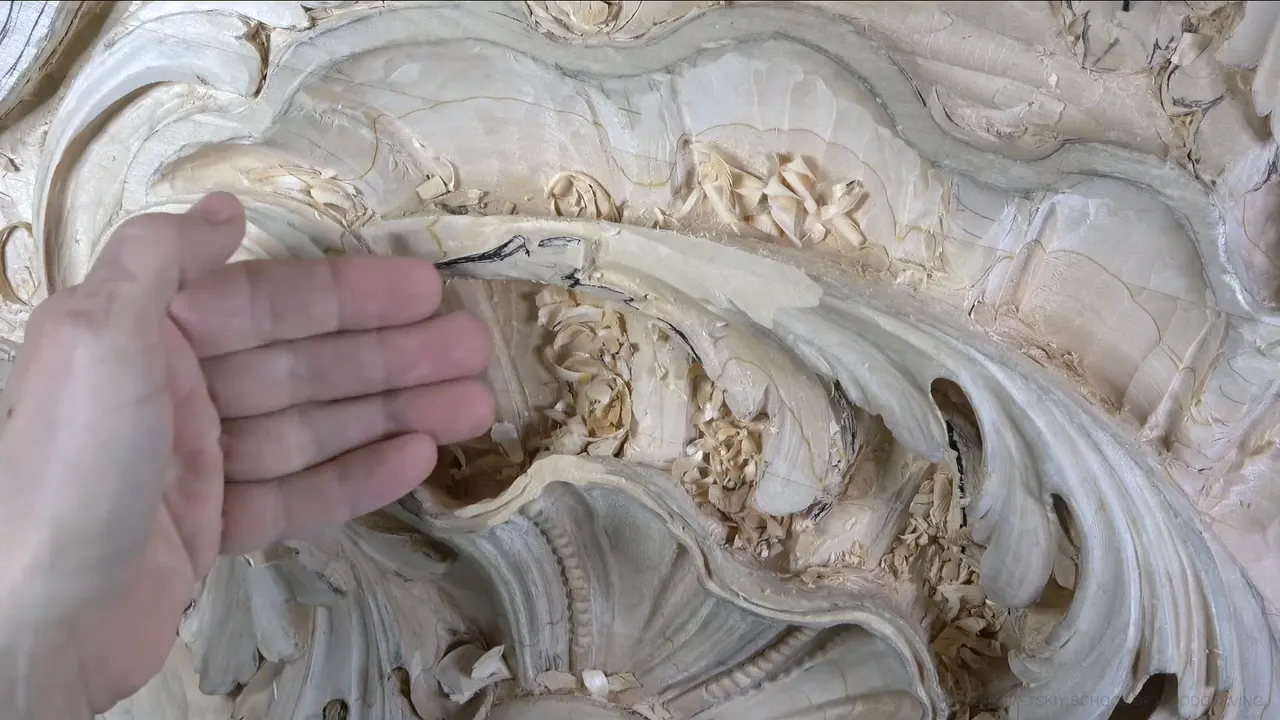

When the tool in my hand is too big for the spot, I say so out loud and pick up a smaller one. This short video has the call three times: "I need smaller, two millimeters now," then "I need smaller number nine," then "this is probably too big, and I need to use two millimeters."
Ever set a gouge on the wood and felt it was one size too large? The size in two of my three calls is two millimeters, or 0.08 inch. This part runs only 404 words, so I put it next to other videos of mine with the same call in my wood carving. They come from more workshops of the Venice room course, and from my Greek, Hashemi, Furniture Panel and Floral and Molding courses.
What do I say in part 6 of workshop 38?

The first line, at 01:09, asks for a smaller one, two millimeters (5/64 in). I say "Two millimeters" once more, and then roughly 40 seconds go by without a word. When I speak again, at 01:55, it is "Okay. And that is probably good. It is good, but I think it is good to that point."
My next sentence is about a bigger tool. "Let me kind of blend that in with the bigger number 11," I say, and moments later, "See? And that is beautiful. Beautiful development."

At 03:08 the tool is a number nine, and I say to clean "that right here." At 03:32 I add that I could go and clean everything, but my main goal first is to establish the main movement. So the nine is for one spot, and the main movement comes first.
"Now let me make an eye cut," I say at 05:04, and the third call lands in the middle of that acanthus detail. Next, at 05:33, "And go right to the eye of acanthus." Number 11 is back by 06:07, and I call it the acanthus tool.

One more problem has nothing to do with size. "This number five needs to be sharpened because it leaves some trail," I say at 07:16. The problem there is the edge.
Do the other parts of workshop 38 step down too?
Parts 5, 7 and 3 do. In part 5, at 02:02, I say, "Number nine and 13 millimeters, half an inch." The job is a big concave. For the smaller one I plan on number 11. (13 mm is 0.51 in, while 12.7 mm is exactly 1/2 in.)

Farther on in part 5, I think about a size lower still. "Maybe about 3 millimeters or even 2, but let me try 3 millimeters first," I say at 06:44 (0.12 in and 0.079 in). That is only a plan, and the next words are "And go around."
The seventh part calls for a second pipe on the inside, one that should not pop out as much. My probable pick is a smaller number 11, "like five millimeters" (0.2 in). "Careful just to use one of the sides of the tool," I add.

In part 3 I ask at 06:37 whether a smaller tool is the better call, "A little smaller." Sizing comes at 07:05: "maybe 10 millimeters and sweep number three," which is 0.39 in.
How do I know the tool is too large for the spot?
I name it as soon as I see it. The relief cuts in Venice Room 62, part 8, start with a number 11 that is a little bigger, "12 millimeters to be exact" (0.47 in). The cut is meant for everywhere I have separations. Around 04:06 I say it is a bit large for this area, and 04:18 gives the answer, a smaller one.

Venice Room 44, part 7, makes the call in a few words. I am on a division. At 01:31 I say, "That is too big." The next line says why: "I definitely want to see this division." I also plan a micro-division on this one later, and I say it needs more care.

The Greek Acroterion course, lesson 4, goes down in steps. Number 5 is my first thought, and I check it: "Take a smaller one." Even that one is "still a little too big" at 05:29, and I name number 6.

Then I swap to another tool altogether. I plan to use a knife, "much quicker," I say at 05:48, and at 06:01 comes "That way, I'm not going to miss my line." So a smaller gouge is not the only change I make there.
A crack comes into Venice Room 157, part 3. "I've got some crack going on inside, but that's okay. I'll take it out," I say at 06:41, and straight on, "a little too big of a tool." My pick is "Maybe just 2 millimeters" (0.08 in), and I add that the approach needs real care.

Is a smaller tool a safer tool?
One video says so in my own words. The Floral and Molding course, lesson 14, has the line at 06:00: "smaller tools are safer sometimes." Why it is safer comes next: "Safer how much material it grabs, so it has a lot less stress."

"I want to be just on the safe side," I go on, and I plan to grab a quarter-inch number nine, then attack from that point going downhill. A tool of 1/4 inch is about 6 mm. I hold a finger so the work stays secure, and the work needs real care.
The next case is about how deep a cut may go. "Okay. I need a smaller one. I'll take two millimeters right now," I say in Venice Room 77, part 4. Next: "Two millimeters, number 11, of course. Going to go a little deeper." A cause comes with it: "I don't want to cut all the way through, so that would be thick." About 20 seconds on I name one and a half millimeters (0.06 in).

Care and a lighter tool meet again in Venice Room 72, part 8. "That would be a big mistake for me to force it," I say, and I wonder if a smaller tool is the better pick. By 02:31 I decide: "And yes, I will use two millimeters, I think" (0.079 inch).
At 03:07 I warn myself to be really careful not to damage the part of a shell. I call that really important.

Venice Room 81, part 11, is about a pipe and the room beside it. Not too far, I say, because I can't exceed the depth of cut in this section, and going past it would be a mistake. At 06:04 comes "a smaller number 11 veiner if I want to create a really beautiful pipe." The room beside it is named at 06:21: "there is another pipe going to be on this side, so I kind of have to be mindful what space I'm using."
Can a smaller tool reach what a bigger one cannot?
The Furniture Panel course, lesson 17, shows it on a detail I want to keep. The design is one I do not want to lose, I say at 01:14. I want to "relieve it inside" at 01:29, and for that I need "smaller tool, like one millimeter." Then: "I really don't want to lose this detail. It's really important detail."

I can actually flip that detail inward, I say, and I plan to keep a little extra material right there. "I'll make the decision later." At 02:02 comes "I'll get with the one millimeter in this area" (0.04 inch), and at 02:42, "And I'll go right in carefully."
Lesson 18 of the same course swaps the gouge for a blade. "Okay, I'm going to need a smaller blade to get inside, but now I can probably get even lower." Next I plan to check the height. A little too aggressive, I say, "but that's okay." As long as I'm not splitting the grain, I say, I should be okay.
Which side I come from matters too. In Venice Room 83, part 1, I count one side, a second side and from above, so three sides. "I need smaller one to attack from above," I say at 04:48.

At 04:55 comes "And now everything is super clean on inside," and then, "Beautiful and clean." You can take it to extreme, I add, and create an invisible point you can't see with the human eye. "But really don't have to. I'm happy with the result like it is right now."
The job in Venice Room 64, part 8, is waste, and the line at 03:46 is "get out all of that mess." Eight seconds on, I think maybe a tool "like four millimeters" (0.16 in) would clear it. Near 04:50 I talk about creating deeper shadow, and at 04:57 I say, "It casts shadow now. Beautiful shadow."
The Hashemi course, lesson 47, puts the size at a point in the work. A five-millimeter tool (0.2 inch) is in my hand, and I plan to remove all that waste from inside, carefully. At 09:02 comes "There's going to be a point where I have to use a smaller one, which is I am about there." As a plan I add, "number 11 and 1 millimeter" (0.04 in), for my really deep excavation.

Next comes a warning about the edge. Don't crank against it, I say, because that can break it, and I found myself guilty also when I'm making cuts like that. Later still I plan to go smaller.
Hashemi lesson 14, part 6, opens with it. "Maybe I have to use smaller tools in this case" is the first line, and a number seven of approximately 10 millimeters (0.39 in) is next. "And it looks like this works better," I say at 00:19. After that I have to go uphill.

Which sizes did I name, side by side?
Here are ten of the moments, with my words about the size and the number I named.
| Source | What I said about the size | Size I named |
|---|---|---|
| 38.6, Venice Room | Smaller, and later this is probably too big | Named twice in the video, 2 mm (0.08 inches) |
| 38.5 in the same workshop | A big concave first, a lighter tool for the next one | Number nine at 13 mm, then maybe 3 mm (0.12 in) or even 2 mm |
| 38.7 | A second pipe, lighter tool | About 5 mm (0.2 in) on a number 11 |
| 62.8 | Relief cuts, with a tool that is big for this area | 12 mm (0.47 in) on a number 11, a smaller one next with no size given |
| Room 157, part 3 | Too large a tool, and a crack inside | Maybe just 2 mm (5/64 inch) |
| 77.4 | Smaller, and the cut is kept from going through | Number 11 at two millimeters (5/64 inch), then 1.5 mm (0.06 in) |
| 72.8 | Perhaps a lighter tool | About 2 mm (about 1/12 inch), I think |
| 64.8 | Something lighter to get all that mess out | Like 4 mm (0.16 in) |
| Furniture Panel 17.5 | A lighter tool to relieve the inside | Like 1 mm (0.04 in) |
| Hashemi 47.1 | A lighter one is needed | Number 11 at 1 mm (0.04 inches), a plan |
In 38.6 and 77.4 the size is the tool I take. For the rest, 72.8, 38.5, 38.3 and 47.1, it is a maybe or a plan.
And when the small tool is still too big?
I take one more step down. The Acroterion video goes from number 5 to a smaller one and on to another. For 77 the second tool is half a millimeter smaller than the first. Hashemi 47.1 has a point where I need a lighter tool, a 1 mm one, and later I plan to go smaller again.
The 38.6 video has the same chain in little. The chain starts at two millimeters, then my plan to blend with the bigger number 11, then the nine for a cleanup, then two millimeters again for the eye. The bigger tool is named right after the small one.

Which reasons come up in these videos?
In several of these videos I give my why out loud, and the why differs. Lesson 62 and room 157 point at the size of the tool. That floral lesson gives how much wood the tool grabs. The 77.4 lesson gives a cut kept from running through, 81.11 the room beside a pipe, and 83.1 the side I come from.
The spots in these lines are a division, a detail I want to keep, and a pipe that needs room.
Where does this help at your bench?
Look at the spot before you pick up the tool at your workbench. What is next to it, what has to stay, how much will the tool take in one bite? If the answers say "not much," do as I do on camera. Say what you need out loud, take the next size down, and look at the wood again.
My Venice Room 38 lesson shows part 6 with the other parts of that workshop. The course page for workshops 38 to 49 holds the rest of this room, and the other courses I named have their own pages. For my lessons in one place, start here.
Every size on this page is mine in millimeters, with the inch figure beside it where I gave only one of the two.
How it's done
- Say what is large. In room 44, part 7, I say that is too big.
- Name the spot. In 81.11 the spot is a pipe, with another pipe going on the same side.
- Name the size. In 77.4 I name two millimeters for a number 11, then one and a half.
- Keep the care. In 72.8 I say I call forcing it a big mistake, and I plan on two millimeters, I think.
- Look again. In the Acroterion lesson the first lighter tool was a bit large.
Frequently asked questions
What did I say about size in Venice Room 38.6?
I asked for a smaller tool, two millimeters (about 1/12 in). Later I said a smaller nine was needed, and near the end I named two millimeters again for the eye.
Why did I want a lighter tool in that floral course?
Smaller tools are safer sometimes, I said, because of how much material they grab, which leaves a lot less stress. I planned a quarter-inch number nine (about 6 mm).
Which video starts the relief cuts with a 12 millimeter tool?
Part 8 of room 62. I called that number 11 a little bigger, 12 millimeters to be exact (about 15/32 in), and said it was big for that area.
What to carve next