

Alexander Grabovetskiy, woodcarver, School of Woodcarving · Published 2020
What does "much better" mean when a wood carver says it?
Quick answer: "Much better" is my verdict on a spot right after a pass. In Venice Room 38.11 I give the reason a few seconds later, and the reason is shadow, more shadow, deeper shadow. Said before a pass, about how a spot will look later, the same words are only a guess.
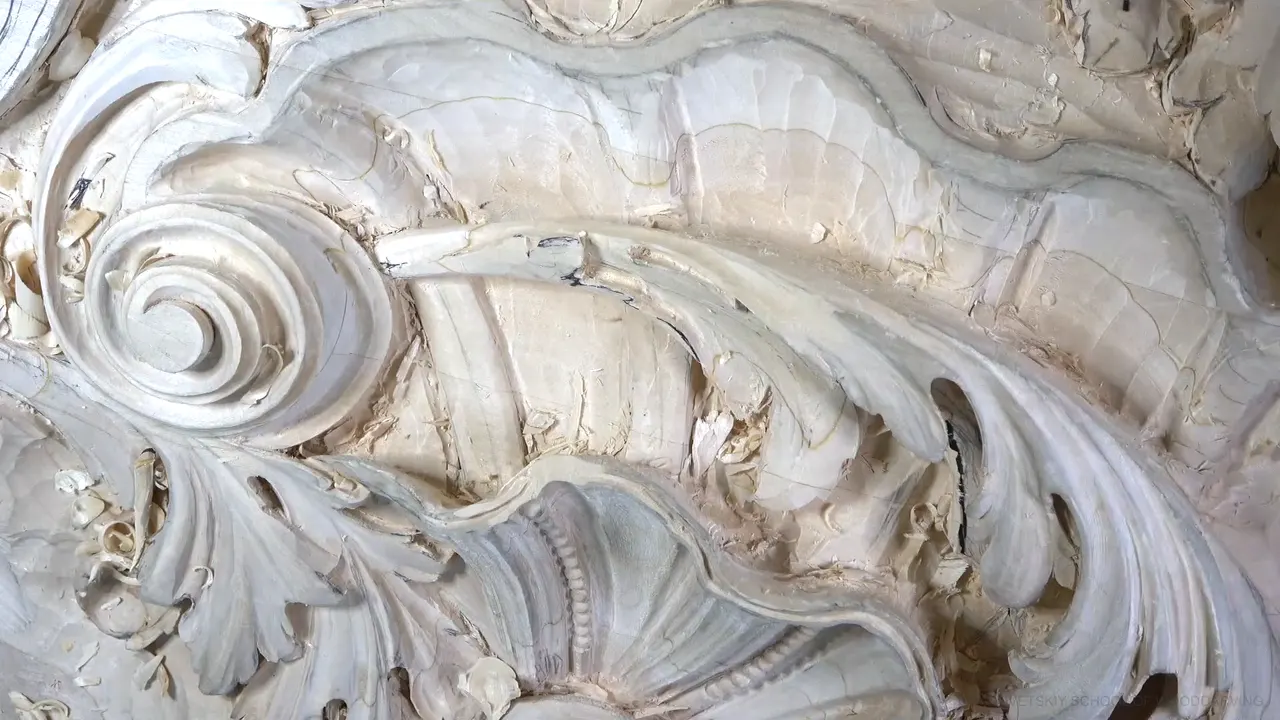

I say "much better" right after a pass, as my verdict on the spot. In Venice Room 38.11 the reason was shadow. "Okay, I think it's actually looking much better now," I say at 06:05. Twelve seconds later comes the why: "it just gave me a more shadow or more deeper shadow, I should say."
Ever finish a pass with a gouge and wonder if it helped at all? These two words turn up in a lot of my videos, and they do not always mean the same thing. This video runs about seven and a half minutes. So I set it next to other workshops from this course and a few of my other courses, the Greek and Roman acanthus leaves, the Hashemi flowers and the plate with butterflies. You will hear where I say it, what I name right after it, and what comes next.
What these videos show about much better
- Shadow was the reason in part 11, more of it and deeper.
- Once the pass is over, a verdict. Said about the future, before the pass, the same words are a guess.
- It does not mean the spot is done, and more than once a next step was named right behind it.
- Pencil and marker lines get in the way of judging, and in several of these videos I want them off first.
- Sometimes the reason is the tool, once a smaller bevel on the same number.
What do I do in part 11 before I say much better?

I open part 11 under the leaf. "Let me clean a little bit underneath," I say at 00:08. For the next half minute or so I talk about back bent tools, because in that spot nothing else fits. Both sides are blocked. Still, I am working underneath. The course page for workshops 38 to 49 tells that story in full, so I will keep it short here.
Next I say I could attack from the opposite side, at 01:12, and then "Exactly the same idea," twice over.

Then I hold something back. "The absolutely true cleaning underneath," I say at 01:47, I should probably leave until the end. I really like the development I have in that area right now. Touching the sides is something I probably will do anyway, and maybe even excavate a little deeper underneath. "But until I've done that, that would be probably too soon."
Under here, I say at 02:52, let me undercut a little bit. Not too much, though. In this area it isn't needed, and I say so: too much undercut there serves no purpose for the look, because it will look exactly the same. It only makes a weak spot. The same goes for excavating a little deeper right there, which I could do: "Again, don't have to, but just a little bit."

I need to clean slightly next. Then comes the idea that matters most on this page, at 04:14, when I think I could give a little bigger concave on the side. I still have to be careful how deep I go, I say, but I believe I can still give something more exaggerated in that area. "I really have to be mindful how I'm doing it," at 04:53. By 05:15 I call it a good area.

After that, nearly a minute goes by with no talk at all. The frames from that minute show my hands and a tool down in the leaf.

What reason do I give for much better in part 11?
Shadow. Once the verdict is out, I add that you probably don't see much of what I've just done, but it gave me more shadow, and then I fix my own words. Deeper, I correct myself.

Work comes next. "And here I want to blend," I say, and I repeat it. I don't want to see the concave right at the edge. "Something like that," at 06:46, and then: "I am really, really happy with that."
About seeing it: I say sorry at 06:31, you don't see it, and I barely see it myself. So a deeper shadow can be hard to see on a screen. In the very next part I say I am almost just shaving, and that it still makes a big difference.
Is "much better" a verdict or a guess?

Listen for the tense. Over in workshop 39, part 10, a part is just a little too high, and I say I will knock it down and bring it a little closer. By 02:11 it still has that upward movement, "but I think it just looks much better." Five seconds later I correct myself: "It's going to look much better, I should say." Then: let me knock down a little more of this part.
The guess shows up alone in workshop 47, part 9. I am picking a spoon for an eye, 2 mm (about 0.08 in), maybe three (about 0.12 in), or even four (about 0.16 in). Let me see if four millimeters will be better, I say, because I really need to see this eye a little bigger. I just think it will look much better.

Next is the border of my plate with butterflies. Eight parts or seven were possible, but I made a decision on six, and I'll just use the calipers for it. My first guess is that it will flow much better. Within four seconds I take it down a notch, and the thinking turns into hoping. "I hope it's going to flow much better. Let's put it that way." It doesn't need to be perfect, I add, and I say that twice too.
Does much better mean the spot is finished?
Each video's next words tend to say otherwise. Right after I am really, really happy in part 11, I list what could come next. I could start giving better details, a letter S for this movement, and much better distinguishable lines. There is going to be an eye. And maybe slight ridges, just to give that movement to the eye. All of them are still plans.

Workshop 42 is shorter about it, in part 10. That mess just bugs my eyes, I say, too many pencil marks, so let me clean it. Then, at 03:50: "So now it's much better I'd say, but I need to add little more right here."
Part 5 of the same workshop goes the same way, and I call it much better at 04:02, then again at 04:23. An even deeper cut inside has to come next. Seven millimeters (about 0.28 in) looks a little too big at this point, so the plan is 5 mm (about 0.2 in), number 11 of course.
In its part 7 I am using a number five, one inch (25.4 mm), on a spot that doesn't look too good. Not too gradual. I can take care of it with a skew again, I say, and seven seconds later: "Now it's better. Now it is much better." Right behind it, I could develop details inside and go much deeper if I wish. "And I think I do wish."

My other courses say it too. In Greek acanthus lesson 15 I don't like how one line is not really flowing, so I take my number 12 knife and fix that line, and I call the result much better. Although, at some point you have to stop, I say, because you always can find imperfections in your carving.

In Hashemi flowers lesson 8 I say I can probably use a knife to get to more or less final form, and much better is my word for it at 02:21, "although I am not too happy with overall shape." In lesson 49 of the same course much better comes with a reason, that it looks like it's growing from underneath this one and that one. So now I need to undercut, I say.
What can come right after much better?
Here is what I named in each video, and what I said next. The right column holds my words, plans included, not a list of what got carved.
| Video | What I named as the change in that spot | My next words, plans included |
|---|---|---|
| This part, 38.11 | More shadow, then deeper shadow, in my own correction | Blend here, keep the concave off the edge |
| Room 47.4 | Much cleaner too, said three ways | Probably number seven, for a nicer letter S |
| Workshop 49, part 11 | More unified, right after the number six | Maybe semi-final shapes on those sides |
| Earlier, 39.5 | Said at 04:02 and again at 04:23 | Even deeper inside, with 5 mm (0.2 in) |
| Room 42.10 | Better, said 19 seconds after the pencil mess | More to add there |
| Greek acanthus 15.1 | A line that flows, fixed with my number 12 knife | Stopping, sooner or later |
| Hashemi flowers 49.5 | Growing from underneath this one and that one | Undercut, with 1/8 in (3.2 mm) first |
| Hashemi 8.6 | Overall shape not there yet | Probably a V tool, number 15, 1/4 in (6.4 mm) |
Why do the marks have to come off before I judge?

My plan in workshop 40, part 4, is to create an environment for myself that I can see. "Because those marks, they're just distracting, okay? They're really distracting." At 06:37: "Now I can probably see much better." Next comes my plan for a two millimeter (about 0.08 in) number 11 and a more pronounced eye cut.
Part 11 has the same thought. While I list the details still to come, I add: "And no, I don't want to use a marker." I don't think I want to use a marker right now. At 07:33 the frame shows a blue pencil in my hand, its tip on the leaf.

In lesson 10 of my butterflies plate I am going to scrape the pencil marks off. If you don't have a professional scraper, you can always use just a blade, like a utility blade, and follow the direction of the grain. "Just get rid of those pencil marks and you can see much better the result. That's why I don't like to use pencil, by the way." For the lesson's sake, it's all right.
Light does the same job. In Greek acanthus lesson 8 I turned it, and because my light hits from a different position, I can tell where I have to clean a little more. Later I will reposition my lights, see from different directions, and find all the marks and ridges I left. "And I encourage you to do the same." It is not always possible to see right away, especially when you're used to the lights.
Can a different tool make the work much better?
It did in workshop 41, part 4, where my number seven has a really long bevel. Pushing down, sometimes it just stops, and when I have to crank, it creates that effect. I can break the tool if I force it too much, because there is almost no metal at the end, and I would not use a bevel that long on a hardwood. So let me use a different number seven with a little smaller bevel, I say. "See, that's much better, and I don't have that same effect." Still kind of long, but not as long, and shorter would have been better in this case, but it's okay.

Early in part 4 of workshop 47 I am not too happy about the mess I just created, too many ridges going in too many directions. I'll take care of those ridges, I say. "Okay, that's much better, I'd say." Then I hit from two sides, and at 01:17 comes "Now it looks much better and cleaner," which I say three ways before I stop. Next, probably a number seven, to get that letter S a lot nicer.
One movement in workshop 49, part 11, still has an overall shape I don't like. A number six is what I believe I'm going to need. Cut this way, I say. "So now it's much better, more unified." Maybe I can create semi-final shapes on those sides, I say next.

Lesson 6 of my Roman acanthus puts the tool talk on control. For some reason, I can control a smaller tool much, much better in cuts like this. That's my personal opinion, I say, and you don't have to think my way.
Which wood carving tips come out of these videos?
Only a few of these are things I told you to do. Move your lights and look from different directions, as I encouraged in the Greek course. Scrape the pencil marks with a blade along the grain if you have no scraper. And know when to stop, since you can always find imperfections.
The rest is me at my own bench, saying much better, then going on with the work. You can watch part 11 with the other parts of workshop 38 on my workshop 38 lesson page. If you want my lessons in one place, start here.
How it's done
- Clear the lines that distract you. Those marks are just distracting. Before going on in workshop 40, I wanted an environment I could see.
- Turn the piece to the light. Because I turned it, my light hit from a different position, and I could tell which spots needed more cleaning. Later I meant to move my lights and look from other angles, and I encouraged you to do the same.
- Watch the depth on the pass. When I talked about a bigger concave on the side in part 11, I said I still had to be careful how deep I would go.
- Look for what changed. What changed in part 11 was the shadow, more of it and deeper, and I said so within seconds.
- Pick the next step, or stop. Most of these videos name a next step as soon as the verdict is out, a blend, a deeper cut with a number 11, a number seven. At some point you have to stop, though, because you can always find imperfections in your carving.
Frequently asked questions
What made the spot in part 11 of workshop 38 much better?
Shadow, and deeper shadow. At 06:05 I said the spot was looking much better. What I had just done, I added, gave me more shadow, deeper shadow, I should say. Right after, I wanted to blend and keep the concave away from the edge.
Is "much better" the same as "nicer" when I say it?
Two different jobs, in workshop 47, part 4. My words "much better, much cleaner" were about the ridges I had just said I would deal with. "A lot nicer" was what I wanted next from the letter S, probably with a number seven. In that video one looked back and one looked ahead.
Is a carving finished when I call it much better?
Far from it. In workshop 42, part 10, I called a spot much better while, in the same breath, saying I needed to add a little more right there. My words in workshop 39, part 5, were followed by a plan for an even deeper cut with a smaller number 11.
What to carve next