

Alexander Grabovetskiy, woodcarver, School of Woodcarving · Published 2020
What does "true form" mean in wood carving?
Quick answer: True form is the shape a part is supposed to have, past the outline and the rough idea. On my Venice Room acanthus head in workshop 39, a number 11 went in shallow, since the true movement was not established yet. My next job was to keep working in toward that form.
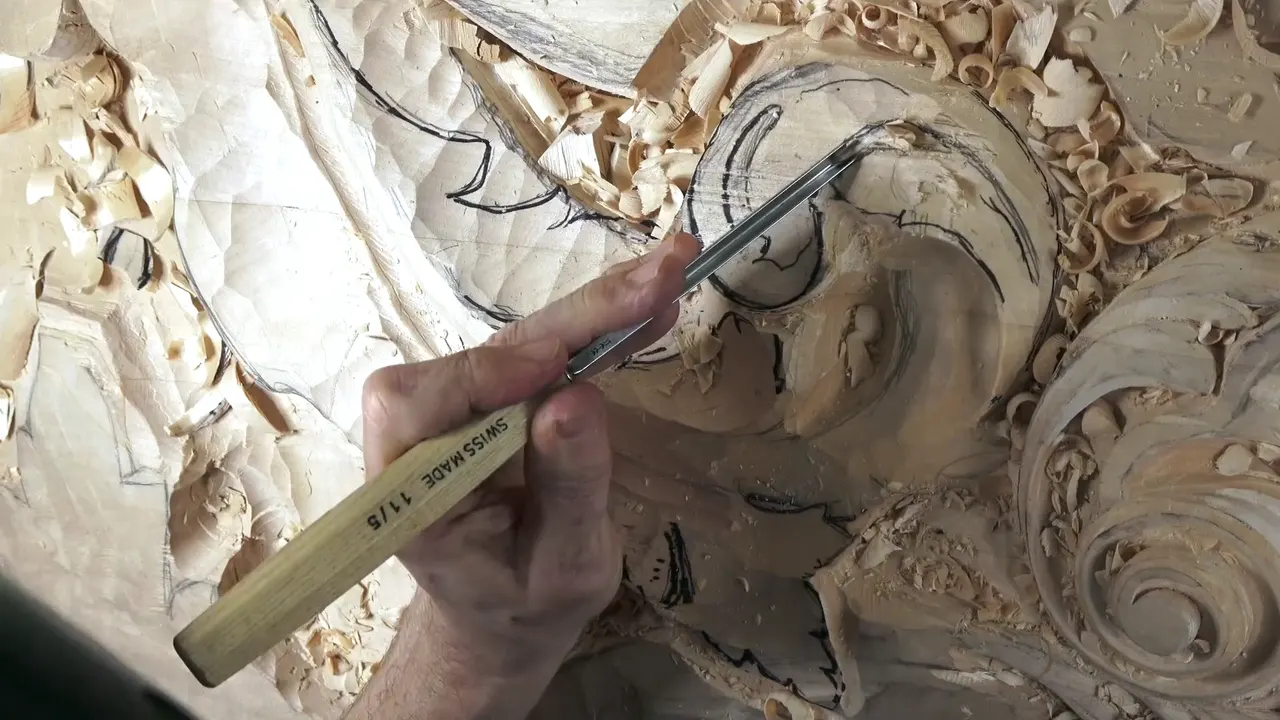

True form is the shape a part is supposed to have, once the outline and the rough idea of it are done. On my Venice Room board, in part 8 of workshop 39, a 5 mm (about 3/16 in) number 11 outlined an eye on an acanthus head, and then a number 11 went in again with the depth held back. I'm not going too deep yet, I said, because I still did not establish the true movement right here.
Would you like to carve the deep part of a leaf only once? And would you like the leaf you rough out to keep its line when the depth goes in? Then find the true movement first.
This part runs about seven and a half minutes. So beside it I put my other lessons where the same word came up, true, for lines, concaves, shapes and flow, and each one is named with a link to its page.
Rough idea first, true form after
- On this head the depth waited, since the true movement there was not set yet.
- The outline shows me my movement.
- A plain downhill slope fell short of a true concave, on the Roman acanthus.
- From the wrong spot I can miss the true shape, and then I can make a mistake.
- Volutes, undercuts and flow lines can stay not true for a while, and I say so out loud.

What happens to the acanthus head in part 8?
The head gets set up for its true form, and the depth waits. First, I said an eye was coming. Then one part could go lower right away, from way over here. I could do it, I said, and my own words got fixed right away. I think I should do it, not I could.

Number five upside down, I said next. With this tool it could give a really nice shape right away, pretty much. I still wanted a really nice shape this way too, along one edge, and that edge had to go like that also. Then came my order to myself. Take number 11 and 5 millimeters (0.2 in) again, and clean that. The page for the next workshop takes up using a gouge upside down.

An eye right there was my next wish, because I thought it would look really nice. That meant this part had to become a part of the same movement, and I needed to knock it down, with the back bent probably. Well, actually, I could use just the side of the number 11.
A pipe was coming there too, and I needed to make sure I was not doing the wrong thing. The pipe was supposed to be raised up anyway. On one side of it I planned a concave, and not a deep one, at least in this direction. The other direction could go a little deeper, but not much. Just to give some indication of the pipe. That is good, I said, two times.

Whatever I don't need, let me take care of it, I said. Then, you know what, I could take care of this mess with just a skew. Another eye was coming, so I didn't have to take too much.

Let me create this eye, I said after that, and that would become a really high ridge. So you keep that edge. Get number 11, 5 millimeters (3/16 in), and outline it. The last part came out twice. A separation was coming there as well, and I could probably indicate that right away.

One area needed care. I did not want to dig too deep in it, and the only way, as I put it, was to get this leaf going underneath of that one.

And again, number 11. But not too deep yet, because the true movement there was not established. Just to give an idea where it's supposed to go. So that's just a movement like that. I have to work my way in now and give the head its true form, I said, the true form of this head of acanthus. Both sides still needed an outline, this side and that side, and the last thing in the part is that something didn't work, because I needed to use a spoon.

When does the depth go in after roughing out?
Once I know where the true depth is. In Venice Room 79 I needed to lower a section down to the true line, and I said I'd use the same number 7, 14 millimeters (about 9/16 in). When I roughed out, I left approximately three millimeters (about 1/8 in) up. Three millimeters, some spots five (about 0.2 in), some spots more.
Three parts later in that workshop, my plan was to just clamp it down before it would bug me. The depth was known then, the highest spot, and that would be the true depth. So I could remove some of the material to that depth. I'll use 12 millimeters (just under 1/2 in), I said. I can safely go down.
Back in workshop 39 the true movement on the head was still open, so the number 11 gave only an idea of where things go.

Is an outline the true shape?
An outline shows the movement, and the true shape comes after it. About one part in Venice Room 84, I said it's just the outline, not the true shape like it's supposed to be. But at least I know exactly my movement. I can start developing it now, I said, and then I corrected myself. I had already started developing it a long time ago.

How do you find the true line on a carving?
With a pencil, at times. The curly kitchen cutting board in Wood Carving for Beginners left me somewhat happy. Let me get the pencil anyway, I said, and kind of find my true line.
Or by taking more wood off first. My plan on the floral and molding course was a smaller tool, maybe about a quarter inch (about 6 mm), a number nine, to remove even more material, so it would be a lot easier to establish the true line. After that I said I'd get a flatter tool, like a number two, and go right on the line, straight down. In that case even number two is not good, I said, so I got to use a skew.

With a knife I work really close to the line I outlined, in the Greek acanthus leaf course. I told people there that if they don't feel comfortable near the true line, they can always leave a space about an eighth of an inch (about 3 mm) away from it. If you feel safer that way, that's absolutely fine.
My words on the Greek acroterion were take it all the way down. Later on, I said, I'll take a small gouge again and recreate the true line, the flow line. But for now, it should do.

A stem in Venice Room 61 had its true line down the middle. What was really important for me right then was to establish it, and then round it. Something sat in my way, so I couldn't really reference my hand. I had to be almost like airbrushing.
Paper and glue came off the Corinthian acanthus leaf, and you could see the line was not even. We want to recreate the true flow, that's how I call it. I also named it true movement and true motion line. My plan was a small gouge, little by little, to reestablish my high ridge. Important not to rush.

What makes a concave a true concave?
The look of a real hollow. For the Roman acanthus leaf I asked people not to go all the way down, and to create the concave instead. The concave is supposed to look like the true concave, and a slope going downhill, like the one I showed, is something else. All you need is the indication there is a concave, I said. I was using just 10 millimeters (about 3/8 in). And see what I just said to you? I did that mistake right then, and started to remove a little of the side of my design. That is no good.

Workshop 58 of the Venice Room had me creating a concave with a number six, 25 millimeters, about one inch. Near the groove it had to be more pronounced. It's not like a true concave, I said, although it's almost like a true concave. Later in that part I named it plainly. Still concave, true concave, only more pronounced right there, because the point of view is going to be from that direction.
Does where you stand change the true shape you see?
The spot I look from decides it. In Venice Room 89 I needed to change my position, because from that spot the true shape didn't show. And when I don't see the true shape, I can make a mistake, which I do not want to do.

The camera has the same trouble from the other side. During workshop 54 I told you that you really don't see the true picture, because you are looking through the lens, at an angle, with the camera a little away from me so my head is not always in the way. The other half came right after. From there you can see the hole much better than I do.
A drawing shows it another way. In the furniture panel design course I said that when you draw and when you carve, it's going to look a little different, because when you carve you see all the chisel marks and all the true movements. Those marks create different ridges, and the ridges, as I put it there, create the main movement.

When do I call a shape not true yet?
While it is still on the way. The first lesson of the Greek acanthus course was one case, where the work was just the introduction of those volute movements, still not a true volute yet.
Lesson 8 of the Roman acanthus had a spot I made slightly like an undercut by rotating the gouge. Not undercut, I said, and then I fixed it. It's not true undercut, I should say.
One leaf on the lily box was a part of a main movement and had to go with the flow line. Not going to be true flow right here, I said, but still, as much as I can, I'll do it. Then, maybe a different gouge. Maybe just a number nine, to try to fit right there, and it was a number nine in five millimeters (3/16 of an inch).

Workshop 2 of First Cuts for Beginners has us carving something that looks like a relief, and I told people it isn't true relief. In a true relief you have absolutely different feel.
And the Venetian flowers rosette started from a drawing that was just a sketch by hand. Some of my drawings were made on an iPad, so even the oval was not perfect. Not true oval, I said, and to make a true oval I was going to use the old trick.
The word catches my own misses too. Before going too far in Venice Room 67, I said let me also clean this movement, because I created some notches but never took care of the true form of it. I need to do that, I said, and I'll use a micro tool. Maybe a smaller one, maybe just about one-eighth of an inch, three millimeters. Number three.

Sometimes true is the word for a shape that has arrived. On the Hashemi flowers one wall wasn't good, and I planned to undercut that side so you could see a true flipping movement. That's how I call it. It just flips. And once the word was about the human body. Everything is symmetrical even on a human body, I said in Venice Room 72, a right eye and a left eye, a right ear and a left ear, but one is always a little bigger than another one. It's never like the true symmetry.
| Lesson | What was there first | What true meant there, in my words |
|---|---|---|
| This head, part 8 | A shallow pass of the number 11, just a first idea | The movement, before any depth |
| Venice Room 84 | Just the outline, though I knew exactly how my movement goes | The real shape of that part |
| Roman acanthus, lesson 16 | A downhill slope where a hollow was supposed to sit | A hollow shaped like a concave |
| Corinthian leaf, lesson 6 | A line that was not even once the paper and glue came off | Flow, motion line and my high ridge |
| Greek acroterion, lesson 3 | One part taken right down, good enough for now | Flow line, saved for a small gouge |
| Lily box, first layer | A leaf meant to follow the flow line of the main movement | Flow, as much as I could |
Where does part 8 sit in workshop 39?
Two thirds through, as the eighth of twelve parts, after the pencil and the plastic of part 7. The part before it ends with my plan for the idea of convex, concave and concave, and the next one opens with the spoon working just fine. The workshop 39 page covers the whole lesson, with the plastic drawing and the carbon paper, and the Venice Room Part 4 course holds all twelve workshops of this board.

This head started part 8 as a rough idea, with lines drawn over it and chips all around. If you want to see how this one takes shape after part 8, the full workshops come with Access, one part at a time.
How it's done
- Lower what has to go lower. On this head I wanted one part lower, from one end. I said I could do it, then changed could to should.
- Shape with a number five. Number five upside down, I said, could shape it nicely right away.
- Outline with a small number 11. My order to myself was a 5 mm one (3/16 of an inch), and I said outline it twice.
- Keep the first pass shallow. Keep the number 11 shallow while the movement is still open. That pass shows where it goes, nothing more.
- Look from where you can see it. From the wrong spot I could miss the shape, so in Venice Room 89 I needed to change my position.
- Work your way in to the true form. That was my plan at the end of part 8, with both sides still to outline and a spoon needed where something didn't work.
Frequently asked questions
Is the outline the finished shape in wood carving?
For me it's a start. About one part in workshop 84 of the room, I said it was only the outline, not the true shape yet. Still, I knew exactly my movement, and from there I could start developing it.
Why carve shallow before the true movement is set?
Workshop 39 had me holding the depth back on the acanthus head, since its true movement was still open. My number 11 pass only marked where things were supposed to go, and the head's true form was the next job.
What is a true concave in wood carving?
A hollow that looks like a concave. On the Roman acanthus leaf I showed a slope that only runs downhill as something else, and said all you need there is the indication of a concave. Workshop 58 of the Venice Room had one more pronounced near a groove, and I still called it true concave.
What to carve next