

Alexander Grabovetskiy, woodcarver, School of Woodcarving · Published 2020
When should you stop and think twice in wood carving?
Quick answer: Thinking twice is the pause I took in the middle of one movement in part 6 of Venice Room workshop 39. I need to clean it, I said, and a number 3 then knocked down the overall movement there. About half a minute later, I said maybe it's okay.
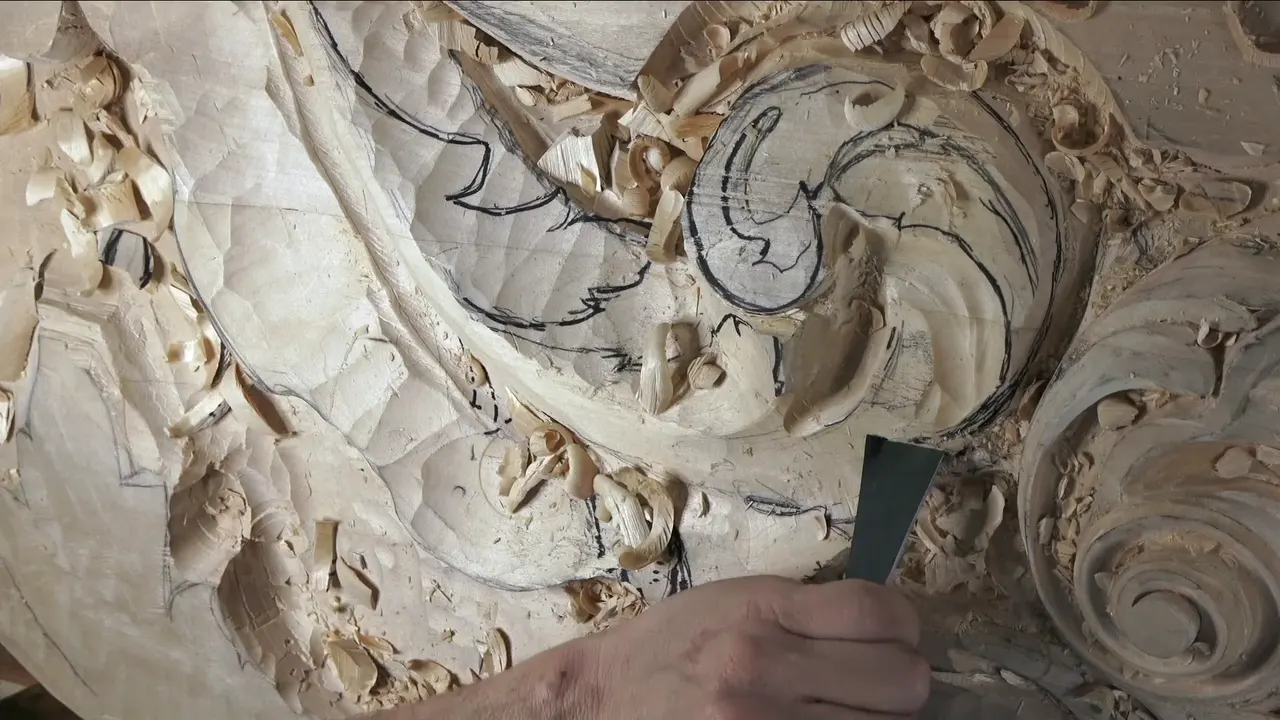

Thinking twice is the pause I took in the middle of one movement on my Venice Room board, in workshop 39, part 6. Well, you know what? Let me think twice how I want to do it. That's what I said. Then, I need to clean it.
Would you like to see when a carver stops before the next pass? And when he just picks up the tool and goes on? Then look at the spots where I said think twice on camera, and the ones with no need for it.
Part 6 of workshop 39 runs about seven and a half minutes. So next to it I put other lessons from the Venice Room and a furniture panel with the same words, or the opposite, and I name each one with a link to its page.
Seven places think twice came up
- In the middle of a movement on this board, and half a minute on, it might be okay.
- Two workshops later, after a slip of the tongue I fixed on camera.
- Before a long bent, in case it was a mistake.
- In front of a hard concave, where I said twice or more.
- Before a detail I might open up completely.
- On a big concave I thought would look good, so the second thought wasn't needed.
- And a production piece, which I would probably start right away, with no second thought.
What happened in part 6 before I stopped?
The video opens on a plan. There's going to be a separation, I said, two times. I still want to keep some area for our glue-up, I went on, and right away, I really don't have to. I can actually screw it. All I need is just a small section to glue.

Depth came next. I'm not going to go too deep right here, I said, I don't really need to. Just deep enough, and much deeper, of course, right here. Then, I need to use a heavier mallet, I said.

Most of one part is going to be hidden underneath the flowers we're going to do. This detail would be a really good one, I thought. The overall movement too, beautiful. I could leave it like that, I said, but maybe I'm going to create something more interesting.
One spot I liked as kind of raising up. Maybe I'd have to knock it down a little more later on, so it ends up a little lower. It all depends on how I develop this one yet, I said. For now, I kind of like it.
How did the movement have to start?
Out of almost nothing. I need to finalize the movement, I said, and this one is going to go all the way in one direction. But it has to go from almost nothing, because it comes from underneath another movement. Pretty much.
I also had to keep in mind how it looks overall. It still has to continue the line, I said, this line right here, so I cannot lose the overall feel of it.

The tool was a number 11 and 15, which is about 5/8 of an inch, if you like the more American way, I said. Inches and feet. Those are United States customary units, and 15 mm works out to about 0.59 in.
I'll go underneath here, I said. And no, I'm not afraid of losing this. I knew a detail was coming, but I can always redraw it, especially with a preliminary outline, and then just start moving inward.
What came after the pause?
First the words, then a tool. Well, you know what, I said, and then think twice, two times in a row.

Next, a number 3 went in to knock down the overall movement right there. Maybe there's nothing to think, I said then. Maybe it's okay. Then, let me take care of this, and go downhill just like that.

Yes, I've got a couple of spots I made earlier too deep, I said near the end, and it's not so good, but it's also not too bad. Not that bad at all. Clean that with the number 11, I said, and the last words of the part were so I've got that movement taken care of.

The next part opens with marks from before still showing up. And now they disappeared completely, I said a few seconds later.
Is think twice the same as double think?
My answer on camera was no, and I fixed the words. On Venice Room 41, two workshops later, I said I could make one part look like it goes a little bit above, with no need to, but I could. Think double came out of my mouth first, then I don't know. Double think? No. Or think twice, I should say, and then think twice how I want to see it, and maybe a part of it would go like this.

Which wood carving mistakes made me think twice?
One I hadn't made yet. For a concave in Venice Room 63, I said I could probably use a long bent. But it could be a mistake. Hold on just a second, I said. Let me think, and think twice, because I don't want to make a mistake. Maybe I can just use a little smaller tool and start. A bit later, maybe skew the opposite direction, I said, because that would give me a much better result.

What I used was a skew gouge, number 7, slightly bent, a medium bend I would say, about 14 mm, about half an inch. Nothing special. I like the skew idea because I'm just pushing and it's already slicing, and my hand doesn't need to make too many movements. The surface comes out much cleaner, right out of the push. Although, maybe I have to sharpen it a little bit, or buff it, I should say. There are limits too, I said, because at some point a number 7 can't go deeper. Until it grabs some of the material, I can keep going. Absolutely beautiful and clean, I said.

Did I think twice about opening up a detail?
At the very end of a part, I did. In Venice Room 28 I said I need a 1 mm (about 1/25 in) number 11 to go to that eye, or even half a millimeter (about 0.02 in). Or even, you know what, I could open up that detail completely. I'm not sure, should I or not? It would give extra crispness, I said, and I could disconnect it and clean that completely. But I have to think twice before I do that.

Does a hard spot need more than two thoughts?
It did in Venice Room 59. It's easy to draw something and then kind of think, why did I do that, I said, because I still need to be able to carve it. If you think it's easy, it's not. The spot was a concave running into the ceiling, and it is kind of challenging. I said think twice or more before I do something like that. Got to think. But let me start.

I thought I could outline it with no problem, and see if I need to change some stuff or not. My plan was a 12 mm number 11 for the outline, half an inch, I said. If you don't think it's challenging, try it once, I said, because both sides limit me there. I was glad the ceiling was eight quarter material, almost 2 inches, more like one and 15/16, a little less than 50 mm. So I had to be mindful how deep I go, and how it all blends together. I could probably outline the main movements right away too, and at least it would look like something done.
When is there no need to think twice?
When I think it's going to look good. Over in Venice Room 70, there was some empty space you don't see on a camera, but I do, and I planned a big concave and an undercut underneath one line. Although, I said, I should think twice. There is nothing to think twice, actually. But the way I do that concave, I have to be smart, because it's right on the slope, and that's not really convenient. Maybe a number 9 and a spoon, I said, but I'd need to be really careful not to hit my detail on the main body, because it's really close already.

In Venice Room 29 the reason was the view from below. That part will be visible from the bottom, and from there one section did not make any sense, so it was extra material to take out. First I'd think, I said. Well, no, actually, just take it out. It makes a beautiful movement overall, I like it, and I can knock that out right away.

Two more times I stopped to think and answered myself on the spot. Venice Room 43 came first. The cleaning there I can get done off camera, I said, so you don't need to watch me. The answer was I love it, and that an area like that could get a small concave, which would look really good. Much later, in Venice Room 98, I wondered what's next I want to do, and said I should probably jump and work on one leaf right there. I'd start by setting up my convex there, I said, and see how it looks. Not too uniform, I said.

When do I not think twice at all?
When I can grab the tool without even thinking. Sometimes it takes time for me to think which tool I should grab, I said in Venice Room 21. That time I just opened the tool chest and grabbed whatever looked right for the job. Don't have to think twice, just grab the tool. It was a number 5 of 8 mm (about 5/16 in), for a letter S shape that goes like a wave. Then a 2 mm (about 0.08 in) number 11, where I had used 3 mm (about 1/8 in) before, and I could go to a single millimeter (about 0.04 in) later. The final form waits until the last moment, I said. When almost everything is done, I spend a few days just to clean and refine everything.

A production piece is the other time. On my furniture panel, a number 11 of 1 mm (about 0.04 in) was cleaning to a line, and I was not undercutting yet, because maybe it needed fixing. I wish I could go right away, I said. If I would do maybe a production piece, I would probably go right away and don't even think twice. But we are trying to make something really nice and beautiful, so we have to be careful with the quality even more. Soon after, a number 6 of 16 mm, five-eighths of an inch, fit just nice and perfectly. Later, cleaning again with the 1 mm, I said it's still possible I'm going to move it, so no undercutting yet.

What about think again?
That one comes up too. Now I need to think again, I said two times in Venice Room 33. That part has to be wider, and it has to go underneath one element. That meant a mirror cut, because one side comes out clean and one side does not, and I needed the right side cleaner.

Venice Room 40 had one area that was going to get a slight concave, not raised, because it's visible from the bottom and there is no reason to. Think again, I said. There's a couple of ways I could do it. A concave or a convex would give me the same feel, so let me try convex first. The number 3 straight tool would not do it there, and I needed a back bent, I said.
| Lesson | What made me stop | What I did or said next |
|---|---|---|
| Part 6 here | Inside one movement, with a cleaning still to do | Number 3 knocked it down |
| Workshop 41 | An effect where one part goes a little above | Double think, fixed to think twice |
| Venice 63 | A long bent for a concave, maybe a mistake | A skew number 7 did the work |
| Workshop 59 | A hard concave that runs into the ceiling | Got to think, then my outline plan |
| Venice 28 | A detail I could open up completely | The part ends on that thought |
| Furniture panel 21 | A piece made for quality, not for production | Care for quality, even more |
Where does this pause sit in the whole workshop?
In the middle, the sixth of twelve parts. The fifth one ends with me saying I need to work around and get a really good outline, and part 6 opens on the separation and the glue area. The workshop 39 page covers the whole lesson, with the plastic drawing and the carbon paper, and the Venice Room Part 4 course holds all twelve workshops of this relief carving. To carve along with me, start here.
How it's done
- Keep a small glue area. I wanted a little space for the glue-up, though a screw would also do.
- Set the depth. Not too deep, I said, just deep enough, and much deeper in one spot, and for that spot I needed a heavier mallet.
- Start the movement from almost nothing. It comes from underneath another movement, and it still has to continue the line.
- Take the number 11, 15 mm. My plan was to go underneath at this spot, and I wasn't afraid of losing it, since I can always redraw it.
- Stop and think twice. My words were think twice, and the spot still needed cleaning.
- Knock it down with a number 3. Right there, the overall movement came down with it, and let me take care of this, I said next.
- Clean up using the number 11. Some spots were too deep from earlier, and the number 11 was my tool to clean that.
Frequently asked questions
Did the Venice board need a big glue area?
Just a small one. I still want to keep some area for our glue-up, I said, but it isn't a must, because I can actually screw it. Most of one part there will be hidden underneath the flowers we're going to do.
Which gouge took that movement in part 6?
The 15 mm number 11, about 5/8 of an inch if you like the more American way, inches and feet. After the pause, a number 3 knocked the overall movement down, and near the end I named the number 11 again to clean.
What if a couple of spots went too deep earlier?
On this board I said it's not so good, but it's also not too bad. Not that bad at all, in my words. Clean that with the number 11, I said, and the part ends with that movement taken care of.
What to carve next