

Alexander Grabovetskiy, woodcarver, School of Woodcarving · Published 2020
Does a complicated wood carving get easier once you start working on it?
Quick answer: Venice Room 51, part 2, holds my words "I know it does look a little complicated," and "It's okay." Other lessons carry my words on a wobbly bench, a new camera system and the lights, each with my own words.
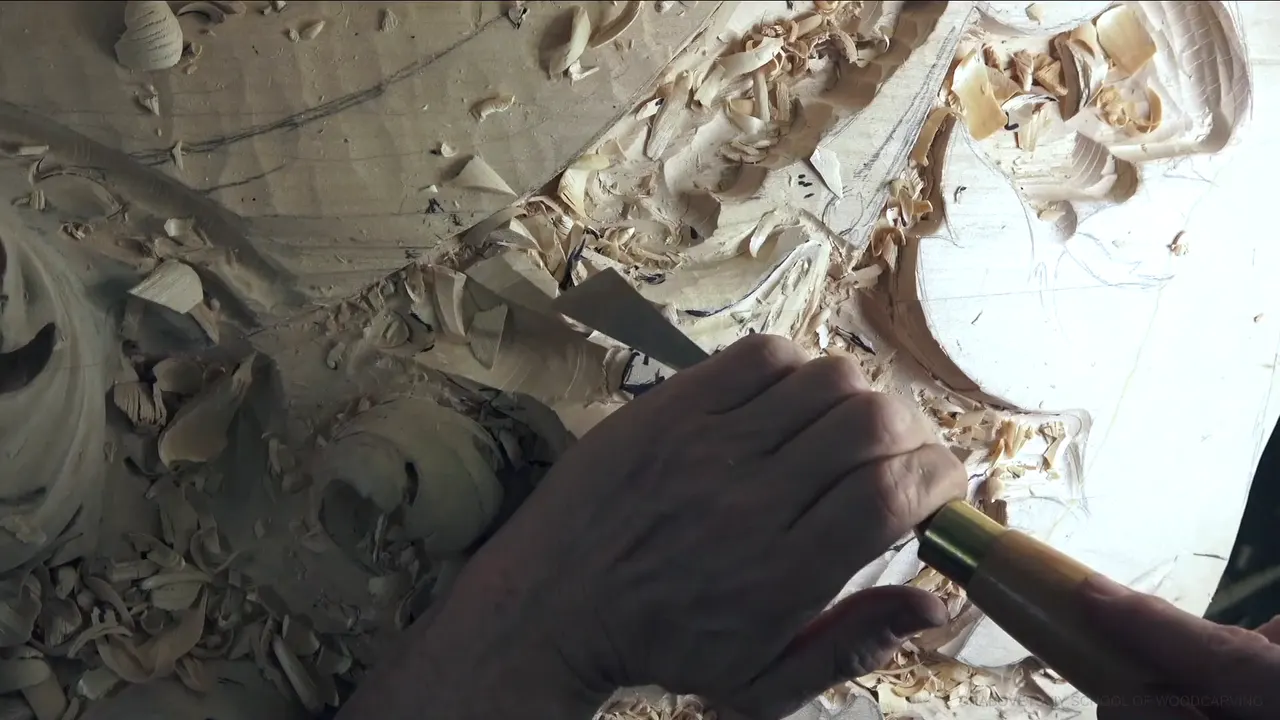

In Venice Room workshop 51, part 2, I told you "I know it does look a little complicated," and "You'll get used to it, okay?" A line like it sits in lessons from my other courses, and each one has a real thing beside it: a wobbly workstation, a new camera system, a light on the cut, a tired shoulder.
Ever sat at a table that rocks under your elbows? Ever worked under a lamp that shows you only half the job? Then you know the feeling. Below I tell you where I said these words and what else I said beside them. It is wood carving, so the sizes come in millimeters and inches, my figure first.
What does part 2 say about the work?
About the work I said it does look complicated, "It's okay," "That is okay," and "It's not complicated at all." My condition for you was "Once you start working on a project like that."
"Let me outline a little bit this side," I said, and that was my plan for one spot. Of the depth my words were "that is going to be much deeper, deeper, but I shouldn't say much deeper, because again, that would be a mistake."

Another plan has something "above" and "excavated even deeper," and I said "Okay, let me do that."
What else is in part 2 of workshop 51?
The part opens with a plan, "I don't need that to be that high, so I can probably start chopping this out also." A skew is the tool I named, "Skew, that's what I'm using right now for this movement."
A point matters here. "I really like the idea of my point being somewhere right there, which is above this part, and develop that type of movement," I said. Material is short: "I do not have too much material because I got the preliminary cut right there, which I'm not going to call mistake, although it's probably." That line goes on: "Well, actually, no, it is okay, that's okay, so I can just carve around and create that movement, really beautiful movement."

About where that part goes, I said it would go "underneath of this leaf." The movement itself needs work: "I need to create a nice movement itself because right now it doesn't look too good, it doesn't look too appealing." It "looks much better," I said, even out of sight. It will be "visible from the bottom," and "going to give me a really nice look."
The point need not be exact, I said: "I don't really have to get the exactly location of the point, but it was somewhere right here." I called that spot "my boundary for this development."
Lines come with a plan: "yes, I'm going to do the separations." "Let me use a little smaller marker," I said. One separation would "go underneath right here," and the big hole would be "somewhere right here." From that hole, I said, "I still want to do a development which is going to go underneath and maybe end up on the other side."

A middle line is planned as well, I said: "there is still going to be a middle line." It would "maybe" end up "under another side, underneath of this development."
One option was on the table: "what I could do, I can actually bring this movement inside, and that excavation can wrap this part, hope it makes sense." My plan: "I'm safely going to make a first cut like that."

Waste is named in that part. "That right here is complete waste," I said, "I can actually lower that down as much as I wish, but I don't want to because I could utilize this spot and create some movement from this element and go underneath." On the depth I said, "Just how deep I'm going to go, but somewhat deep."
"Maybe I don't have to create a movement down here." And: "Clean it a little bit, make it a little nicer and smoother."
Part 2 ends on depth. "I have to excavate on inside right here," I said, and "Start my really deep holes." The limit is in my own words too, "Deep, but not too deep," and one more line, "I don't want to lose the overall feel of it."

Did I say it about a wobbly workstation?
Lesson 15 of the Furniture Panel course, part 3, has me working a router plane over the background. To work it, I told you, "if you just use one of the sides as a reference and another side, you're just making rotating motions just like that," and "don't press too hard," and "Let the tool work."

About the workbench I said, "It's not the workbench for the plane," and "That's why you have all that movement, wiggle." "It's okay" for me, I said. My advice for you was "Just get used to it. Okay."
The work went on. "Get this direction," I said, and "I'm trying not to get too close to the final line." About a closer cut: "I can always get closer with the gouge or with the smaller blade if I need to." On depth I said, "As long as I can get 80% or a little more than 80% consistent depth, I'm okay with that." And about chips: "be careful when you're doing what I'm doing."

Venice Room 81, part 7, has a wobbly workstation of its own. "Please accept my apology," I said, and I warned it would be "a little wobbly," but "it's really convenient for me to work with that" vice, "because I can rotate with no problem any direction."
To the ones watching I said, "if you're not used to wobbly workstation," it would be "kind of hard," "but for me, it's okay." And: "For me, result matters a lot more."
"For me, logical point is just to create those eyes first," I said. The eyes got a plan: "number 11 and the 7 millimeters" (about 0.28 in) to "preliminary excavate the position of the eyes." One spot left me unsure, "Maybe I still have to make it little lower. Maybe yes, maybe no. We'll see."

Roman Acanthus lesson 16, part 2, says it. "Some of you probably don't like that my pieces are shaking while I'm carving," I said, "but that's the way I work." My setup is "two vices," and "that way, I can attack from different points, and I'm used to that." The advice for you is "If you don't like that shaking, please use a stable work bench and fasten it really nicely." For me, "it doesn't create a lot of problem." On those carver vices I have done "huge pieces," I said, "like in the lesson with the lion, or a lion head, I should say," and I "still use exactly the same carver vice." Of tools I said "I would like to use my tool as long as possible before I switch to another tool."

Part 6 of workshop 78 has a word about a movement. "I know if you're not used to that movement, it's kind of scary, but it is stable," I said. The same part has "I hate that I made a couple mistakes and broke the leaf, that's just because I wasn't too careful."
One more line: "if you get in a mode, if you know what I mean by get in a mode, so you should be safe." And a plan: "Let me get number seven again and bring the cuts over to what I just excavated."

What about the new system?
Lily Box lesson 2, part 6, has words about my own work. I said, "I do apologize if I am sometimes working in blind, which I mean that you don't see what I'm doing," and "I'm still getting used to my new system, which saves me a lot of time on editing."
"I really don't have to spend too much time to edit. I'm actually live recording everything. But it does have its own problems." One is this: "if I'm concentrated on the surface I'm working on, sometimes I can't see what my cameras are shooting." I added, "I am trying to do my best as much as I can, and I believe I will get better and better."

Lesson 16 of the Roman Acanthus course has it too, in part 5: "please understand I'm still getting used to the new system, and I'm still trying to adjust my angles, trying to adjust my audio. And be patient with me and have some mercy on me." "I don't have a $2 million budget to spend on all the audio and video equipment, and I have to be more down to earth, just a simple way, but still, it should look good, okay?" And for that day: "let's concentrate today on the Roman acanthus, not on the audio and video."

The reason for the switch is in my words: "I do have a lot of projects going on, and if I would just shoot everything and just edit like I've done before, it just takes so long." I added "I'm not as productive, but I have to be productive in projects for my clients and for the school."
What did the light show me?
Greek Acanthus lesson 8, part 1, has a word on light. "Just because I turned that, my light hits from different position, I can see much better where I have to clean it a little more," I said. Later, I said, I would reposition my lights, look from different directions, see "all the marks and all the ridges I left," and clean them. My advice: "And I encourage you to do the same."
My words on that: "not always possible to see right away, especially when you're used to the lights." Within one angle "you can see one side of the cut, but you don't see other, and also the grain direction and so on."
A tool is named there: "I'll take a smaller V tool," I said, "a 45-degrees V tool, but it's only 3 millimeters" (about 0.12 in). In this case, I said, "just because it's a really long detail." And: "It would be easier for me if I would utilize a light like this."

On shells, in the April 2020 livestream about sharpening a spoon gouge, I said "Rococo style also has some acanthus movements plus shells," and "shells in Rococo is the main movement." Of the style itself: "It's a specific Rococo, it's not what you're used to if you see later Rococo or Northern Rococo, this is Venetian Rococo, okay, so specific to Venice, Italy."
What about my hands and shoulder?
In the lesson on the bevel for hardwood I said "I use most of the time really short bevel like that," and "I still want to get my solution to get my hand underneath." Also: "If you're carving every day, and if you have to raise your tool too high, you have to raise your elbow," I said, and your shoulder as well. "And if you're doing that all day long, like many hours a day, you get some pain. You get tired." A person can adapt to that, I said, "but you get tired."
Acanthus gets the same idea in part 2 of Venice Room 61. "I do understand the logic behind why they did the way they did those pipes, because they carved every day acanthus," I said. Carve acanthus that way, and "I guess" you grow used to acanthus, "and you see acanthus movements everywhere." No matter what you do, I said, it is still "somewhat acanthus."

Which lines sit side by side?
Here are eight of those lines, each as I said it, with the course it came from.
| The spot | What I was working on today | Course |
|---|---|---|
| A complicated project | is okay. It's not complicated at all | Venice 51 |
| A router plane | It's not the workbench for the plane | Furniture Panel |
| A rotating vice | because I can rotate with no problem | Venice 81 |
| A two-vice setup | and actually, my setup is two vices | Roman Acanthus |
| A new system | sometimes I can't see what my cameras | Lily Box |
| Light on cuts | I encourage you to do the same | Greek Acanthus |
| A short bevel | if the bevel is short like that | Tools course |
| Those acanthus pipes | no matter what you do, it's still | Venice 61 |

Where can you watch these lessons?
Workshops 50 to 61 sit in the Venice Room Part 5 course, and the lesson page for workshop 51 is the one to open. The workshop before it and the workshop after it sit in the same course. To carve along with the room, the tuition opens each video.
How it's done
- Say what looks hard. Workshop 51 has my plain admission, in part 2, that the work looks complicated.
- Say it's okay. After calling the work complicated, I said "That is okay," in the same part.
- Start the work. The condition I gave you was that you start on a project like that.
- Fasten a stable bench. If you dislike the shaking, my advice is a stable bench fastened really nicely, in Roman Acanthus 16.
- Move the light. In Greek Acanthus 8 I planned to see from different directions with the light placed elsewhere.
Frequently asked questions
What did I say about a wobbly workstation?
The Furniture Panel course has me saying the wiggle was okay for me. In Venice Room 81 I asked you to accept my apology for a little wobble, and I said that result matters a lot more to me.
What bench do I tell you to use?
In Roman Acanthus 16 I said, if you dislike the shaking, use a stable work bench and fasten it really nicely. I work on two vices myself, and for me the shaking doesn't create a lot of problem.
What does the new system change for me?
It saves me a lot of time on editing, I said, and I'm live recording everything. One problem I named: while I concentrate on the surface, I sometimes can't see the shot. I believe I will get better.
What to carve next