

Alexander Grabovetskiy, woodcarver, School of Woodcarving · Published 2020
What does a wood carver mean by "unique"?
Quick answer: In Venice Room 51.7 I said a detail on one side was similar to the one on another side but still unique, with the same development and the same scale. My other lessons use the word for tool marks, flowers, a movement and a whole project. Each line is below, with its lesson.
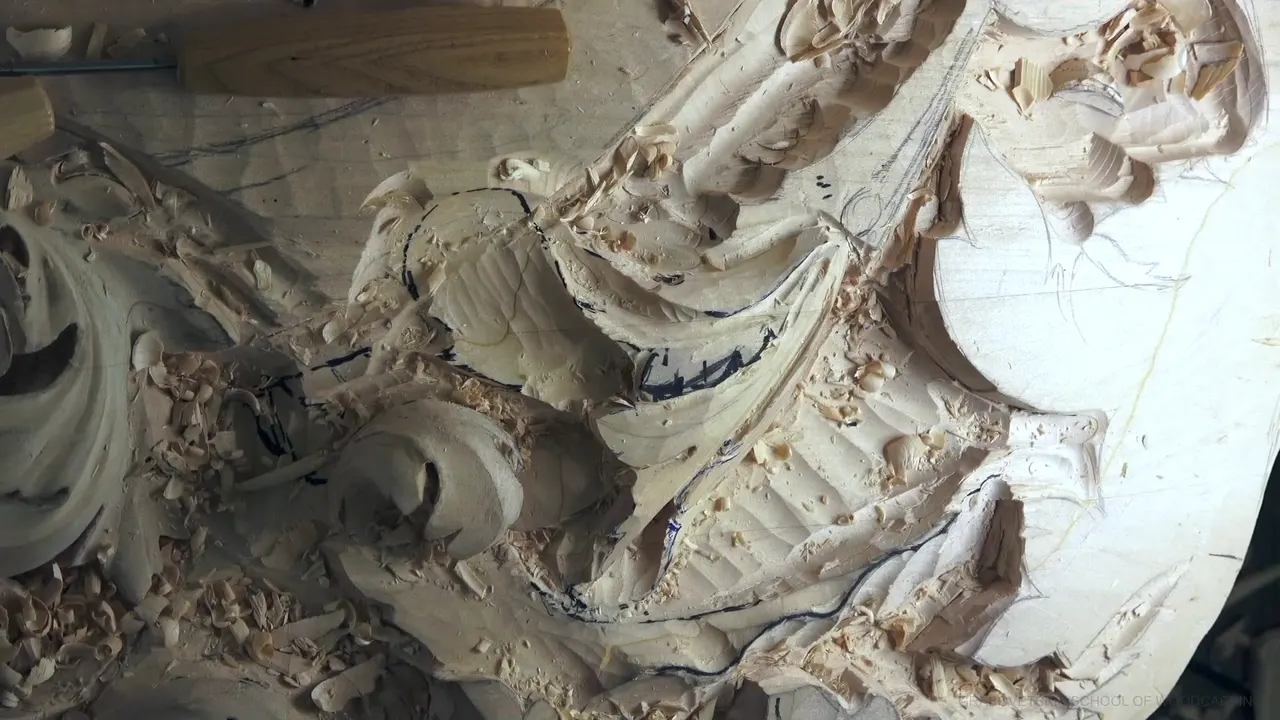

Venice Room workshop 51, part 7, is where I said "It's similar, but it's still unique." My other wood carving lessons use the same word for tool marks, a flower, a movement and a whole project, and below are those places in my own words.
Sizes are in millimeters and inches, my figure first. Open the lessons in a second window and see for yourself whether the page matches the video.
What did I say about the other side in part 7?
The whole stretch, in my words: "See, it's about the same what we see on another side, but it's not. It's similar, but it's still unique." The next lines, in order: "Same development, same scale, but it's absolutely unique." And one more: "So that's what I love about it."
Right before it came "Okay. Now let me create this separation right here." After it: "But we use the same pattern, same plastic to trace it." A little further on: "Okay, that is good. Now I need to excavate underneath."

The part opens with "And maybe this time I can get that detail a little bit underneath of this." Next line: "So that detail going to go a little bit underneath of that."
Which cuts came with that detail?
The cut, in my words: "Create the cut from the eye, go around the main outline, just like that. And blend that cut with some type of tool." On size: "Number five going to help me. I don't need big number five, maybe about quarter inch number five." A quarter inch is 6.35 mm.

A little later: "I'm going to create my cut like that. And this way also I could do that. And let me pop out." A tool I named was going to help me "to pop out that triangle." And right after: "And create really nice and deep shadow spot."
I also said they did not have that tool back then: "But they had similar tools, which called just a skew chisel, which about the same idea."

With the same tool: "I can actually create down cut like this, and create really sharp transition. A really nice sharp transition."
On the hole: "And of course, I need to clean to the hole from all the points." And: "There is a deep hole on inside, and I can just cut to the hole everything. See? It just gives me beautiful finish. Really nice. Love it."

Which plans did I state in part 7?
"And maybe undercut little better right here with the one millimeter. And all the way to the eye." One millimeter is 0.039 in.
On refining: "And yes, of course, I can refine everything and just create a lot nicer finished look, which is I going to do no matter what." And: "At the end, I going to go and work on an overall design after everything is done. And I still going to spend few days cleaning everything and just refining everything until I'm happy with the look."

As for the tools: "And now I can just use a small number nine." About the number 11: "maybe 3 millimeters in this case." Three millimeters is 0.118 in. After it: "And use sideways, just like that." Then: "And start undercutting."
Near the end of the part: "And I going to use a fan or hair dryer to clean it little bit. And here you go, how it looks in overall design. Let me use number seven again, and half an inch" (12.7 mm), "and blend that cut in."

Which of my lessons call a whole piece unique?
Take Venice Room 1, part 1: "This project is unique because it has to be really authentic to Venice, Italy, 15th century design style. It has to be absolutely matching to Venice just the design."
In Furniture Panel 1, part 2: "There are different principles I follow when I'm designing something unique. I don't try to invent the wheel, and I follow the rules."

In Hazelnuts 3, part 2: "We're not trying to replicate anything. We are going to create a unique, never-been-carved." Next: "Although I carved before in a class like this, but it's a little different from what we do."
Plate with Butterflies 1, part 1: "Like I said, I would like to have you know something unique. It's not like a bird I did the last time."

In Lily Box 13, part 11, I said the client is "making this box for a bride." Next: "Secondly, it's based on a Bible verse about the bride, about the flower, and I think it's just really, really unique."
A question-and-answer video from my April 2020 livestream series (the lesson page) has "because it's a unique acanthus. People, it's actually so unique." And: "Acanthus leaf is not just acanthus leaf. There is different types of acanthus leaves, and this specific acanthus, what I'm developing, it's unique to Venice, 15th and 16th century."
What about tool marks?
Part 5 of Furniture Panel 16 has "But on another hand, nothing wrong if you'll see that line because it's going to make it look like you actually did that by hand with the gouges and chisels."

Next in that stretch: "And people who do really appreciate hand work, they actually look for those marks. They really look for those marks. That makes this work unique."
Dining Table Apron workshop 8 says "That's why I don't use any sandpaper and I'm leaving just out of tool because you can see that piece is unique. You can't match all the tool marks. Even the piece is going to look the same, the tool marks you left, still your own. And every piece you make is just a unique piece."

In my livestream of April 5, 2020 (the lesson page): "Although I don't like to see too much tool marks, but they are like brush marks on an artist canvas." Right after: "it just makes it unique and also catches the light, and it works like a diamond, pretty much." And: "Almost like a diamond."
Corinthian Acanthus 5, part 4: "And I think human touch, it what makes wood carving really, really, really unique skill. So when you see marks, that human hand did it, not the machine."
Which details and movements did I name?
In Hashemi Flowers 41, part 2: "I know it's almost impossible to see that, but every little bit of details like that makes it look unique."

Hashemi Flowers 47, part 1, has "But more waves you make or more waviness you make, more unique the flower." Later in the same part: "But unique movements like that make huge difference."
Part 11 of Venice Room 25 has "So this detail going to have a unique movement, which is going all the way from that direction around this side."

From Venice Room 44, part 12: "So this goes underneath, and that is sticking from underneath. It just blends in all together gives that unique look, okay, which is an authentic look, especially to that Venetian style." Then: "And they had a lot of excavations like that."
Next, Roman Acanthus 12, part 2: "But you can already see it creates beautiful form. Something unique."
And Roman Acanthus 13, part 5: "But my goal is to make it look more unique, more ornamental. That's why I'm actually spending time on those details because I really want to see a beautiful end result."

Then Roman Acanthus 11, part 5, talks about yellow glue: "Some resin gets inside of the fibers, and as those fibers are held together with those resins, with this glue, you can work more safely without it breaking. You can get to the really unique thinness, like a paper thin, and still be safe."
Did any of the flowers I carved get the word too?
Over in Furniture Panel 24, part 1: "But I want to attack this area, which has really unique flowers. Why I'm saying it's unique, because it's actually unique. You can use those flowers anywhere. They are called filler flowers."

Which parts of the Venice Room got the word?
Look at Venice Room 13, part 10: I said "I really want to show this part," and a few seconds on, "It's got to be really unique. Okay?"
Next, Venice Room 2, part 2, about what I call a big claw: "That's how I call it. It's an acanthus movement, and it's going to be unique. Complicated, almost."
Then Venice Room 5, part 5: "So they do have one unique detail in the shells, which if you travel to Italy, to Venice, you're still going to be able to find that on original carvings. Really unique detail."
And Venice Room 11, part 4: "And sometimes what they did, there was flipping everywhere. Flipping and overlapping and so on." A few lines on: "Some unique overlapping movements."
And in Venice Room 21, part 11: "But wood carvers did not use that V tool for a long time. So it was something unique invented later." Next: "And that would nothing be wrong for me to use on this project V tool, but I think number 11 gives me even better result."
Which later Venice Room workshops used it?
Back in Venice Room 86, part 2, on a corbel: "It's not the first time I do a corbel like that in this style. But it's a unique one. So it's not like something you can buy in a big box store."
Over in Venice Room 90, part 5: "So this corbel is unique to the Venetian style. But it's beautiful. You could just use the design anywhere on mantels or pretty much anywhere, even in the kitchen below the hood."

Look in Venice Room 112, part 3, for a plan. "Maybe I should do that and create some kind of unique area."
In Venice Room 104, part 2, about a door with the carving in it: "So really unique, really beautiful. Absolutely gorgeous project. I love it."
And Venice Room 132, part 1: "And that is not the final form yet because I have to make sure it looks really nice and unique."
Which tools did I name with it?
From Hashemi Flowers 23, part 4: "I can follow any line, pretty much any sweep. So number 12 knife is a unique tool. Well, not just number 12 knife, any carving knife. It's a multi-use tool."
In Lily Box 11, part 2: "And for those convexes, I'm going to use really nice, unique backbends. Okay? So a couple of them I'll try to use."
And in my October 2020 livestream (the lesson page): "And reflects on design, because some of these unique tools, they're made for specific application, and some of the stuff can be done only with some unique tools."
Which woods, finishes and setups came with it?
The basswood question from my Q and A lessons has me saying you most of the time will not find it at a construction lumberyard: "It's unique wood. They don't usually sell it to the construction companies. You have to go to the lumberyard who's actually selling to the furniture makers."
In a livestream on wood movement from April 2020 (the lesson page), about boards in my shop: "Some of the boards I'm keeping, unique ones, okay? And I have really unique ones, French limewood, which is rift cut and you can still see all the flames."
Lily Box 13, part 3, is about the wood: "It was just unique to this project because it's connected to the Bible and the Holy Land, and that's why the decision was made to use the gopher wood and the olive wood."
As for the finish, Beginner Workshop 18 says "Now, you could take this finish even farther and make it even more unique and beautiful if you want to." And Beginner Workshop 17, about mixing water-based colors: "You can actually easily mix them together and get unique colors, actually, just combining them."
About my setup, in Lily Box 4, part 1: "I know it's not as stable as if you would use, let's say, just a normal workbench, but it works just fine for me. Okay? And believe me, with this system, I've done some really unique and nice work."
Earlier in that apron lesson, about photographers: "Although there's really nice photographers, they do post-production. They also add some unique strokes and effects."
And from Greek Acroterion 1, part one, about the design: "And the design of it is actually unique."
Which four lines sit side by side?
Here are four more lines with the word, and the course each one came from.
| Subject | What I said, word for word | Course and part |
|---|---|---|
| The pipe | I do have a pipe, but that pipe is unique pipe. | Venice Room 82, part 8 |
| The drop | So it's a really unique and interesting drop. | Workshop 85, Venice Room, part 3 |
| The place | It's a really unique place. | Workshop 72 in the Venice Room course, part 1 |
| Tools in the shop | More tools you have, more unique stuff you're able to do. | Roman Acanthus 7, part 4 |
Where can you watch these lines?
The Venice Room Part 5 course holds workshop 51, and the lesson page is the one to open. To carve along with the room, the tuition opens each video.

How it's done
- Start at the eye. In part 7, go around the main outline from the eye, and blend the cut with some type of tool.
- Pick a number five. I said I don't need big number five, maybe about a quarter inch (6.35 mm) number five.
- Pop out the triangle. I named a tool to help me pop out that triangle.
- Undercut with the one millimeter. Maybe undercut a little better right here, using the one millimeter (0.039 in).
- Clean the chips. I planned to use a fan or hair dryer to clean it a little bit.
Frequently asked questions
Which two things did I compare in part 7?
The detail I was carving and what we see on another side. I called the detail similar but still unique, same development and same scale, and I added that I love that about it.
What did I say about the old carvers and their tools in part 7?
I said they did not have that tool back then, but they had similar tools "which called just a skew chisel." The tool I named was meant to pop out a triangle.
How long did I plan to spend on refining?
My plan in part 7: work on the overall design at the end, after everything is done, then still spend few days cleaning and refining until I'm happy with the look.
What to carve next