
Alexander Grabovetskiy, woodcarver, School of Woodcarving · Published 2020
What does a wood carver mean by "probably"?
Quick answer: In Venice Room 51.6 I put probably before a number 11 for an eye, and again before a little deeper eye. My other lessons carry the word before a tool number, a size, a skew, a V tool or a count of tools. Each line is below, with its lesson.
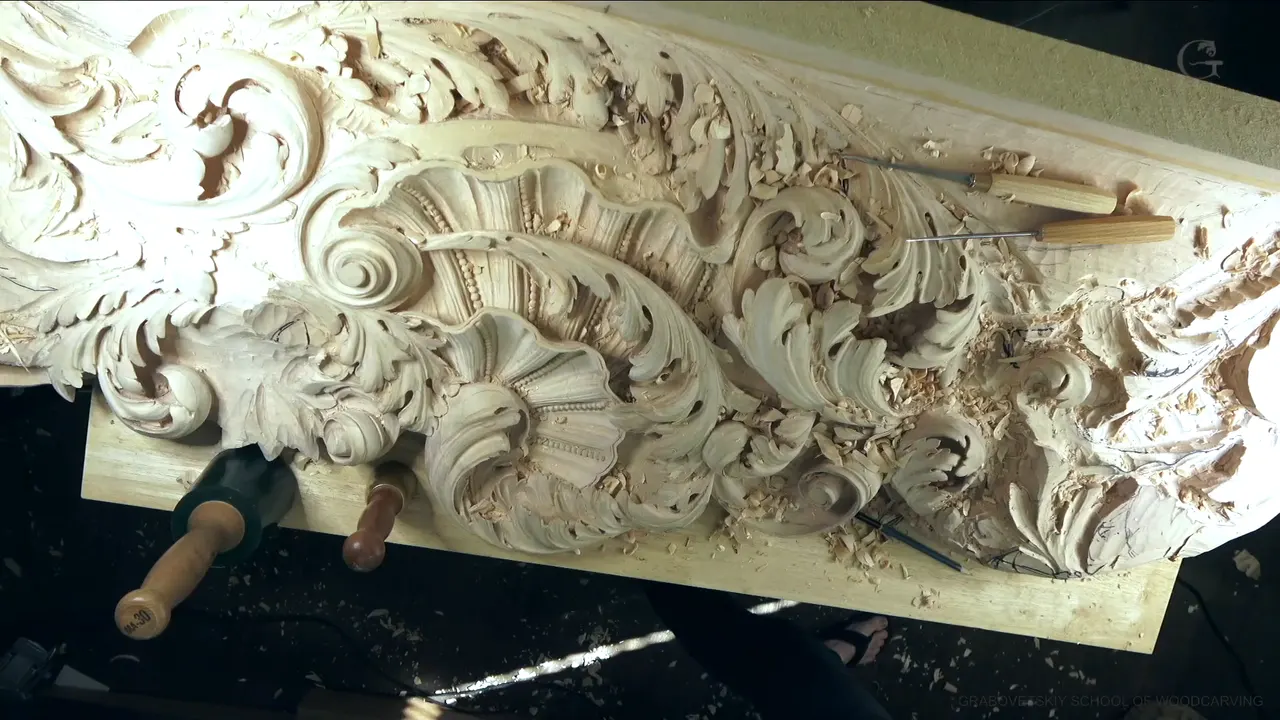

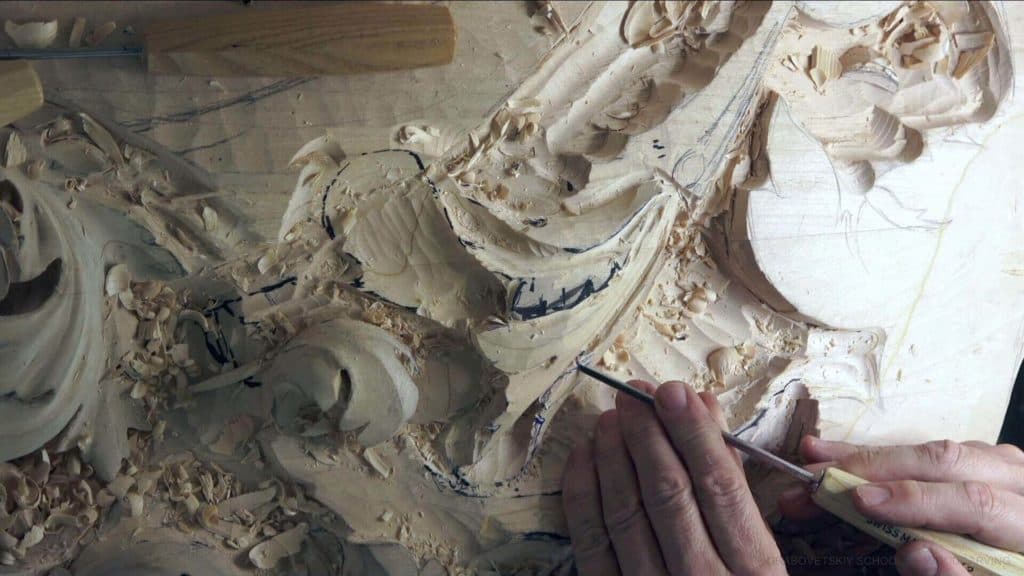
Venice Room workshop 51, part 6, is where I said "I can use probably five millimeters, number 11, and create eye." Five millimeters comes to about 0.2 in. My other wood carving lessons carry the same word before a tool number, a size or a way of working, and below are those places in my own words.
Sizes are in millimeters and inches, my figure first. Open the lessons in a second window and see for yourself whether the page matches the video.
What did I say about the eye in part 6?
Next in that stretch: "And I could probably excavate little deeper eye in this case." And right after it: "It's going to give me a really nice movement."
Two sizes followed. In my words: "Maybe it's little too big. I'll use three millimeters" (0.12 in). Another line: "But it's got to be really nice shadow casting eye." Then "Two millimeters. That's what's going to be next" (roughly 0.08 in). The line after that: "It's going to be really deep eye."

Earlier I said "Get my tools back." After it came "Although, I'm probably going to need" and, at the end of that sentence, "maybe number seven tool to clean a little bit."
The part opens with "So with the number nine and quarter inch, but it has to be sharp because we are not carving with the grain." A quarter inch is 6.35 mm. Further on: "Number seven, that's what I'm using."
Another plan: "Okay, let me use number seven and get rid of some of that stuff."

Later in the same part: "I could use just a number three, even spoon gouge, and blend in like that."
What else is in part 6?
Before the eye I said "Okay, I'm not going to go too deep yet undercut underneath of here because I still have to create a semi-final movement on this side." And: "And create that feel like it's wrapping, okay? Which actually is."
About the view: "Maybe I can show to you from a different angle what I'm doing." Also: "And I'm sorry if my head was on the way."
Near the end of the part I said "I like triple, three parts. But in this case, I don't want to separate down." And: "only two divisions, two separations."
Which other parts of workshop 51 say the same word?
In part 1, after "Okay, number 11, 7 millimeters" (0.28 in), I said "And I can probably excavate that a little deeper right away since I still have to undercut it anyway." Elsewhere in that part: "And I can probably use the same tool," then "Same tool, number 11."

In part 2: "so I can probably start chopping this out also." Then, after "Four millimeters, number 11" (0.16 in), part 3 has "I can just probably start undercutting, and that's going to show me much better what I have to do right there."
Next comes part 4, with "probably just establish this eye. Not big." Right after: "let me see, maybe two millimeters, maybe three millimeters. Three millimeters, probably" (2 mm is 0.079 in, 3 mm is 0.118 in).
Over in part 5: "And I'll go all the way probably to one millimeter or maybe even a half a millimeter. We'll see" (0.04 in and 0.02 in). The same part has "And by the way, that's probably."

"Number six probably is what I'm going to use, and 5/8 of an inch, about 16 millimeters" is from part 8. Later in that part: "And I'm going to switch to probably a smaller tool with the one-eighth of an inch, number nine." Also: "Three millimeters, and I can excavate even deeper."
Part 11 has "That's probably," then "I can't get more than that with a quarter inch" (near 6.4 mm), a plan to switch to "one-eighth of an inch" (3.2 mm), and "I can excavate much deeper. Three millimeters." Later: "That's probably, I don't need to go deeper than that."
Which tool number came after the word?
Over in Furniture Panel 23, part 12: "I can probably use the small one, quarter-inch" (6.35 mm), and then "let me do it with the quarter-inch."

Floral and Molding 10, part 1, gives "I'll get probably number two and 12 millimeters." Then: "12 millimeters, about half an inch."

A line from Venice Room 20, part 10: "And looks like I should just probably use number nine." Then: "But it's not the end yet." Hashemi Flowers 45, part 7, says "Maybe it's probably good idea to use number 11. And again, excavate toward the hole."

From Roman Acanthus 3, part 1: "I'll actually take probably number three." From Grape Onlay 12, part 2: "My favorite tool is always, is gonna be probably number 11." Also in Venice Room 16, part 7: "So now I need to knock out a little bit of this. And the way to do that, I'll use just probably number three."

Then Lily Box 1, part 3, gives "I think number five is probably better than number seven. At least I like it better."
Also, Venice Room 23, part 7: "I should use probably number eight or number nine, or even number seven should do. Well, no, actually, no, number nine or eight."

Look at Venice Room 94, part 11: "And I guess I have to use something bigger in this case, probably just the number three." Next: "I'll use number three, but a little smaller. Like maybe about three-quarters of an inch" (19 mm).

In Hashemi Flowers 47, part 7: "A lot of use of small gouges. Okay? That is probably more accurate. That's what I was trying to say."
How big was the tool that I named in each of those lessons?
For a size, Venice Room 74, part 5, has "I can take probably 15 millimeters or so and outline a little bit" (close to 0.6 in). And Venice Room 49, part 4: "I could probably use even bigger number 11."
Another line, from Venice Room 109, part 3: "And I'll take, in this case, probably 10 millimeters will work. I think 10 millimeters will do a really good job. Of course, number 11, 3/8 of an inch" (0.39 in).
Greek Acanthus 8, part 3: "Let me think which tool I probably should use. And I'll take probably just number five, which is 10 millimeters, let's say" (0.39 in).
Another pair: Grinling Gibbons Maine class 3, part 2, "I could probably get number nine and 20 millimeters at first" (about 0.8 in), and Acanthus over Moldings 7, part 3, says "I should probably use seven millimeters" (0.28 in).
One more from Byzantine Acanthus 10, part 1: "I can take probably number 9 and 10 millimeters, and exactly the same idea" (0.394 in). And Hashemi Flowers 22, part 2: "I could use just probably about number five and six millimeters, and kind of fix it" (0.24 in).
In Venice Room 6, part 5: "probably two or three millimeters, in this case. Spoon gouge, that's what I'm trying to say" (about 0.08 in or 0.12 in).
How small did the word go?
Here is Venice Room 100, part 4: "I would take probably two millimeters, I would say, number 11. Two millimeters or three millimeters will work, but I'll take two millimeters" (two millimeters is about 5/64 in).
From Furniture Panel 20, part 10: "I can use probably half a millimeter" (0.02 in).

And in Venice Room 82, part 10: "Probably one millimeter number 11 will be the best tool to use right now" (about 1/25 in). Floral and Molding 9, part 3: "I think I should use probably one millimeter or so" (about 1/25 in).

Furniture Panel 31, part 3: "I think I have to switch to a smaller number nine." Next: "probably about a millimeter or so" (0.04 in). Then: "Maybe too small."
Take Venice Room 81, part 10: "again, probably three millimeters veiner, number 11" (about 1/8 in), then "create little nicer transition downhill."
Which size looked wrong to me?
One size is in Venice Room 73, part 4: "Although this number 11 would be probably a little too big, and I should use a smaller one."
The other direction is in Venice Room 41, part 11: "And I need to use probably much bigger tool, because right now this is a little too small." Next: "I can use 30 millimeters" (1.2 in).
In Furniture Panel 22, part 9: "Let me see if my number seven would be probably too big." Then: "Let me check number six. Number six works perfectly."

In Furniture Panel 26, part 1: "It doesn't have to be number 11, but I think number 11 will help me." And: "it doesn't have to be two millimeters, okay? It could be three millimeters" (0.079 in and 0.118 in). Next line: one millimeter (0.039 in).
Do I name a tool that is not a gouge?
Corinthian Acanthus 5, part 1: "So the step number one, what I usually do, I would take probably just a V tool, and any V tool will work."
Also Furniture Panel 15, part 3: "Now, I can get probably a little closer and use a knife."
In my October 2020 livestream (the lesson page): "And that is against the grain, so better tool would be just probably a skew."
Another livestream of mine, April 2020: "I need to use probably just a back bent. I need to move that direction with the back bent."
Then Venice Room 120, part 1: "it's probably better to use just the rubber mallet."
Hazelnuts 3, part 3, has "A skew or maybe a bigger gouge." And: "Probably number two."
And from Furniture Panel 39, part 3: "Probably gonna get a smaller grounding tool and remove some of that material." Then Hashemi Flowers 3, part 3: "Number seven, or you could use probably a smaller number five. Important not to rush it."
Acanthus over Moldings 1, part 2: "probably a good idea for me to use number 11 veiner."

Lily Box 8, part 1: "And I'll use first, probably number 11." Further: "Let me use probably two millimeters spoon gouge."

What came with the word enough?
In Lily Box 10, part 10: "That's probably enough. Otherwise, I can overdo it again." Also in Venice Room 12, part 1: "That's probably enough because, like I said before."
Then Venice Room 47, part 9: "That is probably enough with this tool."

Which lines mention a notch?
Take Venice Room 22, part 8: "And I still want to do probably extra notch right here just to give an extra curliness." And in Venice Room 23, part 8: "And I can create probably another notch right here easily."
Which other lines carry the word?
Then Hashemi Flowers 11, part 3: "And now I have to blend this ridge because it doesn't look too nice, although I could probably leave it like that."
Tray of Blessing 7, part 1: "And I'm gonna leave probably more space because again, I think about what tools I have." Then: "my teacher would tell me, think, how are you gonna carve it?"
Furniture Panel 19, part 8: "I can probably leave convex on this side just like it is, just refine overall shape."
And Venice Room 6, part 6, has "I would probably leave it like that. Let me clean a little bit on inside. See, I should do a little deeper cuts, but it's okay."
Hashemi Flowers 42, part 2: "There is many different, I would say, approaches. You can get probably about the same result."
What about a count of tools?
I was asked in my April 2020 livestream (the lesson page) how many tools a person needs to carve. "It all depends on the project. If you want to carve a project like that, a complicated project, you're probably going to need little more than 20 tools, I would say."
Right after that: "Although, most of it done with the number 11s, veiners."
Which four lines sit side by side?
Here are four more of those lines, with the course each one came from.
| Where I said it | The words I said, in full | Course |
|---|---|---|
| Next time | I would use probably smaller tool next time | Byzantine Acanthus 9 |
| A number seven | But in this case, I could use probably number seven | Tray of Blessing 6 |
| The same tool | I would probably use exactly the same tool | Roman Acanthus 13 |
| Just the seven | this time I could probably use just the number seven | Grape Onlay 3 |
Where can you watch these lines?
The Venice Room Part 5 course holds workshop 51, and the lesson page is the one to open. To carve along with the room, the tuition opens each video.
How it's done
- Name the size for the eye. Part 6 gives a number 11 for the eye, then smaller sizes after it.
- Excavate a little deeper. I plan, in part 1, to excavate a little deeper right away, since the spot still has to be undercut.
- Go smaller when the first tool stops. The first tool stops in part 11, with a plan for a smaller size to go much deeper.
- Keep the grain in mind. Part 6 has the number nine kept sharp, because we are not carving with the grain.
- Leave the size open. The number 11 is not tied to the first size I named, in Furniture Panel 26.
Frequently asked questions
Which size did I name with the word in Venice Room 51.6?
The number 11 at five millimeters, for an eye. In that part three millimeters (about 1/8 in) and two (about 5/64 in) came after it, and a deeper eye came with the same word. Five millimeters is about 0.2 in.
What was my plan when the quarter inch stopped?
The line is in part 11 of workshop 51: "I can't get more than that with a quarter inch" (near 6.4 mm). The plan was a switch to a smaller size, 3.2 mm, and then "I can excavate much deeper." And: "I don't need to go deeper than that."
When did I want a bigger tool?
Venice Room 41, part 11, has me saying a much bigger tool was probably what I needed, with 30 millimeters (1.2 in) as the size, and Venice Room 74, part 5, has probably 15 millimeters or so (close to 0.6 in).
What to carve next