

Alexander Grabovetskiy, woodcarver, School of Woodcarving · Published 2020
What does a wood carver mean by "motion"?
Quick answer: In Venice Room 51.8 I said motion after I talked about a bigger tool, and number six, probably. My other lessons use the word for a middle line, a rotation of the tool, a slicing cut and my own body. Each line is below, with its lesson.
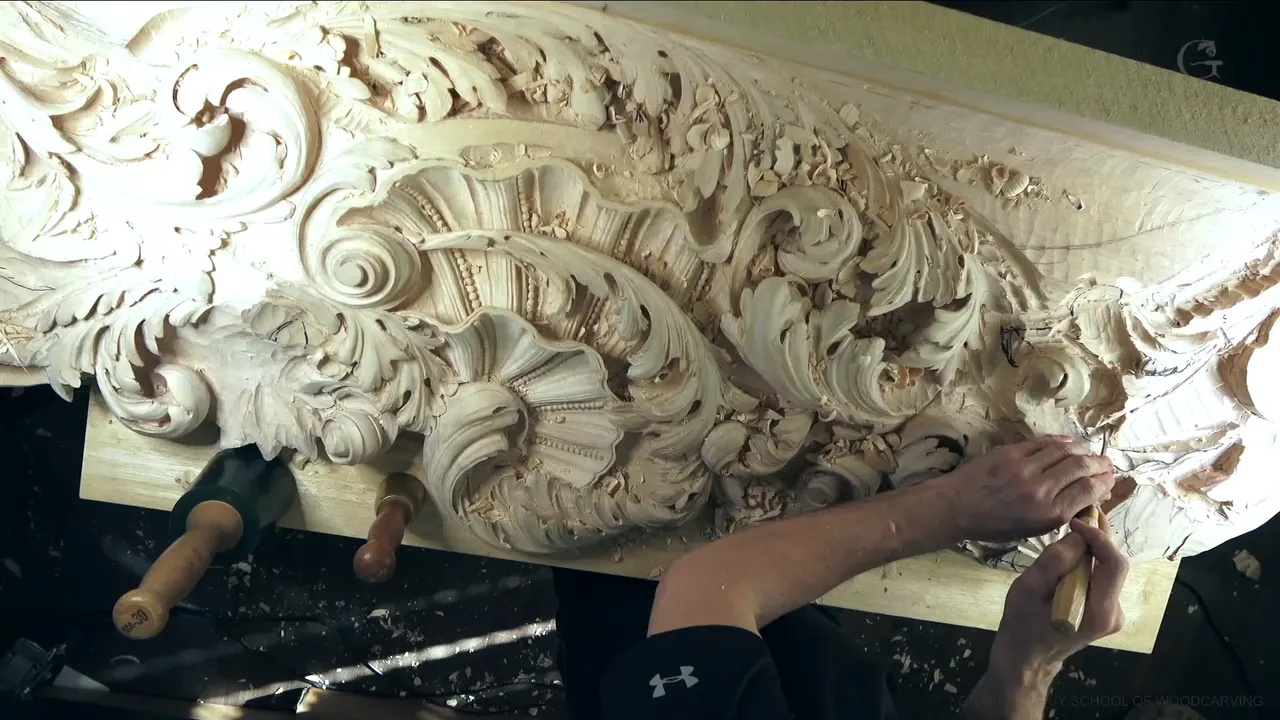

In Venice Room workshop 51, part 8, I said "Okay. Now it just gives me that motion." Other wood carving lessons of mine use the same word, for a middle line and for a turn of the tool, and below are those places in my own words.
Sizes are in millimeters and inches, my figure first. Open the lessons in a second window and see for yourself whether the page matches the video.
What did I say about motion in part 8?
Here is what I said: "And I've got a lot of stuff on inside, which is okay." Then: "Maybe I should use a little bigger tool, and that way I can clean a little better and quicker."
The next line: "So that was number seven and half an inch." That half inch is 12.7 mm. Then a plan: "Let me use number five or number six. Let me see. Number six probably is what I'm going to use, and 5/8 of an inch, about 16 millimeters." In metric, 5/8 of an inch comes to 15.9 mm.

After that: "And create even better concave." Then came the motion line, and right behind it: "Okay. Which is really, really good."
On the separations I said: "And yes, I'm still going to create more separations." And: "But I can do that separation little later."

I put the next step this way: "Let me jump above and finish up this part." Then I asked: "Can you see it? Okay. I hope you can see it." Next: "Right there."
What came next in part 8?
Next I said: "And now I need to use number nine and excavate on inside. Okay. Create a hole again. Okay. And create the hole again. Okay. A little bit with this tool, which is a 5 millimeters number 11." In inches, the 5 mm is about 0.2.

About the hole on the inside, I said: "Again, number nine. Same number nine, quarter inch, 6 millimeters." A quarter inch works out to 6.35 mm, and 6 mm to 0.24 in.
And on where it goes: "And I will go approximately 3 millimeters away from this side and down approximately a quarter inch. Okay. From this ridge." The 3 mm (0.12 in) is the gap from the side, and the quarter inch (6.35 mm) is the depth.
As for the mallet: "Maybe with the mallet preliminary cut like this, flip it and go this direction. Flip it, go this direction."

I also said: "I also don't want to hit this line because I still want to keep that detail. That's why I'm kind of careful how I'm doing it." Then: "Maybe quarter inch is a little too much, but we'll see. Which is actually okay."
Then: "And careful. See, with the drill, I'm not going to be able to do anything. There's no drill. But with this tool, I can lay pretty much rest almost flat and just to go and still create my hole, or cut the plug out."

About going in: "Just like that. Go in, make a full rotation. Make sure you're not cranking like this because this is fragile now, so you can break it. So take your time."
My next words: "If you do stuff like this, okay? If you don't, don't worry about it. But this is one of the approaches how to create deep shadow on inside of those areas."
I said I would probably switch to a smaller tool: "with the one-eighth of an inch, number nine. Three millimeters, and I can excavate even deeper." That one-eighth inch is 3.2 mm.
Then: "But I have to think about how I'm going to finish it. Well, in this case, I can get a tiny, small brush and get that finish on inside." And the closing words: "All right. And now I can cut everything to the hole. And that's a deep hole."
Did I say motion again in part 9?
Yes. Part 9 follows part 8, and in it came: "But looks like it's time to sharpen this one." Then: "And now it's sharp, and I can create that movement going like this. Like really good concave movement. Full motion. Full 3D, if you wish."

Earlier in that part, number seven was my plan for the movement: "beautiful movement going downhill underneath of this one."
Where else do I say motion about a line or a movement?
Take Venice Room 48, part 6: "I could actually roll it backward and go that direction. Okay. That's still going to give me the full motion of the middle line."
Later in that part: "But I do not want to lose motion. Maybe this is going to become part of that movement, and I have to create another one growing from underneath this way."

In part 4 of that lesson: "And let me see. I think I should go deeper right here because I really want to see a full motion."
From Venice Room 47, part 12, about a part that goes underneath: "create a full motion." Then: "See, it's already becoming curly."

In Modern Acanthus 6 I asked "Can you see how I'm creating that motion?" in the first video, and the second has "But now that is the motion we are after."
Over in Venice Room 65, part 12: "See, it just gives me really nice motion, and I can actually use the same big tool and create even more movement in this area." Later: "That is already giving me beautiful movement, although maybe I can actually excavate a little deeper, right here."

The Venice Room 75 lesson, part 5: "But again, like I said, everything's supposed to have a motion like it's moving this direction." And part 9: "In overall, it looks really good, actually. It just really creates that motion backward."
Right after, in part 9: "But let me actually, you know what, let me create a preliminary cut right here. So that way it's going to guide my eye to the right motion, to the right movement."
In the Venice Room 63 lesson, part 12: "And maybe I can actually lower this down slightly, like this. Okay. And give a motion downhill a little bit. Kind of create that feel. I'm using number three."

After "I can establish my concave," in Venice Room 67, part 6, I said it would "give me really nice motion or movement." The size: I said I'd use "a 12 millimeters, a half an inch." In inches that 12 mm is 0.47, and my half inch is 12.7 mm.
And Venice Room 66 has, in part 5: "So now I've got somewhat full movement, full motion going in. So now I need to excavate on inside."
Looking at Venice Room 69, part 2, on the size: "probably around 10 millimeters tool or even bigger, maybe 15 millimeters tool." Next: "I don't need deep cut," and then "want to make sure the light hits and creates the right motion, right movement." Those sizes in inches: 0.39 and 0.59.

Over in Venice Room 76, part 5: "So let me try to create that rolling motion, and I'll use number seven. Number seven or number six will work. Let me think first."
Another line from part 8 of that lesson: "And you'll see what I mean. It actually really gives me beautiful motion." And: "Because it's long motion like this."
From Venice Room 74, part 6: "Pretty much the only fear I have, how it's going to interact with this movement." Then: "Because this also has a lot of motion," and I added that I was not sure it would look okay.

In Floral and Molding 6, part 2: "what I would like to do, the motion has to be just starting from this point," and then I said I'd rotate my tool "almost upside down and go underneath."
Venetian Flowers Rosette 3, part 3: "with the same gouge probably, get my raising motion." Next: "that raised part right in the middle of the petal, because it creates a somewhat beautiful motion." The first video of that rosette lesson: "Just like if you look the real flower, it always has some kind of folding motion."
Rosette 5, part 1: "So I'm really happy with what I've done right here. For me, it looks really nice. It gives me a really good motion, if you wish. Okay, so now let me take that triangle out."

In Hazelnuts 3, part 3: "each of those are going to subdivide in three main motions." Then, in the same part: "some areas I can introduce some extra motions, like a concave inside of the concave. Maybe even some curliness."
From the first part of Hazelnuts 7: "I don't want to see 90-degree cut right here. Not the cut, but motion."
Where else do I say motion about my hand and tool?
Venice Room 48, part 2: "But see, I'm just rotating, and the number nine is a true half round, and I can actually create a really nice rotation motion with that." Next: "And I said in another segment, in another lesson, that you cannot do rotation cuts like this or plug cuts with the number 11 because number 11 is a shape like U, letter U."
Byzantine Acanthus 2, part 1: "while I'm pushing, I create rotation movement." About the name: "So, it's called slicing cut." Later: "And again, you don't see that in the slow motion, but every cut I do, I make a rotation."

The second video of that lesson: "See what I'm doing in slow motion." Then: "feel what the grain does. If it's working against you, change the position, rotate the piece, and work opposite direction."
The rotation motion in Modern Acanthus 1, part 2: "I'm always creating that rotation motion slicing up."

Grape Onlay 10, part 2, has "And I'm slicing, I'm not pushing." Then: "So that gives me a slicing motion." In Grape Onlay 4, part 2, I said "And now I can actually get really nice twisting motion." And Grape Onlay 5 has, in part 3: "once it's done, they're not gonna be as thick. They're gonna get just really tiny, small motions."
The Tray of Blessing 1, part 1: "But somewhere right there, you start your first cut and by the end you create like a rotation motion and you escape the cut at another side of the tool." Further on: "But see how I'm positioning my left hand solidly? That is a really important, really important to place the hand solidly and really important to create a motion of rotation or slicing how it's called."

In Furniture Panel 21, part 1: "And I am making rotation motion and kind of start undercutting." Then: "So I need to change the tool and get smaller tool. And let me try first 1/16 of an inch, number eight," and "So one and a half millimeters." In metric, the 1/16 inch is 1.6 mm; the 1.5 mm is 0.06 in.
The first part of Furniture Panel 24 has "I still create that rotation motion, or slicing motion, I should say."
The Tray of Blessing 8, part 1: "Why? I like number two because it has a slight curvature. It's naturally follows the motion." A little later: "I'm controlling my motion." Lesson 6 of that course, part 3: "It's gonna be really beautiful motion."
Floral and Molding 4, part 3: "You don't see the cut, but you can see that I'm holding my hands really tight to my body, and I'm using that body motion, almost like dancing." Then: "I left, I don't know, maybe about one-eighth of an inch, three millimeters. Something like that. Maybe a little less, maybe two and a half millimeters. That's what I left." Converted: 3.2 mm for the one-eighth, 0.1 in for the 2.5 mm.
Which four lines sit side by side?
Here are four more lines with the word, and the lesson each one came from.
| Subject | What I said, word for word | Course and part |
|---|---|---|
| Slow motion | and make a slow motion, you do exactly the same what I showed you previously on a different part. | Byzantine Acanthus 10, part 4 |
| Some motion | Here you go. You've got some motion going that direction. | Grape Onlay 4, part 1 |
| The roll | And create my rolling motion. | Modern Acanthus 4, part 1 |
| The curl | I can actually use a curl motion, going to go all the way underneath of that element. | Venice Room 75, part 12 |
Where can you watch these lines?
The Venice Room Part 5 course holds workshop 51, and the lesson page is the one to open. Both acanthus courses above are named for the acanthus leaf. To carve along with the room, the tuition opens each video.
How it's done
- Pick the tool size. Here I said a bigger tool may let me clean a little better and quicker. My plan was the number six.
- Keep the plan for the separations. My plan: more separations, with a movement like that underneath, and I can do that separation little later.
- Set the hole. With a number nine, I will go approximately 3 millimeters (0.12 in) away from this side and down approximately a quarter inch (about 6.4 mm), from this ridge.
- Rotate fully. Go in and rotate fully, without cranking, because it is fragile now.
- Think about the finish. Think about how to finish it: in that case I can get a tiny, small brush and get that finish on inside.
Frequently asked questions
After my number six plan in part 8, what came next?
Next came "And create even better concave." The motion line followed.
Which tools did I name in part 8?
Number seven, then number five or six, then a number nine and a 5 millimeters (0.2 in) number 11. Later I named a smaller number nine at three millimeters (about an eighth of an inch).
How do I go in with the number nine?
My words: "Go in, make a full rotation. Make sure you're not cranking like this because this is fragile now, so you can break it."
After the sharpening in part 9, what did I call the movement?
What to carve next