

Alexander Grabovetskiy, woodcarver, School of Woodcarving · Published 2020
What does a wood carver mean by "fragile"?
Quick answer: In Venice Room 51.5 I called a ridge fragile while I excavated a hole with a number 9. My Roman, Hashemi and Panel courses use the word beside undercuts, plywood, grain direction, a knife edge and a hand held in the air.
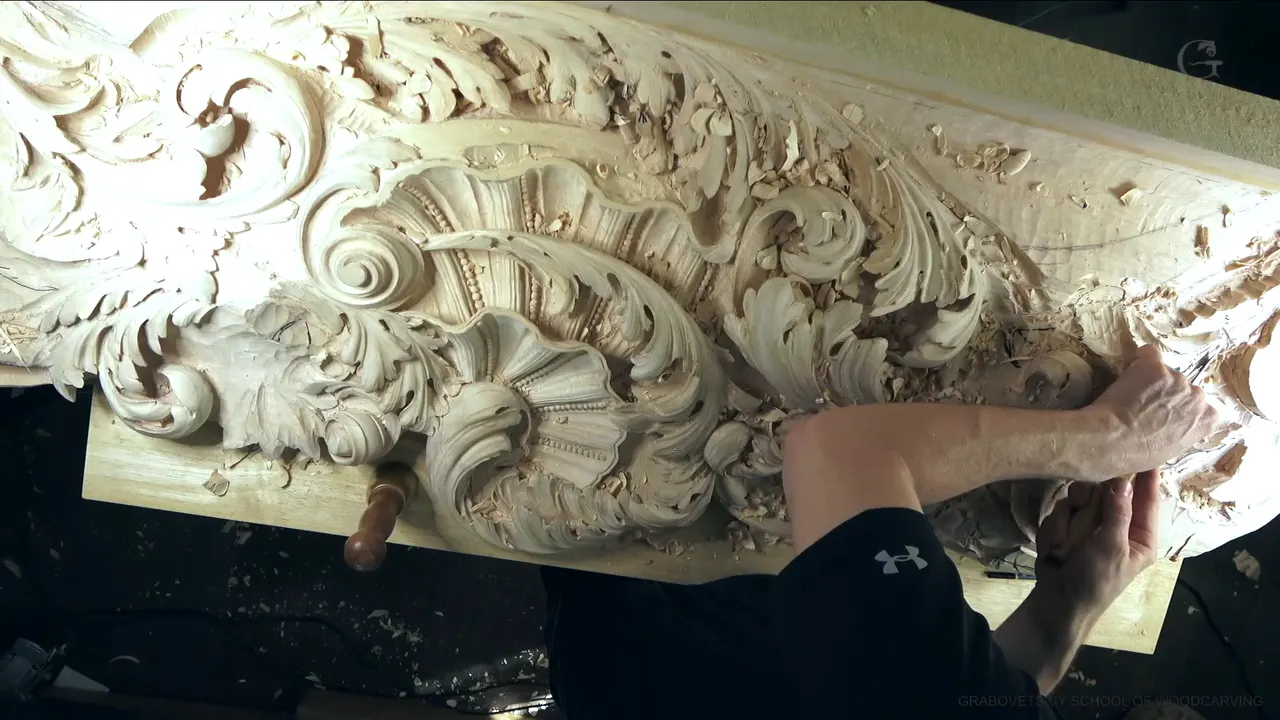

Venice Room workshop 51, part 5, is where I called a ridge fragile and said it's more important to keep away from it. Just before that came my plan: an excavation, with the same number 9 (quarter inch, 6.35 mm). My other courses carry the word too, beside undercuts, plywood, a hand held in the air, grain and a knife edge. Below are the places, each as I said it.
Sizes come in millimeters and inches, my figure first. Open the lessons in a second window and see for yourself whether the page matches the video.
What came before the hole in part 5?
I needed to get rid of a ridge, and I said "I really don't need those extra ridges." Another line: "I really like how it goes underneath," and one more thing: "I can get a little deeper if I wanted to."

About the tool: "lots of that stuff you could get done with just a knife, by the way, or a skew chisel, I should say." My plan for the eye was "a little deeper with the smaller number 11," at "two millimeters" (0.08 in). Another spot got this plan: "relieve also this area."
My idea for the shape: "maybe I can give a better shape right away to overall movement. Just with the mallet." Next came a limit: "I still don't want to undercut too much."
Which ridge did I mean in part 5?
The hole came next, and the plan was to "excavate this hole also with the number nine, and I'm going to go deep." The payoff, in my words: "you'll see a lot more shadow." The wall did not scare me: "I'm not afraid to get really close to this wall because it has to wrap anyway on inside."

Then the line this page is built on: "For me, it's more important to keep away from this ridge because it's fragile. That's more important." And right after: "I can actually start from much farther."
Of the next tool: "Let me see if it's enough with this number nine. I could use a smaller number nine, but this needs to be undercut anyway."
How small did the tools get inside the hole?
"Maybe I can use number 11 first and create that movement, inner movement right through the hole. I know it sounds bad, but what it is, it's just a hole." Then the sizes came down: "I can get even smaller. That was four millimeters" (5/32 in), "number 11, and I can use number 11, three millimeters" (about 0.12 in) "and get even deeper."

One area got a plan: "this area is going to be visible from the bottom, so I really need to use even smaller." I planned to switch "to two millimeters, number 11." I would "go all the way probably to one millimeter" (about 0.04 in) "or maybe even a half a millimeter" (0.02 in). "We'll see. But I need to make that line disappear."
Next: "Two millimeters too big." Another option: number seven, "and get more concave," and then "I can get much deeper cut." Further on: "And I'm still using quarter inch, by the way" (near 6 mm). "But see? I'm still able to cut the plugs out."

Sometimes, maybe: "I have to switch to smaller number nine, like three millimeters, one-eighth of an inch." Of a plug I had just removed: "And it's deep. That's deep." At the end of the part: "I can't even see anymore because the shadow is so deep. Unless if you're going to look with the flashlight, then you're going to see the end."
"But I've got really deep, but it's not the end yet. I still have to go underneath of this region right here."

Does a deeper cut leave less wood?
Roman Acanthus 8, part 4, has me saying "let me use just number nine gouge again. And be careful because right now it's going to become more fragile. More material you remove, the more fragile it becomes." Then: "by slightly undercutting, I'm able to get actually to my pipe."

A few lines on, in the same part: "I know some of wood carvers, they don't approve extreme undercutting, and I absolutely do understand why. Because it becomes fragile. You can easily break it. But like I said before, you can break anything."
About a crystal: "the crystal is really fragile, but just because it's fragile, that doesn't mean you can't create some beautiful things."
Deeper still, Hashemi Flowers 46, part 1: "I need to excavate even deeper under this curl. But you also have to keep in mind, more excavation you do, more fragile this will become." And: "you have to expect you could break something. It's unfortunate, but sometimes it happens."

What should a hand do near a fragile piece?
In Hashemi Flowers 22, part 1, I named "six millimeters, quarter-inch V tool" (6 mm is about 0.24 in) and said: "We are working right on the end, so don't create too much pressure." Then: "Or just get a different approach just to get some support like we've done before."
Of carving in the air: "it actually trains your hand, or hands, I should say, both hands, to feel how fragile this piece is, to feel the pressure, what you have to create, what kind of pressure you should apply." Later in that part: "I could use just an eighth of an inch" (3.2 mm). And: "This is fragile. So it is better to just create multiple cuts."
Hashemi Flowers 12, part 4, puts it plainly: "the pressure is not going to help because there is multiple points you can break now." Further, in Hashemi Flowers 17, part 5: "Keep an eye where you're placing your hand because you've got fragile parts right now." And: "especially don't crank against, okay? Don't pry."

Over in Hashemi Flowers 14, part 6: "keep an eye not to touch this because it's already fragile. This is more stable than this." Another is in Hashemi Flowers 10, part 4: "At some point, I'm not going to be able to lay it on the front side," I said, and the reason was "way too fragile."
The Roman Acanthus 16 lesson, part 3, says: "Don't try to push too hard on fragile areas like that, okay? Because it is fragile, okay? It is fragile." In Greek Acroterion 4, part 7: "right now it's fragile, and if I'm pushing too much, I can break it."
From Roman Acanthus 14, part 4: "Don't press it too much. Believe me, it is fragile, and believe me, you could break it."

Can a part look fragile and still be solid?
In part 2 of Byzantine Acanthus 10 I said "careful, please. Don't place your hand on it." Then: "More you remove, more fragile it's going to become." And about the look: "It looks paper thin, but it's solid."

In Tray of Blessing 6, part 3: "Don't stay too deep inside because it's gonna be too fragile. You're gonna be able to break it." I'm gonna stay "probably about 10 millimeters or so" (0.4 in), "and then I'm gonna carve up to the knife edge. That way it's gonna look really thin, but it's gonna be only visual."

Another line from that part: "If I would do a, let's say, piece of decoration, which is gonna be on the wall, I would do extreme under, but not in this case." A little later: "It's really fragile, but it's not."
A second view of extreme work is in Roman Acanthus 10, part 1, which says: "I have to be careful not to overdo, because I still have to keep some meat. Otherwise, I'm going to make it too fragile." Then a different thought: "it is architectural, but it's more decorative, ornamental." And: "if it's not practical like for furniture, I can go to the extreme."
On the subject of breaking it, Hashemi Flowers 41, part 1, has this, about carving it complete in the air: "definitely, yes. It will be really fragile." Break it? "Yeah, and I've done it many times. So what? Just glue it back." The excavation inside was "about half an inch" (13 mm) deep.
The stabilizing lesson in my Q and A course says the piece will be at the shoulder level and "I want to make sure it's solid." About the glue: "It's really thin," and "you penetrate that."
For Hashemi Flowers 45, part 6, my goal was "to just remove as much as possible the material and make those petals as fragile as possible. Okay. Make it look as fragile as possible. And they will be fragile, of course."

Does the grain decide what is fragile in a carving?
In Furniture Panel 19, part 7, I said I erased a part "because it's kind of becoming more fragile. But in reality, it's not, because the grain runs that direction, and that gives me strength." I said "just because the direction of the grain, I safely can raise this one as high as one-eighth of an inch" (3.2 mm).

"It would not be wise to do if the grain would run that direction. That edge would break."
The Modern Acanthus 7 lesson, part 1, has the other side: "it's a good idea to undercut." Also: "in this case the grain runs that direction." About that piece: "so fragile. You're gonna break right on the grain."

Grain again, in Hashemi Flowers 2, part 5: "really fragile because the grain goes this direction." Until the final detail, I said, I would not go all the way down yet.
Then Furniture Panel 15, part 4: "especially in an area like that, when the grain goes toward the design, it's a kind of fragile area, I will have already relief cut done."

How much wood is left in a fragile spot?
A fragile spot comes up in Hashemi Flowers 8, part 4: "I do have a fragile spot right here. It's less than an eighth of an inch, about 3/32nds already left right here. So I can't dig too much. Just little by little." The 3/32 in is about 2.4 mm.
Furniture Panel 16, part 5, says: "you still want to keep some wood." And: "You don't want to make it too fragile." My memory of one relief carving: "almost only 1/16 of an inch" (1.6 mm) in some spots, "even less in some spots," while "the panel itself, was 3/4 of an inch" (19 mm).
One more fragile spot is in Hashemi Flowers 30, part 1, where I said "I know this piece is kind of fragile. I left small, tiny piece."
Hashemi Flowers 40, part 1: "Let me take some kind of gouge, maybe about 20 millimeters, number seven" (0.8 in). Of force: "I don't force it." Forcing it, I said, "becomes really fragile, and I can easily break it." Also: "It's better not to force it and just approach with different tools multiple times," I said.

From Roman Acanthus 12, part 4: "Just really carefully because it becomes really fragile." And: "Again and again, don't overdo it. If you feel your piece is too fragile now, just stop it and work on something else." Before that I said "I'll take again 1 millimeter, number 11" (near 0.04 in), "and I'll create my channel."
From Venice Room 5, part 1: "this area right here still has to be refined. And I'll do that a little later. But for now, I'll keep it like that because it's already fragile."
Over in Venice Room 8, part 11, I did not want to touch the other part: "other part is very fragile. I'm talking about this side." Then: "Just whatever, if I can excavate."
Floral and Molding 13 gives a method: "I kind of like a slow approach when you're working on a really fragile detail." I still want it "stable and not too easy to break."
The Hashemi Flowers 15 lesson shows a way to work on fragile pieces: "You can see it's hanging in the air." One of the solutions, I said, was to glue it "to a piece of plywood."
Which four lines sit side by side?
Here are four of those lines, with the course each one came from.
| Where I said it | The words I said, in full | Course |
|---|---|---|
| Prying a tool | you can pry against the finger, but not against the wood | Hashemi 17 |
| One thin edge | a really fragile edge and it's like a knife edge | Venetian Flowers Rosette |
| Pressing too much | Believe me, it is fragile, and believe me, you could break it | Roman Acanthus 14 |
| A broken piece | It's better not to break it, but if you broke it, so what? | Hashemi 41 |
Where can you watch these lines?
The Venice Room Part 5 course holds workshop 51, and the lesson page is the one to open. To carve along with the room, the tuition opens each video.
How it's done
- Name the ridge. Part 5 has me singling out one ridge, and saying I could go close to the wall.
- Do not force it. Hashemi 40 has me skipping the force and making several passes with different tools.
- Hold back. Roman 12 has me telling you to go easy, and to work somewhere else if it gets too fragile.
- Read the grain. In the panel lesson the grain direction showed me a part was stronger than it looked.
- Find some support. Hashemi 22 has me offering a different approach, just to get some support.
Frequently asked questions
Which part did I call fragile in workshop 51?
A ridge. It came up while I dug a hole with a number 9 and said the wall could take a close approach, since it has to wrap on the inside anyway. The ridge was the part I wanted kept at a distance.
Why do some carvers avoid extreme undercutting?
They don't approve, and I understand why: the wood left behind becomes fragile. I'm extreme on undercutting. In Roman Acanthus 8 I said extreme undercutting creates the beauty, and a crystal is fragile too, yet it still can give you beautiful things.
What kind of work gets extreme undercuts, in my Tray of Blessing lesson?
Decoration for a wall. A tray is a practical use thing, so my plan there was to stay probably about 10 millimeters or so and carve up to a knife edge. The look is really thin, I said, but only visual.
What to carve next