

Alexander Grabovetskiy, woodcarver, School of Woodcarving · Published 2020
What does a wood carver mean by "honing"?
Quick answer: In part 3 of workshop 65, I said a back bend, number five, needed sharpening. Honing was done off-camera, I said, and a felt came into it. Other lessons of mine use honing for sandpaper, felt, a leather strop and a knife.
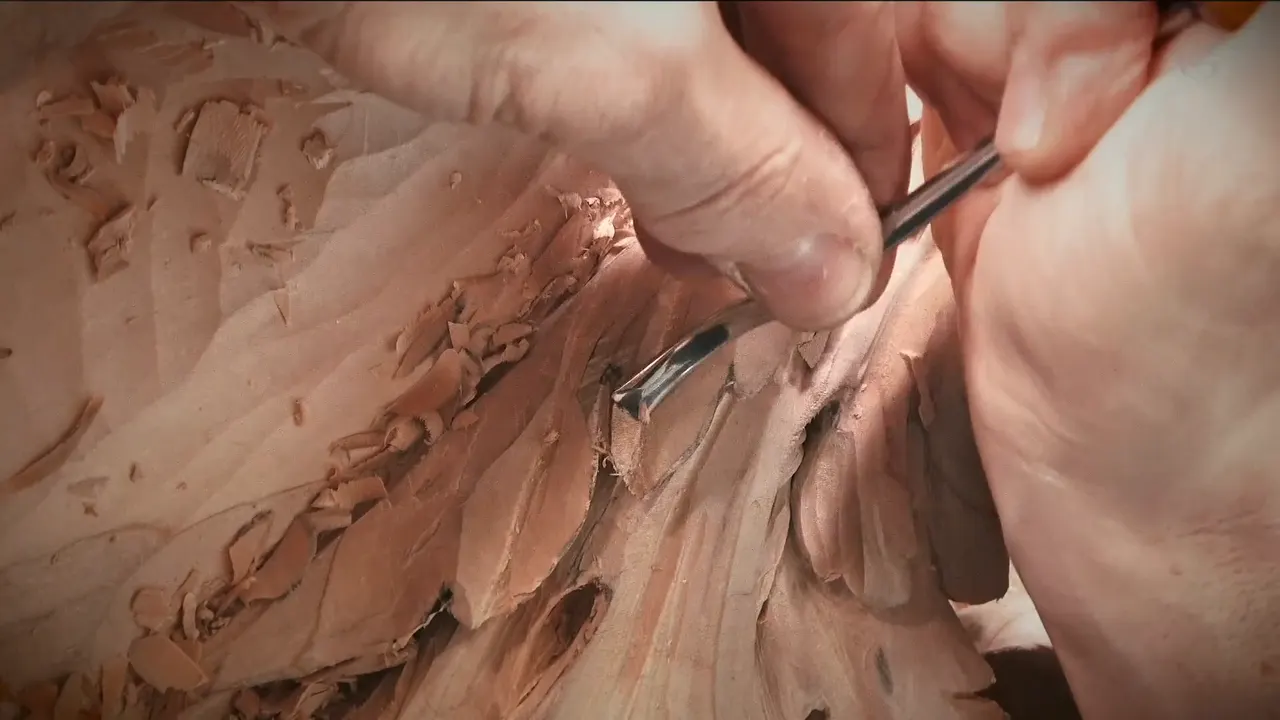

In Venice Room 65, part 3, I told you my number five "needs to be sharpened a little." Then came this line: "I did off-camera some of the honing done." In other lessons I use that word for sandpaper, felt, a leather strop and a knife.
Have you ever held a gouge that looks fine and wondered if it needs a little more? Do you ask yourself whether to strop it, hone it or buff it? This part of workshop 65 has a honing moment, and I said "now it's perfect" when I tried the tool again. Below are the other lessons where the same word shows up.
What did I mean by honing in workshop 65?
I said "I know it's kind of messy," and that I would do "exactly the same on this leaf." I named a number three: "this number three and 12 millimeters, about half an inch." Twelve millimeters comes to 0.47 in.

On depth: "let me check how much material I have, and looks like I do have plenty, so I can actually get deeper. So I can actually give it more shadow." And: "yes, I could actually go deeper right here. Much deeper. And why? Again, all about lights, all about shadows, okay?"
Grain came up as well. My tool, I told you, was "super sharp," and I said "I have to be careful." On back bends: "Of course, my personal preference is always back bends. I just love a finish, what they leave, and it's much easier to work in areas like that when everything is on your way."

My words: "And maybe a little more extreme back bend, like number five, although my number five needs to be sharpened a little." Then came the honing line and my reaction: "Okay, let me try now. I did off-camera some of the honing done. Yep, and that looks good. It is looking good and that gives me a nicer finish, I should say."
Then my plan: "But still not there yet. I need to do it one more time, maybe just above it now." And my test: "And let me try it now. Oh yes, now it's perfect." And on the tool: "I took it to the felt on my workshop, and now it just cuts perfectly even against the grain, leaving really good quality cut."

Inside, I said: "let me get that inside. Maybe I should create a little deeper concave inside." I also planned "extra deep concave on this side," and for the lines that came out of it I said: "I'm going to blend it." Also: "I don't want to see them." One more plan: "blend again with the back bend."
Workshop 65, part 4, has a line about number five: "Number five from back home. Not number two."

How did I know that a tool needed honing in my lessons?
In Carving Greek Acroterion 5, part 6, I put the question to myself: "how do I know it's time to buff that little bit or hone it a little bit?" My answer was about the finger. "When I'm taking my tool, I'm always checking with the finger if there is any burr going on at the end of it."
Then: "if it leaves some marks on the surface, that means there is a burr, micro burr, and you have to take it out." For the fix, "all I take is just the buffing wheel, and buff it a little bit." And: "You could just strop it with the leather also." The wheel: "much quicker than even stropping by hand."

Carving Hashemi Flowers 16, part 3, has a correction of my word: "sharpened, or honed, I should say." Then "Now it's good." After it I said I would need the spoon and named "a number nine and 20 millimeters spoon gouge," which is 0.79 in. Of the big spoon: "Although I'm not always using it right away, sometimes it's easier, like I said, to work with the smaller tools and then in areas like that, and then use a spoon to clean it." Then: "Looks like I'm safe."

Venice Room 67, part 9: "It's already dull." Next: "Yeah, I just buffed a little bit, or honed, and it's much better now." And: "Okay, that is good. That is absolutely wonderful." I planned a spoon number 11, 5 millimeters (0.2 in), "and maybe be able to dig in, okay, from two sides." Next: "Okay. That's what I just removed."

Venice Room 70, part 2, about my tool: "buffed or honed, which is okay. I'll take care of it a little later." My tool there: "Using back bend, by the way, it's sweep number 5 and 20 millimeters." That is 0.79 in.

Is honing the same as stropping and buffing?
In Stropping and Compound, part 1, I named three things for the talk: honing, stropping, buffing. Of stropping: "The stropping is actually one of the stages of sharpening. Some people use, some people don't."
I told a story about my grandfather. "When he was shaving, okay, he had just a razor, the old style, and he would just take a leather, just a leather like that, like a hide, and he would just strop that on the leather."
Part 6 has a correction. "And if you are using felt, you can actually strop on inside." Then I took the word back, and honing too, and landed on this: "It's buffing." My next words: "You're buffing it."

The in-person sharpening class, part 6, has this: "It's just pretty much leather, we're going to do stropping, and felt, we're going to do honing. That's it."
Sharpening Straight Gouge, lesson 3, has a stage in it. "My felt wheel, I'm placing actually right on the top of the sandpaper wheel," I said, and right after it: "It's pretty much just the honing stage." For the fingers: "when I'm honing, I'm placing my three fingers right on top of the tool, and you kind of have to feel the main bevel." A plan followed: "So let me apply some paste."

Did I hone on sandpaper, felt or leather?
Sandpaper is in Venice Room 64, part 9, in a clip about a pipe. Here: "because I'm carving against the grain my tool has to be super sharp." I took "number two and a six millimeters" (0.24 in). The next lines are my correction: "I stropped a little bit. Actually, I did not strop it. I did hone it on a 6,000-grit sandpaper."
My aim: "In this case, I didn't want to round this, so I really needed a really super sharp edge." Then: "Looks like it works really good. Okay, wonderful."

The stropping lesson, part 7, has a sandpaper for honing. "You can buy extra wheel, and there's a honing sandpaper," I told you. On that paper: "it's a honing." A warning follows: "You don't have to charge that. Please don't." And a good point about the paper: "It's a sandpaper. And it lasts long time."
Its effect, in my words: "the same effect as a leather if you keeping your hand really steady." In that part too: "And here you go. You've got your knife honed."

The board in part 4 of that lesson: "10 millimeters, 3/8 of an inch, just MDF board," I said, which is 0.39 in. My method: "you just charge it, and using it like a stone. That way, you're not going to round because it doesn't have that thickness and you're not pushing in." Of the board: "harder, much harder than a piece of wood." And: "I'm talking about basswood."
A short wheel is in that part as well: "and that's just for honing." And: "you can see it becomes black. It becomes black, and that means I'm actually honing it. I'm just stropping it, okay?"

On time, in part 3: "I don't hone anymore by hand for a long time because like I said, time is money for me." And in part 6, with leather and a paste: "I'm using leather with the green paste," and "you're pretty much honing it." And a limit: "You cannot go on inside bevel with the leather because you can hit the glass." On the machine I said they sell an attachment: "for the honing and stropping, which is also just leather." Its speed: "it's super slow." The paste: "I can charge it only with the green paste because the blue paste is so hard."
Part 3 of that lesson has a question for you: "what honing and stropping and buffing approaches you have, or how you do that." Also: "I would really love to hear from you."
Why did the edge turn black when I honed?
The pressure, from lesson 3 of that course: "when I'm honing, I don't apply too much pressure at all." And: "The diamond paste takes care of all the scratches and all the marks." On the felt wheel: "it becomes black, that means the metal is taken out, so it actually removes some material."
In Sharpening a Spoon Gouge I passed on what "they actually claim" about the compound: "while you're actually honing the tools, it actually cools down your tool, so it never overheats." My own check: "I know definitely it takes the metal out because you can see, it just becomes black, the place where I'm placing my tool."

Black shows up in part 6 of the stropping lesson too. "I hardly create any pressure, but see, the edge becomes black," and "It's metal taken out." About rounding: "I'm not afraid of rounding effect. If you are afraid of rounding effect, you shouldn't do that, but I'm not."

The board test: "It just shaves so easily." And on a real piece: "it just gives me so clean cut. Beautiful and clean cut."
The rounding comes in part 2 of that lesson. "When you honing on a soft leather or on a felt, so you actually getting rounding effect." Also: "Even if it's really sharp, you're rounding it." And what follows from it: "you create a little resistance, because you're rounding that."
Part 4 of the in-person class takes it to a machine. "You can't almost escape that rolling," I said. Then my fix: "take the same setup to that machine and use with the same jig just to reestablish the bevel."

Do knives, V-tools and new tools get honed too?
Carving Greek Acanthus Leaf 11, part 1, has a knife in my hand. "One of my favorite knives." Then: "Well, first of all, you really do have to hone that. You can see mine is just like a mirror, and that's what your knife should look like. So you have to resharpen and re-hone it to make it work for you. Out of the box, it's just not going to work as nice."

The next words: "once you sharpen this and make the right honing until it looks like a mirror, you shouldn't have any problem. Absolutely no problem."
A knife video in the in-person sharpening class has my words: "if I can find my honing wheel, or whatever you call it," and later "You just do it on the edge."

V-Tool Sharpening, part 4, has honing on the inside of the tool: "I'm going to also hone it inside. Okay? And for honing inside, I can use a strop like this. And it's a really nice strop, and you create one side pressure." And: "And then the other side."

The skew bent gouge lesson, part 1, has me holding a number eight, "5/8 of an inch" (about 16 mm). Its edge: "you can see the edge is kind of rough. It's just never been sharpened, never been honed, it's just a brand-new tool pretty much, and I need to rework."

The other way is in the in-person class, part 4. "When I get brand-new tool, so I have to check the bevel. Okay? So when I'm checking the bevel, if it's sharp, I'll use it until it's dull, and I don't hone it, okay?" And: "Usually it lasts couple days, three days. Brand-new tool."
Which lessons use my word honing?
Here is each one in a table, with my words and what else the clip says.
| Lesson | The words I used | Said in the same clip |
|---|---|---|
| Venice 65.3 | cuts perfectly | leaving really good quality cut |
| Venice 70.2 | buffed or honed, which is okay | I'll take care of it a little later |
| Greek Acanthus 11.1 | you really do have to hone that | Out of the box |
| Stropping 7 | there is a solution for you | there's a honing sandpaper |
Where can you watch every lesson named on this page?
Every lesson named above is inside one of my courses. This workshop holds all of workshop 65, and workshops 62 to 73 are in Venice Room Part 6. The wood carving courses on sharpening, flowers and leaves are Carving Tool Sharpening, Carving Hashemi Flowers, Carving Greek Acanthus Leaf and Carving Greek Acroterion. To watch the full videos, start here.
How it's done
- Say the tool needs it. I said the number five back bend needed sharpening.
- Hone it. Part of the honing was done off-camera, I said.
- Try it. "Yep, and that looks good. It is looking good and that gives me a nicer finish, I should say."
- Plan another go at it. "But still not there yet. I need to do it one more time, maybe just above it now."
- Take it to the felt. "I took it to the felt on my workshop."
Frequently asked questions
Did I hone on sandpaper?
Part 9 of Venice Room 64: "I did hone it on a 6,000-grit sandpaper." Stropping and Compound, part 7, has "a honing sandpaper."
Does the edge turn black when I hone?
Sharpening Straight Gouge, lesson 3: "on a felt wheel, it becomes black." Part 6 of that lesson: "It's metal taken out."
How quick is a buffing wheel?
Acroterion course, lesson 5: I said it is "much quicker than even stropping by hand."
Do I hone a brand-new tool?
What to carve next
- Venice Room 65 lesson
- Venice Room Part 6 course
- Carving Greek Acroterion 5
- Carving Hashemi Flowers 16
- Venice Room 67
- Venice Room 70
- Venice Room 64
- Stropping, Honing, Buffing
- In-person sharpening class
- Sharpening Straight Gouge
- Carving Greek Acanthus Leaf 11
- V-Tool Sharpening
- How to Sharpen Skew Bent Gouge
- Sharpening a Spoon Gouge
- Carving Tool Sharpening course