

Alexander Grabovetskiy, woodcarver, School of Woodcarving · Published 2020
What does a wood carver mean by "slow motion"?
Quick answer: In part 4 of workshop 65, I said "if I going to be a slow motion, it's the movement" while I worked on facets. A live stream gives my reason: "for school, I'm doing much slower because I'm trying to explain all of my movements." Other lessons of mine use the words for slicing and rotating.
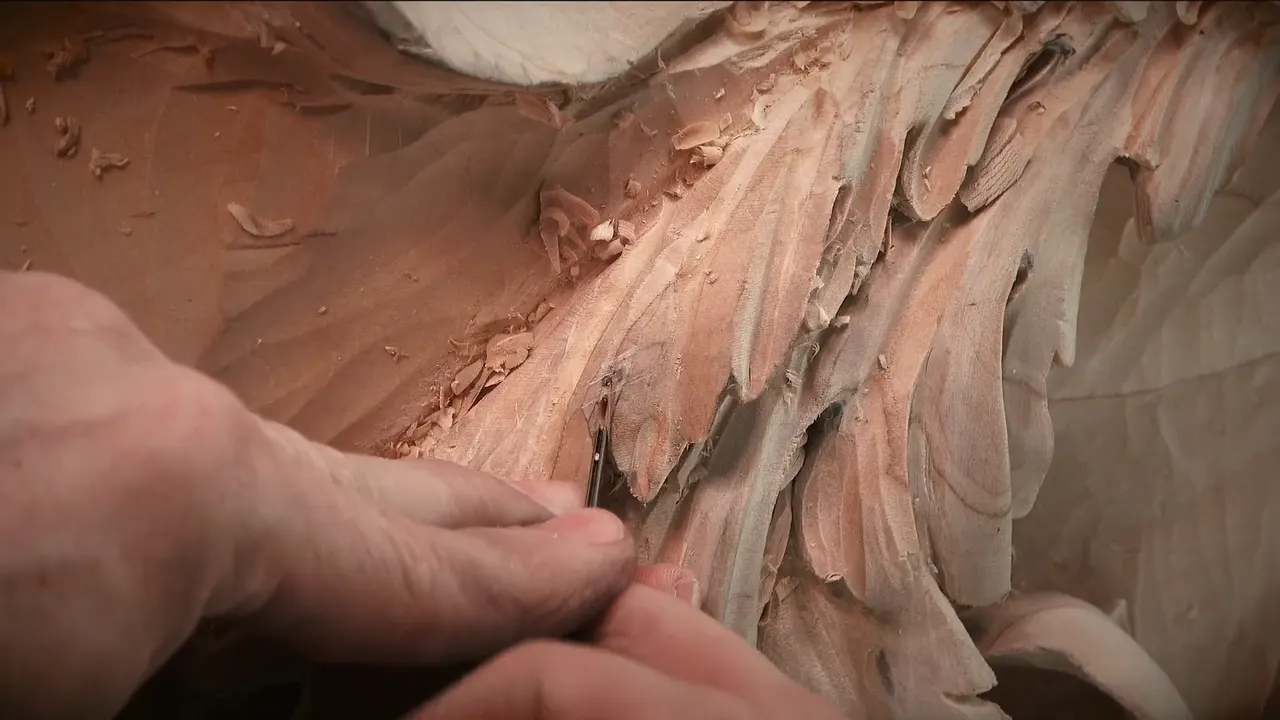

In Venice Room 65, part 4, I was working on facets when I said "It's much quicker in real life." Other lessons of mine say slow motion for slicing, rotation and facets.
Have you ever watched a gouge move on a video? Would you like to see one move slowly before you try it on your own board? This part of workshop 65 has my slow-motion line, and the lessons below are where else I said it.
What did I say in part 4 of workshop 65?
"I'm okay that I'm damaging a little bit inside," I said, and "all I need is just those movements." Next, a plan: "I need to try to go along with the overall movement carefully." After that, "maybe a little super concave right here."
I also said "I know this movement is a little different from all other movements." Then another plan: "I also want to create a micro-separation right here. But to do that, maybe I should bring my concave all the way right here to that point." Then "another concave," and "get my pipe even more exaggerated."

"Okay. It looks good." I added "I kind of like that idea to give more movement, more curliness, even right here, too." You "should see the difference already," I told you. Two more lines: "it just gives a lot more interest, a lot more dimension, I should say," and "it just creates more movement, with those shadows and lights."
Of that side I said "I'm kind of happy with that side," and "maybe just slightly clean up, but it's okay." Next: "let me get that side also." For the concave: "I want to take care of this concave. And careful. Going to go underneath that way." Rounding that side was the plan, "because it has to blend, otherwise it's not going to look nice." Then came "I'm controlling. I'm really controlling my cuts."

"Not too convenient," I said next, and "I don't want to cover my camera. I probably have to for just a second." Then came "I need to make that cut really clean out of the gouge." Also "logically, I can see that I can create extra separation," a really small, tiny one, and "maybe shave a little bit the edge of this shape."
A plan followed: "I need to excavate that deep shadow with the half a millimeter" (about 0.02 in). I also said "I have to control" and "don't want to break anything," and then "half a millimeter makes big difference."

The last lines of this part start with "I'm taking care of those facets." Next, "if I going to be a slow motion, it's the movement." And "It's much quicker in real life." The part ends with "I'm really controlling," and "it blends nicely, blends really nicely."
Why do I carve slower for school?
My April 2020 live stream, Wood Movement in Wood Carving, gives the reason in my own words. "Yes, of course, in real life, I'm carving a lot quicker. For school, I'm doing much slower because I'm trying to explain all of my movements and all of the divisions, what's supposed to make sense, and why I'm doing the concaves, and why I really like those exaggerated pipes."
Carving Byzantine Acanthus 2, part 2, opens with "See what I'm doing in slow motion. I'm not doing really the right way, but feel what the grain does." My advice there: "if it's working against you, change the position, rotate the piece, and work opposite direction." And "try slowly first, but every cut I do, really important, it's called woodcarver's cut." That cut is "a slicing cut."

From a surface "I get closer to the line, and I go to that 10 millimeters mark, so that three-eighths of an inch." Of rough work: "don't worry if it's going to look rough, because it's just the shaping." On grain: "if the grain bites, just rotate the piece."
The Tray of Blessing 6 lesson, part 1, has "I'm gonna do really slowly for you," then "the same thing, but slowly, slowly." From Grape Onlay 12, part 3, comes "I'm gonna show you slowly."
Where does rotation fit into slow motion?
The name comes in the Byzantine lesson, part 1. "In woodcarving world, we call it slicing cut," I said, and "when you're placing your tool on a board, you rotate to one of the sides, either to the left or to the right, and you start your cut."
Rotation came with the push: "while I'm pushing, I create rotation movement." Then "it's a lot less resistance in the wood." One more thing to see was "how quickly I can take the material out." Later in that part I said "you don't see that in the slow motion, but every cut I do, I make a rotation."
The April 2020 stream says it too: "I'm making slicing. I'm making rotation cut like this." I called it slow motion, and "it's called slicing cut or carver's cut." Quickly, "you don't see that because I used to it."

Carving Plate with Butterflies 2, part 1, has "it's called a slicing cut." The words "really slow motion" lead into "my cut like this." A line from later: "I'm not pushing I'm still slicing," and "I'm creating that sweeping motion."
What does slicing look like in slow motion?
"Pay attention. Even if I'm doing a small cuts, I am still slicing." The first line is from Carving Grape Onlay 3, part 1, where I was "taking approximately maybe one eighth of an inch at a time" (about 3 millimeters), and I tied it to slow motion with "that is what I am doing." "Just the slicing, it's gonna give me much cleaner cut." And "I don't have to fight."

A leaf in part 2 of that lesson looks like I am pushing: "I know it looks like I'm pushing, but I am not." Later, "I am still taking just a small slices." And "attack from different positions, from different angles and you just keep slicing, keep slicing."
Grape Onlay 2, part 1: "I'm still not pushing like this. I'm still trying to slice." Part 3 of lesson 3 is shorter: "I am still not pushing."
In Furniture Panel 37, part 2, I named "maybe about number three and six millimeters in my case" (about 1/4 in). "I am not pushing" and "I am slicing" went with slow motion.

"Let me get a little bigger gouge. I will use 1/8 of an inch" (about 3 mm) is how Lily Box 3, part 5, goes. On grain: "I also have to be careful because I am working against the grain." My slow motion reads "I am creating concave, but I'm also rotating my tool, slicing like that, but not pushing. Because if I'm going to push, I'm going to slip."
In Lily Box 2, part 2: "just make sure you're not forcing too much." Then "I'm actually trying to rotate like this," I said, and "I am just blending."

Carving Roman Acanthus 6, part 6, has "first take small chunks out," and "much easier to make it look cleaner, neater, nicer." Doing it in slow motion would be "actually sweeping, just rotating."
For Grape Onlay 11, part 1, the call was "number eight and about 10 millimeters" (about 3/8 in). It went "I'm not poking," and "I'm creating slicing like so." That way "I'm not pushing the whole wedge," and next, "I can attack from this side and create like a opening," and "that way it's gonna be completely airborne."
How do I clean facets in slow motion?
The same part goes on: "see those facets. I just exaggerated them." Next: "I am creating like a circular motion, okay?" And "I'm just rising right on top of it."

"It takes time. By the way, if you think it's a quick process, no, it's not to clean the whole thing, at least for me." A question about the inside of a concave got "the technique, it's exactly the same. It's just on a micro level, just like that." Some of the facets I kind of like to leave on the leaves, but "if it bugs you, that's what you do," and "obviously not everywhere you should do that technique."
Furniture Panel 33, part 3: "puts your tool upside down. In this case, that will be number three," a quarter inch, six millimeters. Then "I gonna do a circular motion like this," and "I'm doing that slowly, but in real life, you know, when you do that, it's actually much faster."

And "you could make it pretty clean."
In Modern Acanthus 5, part 2, the tool is "the number seven and 14 millimeters" (about 0.55 in), and the move is "I gonna ride on top." That is "a slow motion." Chunks were small: "I'm just taking small chunks of wood." Later, "I'm gonna do it slowly for you," and then "I'm doing that rotation motion" and "I can take those facets out."

Modern Acanthus 7, part 1: "you just to take the flatter tool?" And "if I gonna do slow motion, I gonna ride on top of those facets." A fight means a change: "if it fights you which means I have to change the direction."
In Byzantine Acanthus 10, part 4, I said "with the lights you can see the facets," and "you pretty much attack that at an angle." I called it slow motion: "you do exactly the same what I showed you previously on a different part." And "the way you take care of it is just like almost shaving."
In the Grinling Gibbons class in Maine, class 11, part 3, the tool was "number three." The words "a really slow motion just like this" came first, and then "that way it's gonna be clean."
When do I use slow motion on a tiny cut?
Lily Box 6, part 6, has a wiggle. "If you're working with the micro cuts, it helps a lot. And that technique is a jewelry maker's technique, okay? When they're doing the small details on a precious metals like gold or silver, it's what they do. They actually create a little wiggle."

"I'm actually moving my tool, if I go slow, just to show you that in slow motion, just like that, okay? Of course, I'm exaggerating, but it's on a micro level." And "you can really control how much material you are taking out. And carefully."
Floral and Molding for the Panel 2 has, in part 1, "I'm not forcing it," and "I'm referencing just the one side of my tool." With slow motion, I was "trying to just dig in slightly, but without too much force." And "I don't really want to take too much material at once. No reason to."
The Tray of Blessing 7, part 1: "see how slowly I'm create my cut, like almost like a slow motion," and "once you're gonna start carving it, it's not as simple as it seems."
For Carving Hazelnuts, lesson 7, part 2, it was "I'm digging in with just the corner of the tool." Slow motion looked like "I do cut, dig with one corner, and then I kind of slice in, okay? That's how you can get really extreme undercuts without breaking the tool." Right after it: "Keep enough material. Okay? Please keep enough material."

Venice Room 82, part 11: "probably the best tool for it would be number one. Number one would be the best double bevel." The move is "I can lay it right on a surface and create a rotating cut," and I called that slow motion. Then "really at the same level, I should say."

Which lessons say slow motion?
Here is each one in a table, with what I was doing and some of my words.
| Lesson | What I was doing in that clip | My words |
|---|---|---|
| Venice 65.4 | taking care of those facets | real life |
| Livestream 2020 | why I really like those exaggerated pipes | much slower |
| Byzantine 2.1 | a lot less resistance in the wood | slicing cut |
| Grape 3.2 | I am still taking just a small slices | still slicing |
| Furniture 33.3 | puts your tool upside down | much faster |
| Lily 6.6 | they actually create a little wiggle | micro level |
| Hazelnuts 7.2 | I'm digging in with just the corner | slice in |
| Venice 82.11 | I can lay it right on a surface | same level |
Where can you watch every lesson named on this page?
Every lesson named above is inside one of my courses. This workshop holds all of workshop 65, and workshops 62 to 73 are in Venice Room Part 6. The wood carving courses with the other slow-motion passes are Carving Byzantine Acanthus, Carving Grape Onlay, Carving Furniture Panel, the Lily Box and Carving Hazelnuts. Two of them carve grapes and hazelnuts. To watch the full videos, start here.
How it's done
- Show it slowly. "See what I'm doing in slow motion."
- Place the tool on one side. "you rotate to one of the sides, either to the left or to the right, and you start your cut."
- Rotate as you push. "while I'm pushing, I create rotation movement."
- Slice for a cleaner cut. "just the slicing, it's gonna give me much cleaner cut."
- Watch the material come out. "see how quickly I can take the material out."
Frequently asked questions
Is slow motion how fast I really carve?
From Furniture Panel 33, part 3: "in real life, you know, when you do that, it's actually much faster." From my April 2020 live stream: "in real life, I'm carving a lot quicker."
Do I push the gouge in slow motion?
Grape Onlay 3, part 2, has "I know it looks like I'm pushing, but I am not." Then there is Furniture Panel 37: "I am not pushing" and "I am slicing."
Which way do I slice?
Byzantine Acanthus, lesson 2: "It could be from the left to the right, or it could go opposite direction this way." One more, in Grape Onlay, lesson 3: it "doesn't really matter."
What to carve next
- Venice Room 65 lesson
- Venice Room Part 6 course
- Carving Byzantine Acanthus 2
- Carving Byzantine Acanthus course
- Carving Grape Onlay 3
- Carving Grape Onlay course
- Carving Furniture Panel 37
- Carving Furniture Panel course
- Lily Box 3
- Lily Box course
- Carving Roman Acanthus 6
- Carving Modern Acanthus 5
- Carving Hazelnuts course
- Venice Room 82
- The Tray of Blessing 7
- The Tray of Blessing 6
- Carving Byzantine Acanthus 10