

Alexander Grabovetskiy, woodcarver, School of Woodcarving · Published 2020
What does a wood carver mean by "I have to think"?
Quick answer: In part 1 of Venice Room workshop 65, I said I had to think "Before I do some stuff," and then put a question to myself about the finish. Other lessons of mine carry related words before a tool or a shadow.
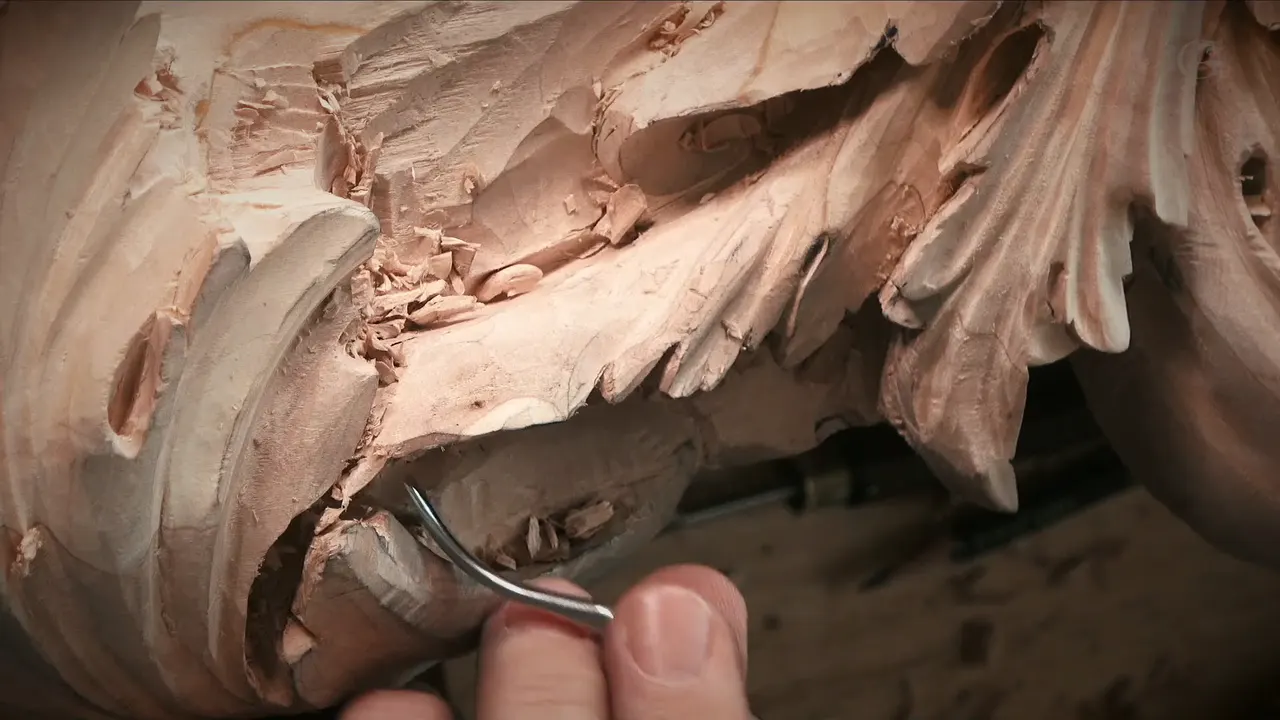

I said it in Venice Room 65, part 1: "Before I do some stuff, I have to think." A question about finishing sat right beside it, and the same pause turns up in other lessons of mine, before a tool or a depth.
Ever stopped with a gouge in your hand because the next cut could wreck the spot? Did you ask yourself whether the wood behind a leaf was enough to go deeper? Then you know this pause. Below is the pause in workshop 65, and then in lessons from other courses.
What was I thinking about in workshop 65, part 1?
The part opens with "Deep excavation. Really deep excavation." I asked myself, "How am I going to finish it? How am I going to paint that stuff?" My answer was "Easy, with the artist brush," and the line from the top of this page came next, with a "Good" behind it.
A point on the leaf came next: "I could actually attach that point to this leaf, and maybe I should," and then, "maybe there's going to be extra support point." The other way was to go right through the leaf and open it up between this side and the inner side. Then: "But should I? That's the question."

Cleaning came next: "a little bit on this side right here." A loose plan followed: maybe start excavating in that direction, maybe skip the opening and keep "that connection point," but still deepen the shadow a little more.
A back bend followed. I was using it, and my plan was to excavate underneath a little bit of that detail, "pretty much trying to undercut it." Then: "And there's absolutely no other tool would work on the back bend." The mallet was part of the plan too: "Going to help with the mallet and go like that."
The underside got its own line: "Unfortunately, you can't see it, but from the bottom, you really see that inner part of that leaf, which is really important for me to make it beautiful."

The back bend left work behind: "because I used the back bend, somehow, I need to clean that up." I named "just 1 millimeter, number 11 spoon" for "some of that mess I created with the back bend." One millimeter is 0.04 in.
I added that number 11 was not required: "It could be just any, pretty much. For example, this one is a 3 millimeters, number 3." Three millimeters comes to 0.12 in. My reason for the 11 was that it "doesn't leave me that sharp meeting line." For this spot, "it's probably okay to use number 3."
Near the end of part 1 I said, "I've got that piece beautifully separated. I've got that outlined with a really nice shadow." A plug cut again would probably be the way, I added, and I would be much quicker undercutting that way.

What did I think about in part 2?
Pauses come first in part 2: "And if I'm quiet sometimes, please forgive me and just watch what I'm doing, okay? I'm also catching myself that I'm thinking in some moments and I forget that I'm supposed to talk." Then: "But I don't think I'm supposed to talk all the time. Not really."
Tools come up in part 2: "Number three, by the way, 12 millimeters. That is what I'm using." Twelve millimeters comes to 0.47 in. I wondered if I could get a little with the straight tool: "And looks like not much, but yes."
A connection comes up, too: "It's still connecting, by the way. This connects that piece." And: "It doesn't have to, but I think it just gives me extra strength." Even if it did not stay connected, I called that okay, and "strong enough." A number nine followed, with a plan to clean a little more and a little nicer "without destroying it."

Later I weighed one more move. My plan was to probably give it a shape: "A little bit of a shape because it has to have some shape, so some kind of division." The doubt: "I don't think I have to, but maybe. Let me do it." And: "if I don't like it, then there is a problem because I cannot fix it."
I saw the result for myself: "And yes, I did separate those two points. And that is, I guess, okay. But I kind of like the result. Really like the result. Maybe I can open it even more."
What did I check before going deeper in part 3?
In part 3 I said, "let me check how much material I have, and looks like I do have plenty, so I can actually get deeper. So I can actually give it more shadow." I also told you, "See, I'm not forcing anything. I can clean that later." A note on the inside: "I have to keep an eye what's going on inside." And: "I could actually go deeper right here. Much deeper."

Then came the why: "And why? Again, all about lights, all about shadows, okay?" The tool: "this number three and 12 millimeters, about half an inch." A choice, in my words: "I could leave it like it is. It still looks beautiful, but I think it's going to look much more beautiful, I should say, this way."
On grain: "Yes, I'm working against the grain." Then: "My tool is super sharp, and you can see it still leaves a good finish, but I have to be careful."
My pipes come up too: "I want to see my pipes." And my reason for the concave: "That's why I'm bringing my concave in this case, not always, but in this case, all the way there. Because there's different types of acanthus. Okay? Not every acanthus is the same."
Which tool do I name before I start a cut?
Venice Room 46, part 4, has a pause between two numbers. I said, "I think I'm going to need the number seven," and then I stopped: "But I need to think which one. Number seven or number six? Let me try number six first and attack this side of that movement."

Later in that part I came back to the seven: "And straight with number seven, it's possible to do those volutes with no problem, but the effect is going to be different. Right here, I've got effect like a dome underneath like this. It gives just a deeper shadow."
I fixed my own line in Venice Room 30, part 2: "Well, I shouldn't say it that way." My fix was about "tools I'm going to use." My plan then was a knife. Then a second thought: "I could probably use number five. Just the gouge. But carefully." Then: "I'll just use a back bend."

A knife did not fit the spot in Venice Room 93, part 11: "maybe with the knife again. Okay. But it's not really convenient for me because you can see, this part is really high and I really can't do anything with the knife pretty much." My fix was to "think differently," and "I'll use probably just the back bend." The size was "six millimeters," or 0.24 in, and the plan was "just the corner of it."
The Tray of Blessing, lesson 7, part 1, has related words about undercutting. My words about undercutting from one side: I needed to think "how I gonna undercut from this side with limitation of tools."

How deep can I go?
In Venice Room 39, part 7, I asked, "Do I want to go too deep or not?" I gave a rough figure, "about an inch and a quarter," which is about 32 mm. My next words: "we'll see if I should go deeper or not."

The best way to take care of this side came up too: "I still kind of don't really like it."
Back in Venice Room 8, part 7, I asked a version of the question from workshop 65. I had to stop excavating at some point, to decide "how deep I want to see it." I also still had to think about painting on the inside: "So, of course, I can go all the way through if I wish, but do I need to? That's the question."

Part 9 of Venice Room 35 has me digging with a limit: "Just deeper and deeper and deeper. But to the point because I still have to be thinking about the finishing."

Do I make the cut or leave it alone?
The question in its plainest form sits in Venice Room 23, part 1: "should I or should not?" I weighed one side: "But on another hand, I also losing the movement." A try came next: "Maybe I should do just that type of concave right here."
A little later in that part, I said, "And now I'm just probably talking to myself pretty much. I'm making the decision what kind of concave I want to do."

Over in Venice Room 47, part 4, I talked about "what I have to do with this because as of now, there's a couple ways I could deal with that." One was "some kind of movement on inside going that way." Then: "And I think I should." And: "all I have to get rid of is just a small section right there."

In Venice Room 59, part 11, the question was how I could create extra division: "think about how I can create extra division right here, because looks like I need to." I held off on it: "Maybe I shouldn't even mark." I wanted to clean it first and then "decide what to do with that."

A look at the whole piece comes in Venice Room 84, part 12: "think how it's going to look in overall." In the same part I asked whether I was making a mistake, and said it looked like I was not.
Venice Room 31 starts part 1 with a fix: "let me think how I can do it. There's a couple of ways I could do. I could create the extra concave right here, and that's going to tie together with the overall movement." Then: "should I do that or not?"
Part 2 of Venice Room 33 has "And now I need to think again." Next: "So now I need to create a narrow cut." A fix to my own word followed: "Mirror, I should say, cut."
What do I think about when I want shadow?
Carving Furniture Panel 35, part 2, has me saying that before I make a cut, I think about where the shadow is supposed to fall. Then: "my shadow has to fall on that part right here." After it came the tool: "Now I'm gonna use, uh, number 11, and in this case I'll use just a half a millimeter." Half a millimeter is 0.02 in.

Workshop 65 puts it plainly in part 3: "all about lights, all about shadows." Painters have a word for light and shadow together, chiaroscuro.
Another kind of thought sits in Venice Room 58, part 4. The talk there was about taking a gouge in your hand or a chisel and digging a chisel inside of the wood: "It's not the hardest. The hardest is design." After it, a line sent you to "think in 3D."

A question comes up in Carving Lily Box 11, part 7: "How I need to attack that?" I needed to think there, "because I'm catching grain." Then: "I'm working with two millimeters, and I know on a screen it looks huge." Two millimeters equals 0.08 in.
Where else did I stop to think?
Here are seven clips in a table, with my words and what else the clip says.
| Lesson | My words in the clip | Other words in the clip |
|---|---|---|
| Workshop 65.1 | And there's absolutely no other tool would work | The back bend |
| Lesson 46.4 | it's possible to do those volutes with no problem | A deeper shadow |
| Room 30.2 | Well, I shouldn't say it that way | A small knife |
| Video 93.11 | So I'll use probably just the back bend | just the corner |
| Clip 39.7 | we'll see if I should go deeper or not | about an inch |
| Venice 23.1 | But on another hand, I also losing the movement | should I or should not? |
| Lesson 58.4 | dig a chisel inside of the wood | think in 3D |
Where can you watch every lesson named on this page?
Every lesson named above is inside one of my wood carving courses. This workshop holds all of workshop 65, and workshops 62 to 73 sit in Venice Room Part 6. The other lessons are in Venice Room Part 1, Part 2, Part 3, Part 4, Part 5, Part 7 and Part 8, plus Carving Furniture Panel, Carving Lily Box and The Tray of Blessing. To watch the full videos, start here.
How it's done
- Ask how it will end. How to finish it was the question, and the answer was an artist brush.
- Weigh the choice. I weighed attaching the point to the leaf against opening it up, and put it to myself as a question.
- Check the wood. Part 3 has me checking how much material was left, and finding plenty.
- Name the tool. Weighing a seven against a six comes up in lesson 46.
- Leave it or change it. Leaving it as it is stayed possible, but I thought the change would look much more beautiful.
Frequently asked questions
How did I plan to paint it?
The question was how to finish it and how to paint it, and I answered with an artist brush. After a "Good," I named one point on the leaf that I could attach or open through.
Does the leaf stay connected in workshop 65?
Part 2 says it is "still connecting." It did not need to, I said, but I thought it gave me extra strength. I had not too much material left, I said.
Which tool did I pick in Venice Room 30?
I named a small knife first, then number five as a maybe. The pick was a back bend, and a back bend came up again to get that wall clean.
What to carve next