

Alexander Grabovetskiy, woodcarver, School of Woodcarving · Published 2020
Why does wood carving take so long?
Quick answer: In part 5 of workshop 65, I said of one section, "for me, takes forever." Other lessons of mine call a small tool, a knife, hand sharpening, editing and measuring slow. In Venice Room 41: "I need to use probably much bigger tool."
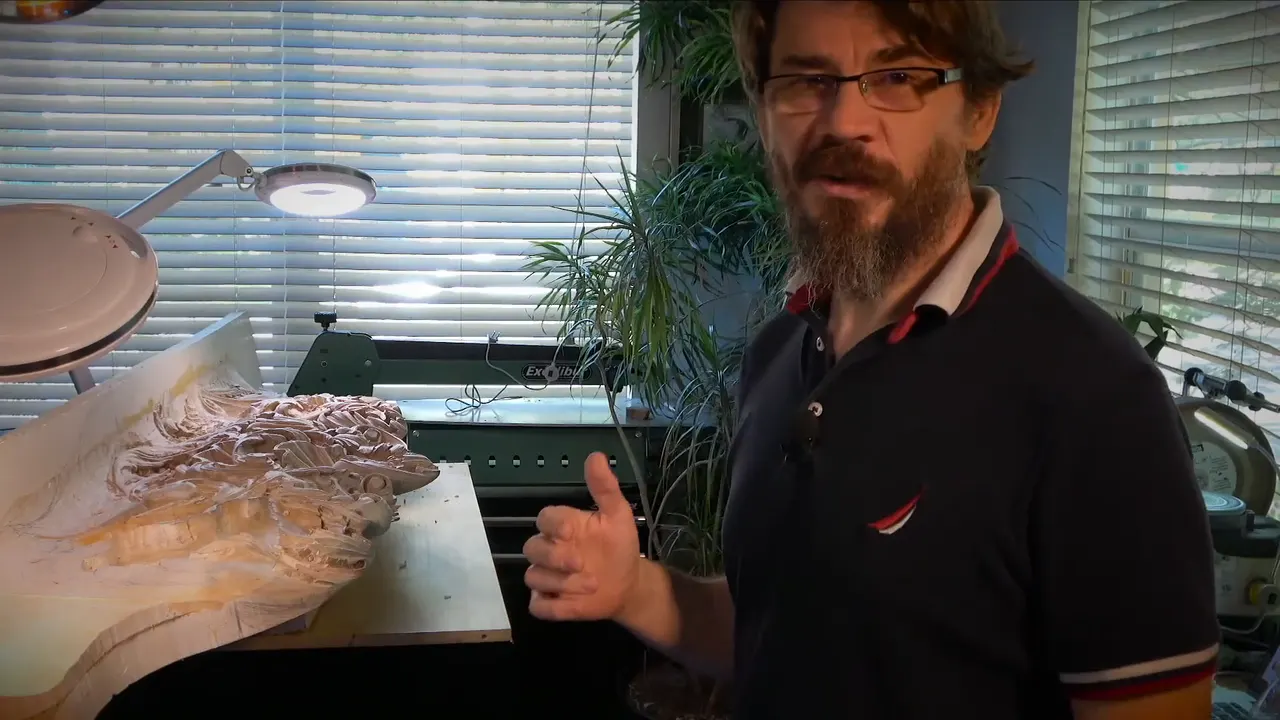

In Venice Room 65, part 5, I told you I did not like how long one section runs. Other lessons of mine name a small tool, a knife, sharpening and editing as what I find slow.
Have you ever looked at a carving and wondered why it eats so many hours? Would you like to hear what I say about time before you start your own board? This part of workshop 65 has my "takes forever" line, and the lessons below are where else I talked about it.
What did I say in part 5 of workshop 65?
I started with "I need to still get more details right now on this piece." The line itself came next: "I know it looks like this section, for me, takes forever, and I kind of don't like it. I kind of don't like that it just takes me so long." And "So it shouldn't take me that long."
I wanted you "to feel the scale of this work, how big that piece is," and said "I want to show you from the side view." The piece is going "all the way, 10 feet" (about 3 m), and "that's going to go all the way to the ceiling."

My view of the result so far: "I'm kind of happy with the result, and you can see it doesn't look too bad in all. I kind of like it. I like the movements." Flowers are planned: "I'm going to add multiple spots, some flowers in different regions."
Next, "now what I want to do, I want to concentrate just in this section." On my productivity: "for me, it's not that hard area, but because I was just streaming too much, I guess, I lost productivity."
The flowers will cover some of it, so "this is not going to be complicated." Still, "it has to be nice. Somewhat nice." Part of it, I said, will be "sticking from underneath."

I would do nothing "right here in this section" because "underneath, there's no reason." As for the rest, "all I need to take care of, it's just a couple of movements pretty much. So I need to fix this pipe, this pipe, and that pipe."
About pipes, "like you saw before, those pipes, that's actually a simple way to take care of them. It's just the backbend." On one side, "yeah, I can round it, it's not going to look like that in all, so I need to excavate actually deeper," and "I need to excavate deeper concave on that side."
My tool: "I'll take again number 11 and let me take just the 3 millimeters number 11" (0.12 in; in this part I also called it "an eighth of an inch"). And "probably just have to attack that from the right position. It would help me a lot." Also: "Yes, I know I'm covering with my hands, but it is impossible for me to make that cut any other way."

"That is good, although that is a little too much right here," I said. On the shape: "a little more exaggerated pipe on that side. Maybe I actually could go a little deeper right here too. Give some shadows, give some movement."
For the blend, "I need to lower down a little bit that section. And I could use number eight or number nine. Pretty much any gouge, even number seven will work. But I'll use just number eight." The correction: "Actually, this is number nine, but it's equal to number eight to other brands because it's not a true half round."

"I know it's a big movement. Big, but I think it's beautiful movement." Inside, "I can clean a little better off-camera, which is almost impossible for you anyway to see."
A plan: "So now let me try upside down the same tool. Maybe I'll be able to establish at least some of the movement. At least one of the sides." Along with it came "Don't want to go too deep" and "It is going to be a big mistake."

The part ends with "let me use again number 11" and "like 7 millimeters will work" (0.28 in), "a little bigger than quarter inch" (6.35 mm), and "maybe I can exaggerate right away this side also."
Which tool did I call too slow?
In Hashemi Flowers 16, part 3, I said "I'll take 10 millimeters" (0.39 in). Then: "Yes, when I'm saying smaller tools, it doesn't mean too small. If I were just to take 1/8 of an inch, that would take me forever. Just too long." The 10 millimeter tool: "that's already small." About the waste, "Look at that old waste I've got," and after it "now I need to get smaller one. Let me take maybe 1/4 inch, number nine" (6.4 mm). I could also "use just a spoon gouge, maybe about seven millimeters" (0.28 in).

From Venice Room 41, part 11, comes "10 millimeters, number 11." A bigger tool was next: "I need to use probably much bigger tool, because right now this is a little too small, and it's going to take me forever to do that. Don't have to. I can use 30 millimeters" (1.18 in). Then "that is part of a future shell, and that shell has to go underneath anyway."

Part 1 of Venice Room 50 shows the choice: "Not the corner, but whatever this chunk of wood. A couple ways, of course, I could do. One of the easiest ways, I could use just probably a skew. Skew chisel. And work my way in just like that, little by little. But it's going to take me too long, and wiser would be to use a big gouge. Maybe I can use a number two. And 60 millimeters" (2.36 in).

So the skew chisel was one way in, and the big gouge was the wiser one. After that, "I have to change the position and work with the grain."
Part 6 of Lily Box 7 has a knot in it. "I'm approaching to area with the knot." Next came "I feel like I'm not carving, but scratching, because it just takes so long in this area." A new pick: "use a little bigger spoon. Use maybe about quarter inch #3, six millimeters" (0.24 in). The words "Looks like I'm getting somewhere" followed, and I said "I'll use a #7 again, and 14 millimeters" (0.55 in).

In Grape Onlay 9, part 2, I talked about big tools. "Let me switch to smaller one 10 millimeters" (near 0.4 in) came after "the only thing with the big tools, they must be super sharp." The lesson carves grapes.

What does sharpening have to do with time?
Stropping and Compound 2 is about hand sharpening and the jigs for it, and I said "you can use those jigs, get the jig and just do by hand." About that way: "I don't like that, because it takes too long time. Because I'm carving for life, and time is money for me." A slow pace means I cannot make money, and without money I cannot buy more tools, "which is like a toy for me."
How to Sharpen a Skew Bent Gouge, part 2, has a minute count: "It took me, I don't know, maybe a minute, maybe less than a minute. You can't beat that." Also, "I love to do sharpening by hand, and that's absolutely fine if you do have enough time to resharpen all the tools." A "but" about how long it runs comes after, and I added "I can achieve really good results by hand."

I also said "I used this machine only couple minutes." The grits: "one minute on a really coarse grit, and another minute on a finer grit."
How to Sharpen Micro Tools, part 2, is about the length of the bevel. On stones I said "when I'm using stones, doesn't matter what kind of stones you're using, water stones, oil stones, diamond stones," and named time as the problem for a long bevel, "like 25 millimeters" (about 1 in). Mine run "about 10 millimeters, 14 millimeters on some of my tools, and some of them 25 millimeters" (0.39, 0.55 and 0.98 in). After that came "So now, I had a problem to solve. How do I create flat bevel?"

What else eats time in my lessons?
Editing. In Lily Box 2 I gave my reason for a live switcher: "the reason why I switched to live switcher, because I do have a lot of projects going on, and if I would just shoot everything and just edit like I've done before." Then "I'm not as productive. But I have to be productive in projects for my clients and for the school."

Workshop 21, part 7, of Venice Room 21 has more about editing: "if you're not planning to skip, and if you're not planning to speed this up, you will hear every tool that I'm using." And "it's just not wise for me on this project to just spend too much time on editing every tool." Re-watching everything is slow too, I said, and "please forgive me for that."

A knife shows up in Hashemi Flowers 42, part 1. "A couple of ways you can do that. You can actually just take a knife, like cheap carving knife, and start removing some of the chunks sideways like this." I called that way "kind of long time." Then "so what I'll do, I'll place it on my workbench." On depth: "I know approximately I have to take an inch deep" (25.4 mm), and then "maybe about, I would say, seven-eighths in the beginning" (22 mm).

The measuring is in Venice Room 6, part 9. The beads: "I'm going to place approximately marks at the quarter-inch distance." And "Again, I am just eyeballing. I don't really have to measure." Measuring it, I said, would cost me time, and the sizes came next. The sizes: "it's six millimeters at the top and five millimeters on the bottom, so a quarter inch and 3/16 of an inch" (0.24 and 0.2 in; a quarter inch is 6.35 mm and 3/16 in is 4.8 mm). On the beads: "my beads, they supposed to become smaller and smaller."

My April 2020 live stream, Livestream April 2020, is on making tools: "wood carvers still make their own tools. And that's not that complicated process, by the way at all. But for me, why I don't do any tools anymore, because it takes so long, and I have to do my production work. I'm carving for a living. Okay? So if I'm making my tools, so I either spend my time making tools or I going to carve."
Venetian Flowers Rosette 5, part 3, is about calipers. "Every second counts, and sometimes it just bugs." The normal pair: "just the normal calipers, just to make that turning and twisting. This one is not quick release, so I have to just spend a few more seconds." What I like is "the quick release mechanism."

Which lessons say it?
Here is each lesson in a table, with what I said costs time and a second line of mine from the same clip.
| Lesson | What I said costs time | More of my words from the same clip |
|---|---|---|
| Venice 65, part 5 | this section of the piece, shown from the side view | I lost productivity |
| Hashemi 16.3 | a tool of 1/8 inch for clearing the inside | Look at that old waste I've got |
| Venice 41, part 11 | a small tool for the spot | a future shell |
| Venice 50, part 1 | a skew chisel worked in little by little | wiser would be to use a big gouge |
| Lily Box 7.6 | an area by the knot, where I felt like scratching | use a little bigger spoon |
| Grape Onlay 9.2 | a switch to a smaller 10 millimeter tool | the only thing with the big tools, they must be super sharp |
| Stropping 2 | jigs for doing the bevel by hand | time is money |
| Bent Gouge 2 | resharpening and reshaping all the tools by hand | maybe a minute, maybe less than a minute |
| Micro Tools 2 | making a long bevel on stones | flat bevel |
| Lily Box 2 | shooting everything and editing it after | I have to be productive in projects for my clients |
| Venice 21, part 7 | re-watching to edit every tool | forgive me |
| Hashemi 42.1 | a cheap carving knife taking off chunks sideways | place it on my workbench |
| Venice 6, part 9 | marking the beads a quarter inch apart | just eyeballing |
| Rosette 5.3 | turning and twisting normal calipers | every second counts, and sometimes it just bugs |
| Livestream April 2020 | making my own tools | wood carvers still make their own tools |
Where can you watch every lesson named on this page?
Every lesson named above is inside one of my courses. This workshop holds all of workshop 65, and workshops 62 to 73 are in Venice Room Part 6. The wood carving courses with the other clips are Carving Hashemi Flowers, Carving Tool Sharpening, the Lily Box and Venetian Flowers Rosette. To watch the full videos, start here.
How it's done
- Name the work left. Start from "I need to still get more details right now on this piece."
- Fix the pipes. The pipes: "I need to fix this pipe, this pipe, and that pipe."
- Lower the section. The blend: "I need to lower down a little bit that section."
- Think about depth. "I actually could go a little deeper right here too."
- Watch the depth. "Don't want to go too deep."
Frequently asked questions
How big was the piece in part 5?
I wanted you to feel the scale, "how big that piece is," and said it reaches "10 feet" (about 3 m) above where I was working.
What was lost in part 5?
"for me, it's not that hard area, but because I was just streaming too much, I guess, I lost productivity."
Which size did I name for a bigger tool?
The size I named was "30 millimeters" (1.18 in), in the Venice lesson 41.
What about doing the sharpening by hand?
What to carve next
- Venice Room 65 lesson
- Venice Room Part 6 course
- Hashemi Flowers 16
- Hashemi Flowers 42
- Carving Hashemi Flowers course
- Venice Room 41
- Venice Room 50
- Lily Box 7
- Lily Box 2
- Lily Box course
- Grape Onlay 9
- Stropping and Compound 2
- Sharpening a skew bent gouge
- How to Sharpen Micro Tools
- Carving Tool Sharpening course
- Venice Room 21
- Venice Room 6
- Livestream April 2020