

Alexander Grabovetskiy, woodcarver, School of Woodcarving · Published 2020
What does a wood carver mean by "I just broke"?
Quick answer: In Venice Room 65.7 I said I just broke a piece while working with a number five. I called it no good, then said I shouldn't. In other lessons the same words come with edges, tools, thin parts and gluing.
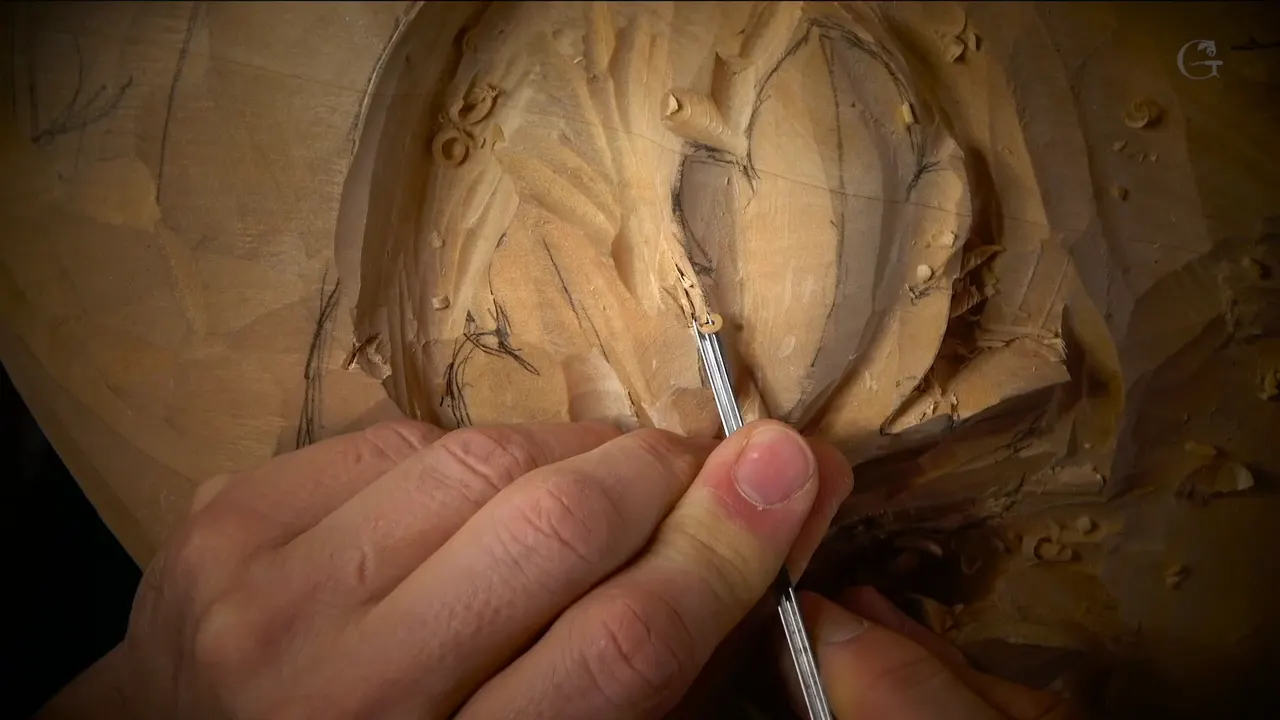

In part 7 of Venice Room workshop 65 I said "Use number five," and on the next pass I said "I just broke that piece." Other lessons use the same words about edges, tools, thin bits and glue.
This page follows that line through part 7, and then through the lessons where I said "broke" and named a reason or a fix. Wikipedia has a short page on wood carving if you want the craft in general.
What did I say in part 7 before the piece broke?
The part opened with a size change. "It's time to switch to a smaller one," I said, and I planned two millimeters (about 0.08 in) "at the beginning." The finish on the side was "not too nice," and a bump on it was something I did not want to see. I planned to "gradually move that way."

Two millimeters, I said, was "actually too big also." One millimeter (0.04 in) was next in my plan, and the tool was a number 11: "All of them are just number 11s." Then came "All I need is just a shadow."
A second plan was a plug cut on each side: "What I could do, I could actually do a plug cut from this side and a plug cut from that side." That would give me "a frame," I said. "Every element supposed to be like a frame with the shadows." Otherwise, I said, it would not look nice. One detail I called dull for lack of a frame around it, and I had two things to keep in mind, "the light and the shadow."

My next plan was a "quarter-inch number nine because it just rotates beautifully." A quarter inch is about 6 mm. I called it "a half-round true number nine." I offered a view "much closer," and then said, "See, it's already giving me beautiful dark spot, beautiful shadow."
Next: "So now we're going to do exactly the same right here." Then: "I'm going to get that plug out."
I had a question from before. People saw some of my work online and asked how I painted it and how I stained it. My answer was that I used no stain at all. I get that look "just by pure carving."

"But right here, I'm just digging in," I said, and "that's probably enough" followed, with "Don't want to do too much." Another spot came next, one I could "just right away relieve."
Then: "for me, logically, I could actually do right away some extra subdivisions." It "doesn't look too good," I said, but "I really want to make it look good." The pick: "number 11." The size: "just one and a half millimeters" (about 1/16 in).

"Beautiful tool," I said. Then came "Number fives and number six, just to get around, and that's going to do the trick." After that: "This is a little too big. Use number five."
Next pass: "Number five that way, and I just broke that piece right here." Right after came "No good," and the next lines were "I didn't do the right thing" and "Just rush it." Then: "I did rush it, and I shouldn't."

Which lines in parts 6 and 8 touch on a break?
Part 6 has "there's going to be separation," and then a plan: "just hit that with the same skew and hope it's not going to break." Then: "And it did not break. That's good. I like it."
Part 8 has "I know I said I made a mistake right here, and yes, I did, actually." That mistake was "easy to fix," and my plan was to "bring that slightly downhill." Later: "nobody's going to know that was a mistake I've done. And only you."
Which pieces broke at an edge?

A spoon gouge was on my mind in workshop 40, part 3. Then: "I just broke this edge, which is not too good." And: "It's okay, but I wish I didn't." The next step was a smaller tool, to "go underneath, give that roundness."
Another edge went in workshop 13, part 7. "This one, no bueno." That was "still okay," and "It's just going to be lower." But "it's still better not to break. Don't get me wrong."

Over in workshop 18, part 11, an edge broke. "I need to fix overall," I said, and "It doesn't look right." A little roundness "this way, slightly" was the plan, and I did not want to force it.
Workshop 120, part 2, gives it with a reason: "Not carefully. See, I just broke the edge because I wasn't too careful, which is okay in this case, but in another case, it would be really bad." The tool was "a little too big for that," so I planned 2 millimeters (about 5/64 in).

Furniture Panel lesson 27, part 3, had me on a "number 11 with two millimeters" (0.079 in), and the edge went: "I just broke the edge, which means I'm pressing too much."
An edge went in lesson 4 of the Lily Box course, part 13: "which is okay. It's not okay, but what can you do?" Later: "I broke my edge. Edge of my design, not my edge, but edge of my design." I needed to "recreate original line movement." That course's lesson 10 had an edge break too, in part 6, and I had "to attack that and preliminarily clean it."

Hashemi Flowers lesson 18, part 3, gives a reason: something was on my way, so I used a back bent. "That I should not do," and the edge broke. "So again, we have to be really careful, and it's hard to be really careful when I'm just talking."

How did I talk about a small piece that was not an edge?
In workshop 69, part 1: "Well, I just broke on my way in. It's okay." The detail was not lost, but I had to be "a little more careful." Workshop 37 lost "a little part of previous shell" in part 10. "Got to be more careful," and I had "to lower that down and take care of it."

Over in workshop 78, part 6, I asked "What did I do?" and said my "separation cut" had broken, then added "It's okay, I'll fix it." Maybe I was "just a little too aggressive."
Workshop 4 sits in Part 1 of the Venice Room. An end broke in part 8: "I did not touch the pencil mark," with "plenty of material" left, so "I would not consider that as a mistake." Later, part 10 has "I broke underneath because I did not relieve it, the triangle." The mistake: "that I rushed, and I didn't take care of the triangle."
Workshop 72, part 4, has: "when I just applied some force, I broke with the grain." That was "a problem," and "one of the mistakes I made." Still, I removed "the whole bunch" of what I would not need anyway.
Did I glue it back, or redesign around it?

Carving Byzantine Acanthus lesson 6, part 3, has me ask: "If I broke something, what do I do?" First "You just glue it," and then "No, I'm going to redesign it." It would become "a French acanthus," and I added "I guess that's how they developed that, right? By breaking stuff."
In Roman Acanthus lesson 2, part 4, someone asked what to do if you break something. I make that mistake "many times when I'm not too careful, when I'm just trying to get my job done quickly and I'm breaking stuff." Gluing I have done, but "I prefer not to glue." Of a break I said "let it be," because "it meant to be like that," and to "redesign around that broken part."
Back in workshop 13, part 7, I said a break was "meant to be," and "I'm not going to tell nobody that I broke it." I would give it "a bigger separation." Gluing was possible: "I could glue it back," and "It's possible." Still, "I just don't want to do it."
A glue fix opens workshop 77, part 7. The part I "broke" was "really tiny, less than a 16th of an inch right now" (about 1.6 mm). The piece was glued: "I just glued that." It would be okay, I said, because the piece is "paint grade."
A glue plan comes in workshop 78, part 4: "I can glue it, but it's less than a 16th of an inch thick," and I was not sure it was "a good idea or not." For now, "I'll go glue it off camera."

My Questions and Answers lesson, in the Techniques course, has "I use the small bottle of glue," and says I glue the piece back if I need to. Asked if it ever happened to me, my answer was "I broke some stuff."
The Lily Box course has more. In lesson 6, part 1, there is "I just broke this part," and I called it okay. I could feel it was "really fragile, so I need to remove it anyway." It went again in part 2: "I broke that again because I have a glue underneath, but it's okay." And: "It wasn't enough glue on the bottom, I guess."
The Roman Acanthus course, lesson 16, part 3, has "Oop," and then "I broke it again," followed by "But that's okay." Gluing it on again was the plan, and the warning was "Got to be careful at the end, especially at the fragile pieces."

Greek Acanthus lesson 13, part 3, gives me a break on "this piece right here," and I had to take care before gluing, so "I don't hit it again and don't completely break it." Lesson 14 adds that a broken piece gave me an advantage: "I can use it as advantage and undercut this section."

Grape Onlay lesson 10, part 2, has "Oops," and then a break: "That means change of design." I "attacked from the wrong side," and "if I'm working without the cameras, I would obviously just rotate the piece and attack that way." And in lesson 7: "I broke that section and I lost it," and "I had to put a hide glue," which I like "because it's actually easier to blend."
When did the tool break instead of the wood?

Next, a tool. In Lily Box lesson 10, part 13, I asked "Did I break it?" and answered "Indeed, I did," and then "I just broke my two millimeters right there" (2 mm, or 0.079 in). "Really tough," and "you saw I was really careful." It "usually happens with the harder woods."
The tool in Lily Box lesson 7, part 6, was a number 11: "I just broke my number 11 half a millimeter" (about 0.02 in). "I don't like when I break my tools," and "I do have another one," so I would resharpen the one I just broke. "I didn't force too much, but just because that is a hard wood."

A few years ago hard pine broke "quite a few gouges" for me, I said in Lily Box 10, part 2. "You can't even drive a nail in it. It was just so dry."
A knife comes up in Hashemi Flowers lesson 26: "I broke my tip and I had to resharpen it, and I actually like how it works, the shorter version." The Beginner course cutting board workshop 6 has a blade: "I broke the blade and I had to resharpen that." I "found the shorter blade, it's actually easier to work."
Undercutting is a risk to a tool, I said in Corinthian Acanthus lesson 5, part 1: "you can break your tools easily if you do an extreme undercut like I do," and "I broke some tools when I did the undercutting."
Haste comes into it in workshop 56, part 12: "when I feel that I'm rushing something and I'm becoming a little more aggressive towards my cuts, I can break tool." "Not that I'm breaking them all the time, but I broke before."
A spoon gouge and a mallet are in workshop 38, part 1: "You can break the tool." And "I didn't break multiple. But it was one too many." Floral and Molding lesson 1, part 3, brings a sound: "Sometimes that sound tells you the tool broke." Then: "But no, I did not break the tool," and the break was "just the wood itself."
How do the cases line up?
The table sets seven parts side by side, with part 7 of workshop 65 first. The first column names the tool or size I mentioned around that break, and the last one gives my words.
| Before | Where | After |
|---|---|---|
| Number five | Venice Room 65.7 | No good, and I rushed it |
| Two millimeters | Lily Box 10.13 | Really tough, and I was careful |
| Number 11 | Lily Box 7.6 | I had another one to use |
| Number 11 again | Furniture Panel 27.3 | Which means I am pressing too much |
| Spoon gouge | Venice Room 40.3 | Not too good, and I wish I didn't |
| Back bent | Hashemi 18.3 | A step I should not do |
| Knife | Hashemi 26.1 | The shorter version, which I like |
Where can you watch the full videos?
Every lesson named above sits inside one of my courses. All of part 7 is in workshop 65, and workshops 62 to 73 are in Venice Room Part 6. The relief, shadow, acanthus and hide glue pages linked here are for reading. To watch the full videos, start here.
How it's done
- Go smaller when a size is too big. A size of two millimeters (5/64 in) was too big also, and the plan was one millimeter (0.04 in), with a number 11.
- Look for the shadow. All I needed was a shadow, I said, and I called what I saw a beautiful dark spot, beautiful shadow.
- Name the tool for the spot. I planned a quarter-inch number nine (about 6 mm), because it just rotates beautifully.
- Say what went wrong. I said I didn't do the right thing, and then that I should not.
Frequently asked questions
Which tool did I name before the piece broke in part 7?
A number five. Earlier in the part I had named number fives and number six "just to get around."
How did I describe the break itself?
The first words were "No good." After that came the line about rushing: "I did rush it, and I shouldn't."
Did I say I would glue a broken piece back?
Sometimes. In workshop 77 I said I glued a tiny part, since the piece is paint grade. In Roman Acanthus lesson 2 I said I prefer not to glue, and in workshop 13 I said gluing was possible but not what I wanted.
Did a tool break in other lessons too?
What to carve next
- Workshop 65 lesson
- Workshop 62 to 73 course
- Workshop 40 lesson
- Workshop 13 lesson
- Workshop 18 lesson
- Workshop 120 lesson
- Furniture Panel lesson 27
- Lily Box lesson 4
- Lily Box lesson 10
- Hashemi Flowers lesson 18
- Workshop 69 lesson
- Workshop 37 lesson
- Workshop 78 lesson
- Workshop 4 lesson
- Workshop 72 lesson
- Byzantine Acanthus lesson 6