

Alexander Grabovetskiy, woodcarver, School of Woodcarving · Published 2020
What does a wood carver mean by "whatever you call it"?
Quick answer: In Venice Room 65.8 I used that phrase about the main end of an acanthus, then said I had to make up a word for it. In other lessons the same phrase goes with a plug, a berry, a stem and a plate.
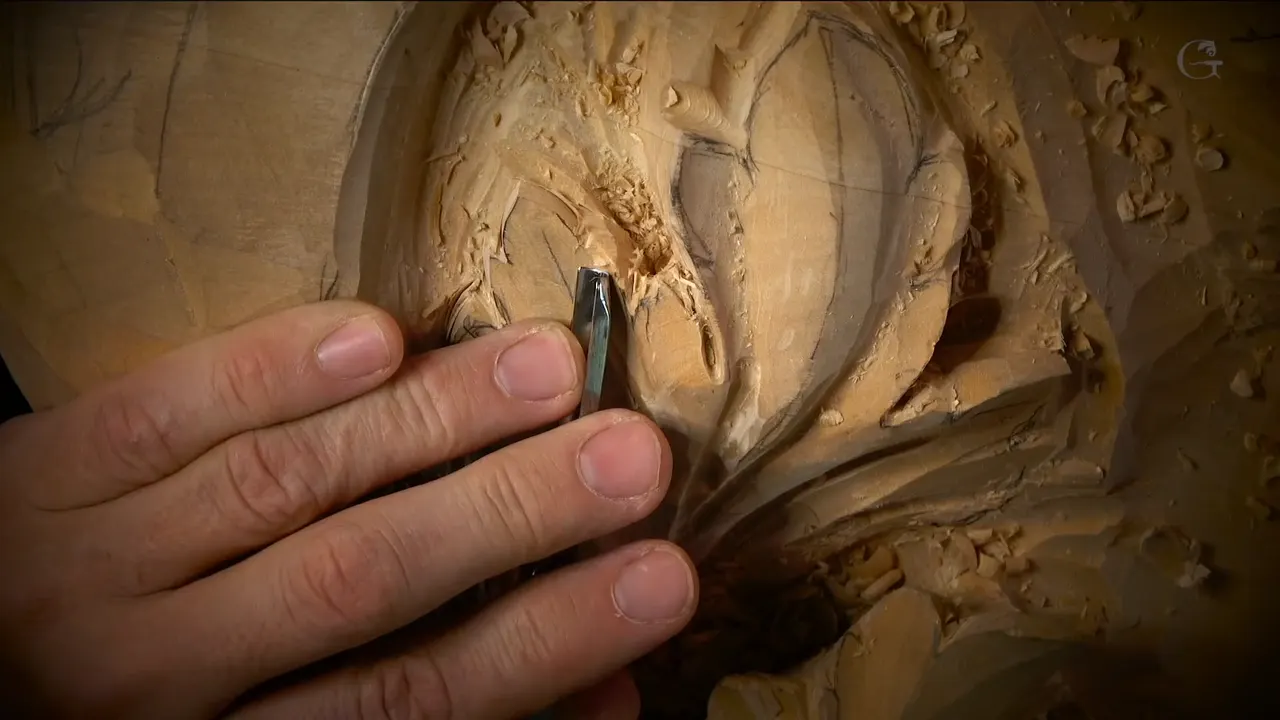

In Venice Room workshop 65, part 8, I had no word for one part of an acanthus, and I said so: "I don't know what kind of word to use." Lessons across my courses hold the same kind of moment, with a plug, a berry, a stem and a plate.
This page starts with that part. I also fixed a mistake and picked a number 11 for two eyes. Then the page follows those moments through other lessons, where I pointed at things the same way and kept carving. Wikipedia has a short page on wood carving if you want the craft in general.
What did I fix in part 8 before the missing word?
"I know I said I made a mistake right here," I said at the start, "and yes, I did, actually. I did, and I admit." Then: "But that mistake is easy to fix." And: "Not too late to fix, I should say."
A gouge was the plan. "What I could do, I could actually bring that slightly downhill," and "I'm still going to keep consistency between those two sides." The size was a guess, "Maybe number nine and a quarter inch" (6.35 mm), and a warning came with it. "But I have to be careful." The move itself: "I kind of scoop out by rotating and go downhill, downhill."

"I still was able to keep consistency, but I just moved that movement downhill," I said, and "nobody's going to know that was a mistake I've done. And only you." A smaller tool came next, "Number five and smaller this time. Like a quarter inch" (6.35 mm). Then: "And yes, I know I am carving. Please don't judge me." I also said I wish there is such a thing as airbrush, "when you can stay away with your tool and still paint something. Airbrush carving."

A little later: "All right. So, see?" And then "I still kept the distance," and "it just gave me extra movement. That's it." Finally, "I actually did not do too bad."

Where did the missing word come in?
Next I said "Maybe yes, maybe no" and asked "What should I do?" The plan was extra separations, though "I don't want to make it look stupid, if you know what I mean." Bigger eyes were what I wanted, because "it's just too chunky in this area. Just not what I would like to see."

Here is the line. "There's going to be two eyes, and that part and that part are going to go above that main thing, whatever you call it. The main end of acanthus." Then I said "Sometimes, yes, I don't know what kind of word to use. I have to make it up." The tool followed: "Okay, so what I'm using, it's 2 millimeters. And that is, of course, number 11." (2 mm is about 0.08 in.)
"You could use number nine, by the way," I said, "so it would give exactly the same result." I like number 11: "I just really like the idea of using number 11 because they used a lot of those on acanthuses." The tool is called a veiner, I said, "just because they used that to cut all those veins in eyes and stuff like this," and "the tool itself exists just because of those carvers carved those acanthuses." That is my telling of the history, as I said it in the lesson.

"I don't need too deep. I could, but I don't need it. I really don't." Two spots needed darkening, "to give that pop." My plan: "Let me use 2 millimeters first," and "I'll excavate one, and I'll excavate two." A 1 millimeter (1/25 in) "would give me even better shadow," I said, and "maybe I could actually undercut a little bit, which I don't need to because it's going to be covered with the flowers, like I said before."

"And I have to be wise," I said. "I could spend too much time in an area I don't need to." Then a question: "how about Riemenschneider?" My words about him: he "was working even on the backside and made it to the perfection," and would say "People will not be able to see it, but God will." "And that's true," I said. "But we live in a different century right now, and people expecting everything done pretty quick. I don't have that luxury of what they had in 15th century." Carvers in the 15th century "could spend years in just one location," and "they would get paid really well, actually." Then: "As far as I know, of course, and nobody's able to ask him now." The course page for workshops 62 to 73 covers that question.

Where else did I say it about the main part of a leaf?
The plan in workshop 82, part 1, was to "leave approximately a quarter inch above my main" (about 6 mm). The same phrase came next. After it: "I don't know how you call this thing, but it's supposed to feel like it's laying right on top of that thing." "I'm going to call it thing," I said, and "I have no idea what's the proper name for it."

Workshop 83, part 11, has "So that movement's supposed to go like that." The part got the label "the main, central," and the phrase followed. A correction came right away: "The center. Not really the center, but in this case, it is a really interesting movement." The video is in workshop 83.
In workshop 71, part 8, I did not want to lose "the feel of that overlapping or over-- I don't know how to say that anyway," and I named the spot "the area of the eye." Those words came after "Like movement." After that, "the skewed version of number five back bent, 13 millimeters, half an inch" was the plan.

Part 9 of workshop 17 has "I still have to clean this little detail I just created, an extra detail," and "I don't want to get rid of it because it just gives some really interesting movement." For the tool I planned "number 11 and 3 millimeters" (0.12 in). After that: "I need to give a shape to that little thing," and the phrase again. Further on: "This gives a little extra movement. I think it's a good detail."

In Modern Acanthus lesson 5, part 3, I said "I have to create the cut. Right on the side of that little thing," and the phrase came with it. Then: "Okay. It's a little thing." The tools named were "number nine and 10 millimeters" (0.39 in), and I planned to "work my way little by little without forcing."
The Chamomile and Bow Rosette course, lesson 2, has it beside a berry, an element and a stem. "I can actually go from below the main berry," I said, with "Berry or not berry" after it. Later: "Here you go. I exposed my element." At a third spot I would "start excavating right on the side of the stem," with "stem or not stem" and then "which holds the whole thing together." I added "I also need to remove some of the material right here, because stem should not go all the way up."

When did I give one thing two names?
"I need to probably create the straight down cut first," I said in workshop 34, part 10. "Otherwise" it would be "a mistake without the relieving." Then: "Create those separations or divisions," and my usual words, and "Divisions, separations, it's still the same thing."

Part 1 of workshop 37 sounds close: "Going to use number 11 and 3 millimeters, I would say, to give those divisions or separations, whatever you want to call them. Make relief cuts." (3 mm is about 0.12 in.)
A preliminary cut "makes it a lot easier for me," I said in Grape Onlay lesson 14, "to create that notch with the number three. Not notch," and then my usual words, "separation or so." Then: "I call it separation, subdivision."

Over in Lily Box lesson 2 I said I have to "just kind of round a little bit those ends of my design," and the phrase came, with "You can call it fillet." Then: "Filleting. But it's still rounding."

The line in Furniture Panel lesson 23 was "filleting or chamfering, whatever you want to call it." "That is the point to make it a little lower that side, but not as low," I said, "no more than 16th of an inch, like millimeter and a half, maybe even less, maybe just 1 millimeter down." (1/16 in is about 1.6 mm.)
I wanted "a smooth transition" in workshop 27, part 8, and I did not "need to see that hump or bump," and the phrase followed. "Number seven" and "one inch" (about 25 mm) were the plan.

Chamomile lesson 4 has "transitioning downhill." "I need to knock some of the edges right here. Not the edges," and then the same words. Next, "I'll just blend that." And: "I can do that with the knife."

How did a name change with the carver?
In Vase with Grape Leaves lesson 1, part 1, I said I "made just a really small project" and "I'm not going to show how to turn it." It is "about 10 and a half inches" (267 mm), "hollow on inside," and "about four and a half inches the widest part" (114 mm). In part 11 I said the word for the vase two ways and added "I guess it all depends where you at."
Workshop 65, part 9, has a name problem of its own. I first said bracket for a spot, "a connection for my bracket," and fixed it at once. "Some people would call it bracket, but it's a corbel." Wikipedia has a page on the corbel too.
In the beginner course, Curly Kitchen Cutting Board workshop 5, I said "Again, another volute," and used the phrase. Next: "It is actually architectural element called volute." And: "this element was known even before Greeks," with "European cultures did the same element long before those Greeks."
"Let me think which tool is gonna be the best," came first in Acanthus over Moldings lesson 3, part 1. The new tool got "Whatever you wish, okay." Right after: "It's essentially just a skew," and next "I'm creating shape of water drop right here."

What did I say when the name did not matter?
In the Lily Box course, lesson 10, I said "A lot of wood scratching, not carving." Then: "But as long as we can get to the result," the phrase, and "wood scratching, wood carving, or wood shaping. As long as it works." Then: "It's fragile." And: "So now I need to remove all the junk somehow without breaking anything." I planned "1 millimeter" (1/25 in), "of course, that's number 11."

"Now, we're going to work on the lattice detail, or whatever," I said in Butterflies lesson 10, part 2. Those words came next, with "Whatever the grid, it's okay." Just before it I had said "it's only one millimeter deep" (0.04 in), "So I do not do more than that."
"Five inner parts or petals," I planned in Venetian Flowers Rosette lesson 2, with the phrase after it. Then: "Petals or not petals, but still something like that." Next: "inside of those petals, I need to create some concaves and convexes."
"Really careful in this area because that thing doesn't have any glue underneath," I said in the Lily Box course, lesson 7. My next words were "I apologize, sometimes just my mind stops blinking." Then: "So I'll take number seven and make a slope."
Hashemi Flowers lesson 28 has my own word for something I install on my vise: "I call it plate." Also: "It's just so handy, just for any type of carving." In Furniture Panel lesson 21 it was "Going to remove that plug," and the phrase, "It actually looks like a plug." That area could go "all the way to the 1/8 of an inch to the three millimeters."

In workshop 69, part 7, I had "approximately 10 millimeters, my bevel" (0.39 in). It would be "a lot less effort to create that ball shape," I said, and then comes the phrase, "like a sphere shape, okay? It's probably a better name for it."

How do the cases line up?
The table sets eight of them side by side, with part 8 of workshop 65 first. The first column says where I was, the second what I pointed at, and the last gives my words.
| Lesson | A spot I could not name | My words |
|---|---|---|
| Venice Room 65.8 | An acanthus end I had no word for | I have to make it up |
| Venice 82.1 | The main thing, laying on top of that thing | I'm going to call it thing |
| Venice Room 83.11 | A main, central part of a movement | The center |
| Chamomile lesson 2, part 1 | A berry, or maybe an element I exposed | Berry or not berry |
| Grape Onlay lesson 14, part 2 | A notch | Separation, subdivision |
| Lily Box 2, part 13 | The ends of my design, which I wanted to round | You can call it fillet |
| Hashemi lesson 28 | Something I install on my vise | Plate, so handy |
| Vase course, lesson 1, part 11 | The vase | It all depends where you at |
Where can you watch the full videos?
Every lesson named above sits inside one of my courses. All of part 8 is in workshop 65, and workshops 62 to 73 are in Venice Room Part 6. The shadow, acanthus and millimeters pages linked here are for reading. To watch the full videos, start here.
How it's done
- Bring a mistake downhill. My plan used a gouge, maybe a number nine of a quarter inch (about 6 mm), to bring the movement slightly downhill. Afterward I said I still kept consistency between the two sides.
- Say the word you do not have. I said I did not have a word for the spot, and that I would make one up.
- Pick the tool for the two eyes. I named a number 11 at 2 millimeters (5/64 in) and said number nine would give the same result.
- Darken the two spots. Two spots needed darkening, to give that pop, and I planned to use 2 millimeters (5/64 in) first.
Frequently asked questions
What word did I give the end of the acanthus?
I gave it no name. I called it "that main thing" and then "end of acanthus." I added that I had to make up a word for it. Two eyes were going above it, and a number 11 was my pick for them.
Which tool did I name for the two eyes?
Number 11, at 2 millimeters (about 0.08 in), was the tool for the two eyes. Number nine would give the same result, I said. A 1 millimeter (0.04 in) could cast an even better shadow, I said, and I planned to excavate one eye, then the other.
Which lessons gave one thing two names?
Workshop 34 says divisions and separations are still the same thing. Grape Onlay has me calling a notch a separation, a subdivision. In Lily Box, fillet is the other word. It's still rounding.
What to carve next
- Workshop 65 lesson
- Workshop 62 to 73 course
- Workshop 82 lesson
- Workshop 83 lesson
- Workshop 71 lesson
- Workshop 17 lesson
- Workshop 34 lesson
- Workshop 37 lesson
- Workshop 27 lesson
- Workshop 69 lesson
- Chamomile and Bow Rosette lesson 2
- Chamomile and Bow Rosette lesson 4
- Grape Onlay lesson 14
- Lily Box lesson 2
- Lily Box lesson 10
- Furniture Panel lesson 23