

Alexander Grabovetskiy, woodcarver, School of Woodcarving · Published 2020
What does a wood carver mean by "inconvenient"?
Quick answer: In part 1 of Venice Room 68, "It is inconvenient" came right before "I got already to the ceiling, so I can't twist, but that's okay." Other lessons of mine put the word beside grain direction, carving toward myself, and my head in the camera view.
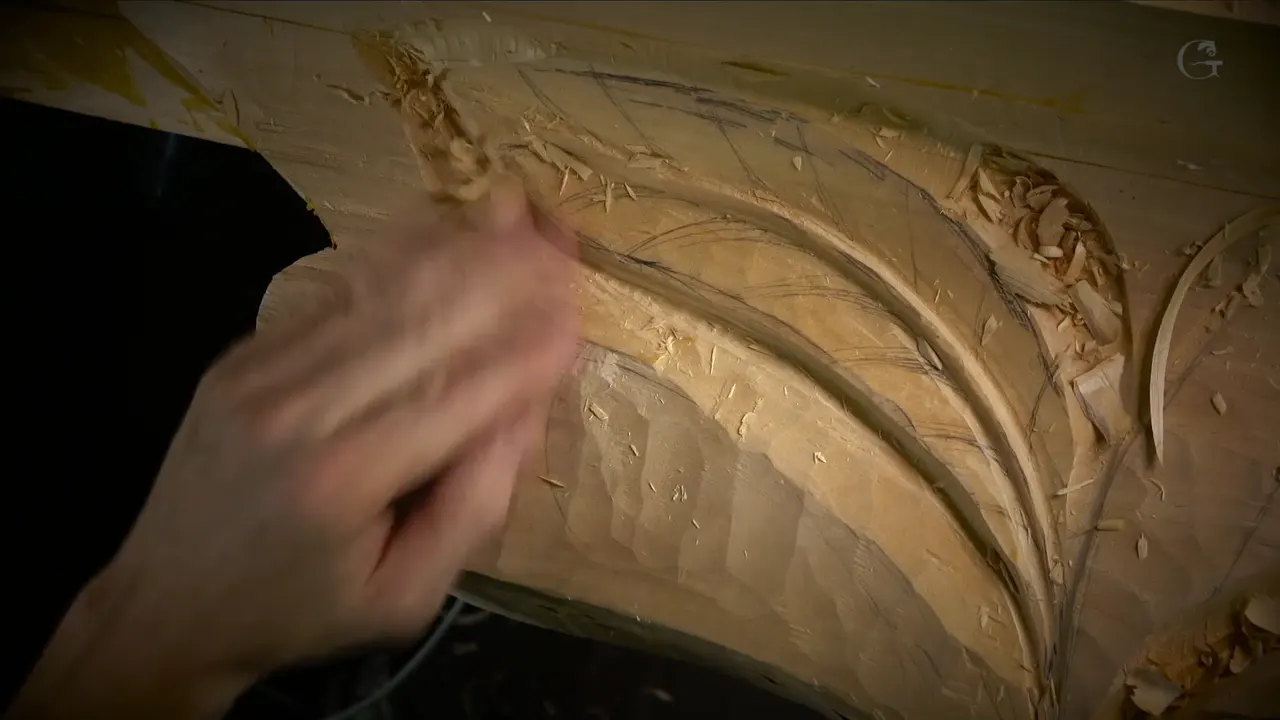

In the first part of Venice Room 68 I said "It is inconvenient," and I could not twist, because I had already got to the ceiling. Other lessons of mine carry the same word beside the direction of the grain, a spot that was in my way, and the camera view.
Its own place is part 1, with a lot of work on both sides of it. Lessons where I said it again come after that, each with the work that sat around it.
What was I carving before the word came up?
Part 1 starts with a depth. "Okay, that's good enough," I said. The figure followed, "approximately half an inch down," about 13 millimeters (1/2 inch is 12.7 mm). Next in line was the job: "it's time to create those cuts. Okay, concave cuts."
Which way to go at it took some thinking out loud, and my plan was to "attack it from two sides, I guess." My reason, in my words, was that "every time when I'm using gouge or veiner, one side always cuts clean and another side cuts rough." I came back to it as a conclusion, and said the reason again.

Depth was next. "And yes, I'll go all the way down," I said, and "that feel of depth" was what it was going to give me. Speed was on my mind too, and "Some of them I can actually do quicker with the help of a mallet" was my line, then later "I can do a much quicker job."
The order was a plan. "Just get the relief cuts first and maybe use a bigger one, maybe 18 millimeters." Eighteen millimeters is 0.7 in, and a gouge that wide was still a maybe.

What came after it in part 1?
First, the word itself. "It is inconvenient," I said. Next, "I got already to the ceiling, so I can't twist, but that's okay." Two short lines followed, "We'll get it done. We'll get that down."
My verdict came next, "Really deep and nice. Beautiful movements." A duty went with it, "of course, I need to do them everywhere," and so did a size I was unsure of, "Maybe I should use even bigger, maybe 20 millimeters" (0.8 in).

One short line sits in between, "Oh," and then "It needs some persuasion." A turn follows, "But on the other hand, what I need is just a spoon gouge right now. Or a spoon veiner, I should say."

Why did a spoon come to mind?
Two lines tell it. "Because it is not the right way I'm doing it," I said. Next: "See, I'm actually laying right on the board already when I'm doing those cuts." A limit rode along with them: "And I can't put hand underneath, and I can't put hand underneath right there, too."
Out of that came a plan, "So I probably should switch to a spoon," with "I'm going to just use a spoon" among the lines after it. The size was left open, with a number nine in mind, "I can use probably 15 millimeters, like 5/8 of an inch." I fixed a size aloud, and 15 millimeters (about 0.6 in) stood.

The hollows got a verdict, "that is plenty of excavation," and a new job followed it, "Now I need to do convexes." For those I had a back bend in mind, and I wondered "if I'll be able to use a 5/8 of an inch back bend." It could be "a little too big."

What happened in parts 2 and 3?
Part 2 starts with the answer: "Yes, that is too big. I need to use a smaller back bend." That work could come first, "before back bend, what I could do, I could actually create those cuts," and the tool I named was "the same tool, number 11, and 12 millimeters in this case" (0.47 in). My aim was to hit "straight down," or "at least close to the outline."

Sizes kept moving in part 2. My next thought was "I think I should use a 20 millimeters, like three-quarter of an inch" (that inch figure is about 19 mm). Later came "maybe 30 millimeters will help me to do it much quicker," and then "I think 30 millimeters is much better in this case," a size of about 1 3/16 in.
Depth came up again. "I need to excavate deeper," I said, and "Outline deeper, okay? That's what I mean." The tool I named was "seven millimeters, number 11" (0.28 in), and my reason was "I need that concave going a little deeper. Otherwise, it's not going to be what I'm visualizing."
A line about the look sits in the same part: "I know it looks messy, but don't worry, okay?" And then, "look really nice" was my promise. For the opposite side I planned a back bend, with a note about the camera: that side would be off-camera, since otherwise my head would be all you would see.

A limit of another kind opens part 3. A number seven at 14 millimeters (0.55 in) was the plan, and then "looks like I'm able only to do to the certain degree." A shallower tool for the opposite side was the plan, and I checked a number three, which got a plain no. A number five was next, and "number five is actually good."
Later in that part came this: "At this point, it's better to take time and make sure you're not making mistake. So you're just removing whatever needs to be removed, but not more than that."

How did the word sound in workshop 67?
A half-inch tool came first in workshop 67, part 6: "In this case, I'll use a 12 millimeters, a half an inch." Then came: "And it's not that easy, I should tell you, because everything is in my way. That's not too convenient."
Grain came into it, "I can't attack from this side because the grain runs that direction. But it's okay." After that, the word itself: "Every project like that. Okay? Every project, there is some areas which is inconvenient, really inconvenient."

My answer was short: "So I'll survive," then "I'll do my work," and "I'm okay with that." What I like about it came next: "I actually like those challenges and just to find a solution, the right angle, it kind of makes that work really interesting."
The big tool had a reason, in my words: "it gives me a lot nicer, cleaner, wider cut." "I could actually use even bigger than that," I said, and I named 15 millimeters (about 19/32 in), planning to "just do even wider."
A line about my position came further on. "Of course, it's not again really convenient. I'm carving towards myself, and I would encourage you not to because it's not the safest way. So what can happen, you can slip and cut yourself, and that would be big mistake."
A verdict followed: "But it is okay. I've got a pronounced pipe which is going right here. I've got a really nice concave, and it just rolls to the convex and goes underneath." A catch came after it, "I just created a really sharp middle line, which I don't need," and I planned to "hit that with the back bend."
Where was the word in workshop 72?
In workshop 72, part 7, I had a plan first, "maybe I can just create the convex and get rid of whatever right there I don't want to see. Okay? So let me do that." Then the line, "really inconvenient," with "It's on the way" right beside it, and once more "Really inconvenient."

A second thought followed: "Well, actually, I don't really need to." Then: "What I was trying to say, I need to create the visible line, the center line, but I really don't need to. Not really."
A little later came a limit on tools, "I cannot use traditional tools or normal tools in this case," and the reason was the slope the work sat on. Of a deep one, I said "I was afraid at first, but looking at it, it looks not bad at all."
What did I say about grain in workshop 84?
The third part of workshop 84 has a line of care first: "I got to be really careful because of the grain. I can easily break it." And "I don't really want to break it." A question comes up, and I answered it myself: "yes, it will be strong," and it would hold.

Next came the word itself, "It's just inconvenient to carve. That is the only problem." The piece would hold, and the one problem I named was how it carved.
Which camera line sits in part 11?
The same workshop's eleventh part has me saying "I'm going to take care of the detail off camera probably." My words after it were "Like I said, it's really inconvenient for me to stick my head in the camera all the time." I work from one position, and the camera sits there too, since "the camera is also from there."

A size came before it, "Get 2 millimeters. Number 11" (about 0.08 in), and a verdict, "Really interesting section." A plan followed, "I can probably start developing this section," and then another verdict: "It doesn't look good, I should say, yet."
Did workshop 85 say the same thing?
Workshop 85 has a shape in its first part, "concave going to go all the way like this, and another one going to go this way." Then came a size: "Let me take seven millimeters. I'll try with the seven first." I called it so inconvenient, with "I have to carve toward myself" right behind it, and that seven is about 9/32 in.
Beside grain, the word shows again in part 3: "And let me please do it off-camera because, like I said, it's really inconvenient for the grain direction." A little before it I had said "I probably have to do a small separation right here," and that I need to clean "that little bit," which I planned to do off-camera.

Further on came the position: "But for now, for me, I really have to stand from the position of the camera because of the grain. Got to do it, otherwise it's just really inconvenient." A statement followed: "I understand that I did most of it off-camera, and I'll show you from different positions."
Where else did a head come into it?
Over in workshop 89, part 3, I planned to "clean it a little more right now." Another plan came with a reason: I would "clean it off camera because it's so inconvenient for me sometimes just to not stick my head, that's the goal, inside of the view." I added that sometimes it is really hard.

"All right. So that is good," I said, and "I really like it." Its blending point came next, "all of those movements going from the same movement."
Did a tool ever go downhill beside the word?
In lesson 3 of the Lily Box course it did, and a line about shadow came first: "I can create really beautiful shadows." Next, "I have to be really careful in this area," and "I am actually cutting against the grain." Flipping the tool was the other idea, "because it's going downhill," and then the word, "inconvenient to cut the right direction."

The next line was about the tool: "But if your tool is sharp, you shouldn't have any problems." It came right after the word.
Which lessons carry the word?
One table holds the places, and its first row is this lesson. The middle column is the spot the word sat in, and the last is what I said around it.
| Lesson | Where the word sat | Next |
|---|---|---|
| Workshop 68, part 1 | Already at the ceiling, and I can't twist | "That's okay" |
| Workshop 67, part 6 | Everything in my way, and the grain running that direction | "So I'll survive" |
| Workshop 72, part 7 | Something on the way, and a convex I could create | A second thought |
| Workshop 84, part 3 | Grain that holds, and the one problem I named | "Yes, it will be strong," then "inconvenient to carve" |
| Workshop 84, part 11 | The camera view, and the one spot I work from | Detail for off camera, probably |
| Workshop 85, part 1 | Carve toward myself, with 7 mm (about 9/32 in) to try | Size first |
| Workshop 85, part 3 | The grain direction, and the spot where I stand | Most of it done off-camera |
| Workshop 89, part 3 | Not sticking my head inside the view | Cleaning, a plan for off camera, I said |
| Lily Box, lesson 3 | A tool I could flip, going downhill | "If your tool is sharp" |
Where can you watch the full video of each lesson?
This lesson holds all twelve parts of workshop 68, and workshops 62 to 73 are in the Part 6 course. The next two courses of the room are workshops 74 to 85 and workshops 86 to 97, and Lily Box has a course of its own. Each one is wood carving in real wood. To watch the videos, start here.
How it's done
- Come at it from both sides. One side always cuts clean and the other rough, I said, so my plan was both sides.
- Dig down for depth. For that feel of depth, with relief cuts first and maybe an 18 mm (about 0.7 in) tool.
- Let a mallet help. Some of the cuts I can do quicker with the help of a mallet, I said.
- Switch to a spoon. With no room for a hand underneath, a spoon was my plan.
- Take a back bend for convexes. A back bend was my plan, and I wondered if the size was too big.
Frequently asked questions
Why could I not twist in part 1?
I had already got to the ceiling. That came right after I called the carving inconvenient, and I added that we would get it done.
Which sizes did I name in part 1?
Maybe 18 millimeters (about 0.71 in), and maybe 20 millimeters (0.8 in) if bigger was needed. Then 15 millimeters (0.6 in) in a spoon. For a back bend I wondered about 16 mm, and I said it may be too big.
Is the word only about grain?
My lessons put it beside carving toward myself (workshops 67 and 85), the camera view (84 and 89), and a spot on the way (72). Grain shows up in 67, 84, 85 and the Lily Box lessons.
What to carve next