

Alexander Grabovetskiy, woodcarver, School of Woodcarving · Published 2020
What does a wood carver mean by "my client"?
Quick answer: My client, I said in workshop 68, part 9, is the person who asked for the carving and is paying for it. I hoped you would like the movement, I said, but most important, my client will like it. Other lessons show a natural finish, a design change and a taste for tool marks.
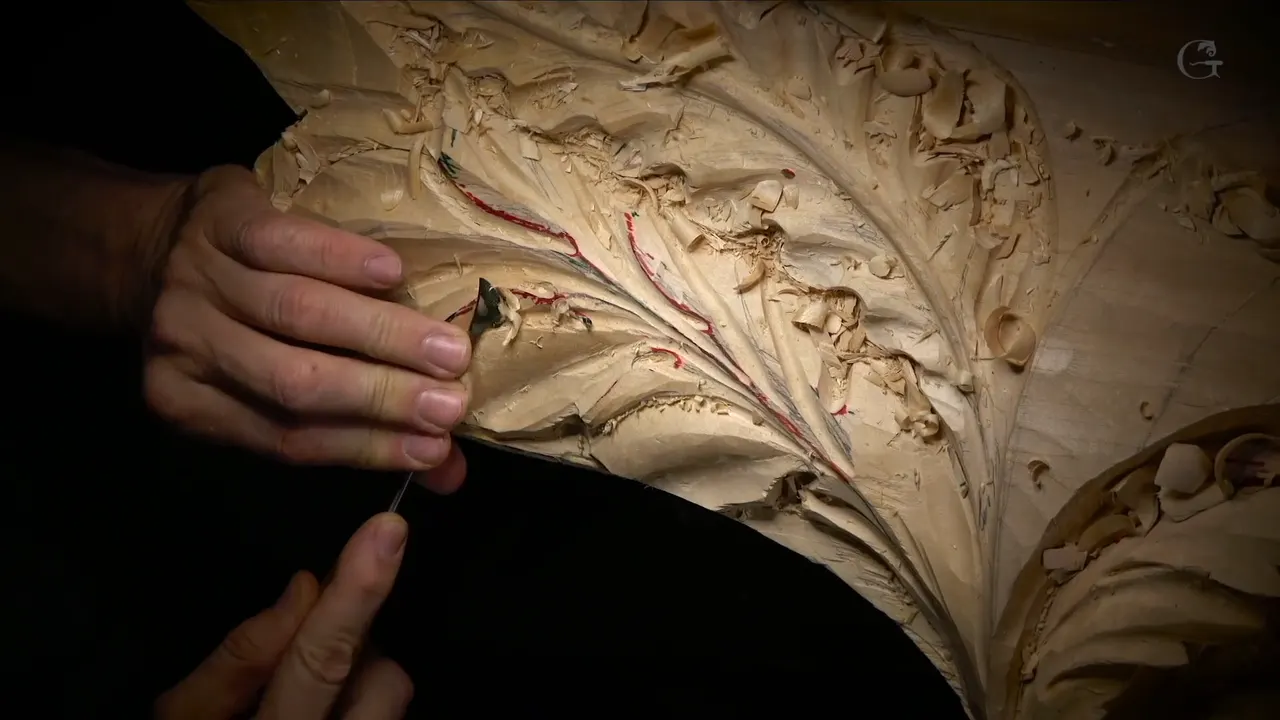

My client is the client who ordered the carving and is paying for it. The line is in part 9 of Venice Room workshop 68, right after I told you I hope you like the movement. Below is that moment, the wood carving around it, and the lessons where a client picked a finish, asked for a detail, or what a client does and does not see.
Ever finished a pass and wondered who it was really for? Would the answer change how deep you go, or how clean you leave the wood? That part is a short stretch of work, and in the middle of it I said the answer out loud.
A glance at the client lines
- The ninth part of workshop 68 names the client as the one who matters most.
- The olive box stayed natural, and the client decided that.
- A surface covered in facets is not to every client's taste, I said.
- Changes are fine when the work is not for a client.
- A client may not understand how hard a carving was, and I said that was okay.
- As I understood it, the Greek Acroterion client, an architect, said the piece would be some type of metal casting.
Who is the client in part 9 of workshop 68?
One line in part 9 names the client plainly, right after I walked through where the divisions would run. "So it's going to be a beautiful movement. Gorgeous movement. And hopefully, you're going to like it."
Next I said "Well, hopefully, you're going to like it, yes." Before I told you who the client is, I said "But most important, my client will like it." The answer followed. "The client who ordered and pays for it, okay?"

You come first in that sentence, with my hope for you. I said which one is most important, and in that part I gave no reason. Right after, "So that is a absolutely gorgeous movement right here. I'm really happy with that movement."
What was I carving when the client came up?
The Venice Room panel, with the divisions still to come. Near the start of the part my words were "I don't worry about how clean it is right now because I still have to make the divisions and so on. It's just preliminary." Facets and tool marks were still on the surface, and I had a plan for them.
The divisions were a plan too. One would sit "right here," overlapping this side. Another would come "somewhere right here," and "then it's going to go downhill that way." More would run in other directions, each one a new division.

My back bend came up next. "Back bend will help me, and let me think, maybe number five back bend." And my reason was "that way, I can get rid of all of those facets right away, all of those tool marks, and right away, kind of round the side of that future pipe."
A second idea followed, and I weighed it out loud. "I could create a deeper shadow on this side and just leave that piece sticking out like that." I put it as a question. "Maybe it's a good idea, right?" I added that I think it would look more organic. If I would not like it, I said, it was too late anyway.

About the spot, "I think it's a good spot, actually, for showing some shadow." Then "let me relief that area and that area right away."
The opposite side was not settled. "I like this overlapping idea, but I'm still not sure if I like the opposite side." Then, "And yes, I think I do." Next I planned to dig a little deeper around that spot, to know exactly what was going on.

The shadow spot got a tool. Number five was the plan, and maybe one inch (about 25 millimeters), to establish this movement. The last lines are plans. "Let me get my middle line moved down this direction." Then "I'm going to have a division right there, and I have to have a division on the other side exactly the same way." And last, "let me chop those triangles, and I'll see exactly what is going on."
The parts on either side add more numbers. In part 8 I had a bigger number 11 going, 15 millimeters (about 5/8 of an inch), and I said maybe even try 30 millimeters (about 1 3/16 in). By part 10 I had stopped short of the first layer on purpose, with approximately an eighth of an inch (about 3 mm) left. Later on I would clean it up, and "if I'm going to go too deep, by the way, that's going to leave some tool marks on a layer. I don't want to see tool marks."
Does the client decide the finish and the stain?
On my olive wood Lily Box the finish was a question for the client. The Lily Box 11 lesson answers it, about stain on the olive wood box I was carving then, and I put it as a hope. "I hope I'm not going to put stain. That all depends on the client, of course. So I'll talk to him." About the wood I said "I really don't like to destroy the beautiful movements of the grain and the play of the colors of that olive wood."

My Lily Box 9 lesson held a plan for a color blending between two different woods, and I said "I'll talk with my client first." In Lily Box 13 I said "I did not discuss the final look with the client. I really like the natural look like this." I also allowed for a different choice. If they decided on some kind of reddish color, I said, I would not be the biggest fan of it. "But client is a client and whatever they want."
A later part of that lesson says it outright. "I did not apply any stain after talking with the customer, with the client, so he decided to leave it natural, and I like how it looks."

The finish had its challenge, too. A Bible would sit inside that box, so "I could not use wax". My reason was the heat. A waxed box inside the house pretty much all the time can sit in a warm room, and "the wax, it's melting." I still wanted it to look like it was waxed, and authentic, and it still had to be durable.
A detail came from the client too. In that same lesson I said the client asked me for thorns that would be really detectable, and I called exaggerating that look "a good technique, actually." When the box was done I said I would ship it to my client the next day, and I wanted to make sure it looked "absolutely nice."

Do clients want smooth wood or tool marks?
The answer changes from one client to the next, and I gave both sides of it. My scrapers lesson says some customers like it really shiny and smooth, and "Some of the customers, they like to see those tool marks." Personally, I keep a little more of the facets, a little rougher. I "kinda like both."

Grape Onlay 12 had facets going all over one area. I called a surface covered in them "pretty much mark of a hand done." "Some people like it," I said. Then "not every client likes that." After that I would get, I said, probably a number seven, 14 millimeters (about 9/16 in).
Over in Venice Room 24 I looked back at sanding. "I did little bit on some of the works, depends on the customer. Some customers, they really require everything is smooth and absolutely polished, almost.".
Back to part 9. Nothing in that part says what the client wanted for the surface, so I will not put words in the client's mouth.
Does the client see what I see?
A convex was coming along in Venice Room 38, and I said "See that development of this convex? I think it's really nice." Then "everything is in my way, but probably the client will not understand how hard it is to do it. But it's okay. It just makes me happy when I have stuff like that, which I know is really hard to do, but I'm able to."

Digging a little inside, in Venice Room 42, I said "which I know you don't see. But it's okay. You actually see what the client is going to see no matter what."
The point of view was a plan I was still working out in Venice Room 142. If I kept one part higher and dug out one side, taking out a wall, the client would look from one position, which is the point of view. Then a doubt. Even with a really nice transition, they would still be able to see that, and I said I did not think I would like it.

When is the carving not for a client at all?
In my furniture panel lesson I talked about changing the idea from the paper. Sometimes you really want to make changes, I said, because the carving looks different from what you expected. The change was fine "in this case because I'm not working for the client." The other side of it came next. Sometimes, I said, it is not easy to convince the client that the change will look better. It can happen "when a client imagines something" and then "you see it's not gonna work in real life."

A design that is not symmetrical came up in Floral and Molding 3. "People wouldn't even notice if I would just do symmetrical both directions, and the client probably wouldn't notice that. But for me, it wouldn't be so interesting to work on."
The Tray of Blessing gave me another line. "I don't explain that to my clients why I've done that way. Don't need to." Most of them don't care, I said, "As long as they like it."
My April 2020 live stream about making money in carving has "If they don't want to pay for me, that's not my client, okay?" On another stream a viewer asked about using gouges, chisels and knives together, and I said the tools you can use depend on the client. "If you're doing for yourself, you can use whatever tools you wish." My project then was an example. "I cannot use V tools or knife," because "I really want to be authentic 15 and 16th century."
A table of the client's part in each lesson
| Lesson | How the client came up | Words close by in that lesson |
|---|---|---|
| Venice Room 68.9 | Ordered and pays for it, I said | most important |
| Lily Box 11.3 | Stain, I said, all depends on them | beautiful grain |
| Lily Box 13.10 | Left natural, no stain, after we talked | Bible inside |
| Rosette Workshop 6 | Original match was kind of an issue | same texture |
| Rosette Workshop 3 | Customer sent just a picture to match | from pictures |
| Greek Acroterion 5.2 | Architect client, I understood, said metal casting | a prototype |
| Greek Acroterion 5.6 | A bevel, about 1/16 in (1.6 mm) | I hope |
| Apron Workshop 17 | Spoke with customer, changed design a little | main idea |
| Grape Onlay 12.2 | Facets all over, not every client likes | hand done |
| Furniture Panel 32.1 | Paper changes are okay in this case | looks different |
| Venice Room 142.3 | Client looking from this position, I said | see extra |
What do I change when the client talks to me?
On the dining table apron the design changed a little. "I finished all five because I needed four, but the first one after I've done, I spoke with the customer, my client, and we decided to change a little bit design. So the main idea is the same, but I change it just slightly."

For the antique style rosette the customer sent a picture. "I have to match the antique style my customer sent to me, just a picture, actually, pretty much." About my own taste, "I prefer to carve my own design, but I'm doing that for a living, and whatever my clients want, I have to give to them."
Done with the rosettes, I said "It has the same texture. It has exactly the same design. And I hope the client will be happy." Earlier "it was also kind of an issue to make sure it matched the original one."

The Greek Acroterion was a prototype. One of my clients wanted one, and after I carved it they would make a form and cast bronze to go on top of a building. Lesson 5 adds "that piece is just a prototype," so "I'm probably going to use sanding after I'm done." As I understood it, the client, an architect, said the piece would be some type of metal casting, "multiple of them on the building."

One bevel, about a 1/16 of an inch (about 1.6 millimeters), came with a hope for the client. An older story sits in lesson 3. I think it was 1998, and "I actually designed the ceiling itself for my client." That was a coffered ceiling.

A flower in Venice Room 136 shows the client having a say. I had an idea for one from a 15th century building in Venice, and the client and I talked it over. "Yes, sure thing. They want to do that, okay?"
Near its end, part 9 was still a plan, not a finished carving. "Let me chop those triangles, and I'll see exactly what is going on." Walk through the divisions with me and see who the movement is for, in workshop 68 of the Venice Room Part 6 course.
How it's done
- Lay out the divisions. In part 9 I planned divisions that overlap and run downhill, and I called the movement gorgeous.
- Say who it is for. Hoping you would like it came first, and then I said who matters more, the client.
- Plan the back bend. A number five back bend was my plan, to clear off the facets and round the side of a future pipe.
- Weigh a deeper shadow. A deeper shadow on one side came to mind, with a piece left sticking out, and I said it would look more organic.
- Plan the dig. A little deeper around one spot was my plan, so I would know what was going on, with a number five, maybe one inch (about 25 mm).
- Talk to the client about the finish. The olive box stayed natural once I had spoken to the client, with no stain on it.
Frequently asked questions
Who is the client in Venice Room 68.9?
Mine is the person who ordered the carving, and I called that same person the one who pays. Most important is the client, I said, and you come after, with my hope for you. I gave no reason for that order in this part.
Did my Lily Box client want stain?
No stain went on after I spoke to the client, so he decided to leave it natural, and I like how it looks. Staining is up to the client, I had said, and a client is a client, whatever they want.
Does every client like facets on a carving?
Some people like them, I said in my grape lesson, and I called facets across a surface a mark of hand work. In my scrapers lesson I said some customers like to see tool marks, and some like it really shiny and smooth.
What to carve next