

Alexander Grabovetskiy, woodcarver, School of Woodcarving · Published 2020
What does a wood carver mean by "you'll see what I mean"?
Quick answer: I said the line in part 8 of workshop 68, after "A concave, convex" and my plan to carve them together. My Hashemi, Furniture Panel, Venice Room, Roman Acanthus, Grape Onlay, Gibbons and Lily Box lessons hold the same words, each with a different tool in my hand.
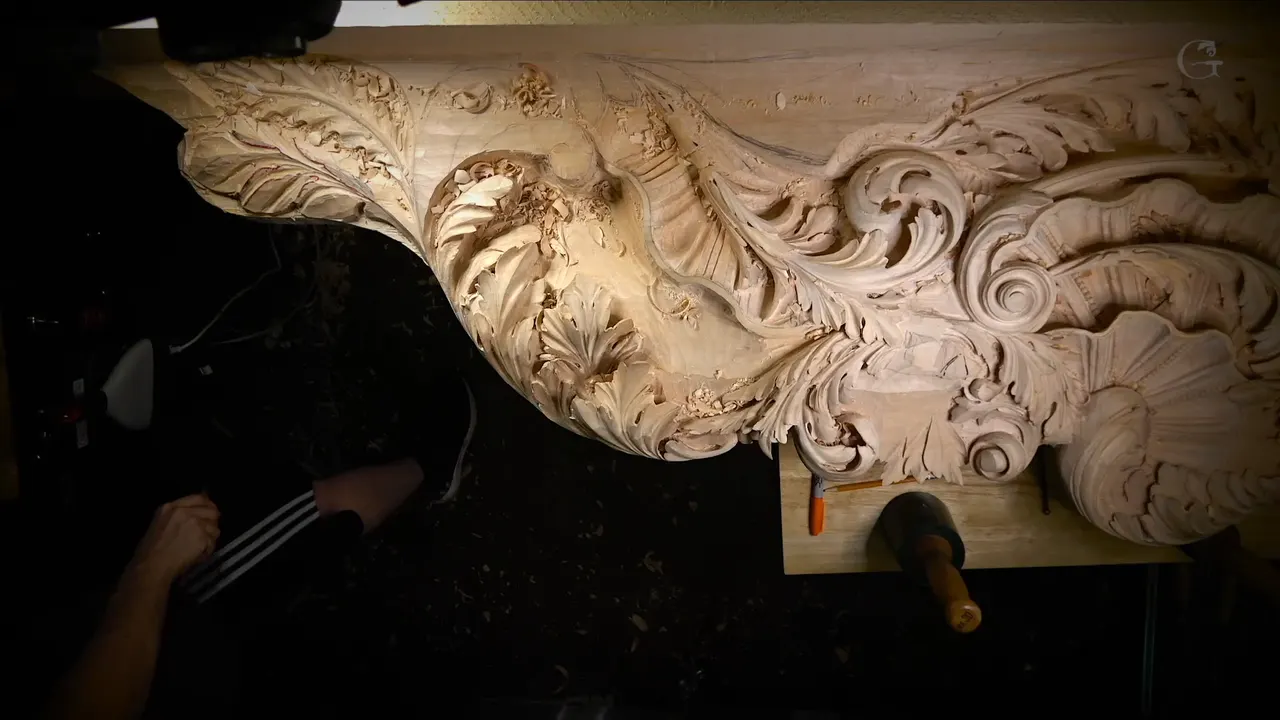

In part 8 of workshop 68 I said "You'll see what I mean" about carving a convex and a concave together. The same words come up in my Hashemi, Furniture Panel, Venice Room, Roman Acanthus, Grape Onlay, Gibbons and Lily Box lessons, so below you get each place, the tool in my hand and what I said around it.
Ever told someone a cut would make sense later, before they could see it? Come along into part 8, where I work number 11 gouges on concaves and convexes in this Venice Room wood carving lesson.
What came before that line in part 8?
Part 8 opens with "And I'll go all the way in, just like that." I had to go on another side of the middle line, "somewhere right here," and on that side "we do exactly the same on this side."

A tool problem came up: "But here, I could do with a little bigger tool. This one is a little too small, I think, for this operation." Then a comment on how it looked: "I know it looks messy, but it's okay. That is just steps. Little steps to the final thing."
Then a plan: "So now I can start blending a little bit, but actually, let me try to use a bigger number 11 to create a little cleaner concaves and convexes." The one I was using was 15 millimeters, about 5/8 of an inch (0.59 in). "Although in real life, it looks like it's bigger." After that: "So that is much cleaner. And I can do this one exactly the same way."
Which tools did I name in part 8 before the line?
"Even I could probably do even bigger. Maybe even try 30 millimeters" (1.18 in), I said, and a little later, "I have to be careful on this side."

A back bend came up first, and a straight tool second. "I could actually hit this side with a back bend. Maybe not even back bend. I could use a straight tool because I do have accessibility. It's accessible for me. And maybe with number five." Then: "That's going to give me a really beautiful convex."
More thought on the straight tool: "Although it's still not convenient with straight tool. It still has a limitation. So I would still probably use number five, but back bend." And later I said: "See? It gives much cleaner cut."
What happened in the last lines of part 8?
Next came a maybe. "And that is good, except I could probably hit the... Well, I'm not sure if I should or not actually make it a little lower, this part. And make that part as more pronounced. Okay? So I think it's going to be good."

Then: "Beautiful. So now I need to exaggerate that concave on this side. I'm going to use probably, again, big 30 millimeters, number 11. And attack from two sides." That 30 mm size is 1.2 in, and then I said "Okay, wonderful."

The closing lines came last. "See? It's a beautiful movement there. A concave, convex, and then I'm going to establish, of course, this. And in this case, I'm probably going to do convex and concave together." The line itself ends with "okay? You'll see. You will see." I have to use probably a tool for that, I said, and "I think it's a good idea. Because it's going to be a gradual thing."
Is it in my Hashemi lessons too?
Hashemi Flowers 11, part 9, has "Okay, let me take a #9 just to make a concave cut in this section. Or #8 will work also. Maybe bigger. I'll take about 10 millimeters" (0.39 in). Next, about why: "if you would ask me why I do that, what I want to make sure I achieve the result, it's like this leaf flips upward like this."

Then came the line, with "later on" ahead of it and "Hopefully" behind it. "Also preliminary cut this one," I said. The V-tool was next. I needed it and would take a small one, number 16, 3 millimeters (0.12 in), to "make my separation cut like this."
Over in Hashemi Flowers 47, part 1, I described how I look at a piece: "what I usually do, I look from different points of view and think about what movement I can do." Then: "Let me think I should or not. Maybe some curl out some spot like this and curl in." "I know it doesn't make sense as of now," I said, and the line followed.
The tool was a plan: "I'll use just a small gouge. This one is a number seven and really tiny one, like three-sixteenths of an inch, five millimeters. Make my concave cut."

Where does it show up in the Furniture Panel?
Furniture Panel 15, part 4: "let me use again number nine and get this area relieved a little bit." The cut would go straight down. "That way, especially in an area like that, when the grain goes toward the design, it's a kind of fragile area, I will have already relief cut done." Then: "get it really close to the final line."
My line there came with "once you try it" in front of it. After it, "So that is actually a really good technique to do that."

In Furniture Panel 21, part 8, I said "Let me attack again that detail with the small gouge, like number eight. Number eight and 1/8 of an inch" (3.2 mm). I was going to recreate "that motion I wanted to see going down and going up again." Also: "I need to fix this edge. It does not look like it's flowing."
The line ended "now." Next: "Whatever fits the profile to create a really nice, smooth transition. And yes, every little bit counts."

Over in Furniture Panel 20, part 3: "And a little blending right here until the previous cuts disappear." Next: "Now what I can do, now I can just create the middle line, and I can use just a pencil probably, and create a really nice and beautiful flow line." A twist was a maybe: "And I could twist this way a little bit." A question about flow came next. Then: "See, now it gives me a really nice S shape."

What about Venice Room workshops 8, 7 and 36?
Back in workshop 8, part 6: "Maybe I have to change something. Kind of not too happy what I see." Perhaps this was the part of the upper division, and then "I can move it a little bit this way." Another line was about a bigger picture: "So that could be a part of a bigger movement." After the line: "So you'll see exactly what I'm developing." And "So I need to make another subdivision."
Workshop 7, part 12, comes from the first Venice Room course: "I should probably use a smaller tool. Okay. A quarter inch" (6.4 mm). On the inside I planned to clean a little better with "same number 11 that I used before, 7 millimeters" (0.28 in). I knew you did not see it yet, "but later on you will." Then: "Maybe even smaller, number 11, 5 millimeters" (0.20 in). Next: "And it is good."
Still unhappy with one spot: "Still kind of don't like how the eye develops. In this case, I have to probably just create a secondary cut right here and excavate a little more."

Next, workshop 36, part 7: "I have to probably change the tool to a smaller one," with "a little too big, I would say" as my reason. Then: "in this area, I could use not number 11, but number 7. The closer to the upper part I get, I could use just the number 7." After "Let me use it," the line came. Then "Get the right number 7."
Do workshops 42, 44 and 47 have it too?
Workshop 42, part 12: "not too deep because this can go right underneath." The question to you came right after that. Next: "So now it looks like the middle line in the right position." If I clean it, the middle line would not show, "so I need to create somehow the movement from the middle line downhill."

And workshop 44, part 5: "Let me chop that way." Then: "Maybe even I should use a little bigger. Well, maybe not a little bigger. Big, like 30 millimeters" (1.18 in). I asked my question and added "giving a beautiful movement on the side."
"But before I go too extreme to that point, I still need some material because I still have to develop this part." What was left: "about 20 millimeters I'd say. That's what I left, about three-quarter of an inch" of the material (20 mm is 0.79 in).
Then workshop 47, part 7: "that's going to make probably a little more sense if I can take it a little more deeper." A little heavier mallet was my plan. After that: "I think it's good enough. And it's actually gave me ability to get a little more three-dimensional movement right here." Next came that line, and then "it's growing from underneath."
And in Venice Room workshop 76?
Come to workshop 76, part 8: "that concave can go all the way like this," and a long movement is my reason. Next: "So let me preliminary cut it." After the line: "It actually really gives me beautiful motion."

Later: "I know it's almost impossible to see now, but let me try to change the light position, and you'll see it actually gives me some shadow. Right. It's not clean yet, of course, but it's okay."
What about the Roman, Grape Onlay and Gibbons lessons?
Roman Acanthus 16, part 5: "you should be able to see that right now. It just gives that extra light spot." Next: "It's just the way the light hits." Then: "For example, let me turn one of the lights off," and the line, and after that "Okay, so you should be able to see that more clearly. Let me cast a shadow, and you should detect that light. I mean, detect this ridge."

Grape Onlay 14, part 3: number 11, three millimeters (0.12 in), "the same two what I used previously." I was going to get my tool upside down, "with the flute to about 6:00." For anyone who does not like relief cuts, I said to try a flatter gauge cutting inward, and the line followed. "A lot of times, you just gonna break the edges, but try if you don't believe me."

Grinling Gibbons Maine 17, part 2: "So now what I want to do on the opposite side. I wanna create some kind of darker spot." "it's gonna be two layers," I said. I needed my preliminary cut "with the number 16 all around pretty much." "Not sure if I can explain that clearly," I said. My line came, and then "like onion. Or onion husk, I should say."

Did olive wood come up in Lily Box 7 as well?
Lily Box 7, part 3: "It's absolutely different feel, especially on a curly wood like this, on a curly grain." Of the grain, I said this: "you couldn't really keep doing the right proper way with all the grain movements and stuff like this, so you had to break all the rules."
Olive wood to carve came before the line, "especially like this one, a really nice and curly one." After it: "So it's not the same at all." My tool, I said, was "number three and 14 millimeters, half an inch, to clean that" (14 mm is 0.55 in).
How do those lessons line up?
| Lesson | Tool I named | My words close by, in the lesson |
|---|---|---|
| Venice Room 68.8 | Number 11 at 15 mm, then 30 mm | gradual thing |
| Hashemi Flowers 11.9 | Small number 16 V tool, 3 mm | flips upward |
| 47.1 in Hashemi Flowers | Gouge number seven, a small one, 5 mm | curl out |
| Furniture Panel 15.4 | Number nine, to relieve this area a little | fragile area |
| Panel 21.8 | Gouge number eight, small, 1/8 in | smooth transition |
| 20.3 for the Panel | Pencil for the middle line, I said, probably | flow line |
| Venice Room 44.5 | A bigger tool, big like 30 mm | too extreme |
| Room 7.12 | The same number 11 as before, 7 mm | later on |
| 76.8, Venice Room | A preliminary cut for a long movement | some shadow |
| Acanthus 16.5, Roman | Switching a light off, my plan | this ridge |
| Grape Onlay 14.3 | Tool upside down, number 11, 3 mm | the edges |
Where can you watch each of those lessons in full?
This part belongs to workshop 68, and the whole panel is in the Venice Room Part 6 course. The Hashemi Flowers course, the Furniture Panel course, the Roman Acanthus Leaf course, the Grape Onlay course, the Grinling Gibbons course and the Lily Box course hold the rest.
How it's done
- Name the side. In part 8 I had to go on another side of the middle line, "somewhere right here."
- Pick a bigger tool. A bigger number 11 was my plan, for "a little cleaner" cuts.
- Look at something bigger. "Even I could probably do even bigger," I said, about the tool.
- Exaggerate the concave. "I need to exaggerate that concave on this side," and "attack from two sides."
- Carve them together. "I'm probably going to do convex and concave together," I said, and a tool for it was needed.
Frequently asked questions
Which tool sizes did I name in workshop 68, part 8?
Number 11 at 15 mm (0.59 in) was one, and I said maybe even try 30 mm (about 1.2 in). A number five came up as well.
Why did I weigh a back bend against a straight tool in part 8?
A straight tool was accessible, I said. Then: "it's still not convenient with straight tool. It still has a limitation." So number five, but back bend, was my probable pick.
What was my word on messy work in part 8?
"That is just steps. Little steps to the final thing."
What gouge came up in Furniture Panel 21, part 8?
What to carve next
- Venice Room workshop 68
- Venice Room Part 6 course
- Hashemi Flowers 11
- Hashemi Flowers 47
- Furniture Panel 15
- Furniture Panel 21
- Furniture Panel 20
- Venice Room workshop 8
- Venice Room workshop 7
- Venice Room workshop 36
- Venice Room workshop 42
- Venice Room workshop 44
- Venice Room workshop 47
- Venice Room workshop 76
- Roman Acanthus 16
- Grape Onlay 14
- Grinling Gibbons Maine 17