
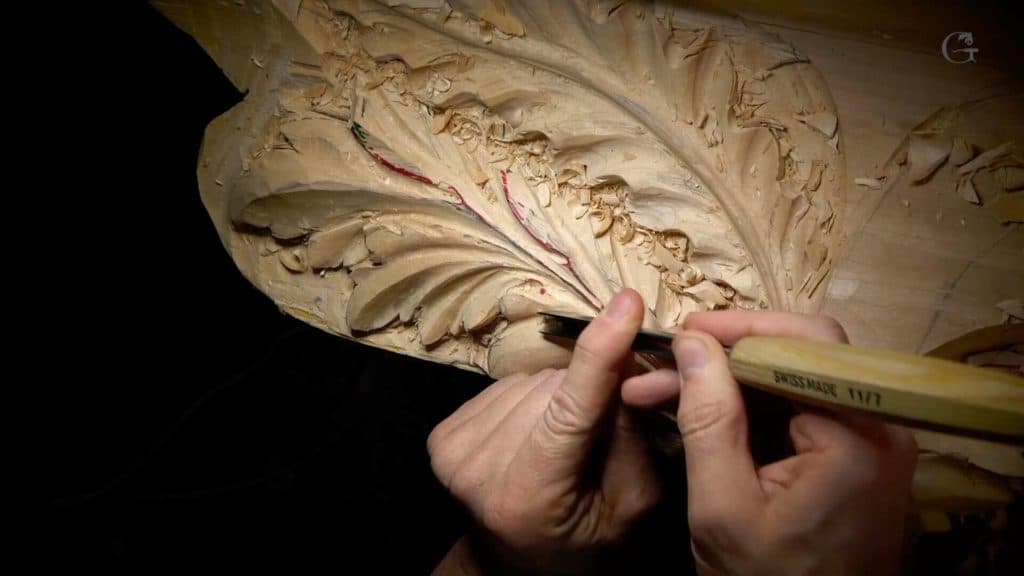
Alexander Grabovetskiy, woodcarver, School of Woodcarving · Published 2020
What does a wood carver mean by "redundant"?
Quick answer: In Venice Room 69, part 3, I said I still had to clean it, and then came the word redundant. My Furniture Panel, Grape Onlay and Gibbons lessons use the word too, and the lines are below, each with what I said beside it.
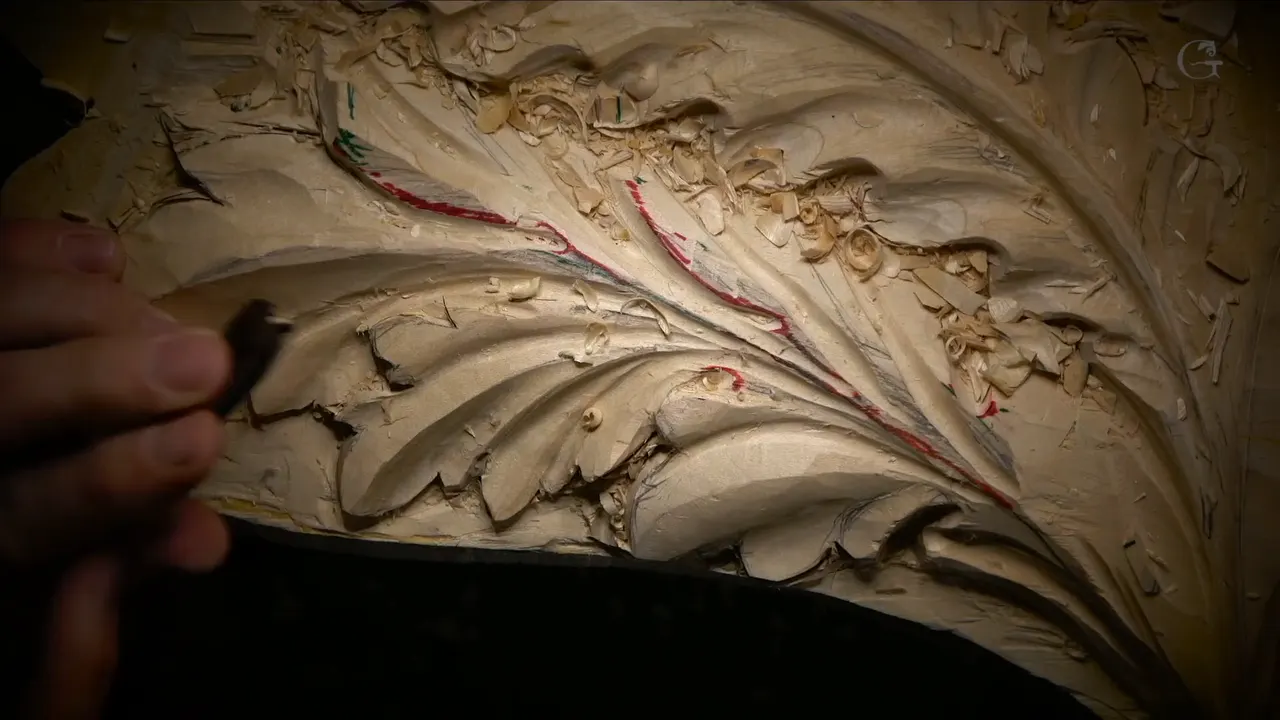

In Venice Room 69, part 3, I said I still had to clean it, and then came the word redundant. My Furniture Panel, Grape Onlay and Gibbons lessons use the word too. Each line is below.
Have you ever finished one side of a leaf and looked across at the other side, knowing the same divisions are waiting there? Would you want me to show every one of them in front of the camera? Here I told you I would carry some divisions on out of sight.
What did I call redundant in workshop 69?
I used the word after I talked about the divisions and the cleaning still to do. Earlier: "now I could create that division that I'm after right here." I said "I need to outline nicely, but got to be really careful."
I named tools as I went: "That was number five, by the way," and then "I need to continue this outlining with the number three on inside." Between those two things I could use a smaller tool, "like maybe one millimeter, number 11" (0.04 in). It would "create extra separation."

An undercut was waiting too. It would be "a little later because it will be too early," and for now I planned "a couple undercut cuts." Later: "that is some like what I want to see."
Here is where I stood. "I think it is enough divisions. It's exactly the same amount of divisions what I've done on another side." The rest would follow everywhere else, "which we don't really need to see," and I would show you the results later "if it's okay with you, of course."

It was not finished, and I said so. "I still have to clean it, hit with the multiple tools and get with the right direction." Then came my line. "But it's just redundant. Okay, so it's going to be the same all the time, pretty much."
What came after that line in part 3?
"But I am able to see my concave and convexes," I said, and "my acanthus right here." A need followed: "I need to actually exaggerate this pipe." Then: "And this pipe right here, because it doesn't look like it's casting enough shadow to me. I need little more shadow."
My words to you: "you should be able to understand the process." More acanthuses were coming, and if the idea did not land right away, "you'll see a little more development," because "it's all about acanthuses in this project." Oak leaves would come later in it.

About my tool I said "backbend, that's what I'm using." Near the end I said I could "clean little more inside in this area." And: "Number 11, seven millimeters." Seven millimeters is 0.28 in.
Do the other parts of workshop 69 say the same thing?
My reason comes in part 4. "I've done some off-camera, like a shell with the same beads." I did that "because of the position and I did not want to stick my head in a camera view."

In the same clip I pointed you to the other videos. "If you want to see and if you missed this section," I said, "I would just highly encourage you to just go ahead and watch all of the videos and the process, how I've done those everywhere." I added that I had "that also, which is not visible, but it's on the right-hand side."
Next I wanted to jump on a section inside, where "a flower also, or a couple flowers, I don't know" would go. On the leafage there: "Just sticking out some leafage, like some leafs sticks out. And I'm going to do exactly the same right at this area."
A cleanup sits in part 2 too. "A little bit cleanup," I said, "just barely hitting the upper part of the fibers." Then: "that's really clean. I don't need to sand anything or anything." The ridge would need "probably around 10 millimeters tool or even bigger, maybe 15 millimeters tool," which is 0.39 in and 0.59 in.

Where else does the word show up in Venice Room?
Venice Room 74, part 4, is the next place. Quite a few flowers would sit all over the main body, and I would show their positions, "but I probably going to carve them not on the camera." My reason: "it just takes long time to edit and so on," and it would be "just redundant," the same thing I had done before.

The update came next. "We are getting pretty close on this particular part," I said, with "a lot of cleaning" left, and soon I would start "on the corbels on both sides." My idea was to create one leaf. "I really have to kind of repeat the movement," I told you, and "the law for repetition" came up: it "has to be somewhat parallel to this movement, but it still has to taper out."
My tool was this: "I'm using number nine, pretty much 20 millimeters, about 3/4 of an inch," or 0.79 in. I could "use some force and use a mallet." Across the grain is "always safer," I said, because "if I would just do by hand, I could slip."

Venice Room 136, part 2, is the other one. I wanted "the plug cut right inside" at all of those points, and thought of two millimeters (0.08 in) first. Then three millimeters (0.12 in), and I said "Yep, three millimeters will do." Of my eyes: "that's just for the sake of the shadows."

Next: "But some of them I'll do just off camera because it's just redundant. The same idea, okay?" Whenever I see an eye, "I have to create some kind of convexes, okay? Just to pop and create the idea of pipe." For concaves I said "maybe five millimeters," about a fifth of an inch, and "number 11, of course." Soon after, "maybe that is little too small. I'll take probably number eight."

How did the Furniture Panel course put it?
In Carving Furniture Panel 16, part 8, I was talking about the background. "Again, I'm going to attack across the grain." Then: "make sure you are not digging too deep to the background because we really need to keep whatever we're doing with the tool before router plane, a little higher than the router plane, okay? So don't overdo it."

Next: "I know it just sounds redundant, but" you do not want to make that mistake, I told you. A plan came with it: "let me get again number 11." Near the line I said to "get really close to the line," and I could "probably get again number 2 and just go around," then "just place it on the line and make my straight down cut."
"Because I used knife before, for me, it's just like a piece of cake to catch that previous cut," I said, and then a warning came.
"Please, please don't angle that on inside. That would be a big mistake."

For a couple of spots, "let me use number 7 at 4 millimeters" (0.16 in). My limit: "I really want to stay above my final background depth. So at least I want to stay about 1/32 of an inch," which is 0.8 mm. If you made that mistake, "don't tear your hair." If material is left "between the back and this surface, you can shave it just slightly more." That would not be really noticeable, I said.
Carving Furniture Panel 33, part 1, has the word as well. I talked about a back bevel, "and one of them you using the tool upside down. It's much easier if you have a bevel on the backside." My aim for the section: "I'm not after the final shape yet, but just, you know, going to chop approximately how it's supposed to look."

"Like I said, gonna repeat, maybe it's redundant, but anyway." Next: "Even if it's gonna be overlapping motion, it still has to be like going uphill. Don't worry about how it looks overall yet." Divisions would come: "we are gonna have some divisions." I added: "I wanna make sure, uh, you do not lose that central movement, okay? So really important to keep that in mind." At the edge, for the waving, "I use number seven and create that whatever the waving is at the edge, don't overdo it because you don't wanna damage the leaves below."

What followed in the Tray lesson and the Grape Onlay?
The Tray of Blessing 1, part 3, has me saying to pay attention to how I was placing it. "I know I, it's kinda redundant. I'm saying that all the time, but it's, it's super important. Okay, if you don't want to damage yourself, if you don't want to cut your hand off. So just, uh, place it solidly."

Later in that part I checked my depth, with "about an inch from the edges." "Gotta be careful now because I'm getting really close," I said. On the back side: "no more than about three eighths of an inch." An inch is 25 mm. Three eighths of an inch is about 10 mm. Then: "attack from another side."

In Carving Grape Onlay 12, part 1, I was undercutting a leaf toward a knife edge and talked about thickness. "Overall thickness, it's still about quarter of a inch. It's what I left." I could live with "maybe five millimeters right now," and I said "Maybe the most I've got are two millimeters, okay?" In spots it was "just about one 16th of an inch." Those are about 6 mm, 0.2 in, 0.08 in and 1.6 mm.

"I don't wanna take it, uh, too thin," I said, and I told you why: "I've done that mistake multiple times when you just pretty much cut all the way through." Then: "But how do I approach undercutting? Obviously, like I said, I'm gonna repeat myself. I know it's gonna be redundant, but, uh, it looks rough and I'm not taking care of the roughness until the end when everything is done."
Clean-up would follow: "I'm gonna clean all the facets." Some pieces of paper on the onlay marked spots I had not touched. "I need to keep those high spots because I have to remember, at some point I will have to flip it and it's gonna rest on those spots." Those spots would "serve me like legs." My plan was to get a couple of clamps, and "it doesn't matter what brand you using."

What about the livestream and the Gibbons class?
In Livestream April 2020 I was reading questions. "By the way, maybe it's going to be redundant, but I have to explain a lot of times to my clients." Out of all woodworking trades, I said, wood carving is "the only one thing you cannot really expedite."

My next words: "You're still using the same tools, what people 2,000 years ago, 1,000 years ago, 300 years ago used." Then: "You still have a same approach, same thought process." And: "it takes the same time, pretty much what those people took back then." Some people argued with me that CNC machines do it much quicker. My answer: they "actually really limits it," and do not reach "the level of what an experienced wood carver able to do."
A bit earlier a question about pine had come in. "It's not pine," I said. "That is lime wood. It's actually basswood if you're in the United States." Linden is the name in Germany, I said, and Lipa in Russia.

The Gibbons lesson is Maine class 12, part 2. Petals, I told you, start growing folded and open outward. "But right in the middle in those spots, it's always like concave," I said, and added "not all flowers, but a lot."
Following that rule would give me "a little more natural look." On my tools, I said I'm spending a little more time on stropping, "because again I know it's a redundant. I tell that too many times. But it's important."

Then a cut: "Let me get that concave cut inside." I would "divide that to 60% from this point to that point approximately," and with "about 40% or 38% I'll be in a golden ratio. Which I don't really have to be in this case, but it's okay."
Looking at it, I said "It does not look really nice. Because I didn't spend time of blending everything." About the ridge it left: "I don't like the ridge it left, but I don't see the problem with that."

Where do those lines sit side by side?
Here is each line, and the words I said beside it.
| Lesson | What came with the word | Nearby words |
|---|---|---|
| Venice 69.3 | divisions and cleaning still to do | I still have to clean it |
| Lesson 74.4 | flowers to carve off the camera | it just takes long time to edit |
| Furniture Panel 16.8 | not digging too deep to the background | keep it a little higher than the router plane |
| Tray lesson 1.3 | placing it solidly, to avoid damage | it's super important |
| Furniture Panel 33.1 | an edge that has to go uphill | don't worry about how it looks overall yet |
| Grape Onlay 12.1 | roughness in the undercut | I'm not taking care of it until the end |
| Venice 136.2 | plug cuts at the eyes | some of them I'll do just off camera |
| Livestream April 2020 | wood carving cannot be expedited | I have to explain a lot of times to my clients |
| Gibbons Maine 12.2 | a little more time on my tools | I tell that too many times |
Where can you watch every lesson named on this page?
Every lesson named above is inside one of my courses. This workshop holds the part I started with, and workshops 62 to 73 are in Venice Room Part 6. The others sit in Venice Room 74, Venice Room 136, Panel 16, Panel 33, Tray lesson 1, Onlay 12, the April 2020 livestream and Gibbons class 12. To watch the full videos, start here.

How it's done
- Say when there are enough divisions. The same amount as on the other side, in my words.
- Plan the rest. The other divisions would follow everywhere else, out of view.
- Name what is left. Cleaning, with multiple tools and the right direction, was still ahead.
- Look for shadow. I needed to exaggerate the pipes, because they did not seem to cast enough shadow.
- Point to the videos. Workshop 69, part 4, has me encouraging you to watch the earlier videos to see how I did those.
Frequently asked questions
Did the leaf in workshop 69 need more divisions?
I said I thought there were enough divisions, the same amount as on the other side. The rest would follow elsewhere, and I still had cleaning to do with several tools. The results would come later, if it's okay with you.
Why was some of the carving done off camera?
For a shell in part 4 of workshop 69, I gave the position and my head in the camera view as my reason. In lesson 74 I said the flowers would probably be carved not on the camera, because editing takes a long time.
How thin did I leave the wood in the Grape Onlay?
Lesson 12, part 1, has a few sizes: about a quarter of an inch (about 6 mm), five millimeters (about a fifth of an inch), and in spots one 16th of an inch (1.6 mm). Going all the way through is a mistake I had made multiple times, I told you.
What to carve next