

Alexander Grabovetskiy, woodcarver, School of Woodcarving · Published 2020
What does a wood carver mean by "forgivable"?
Quick answer: In part 5 of workshop 69 the grain was already breaking, and I said almost every mistake is forgivable, but consequences you can't change. Other lessons of mine use the same word for a wood, for a spot that never shows and for a project that gets paint.
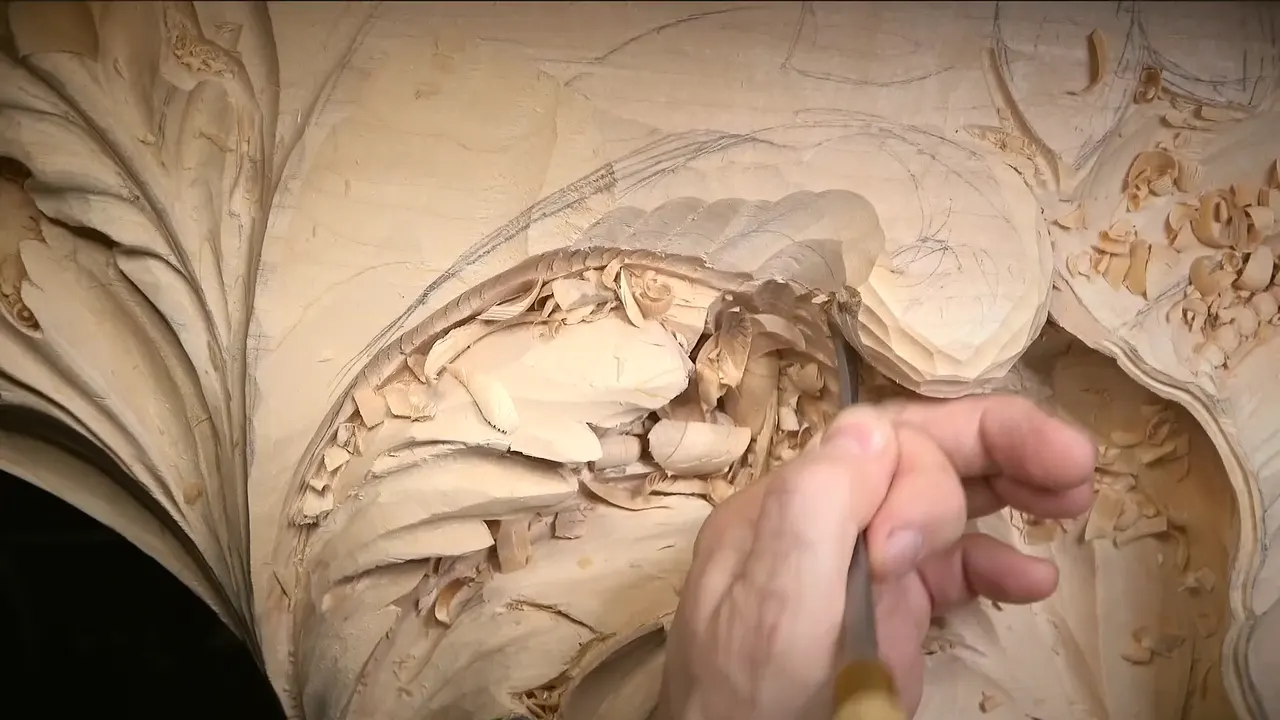

In Venice Room 69, part 5, the grain started breaking, and I split forgiveness from consequences. I use forgivable, unforgivable and forgiving in other lessons too, for a wood, a spot and a whole project. Every line is below, with what I said beside it.
Ever felt the grain start to break under your tool? Could you tell, before the next stroke, how much that wood would forgive? Then you are standing where I stood in this video.
What did I say before the grain started breaking?
I told you "I really like to use huge tools because it just gives me a much quicker result," and that "not all of you have exactly the same as what I have." Then: "I really want to make sure you're also able to do what I'm doing."
I was "just looking from different points of view." Tool marks do not worry me, I said, because "it's not a big deal at all, for me at least." Of the cleanup: "I can clean them with no problem."
My tools come back in part 6: "I understand all of you don't have tools like me, and I should probably just do my normal way." And in part 4 I said "if you don't have huge tools and you have just, for example, if you can find number seven and 14 millimeters (0.55 in), that is actually excellent tool to create the shape. Any shape, pretty much."

My plan was "to probably take number 11 and get a little bit undercut done because I think it's going to make sense." The roundness would be "easier for me to establish."
The tool I named was "number 11 and 10 millimeters (about 3/8 in)." A bigger one crossed my mind, for "a little cleaner cut, quicker," so: "I'll use 20 millimeters (about 3/4 in)." The grain got a reminder too: "watch out the grain."

Another idea was "number seven and 14 millimeters (0.55 in)," carried on "until I'm happy with the overall shape." Meanwhile I was "constantly checking from all the positions, how it feels in overall." My verdict was short. It "still does not feel like it's supposed to feel, which is okay."
How did a number 17 end up in my hand?
I planned to go around a line. Some of that material had to go. For that, I said, "let me use 20 millimeters again, three-quarters of an inch."
I looked at the tool. "Well, this is actually not number 11. I apologize. This is number 17." It is a specialty tool, I said, and "It look like number 11, but it's not." So: "let me put that back," then "let me use number 11." As for the stray: "that number 17 got inside of my wrong drawer."

Which words came when the grain started to break?
"Okay, got to be careful. See, it's already breaking the grain, which is okay in this case, but if it would be closer to finish line, that would be a big mistake to continue my cut." Then: "And no. Sometimes those mistakes are unforgivable." I took the last word back: "Well, I shouldn't say unforgivable, almost every mistake is forgivable, but consequences you can't change." And: "So there's a forgiveness and there's the consequences."

Then the Bible. "Same like in the Bible, actually. You can get forgiven, but the consequences you still have to face."
I also like an example sometimes, I said, about "the young girl who made a mistake when she was really young. And she damaged her health, and then she realized she was really wrong, and she asked for forgiveness." My words for the end of it: "absolutely, she's got forgiven. But the consequences she has to carry pretty much all life."
A limit followed. "No specifics. I'm not going to tell you what I mean by big mistake, because I do understand there's different people watching what I'm doing and different points of view." My goal was not "to tell you what's right, what's wrong in life."

In carving I can say what is "right and wrong in the wood carving, in my opinion, of course." And one more line: "I would never say that is the only way you're supposed to carve or do something."
Which mistakes did I call unforgivable in other lessons?
A molding in Furniture Panel 15, part 6, shows a mistake of mine. "I've got too deep cut right here. So have to pay attention to that thing." The depth was "about 1/32 of an inch (0.8 mm)," and the overall height of the molding comes to 3/32 of an inch (2.4 mm). Later: "I should have paid attention." Then: "if I would zig a little deeper," a "huge problem," and "an unforgivable mistake."

The tool for the next step was number one, the double bevel, at 6 millimeters (about a quarter of an inch). Its place was "right on the line." It was "really important for me not to miss that line."
Moldings come up again in lesson 19. "I really don't want to undercut right now, okay?" Then: "Unforgivable mistake. Okay?" Earlier in that part: "I like double bevel," and "It could be just a normal carpenter's chisel."

Workshop 160, part 2, of the Venice Room uses it on a molding. "I'm about 16th of an inch (1.6 mm) off, okay? And for the molding, it's big." Then "unforgivable mistake." Before that I had said "I place my big gouge and try to fix it." After it: "I should be in good shape. Double-check."

Workshop 11 of the Dining Table Apron course uses it too. "So be careful not to snap." And: "Wood carving requires a lot of patience." Then: "if you rush it, you can make an unforgivable mistake."
Where was a mistake still forgivable?
Hashemi Flowers 5, part 2, uses the word for a stage of the work. "the more material you take out, the weaker it becomes, and it's easier to break." Later: "Be careful when you're doing with the grain." Next, "Oh, dumb mistake. It has to go this way. It's okay." A little later: "And yes, I do make some mistakes once in a while. But in this stage, it's still forgivable."

The other half followed: "But later on, if you make a mistake, you screwed up. That's it. You're done. So I have to be more careful myself." For the depth here: "I'm not going to go 3/16 (4.8 mm), maybe about eighth of an inch (3.2 mm). I think it should be plenty."
A slip nearly happened in part 8 of workshop 73. "Oh, got to be careful. Almost messed up." And: "Almost messed up, and that would not be forgiving." On the other hand: "I could actually excavate deeper in this section also."

Which woods did I call forgiving?
Walnut shows up in part 3 of Furniture Panel 18. "Let me lower that even more," I said, and of one pass: "Maybe it's a little too much for one pass. That's okay." And: "This wood is a forgiving wood, okay? So it's hard to make mistake in this wood." And: "I love this wood. I love walnut, I should say."

The first part of that lesson has "that depends also on the type of wood, of course," and later "It's little more forgiving wood." Earlier I told you "feel free to take a little more time and do a lot more passes." About a spot I could not get into: "It's too much for the router plane." For that: "What I'll do, I'll just scoop" material out with a gouge, a number seven, a quarter inch (6.4 mm).
The wood has a name in Furniture Panel 25, part 2: "what I like about Walnut it's somewhat forgiving sometimes you could go against the grain." I added "any not nothing bad gonna happen. I should say, okay." Still: "You still have to keep an eye what the grain of the wood does." And: "That's really really forgiving."

In Furniture Panel 26, part 2: "I am doing a somewhat wrong way, but with the walnut it's all right." And of walnut: "a little more forgiving in this case." In part 1 of lesson 32 it was "it's a walnut," then "in my case it's what I think it's little forgiving."
Other species came up too. "They're really crunchy," I said, and "if you're just taking too much at one cut, you can snap off the whole detail." Scraping comes up in Furniture Panel 20, part 3: "some of the woods, they're not forgiving about that scraping. But that scraping actually sometimes expedites the things, makes it much quicker."
What about woods that are not forgiving?
The apron course has oak in workshop 15. I told you not to carve against the grain, I said, "but just because I'm filming everything, just limits it all." I did not want to "rotate all the time my piece." So: "that is oak and it's crunchy." And: "My tool is not digging in, so it makes it a little easier to break that rule." Then: "But not every wood is that forgivable as oak."

Lily Box 3, part 8, has the word with a not. With a relief cut, "all that waste is just flying out," and that is "especially important if you are working with the hard woods." Then: "Just like this wood, really important because it's crunchy and it's not forgivable. Not like basswood or lime wood, if you call it lime wood, or linden, if you call it linden."

Sharpness gets the word in Lily Box 13, part 2. "make sure you are slicing, okay?" And "your tool absolutely must be sharp," especially "on a wood like that." Then: "Some woods are more forgiving, I would say. But this one is not."

What spots and jobs were forgiving?
A project gets the word in Venice Room 74, part 12. Going too deep would leave "a mark really deep inside of this cut." I knew it was "a paint grade" and that things were "pretty much hidden," but "like in other cases, it would be a big mistake."
In my words: "This one is a somewhat forgiving project, I would say." Mistakes get "covered with the paint," and "At least I'm telling you honestly."
An area gets it in workshop 99, part 12. About how deep I was: "About an inch (25 mm) deep, so it's plenty." Next: "this area, like I said, it's a somewhat forgiving area because it's never going to be visible. But still, I'll try to get that clean."

In Venice Room 95, part 3, I said I would use a smaller tool, still a number three, "a small one like 10 millimeters (3/8 in)." To ride on top of those fibers and slice them was the plan. Tools "must be super sharp, especially if you working in this area," and then "tools must be sharp, no matter where you work, probably." And: "But some of the areas more forgivable."

Depth comes in part 4 of workshop 18. The transition was "still going to be visible from the bottom." "I want to make it deep because deeper I go," I said, and I called that "more forgiving for me."
Paper has the word too, in workshop 101, part 6. Artists who work in 2D might ask me "Why do you do that stuff?" Then: "On the paper, it's a lot more forgiving, all right? I mean, I'm able, I have no problem." And: "I feel like I have a lot more control if I'm doing a lot shorter strokes when I'm drawing like this."

Where do those lines sit side by side?
Here is each lesson, what the word was about and the word I used.
| Lesson | About | Word |
|---|---|---|
| Venice Room 69.5 | grain breaking, and consequences you still face | forgivable mistakes |
| Hashemi Flowers 5.2 | a dumb mistake, but in this stage | still forgivable |
| Venice Room 74.12 | a paint grade project, mistakes get covered | somewhat forgiving |
| Dining Table Apron 15 | crunchy oak, my tool not digging in | forgivable oak |
| Lily Box 3.8 | a crunchy hard wood, not like basswood | not forgivable |
| Furniture Panel 25.2 | walnut, and an eye on the grain | really forgiving |
| Furniture Panel 19.3 | undercutting the moldings, which I didn't want | unforgivable mistake |
Where can you watch every lesson named on this page?
Each lesson named above is inside one of my courses. This workshop holds the part I started with, and workshops 62 to 73 are in Venice Room Part 6.
The other Venice Room workshops are 73, 74, 99, 95, 18, 101 and 160. The Furniture Panel lessons are 15, 18, 19, 20, 25, 26 and 32. The rest are the Hashemi lesson, Lily Box lesson 3, Lily Box lesson 13 and the apron course. To watch the full videos, start here.
How it's done
- Say what the grain is doing. Already breaking the grain, I said in part 5, and I let it go.
- Say where the finish line is. Closer to the finish line, I said, continuing my cut means a big mistake.
- Keep forgiveness and consequences apart. I said there is a forgiveness and there are the consequences.
- Ask what the spot allows. In workshop 74 a paint grade project was somewhat forgiving. In workshop 99 an area that is never visible was too.
- Check the wood. Some woods are more forgiving, I said in Lily Box 13, and walnut was one I called forgiving.
Frequently asked questions
What was forgivable in workshop 69?
I separated forgiveness from consequences in part 5. I called the breaking grain okay there, and nearer the finish line, I said, continuing my cut means a big mistake.
Which woods were forgiving, in my words?
Walnut, in several Furniture Panel parts. Lesson 25, part 2, has me saying nothing bad gonna happen with walnut, though you still keep an eye on the grain. In the apron course I said not every wood is that forgivable as oak.
Was a whole project ever forgiving?
Yes, in part 12 of workshop 74. I called it a somewhat forgiving project, because mistakes would be covered with the paint. I added that I was telling you honestly.
What to carve next
- Venice Room 69 lesson
- Venice Room Part 6 course
- Venice Room 73
- Venice Room 74
- Venice Room 99
- Venice Room 95
- Venice Room 18
- Venice Room 101
- Venice Room 160
- Carving Furniture Panel 15
- Carving Furniture Panel 18
- Carving Furniture Panel 19
- Carving Furniture Panel 20
- Carving Furniture Panel 25
- Carving Furniture Panel 26
- Carving Furniture Panel 32
- Carving Hashemi Flowers 5