

Alexander Grabovetskiy, woodcarver, School of Woodcarving · Published 2020
What does a wood carver mean by "definitely"?
Quick answer: In part 9 of workshop 69 in the Venice Room, I say it while I check "if it's going to look good with all the divisions or not." My Hashemi, Furniture Panel, Roman Acanthus, Greek Acanthus and Lily Box lessons carry the word too, and below you get each place with the line around it.
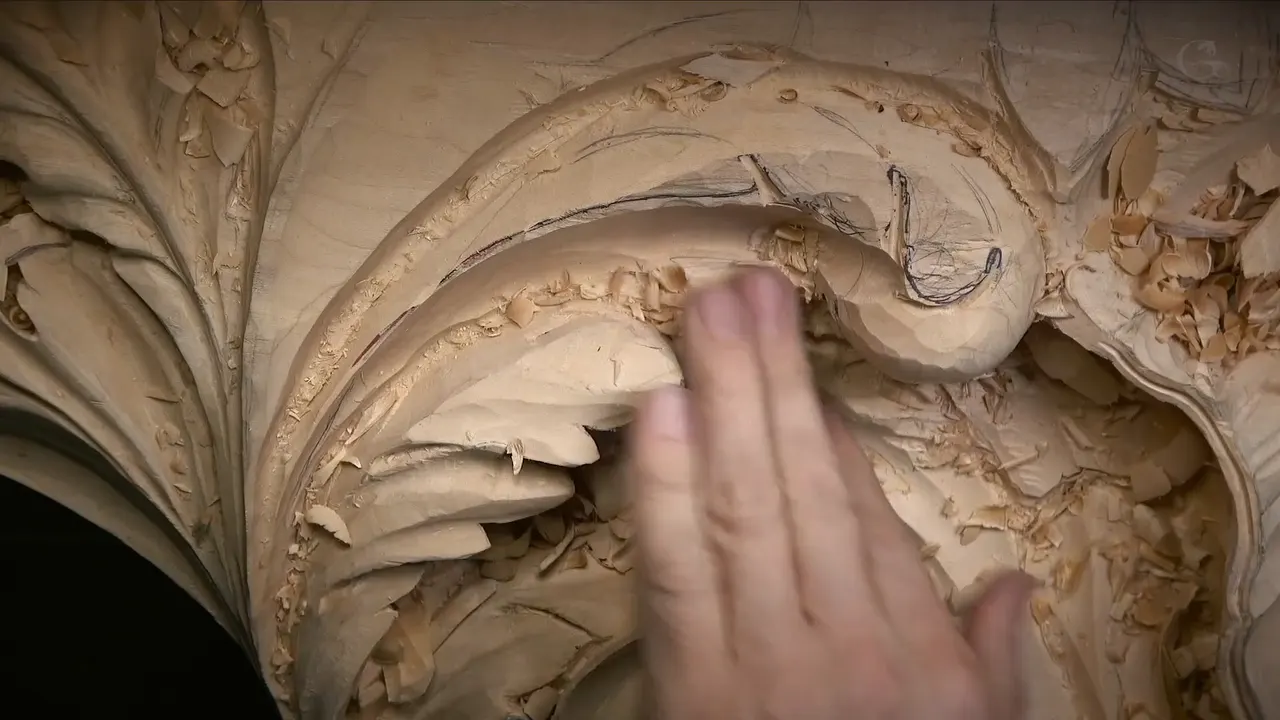

"Definitely" is a word I say in part 9 of workshop 69 in the Venice Room: "I can definitely change something." I say it while I check where an eye goes against its divisions. The word comes back in my Hashemi, Furniture Panel, Roman Acanthus, Greek Acanthus, Lily Box and other Venice Room lessons, and below you get each place with the line around it.
Ever moved a pencil mark on a carving and wondered if you could still change it? Come into this Venice Room wood carving lesson, where I check the position of an eye before I make a division.
What was I doing before the word in part 9?
The video opens with "And little by little, just shave it down." Then: "I like that." Soon after: "that part is overlapping the main head of acanthus."
A word to the viewers came next: "And don't pay attention, that is little rough right now. It's not the final shape yet of this upper part. I know some of you probably don't like that, and it bugs you, but that's okay. It's just a matter of cleanup."

Another eye came next: "So I've got another eye and I've got this part." I named a tool: "And I'll use 7 millimeters, like quarter inch, little bigger than a quarter inch" (0.28 in), for one small pass right there.
A bigger gouge came after that: "And I can take a bigger number 11. In my case, it would be 20 millimeters" (0.79 in). "I think it's a good idea to use a little bigger because I really need to, again, to raise one of the parts of that movement up." It would be "somewhat authentic to the original."

About the style: "But in this case, it's a Venetian style, which I really like." And: "But overall movement, I am happy. And also I can probably hit right away this part with the same tool. And go around that pipe."

Where did the word come in part 9?
Earlier than that line: "That is good. And now I'm ready to do more details in it." Then: "So, which means I need to decide where the middle line of this detail going to be." A moment later: "And it has to go right there somewhere. That's the middle line."

The eye came next: "There's an eye, and maybe I have to move this eye a little farther." Then: "just slightly farther because I need to make the divisions on this piece." And: "And that eye was a little too close."
My plan for the tool: "Let me get one-eighth of an inch again, number 11" (3.2 mm). Also: "And pre-establish preliminary the position of the eye." Those passes were not coming right away: "That's the reason why, because I'm changing the position of those eyes logically."

And here is the line: "I'm just checking if it's going to look good with all the divisions or not, and then I can definitely change something. Okay? So and I think it's good."
Then came what was still to do: "And also, I did not take too much material down below, although I still have to establish my concaves on that upper part of a movement, and it still has to be a little lower. But I'm taking my time. Okay? I'm taking my time, and maybe I'm just trying to be a little more accurate."
Next, an S: "an S, letter S movement in this section." A tool, too: "It was number five, by the way." The size: "Number five and about 16 millimeters, like five-eighths of an inch" (0.63 in). Also: "I am ready for the establishing main concaves and convexes."

The concave should go "without touching the pipe," I said. And the tools: "But obviously, I cannot use huge tools, but 7 millimeters will be sufficient, I think, and of course, it's number 11 again" (about 0.3 in).
Part 9 ends on the hand: "And carefully, I'm going to start little by little, cut by cut, and I'll go all the way." Then: "it looks like I'm holding my hand really high, but it's not. If you look at this finger, I am actually referencing on that finger." And: "I'm always referencing somewhere. And in this case, I actually can put two fingers."

Does the word come with a doubt in other lessons?
It does in workshop 34, part 12: "I still want to give a feel. Maybe, actually, I don't know. I could give a little convex on this one. I'm not sure if I should or not, but definitely I need to give a concave right there."

Early on, workshop 7, part 9, has it too: "We'll see. Well, definitely I could add something right here." After that: "And this one, later on, I have to make the divisions."
Over in workshop 8, part 6: "I need to make another subdivision. Maybe just right there." And "I don't know yet about this one," I said, with "definitely I can start working on this small subdivision."
Further on, workshop 94, part 10: "so I can do s curvature like this if I want to do in this section. I don't know yet, but definitely I think I want to do right here." Then: "so let me use a smaller number 11 five millimeters" (0.2 in).

Workshop 53, part 3, says: "maybe go this direction, but at least this side, I could definitely do something like that."
In workshop 59, part 11: "Or maybe I should get rid of altogether this chunk. But I kind of like that returning effect. But definitely what I could do, I could actually get another separation right here in this area, and I need to do exactly the same on the opposite side."
Furniture Panel 13, part 4, at the close: "I'm not sure about if we're going to finish it or not, but definitely going to work."
What did I name right after the word?
Venice workshop 6, part 7: "Yes, I definitely need deeper cut. I'm going to probably turn to number eight." Then: "Okay, let me try number eight."
From Hashemi Flowers 47, part 4: "I'm using just number one to blend that. And let me blend this side also. Definitely, I could use just a knife."

Lesson 15 of that course, part 4: "I could definitely use just a number seven, and I would take probably just one inch and make a really smooth cut. And that's going to take care of all of those ridges." One inch is 25 mm.
Take Roman Acanthus 7, part 5: "You don't have to have tiny tools like I do. Any small tools will work, especially in this stage. This is not micro carving. On the micro carving, yes, definitely, I would use just micro tools. But not in this case."
Greek Acanthus 15, part 3: "So like I said, it's all about your taste and availability of time, how much time you want to put on it. Definitely if you have bigger tools, it's much better to do that with the bigger tools. Again, don't force it."

From Furniture Panel 15, part 8: "And if I would use a harder wood than this one, I would definitely do relief cuts first. But in this case, I feel I'm safe." Next I named "#5 and 8 millimeters" (0.31 in).
And in Furniture Panel 19, part 4: "But it's definitely going to be lower than the main design. And I think the best tool would be, in this case, number 23. And 4 millimeters is what I have" (0.16 in).

What job followed the word?
Back to the Venice Room, workshop 106, part 2: "I definitely have to undercut underneath because this is going to flip above. Okay? Hope it makes sense." Then: "number 11 and seven millimeters in this case" (a little over 0.27 in).
On to Hashemi Flowers 31, part 1: "Let me fix the look for this one. And definitely, I have to undercut. Maybe I can change the angle."
Next, Hashemi 44, part 2: "First of all, definitely I need to establish more form."

Venice workshop 44, part 7: "That is too big. Need to use a smaller one. I definitely want to see this division."

Workshop 96 shows it in part 7: "It's actually really good that they had that extra wide space. I can definitely start my movement from all the way at this point and go around, around and around." Then a big skew: "like one inch" (25 mm).
Lily Box 10, part 14: "And now we need to take care of this ridge. I'll take probably just a number one. Definitely have to redo this one."
In part 7 of the same workshop I said "I am always trying to overdo it." Then: "Now I have to definitely glue it. Okay, let me put some glue in it, and I'll be right back with this one. Maybe it's a good idea to break it completely and re-glue the whole thing."

Where did I use the word for a caution?
Hashemi Flowers 40, part 1: "Definitely, I cannot create too much pressure. It would be a big mistake."

Later, in Hashemi 47, part 9: "Definitely, I would not suggest to do that everywhere because those are small details."
Lesson 10 of the same course, part 4: "And definitely, I do have to be careful where I support my hand. See, those pieces become fragile."
Roman Acanthus 13, part 4: "Definitely when I'm doing a production work, I have to be much quicker, because I can't waste time, but I am more on the side of being more careful than rush it. Okay. And I've done those mistakes when I rushed too much."

At Lily Box 13, part 10: "I don't want to put glue everywhere. Definitely, I don't want to create a mess."
What other lines carry the word?
Furniture Panel 18, part 12: "And it looks like my veiner needs to be sharpened again." A little later: "And yes, it definitely needs to be sharpened. Let me just buff it, and I'll be back." Then: "Yep, that's much better."

On wood, Greek Acanthus 5, part 2: "Of course, you can damage any type of wood." Then: "Definitely, you can damage lime wood also. I don't know why would you do that, but I really love lime wood."
Early in the Venice Room, workshop 3, part 10, on a big piece: "I don't know how many calories I'm burning, but it's a really good workout. I'm definitely burning a lot. It's a really good cardio. So that is another benefit of wood carving big pieces like that."
What did I leave open with the word?
Hashemi Flowers 43, part 1: "Definitely what I could do, I could actually take it to the band saw and cut some of the chunks on an angle." And: "And if you wish, you can do that."
Then workshop 121, part 2: "And definitely right here," I said, then "Why don't I establish them? That way I'll know how deep I have to go that direction."
Back in Furniture Panel 11, part 2: "And definitely, I can always come back and refine my movements. The first line I placed, it was just a sketch line."

After a blend, Hashemi Flowers 45, part 7: "I created the ridge, and I have to blend that ridge right now nicely. I'll use just number eight. And blend that in. Okay. Not sure if you're able to see the result. Definitely it's not the end yet."
How do those lessons line up side by side?
| Lesson | My words near it | Tool |
|---|---|---|
| Venice Room 6.7 | I need a deeper cut, probably number eight | number eight |
| Venice 34.12 | Maybe a convex, but a concave right there | a concave |
| Hashemi 47.4 | Number one to blend, or a knife | a knife |
| Roman Acanthus 7.5 | Small tools work, micro tools for micro carving | micro tools |
| Panel course 19.4 | Lower than the main design, I said | number 23 |
| Room 106.2, Venice | Undercut underneath, because that part will flip above | number 11 |
| Hashemi lesson 31.1 | Undercut, and maybe change the angle | the angle |
| Hashemi lesson 40.1 | I cannot create too much pressure | V cut |
| Panel lesson 18.12 | My veiner needs sharpening, I'll be back | a veiner |
| Lily Box 10.7 | Glue the piece, maybe break it and re-glue | the glue |
| Furniture 11.2 | I can always come back and refine | sketch line |
Where can you watch each of those lessons in full?
This part belongs to workshop 69, and the whole panel is in the Venice Room Part 6 course. Other lessons I quoted sit in the Hashemi Flowers course, the Furniture Panel course, the Roman Acanthus course, the Greek Acanthus course and the Lily Box course.
How it's done
- Find the middle line. I said I needed to decide where the middle line goes, and "That's the middle line."
- Pre-establish the eye. "And pre-establish preliminary the position of the eye," I said, after naming a number 11.
- Raise the movement. A bigger number 11 came with this line: "I really need to, again, to raise one of the parts of that movement up."
- Rest on a finger. "I'm able to raise a little higher my handle," I said, with my finger as the reference.
Frequently asked questions
Which tools did I name in workshop 69, part 9?
A 7 mm tool (0.28 in) for a small pass, and a number 11 of 20 mm (0.79 in) that I could take. Then the number five, about 16 mm (5/8 in). My plan for the eye was a number 11 of one-eighth of an inch (3.2 mm).
Why did the eyes wait in part 9?
The eyes were not getting those passes right away, because "I'm changing the position of those eyes logically."
Was the upper part finished in part 9?
No. I told the viewers "don't pay attention, that is little rough right now" and called what was left "just a matter of cleanup."
How was my hand placed in part 9?
What to carve next
- Venice Room workshop 69
- Hashemi Flowers 15
- Hashemi Flowers 44
- Hashemi Flowers 43
- Hashemi Flowers 36
- Venice Room workshop 121
- Venice Room Part 6 course
- Venice Room workshop 7
- Venice Room workshop 53
- Venice Room workshop 59
- Venice Room workshop 3
- Venice Room workshop 34
- Venice Room workshop 8
- Venice Room workshop 94
- Furniture Panel 13
- Venice Room workshop 6
- Hashemi Flowers 47