
Alexander Grabovetskiy, woodcarver, School of Woodcarving · Published 2020
What does a wood carver mean by "convex"?
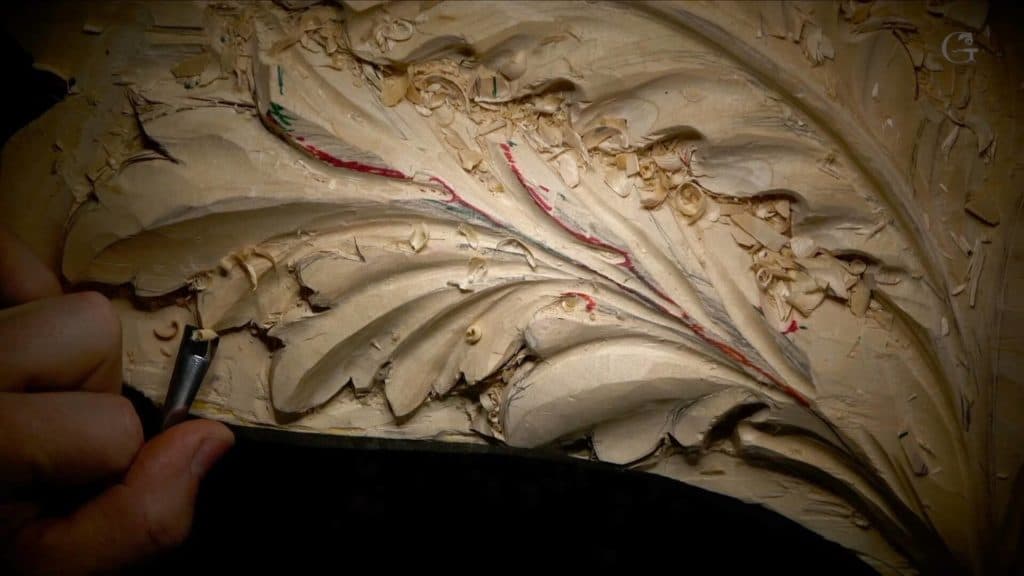
Quick answer: Convex is the raised part of a carving, a hill beside a concave valley. In Venice Room workshop 69, part 2, I wanted a ridge more convex, and the middle part was my next plan. Other lessons of mine call it a raised part, an outward cut and a bulge.
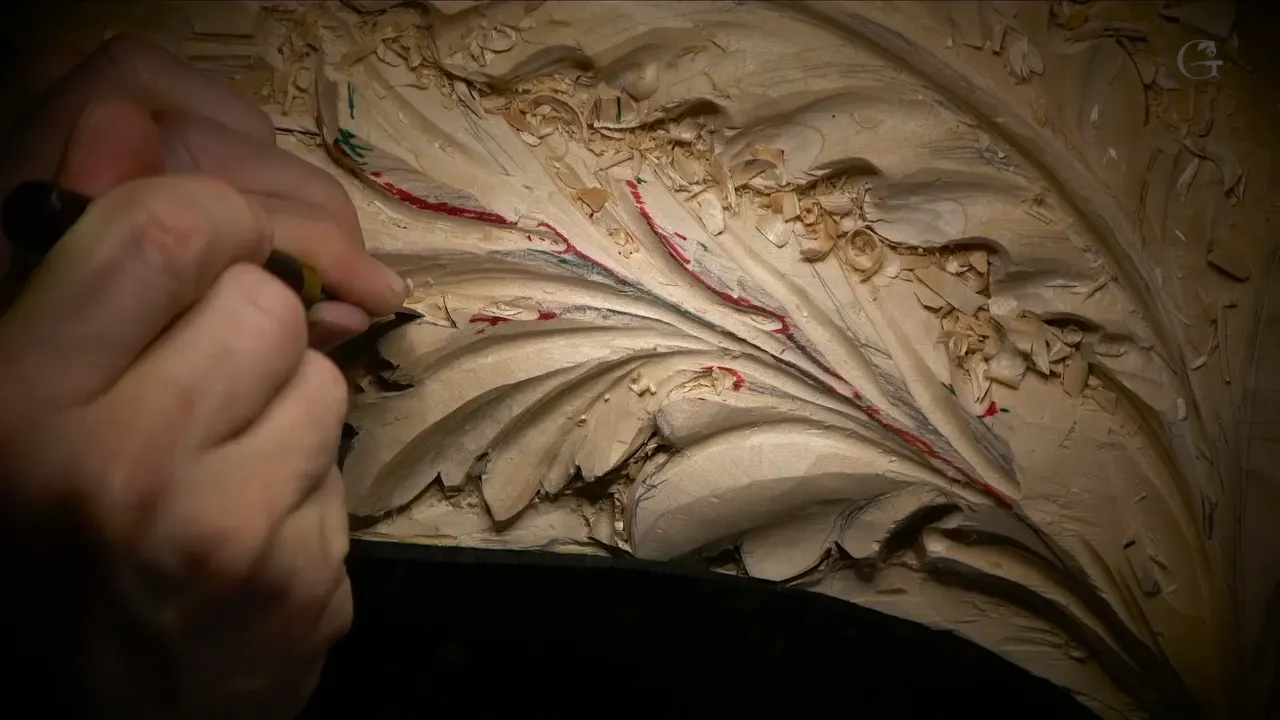

Convex is the raised part of a carving, the hill that sits beside a concave, which is the valley. Workshop 69, part 2, has a ridge that needed my attention, and in the same part I said I would convex the middle part.
Have you ever looked at a ridge on your carving and felt it needed to swell a little? Could you tell which side of it should stay low? Then you already see what I mean, and below are my own words for it from this part and from other lessons, each one linked.
What does convex mean in my lessons?
- A hill, set against a valley.
- A raised part, with a concave as the inside cut and a convex as the outward cut.
- A bulge.
- A verb, as in convex it and convexing.
- A partner for a concave.
What did I do about the convex in part 2 of workshop 69?
The part opens with "with the same tool, I can actually get to the point." I ask you to look. "Can you see what I see?" The next line is my goal for the ridge: "Now I need to take care of this ridge and make it more convex."

A cleanup follows. My words: "And just like that. And of course, I need to clean inside again, which is not a big deal." Then came "A little bit cleanup. Just barely hitting the upper part of the fibers." After that, "Okay, and that's really clean," and I said I did not need to sand anything.

One thing bothered me. "The only thing I don't like in this case is that center line is a little off." My plan was a tool of "around 10 millimeters" (roughly 0.4 in) "or even bigger, maybe 15 millimeters tool" (about 0.6 in). No deep pass was on my list. I put it this way: "I don't need deep cut, but still want to make sure the light hits and creates the right motion, right movement."

Next, a second hollow. "But before I clean this up, I need to create another concave right here." That hollow would run "all the way to here," and I called it the middle of my concave. Five millimeters (0.2 in) was the size I planned for it. A doubt came along: "I'm not sure should I do that or not. Maybe yes, maybe no, but I'll do it anyway."

The reason followed. "What I'm after, actually, too, I want to raise a little bit this part." Sizes climbed. "So after 5 millimeters, I should use bigger one, maybe 10 millimeters." Next came "But even 10 millimeters is too small." And last, "15 millimeters, because I don't need that sharp ridge on this side." And then: "So yes, I achieved that result what I'm after. I raised that up, but it's not clean."

I gave the cause in the next line. "That is not clean because it is kind of against the grain, but it's okay."
Then the line about the middle part. "So now I'm going to convex it, the middle part." After it, "And it's going to be gradual convexing." The part ends on a plan: "Okay, that is good, except I still don't like that part, and because it's against the grain, maybe it's a good idea to use a micro tool. That's going to give me a cleaner cut."

Two other parts of workshop 69 use the word. In part 1, "For me, it's more important to get a cleaner convex side." And part 3 has "But I am able to see my concave and convexes." You can open workshop 69 for all twelve parts.

How do I explain a convex to someone who has never held a gouge?
Venice Room 23, part 5, has the plain version. "And for those of you who don't know what the convex means, it is like a hill. Okay? If you look, here is a valley. It's a concave, and a convex would be opposite direction, like a hill. Okay? That's convex."

Lily Box 12, part 4, puts it in a few words: "it's a raised part, just like that." Next: "Concave is a inside cut and convex, outward cut. So that is a convex."

Modern Acanthus lesson 4, part 3, calls it a bulge. "It's always raised up. It's a bulge." About a pipe, in part 1 of that lesson, I said "Pipe is always convex."
In Grinling Gibbons, Maine class lesson 1, part 3, I said, "I don't know how to explain to people. It looks like it's simple concave convex, but people still mix up the you know those too." The plain version came next and it fits in one breath. "Concave it's just like a cave. Okay, it just goes down." For the other direction, I said just this: "But just that goes up."
How do you make a convex with a gouge?
Chamomile and Bow Rosette, lesson 2, part 3, tells how. "First of all, the main convex everywhere. Convex, convex. To make that convex, obviously, you have to do concave and concave on the sides, middle line, middle groove, and then blend that."

The Floral and Molding course shows another way, in lesson 3, part 3. "What I can do now, I can create a convex." Then: "One of the approaches, I can take the same tool and just create the filleting or fillet cut." And: "There is multiple approaches you could use."

Workshop 63, part 4, has a plan to roll a ridge. I said I would give it "just the feel of it like it is convex, okay? Convexing." Then: "Back bent is what I'm going to use, okay? And in this case, it's a number three." The sweep, in my words: "number three sweep and a quarter inch, six millimeters."

More from that part: "So can you see that? It just gives me that feel of, it's like starting convexing. Starting convexing. Little by little. Again, I have to pay attention to the grain of the wood." A bigger one crossed my mind. "Maybe I should use a little bigger version of back bent, and maybe number five and 3/8 of an inch." That is about 10 mm. "Just give a little better convex."

A slip of the tongue sits in workshop 62, part 5. I had named a spot my middle ridge and said I was going to need to soften it. Then: "Let me do some concaving. Convexing. I apologize. I guess I am getting a little tired." My tool was "number eight, by the way, and approximately 18 millimeters or so back bend," about 0.7 in. And: "Yep. Convexing it actually helped a lot."

A number five back bent comes up in workshop 72, part 2. "So now I have to take probably a back bent and just give a convex to this area." Its size, in my words: "number five sweep back bent. Now, that's six millimeters, one quarter inch." And a doubt: "Maybe it's a little too big of a convex. I don't know."
Workshop 68, part 3, has a skew. "now I need to establish those convexes." I thought it over. "Maybe I should use even a skew." My own short line for it: "A skew for the convex."
In Lily Box 4, part 6, I started with a plan. "Let me first establish the convex shape. Well, reestablish the convex. Establish the overall movement right here because it's kind of choppy." The gouge I named was "number two and 12 millimeters," about 0.5 in. Carving Hazelnuts, lesson 7, part 2, offers a choice. "I could just do a convex shape, or I can do a convex and a concave. Also legit."

What do I say about a convex while I carve it?
"What I worry about is to make it a really beautiful convex. That's what I worry about, to make it look really nice," I said in workshop 56, part 1, with the back bend in my hand. In workshop 38, part 3: "now I can probably just make a really nice convex. Really nice and beautiful convex."
Workshop 37, part 7: "I know it's hard to see on the camera, but it's already feeling like it's already convexing. Okay. It is feeling like it's convexing."

A word fix sits in workshop 34, and I corrected myself right there. "Oh, I shouldn't say make it more like convex."
Venice Room 21, part 8, tells what a concave would do to the edge. "And I also want to create this concave going all the way to that point." Then: "So what's going to happen, the edge of this movement going to look higher a little bit," with "a little more convex on this side."
Workshop 10, part 10, stops in the middle of a sentence and picks it up with a wish. "I would like to see that a little more convexing." Next, a tool: "let me try to use number six."
Workshop 145, part 3, gives a reason. "And why I'm using not a straight cut because I really want to see already convex on this side. So important for me to start convexing."
Furniture Panel 33, part 1: "The next tool I'm gonna use is gonna be number three." And: "And I'll just make that convex smooth."
Workshop 72, part 10, has a spot where I said a convex was not a must. "So I know it's convex, but I really don't have to have a convex right here." Then: "I could have convex, but not as high, I should say."
And workshop 71, part 6, puts it as a question. "should I do the big convex, not really big, but still convex, or should I leave it as a concave? That's the question."
Why does a convex need a concave beside it?
Opposition came up in that Lily Box lesson: a hero and an antagonist, a plus and a minus. "There's supposed to be opposition, okay?" Then it returned to the carving. "So if I have a convex somewhere right in the middle, so logically, I have to create opposition. So that would be concave right in the middle."

The Floral and Molding lesson shows the same pair, seen from the side, and gives sizes. "some kind of movement like that, concave, convex, concave." Here are the sizes: "drop about three millimeters" (about 1/8 in) and "approximately six millimeters, quarter of an inch."
Workshop 76, part 6, says what I needed. "I need to create a convex on inside." I thought it would look better with a pattern: "convex it this way, then concave it, then convex it, and again, concave and convex."
Hashemi Flowers 49, part 1, carries the same pair. "So which means it's a concave cut, and it's going to be convex side."
Light came into it in Acanthus over Moldings 3, part 2. "So concaves versus convexes. All this preference if you need to exaggerate the shadow, like I said depends how the light going to hit."
Which lessons say convex in my words?
Here are the lessons above in one table, with what I was describing and my words about it.
| Lesson | Which convex I mean, in a few words | In my words |
|---|---|---|
| Workshop 69.2 | A ridge I wanted to make more convex, and then the middle part | Gradual convexing |
| Venice 23.5 | A hill that runs the opposite direction from the valley, which is the concave | That's convex |
| Lily Box 12.4 | A raised part, set against an inside cut, with the convex as the outward one | Outward cut |
| Modern Acanthus 4.3 | A bulge, said in a lesson that also names the pipe and the eye | Little by little |
| Chamomile Rosette 2.3 | The main convex everywhere, made with a concave on each side and a blend | Then blend that |
| Floral Molding 3.3 | A convex of about 6 mm, a quarter inch, between two concaves seen from the side | Concave, convex, concave |
| Venice 62.5 | A middle ridge I said I was going to need to soften | Let me do some concaving |
| Lesson 72, part 2 | A number 5 back bent of 6 mm (1/4 in) for a convex in the middle part | I don't know |
| Hazelnuts 7.2 | A choice between a convex shape alone, or a convex and a concave | Also legit |
Where can you watch the full videos?
Each lesson above sits inside one of my courses, so a full video stands behind every line. This workshop holds all twelve parts of workshop 69, and workshops 62 to 73 live in Venice Room Part 6. You can go back to workshop 68 or on to workshop 70. To watch the full videos, start here.
How it's done
- Say what the ridge needs. The ridge needed care, I said, and I wanted it more convex.
- Check the center line. I did not like that it was a little off. My plan was a tool of 10 mm (0.4 in), maybe 15 mm (0.6 in), with no deep pass, so the light hits and makes the right movement.
- Plan another concave. I needed one more hollow, and I planned 5 mm (0.2 in) for it, running to my previous concave.
- Raise the part beside it. I wanted to raise that part a little. Even 10 mm was too small, I said, and I named 15 mm, because I did not need a sharp ridge on that side.
- Work the middle part. A gradual convexing was the plan there, with a micro tool to carve it cleaner where the grain ran against me.
Frequently asked questions
Which words did I use for a convex?
In Venice Room 23, a hill, with a valley beside it that is a concave. In the Lily Box lesson, a raised part and an outward cut, and in Modern Acanthus 4 a bulge that is always raised up.
Which back bent gouges did I name for a convex?
Workshop 62 had a number 8 of approximately 18 millimeters (0.7 in). Part 4 of workshop 63 named a number 3 of a quarter inch (6 mm), and maybe a number 5 of 3/8 inch (about 10 mm). Workshop 72 gave a number 5 of six millimeters, 1/4 inch.
Why did I want a concave next to a convex in the Lily Box course?
Opposition, I said, a plus and a minus. With a convex somewhere in the middle, logically I have to create opposition, and that would be a concave in the middle.
What to carve next