

Alexander Grabovetskiy, woodcarver, School of Woodcarving · Published 2020
What does a wood carver mean by "leaning toward"?
Quick answer: In part 4 of workshop 69 I told you where my point might go: about 20 millimeters (roughly 0.79 in) below, not twisting up. In other lessons the same word, leaning, shows up with a tool, with a leaf and with a style. The lines are below, each with what I said beside it.
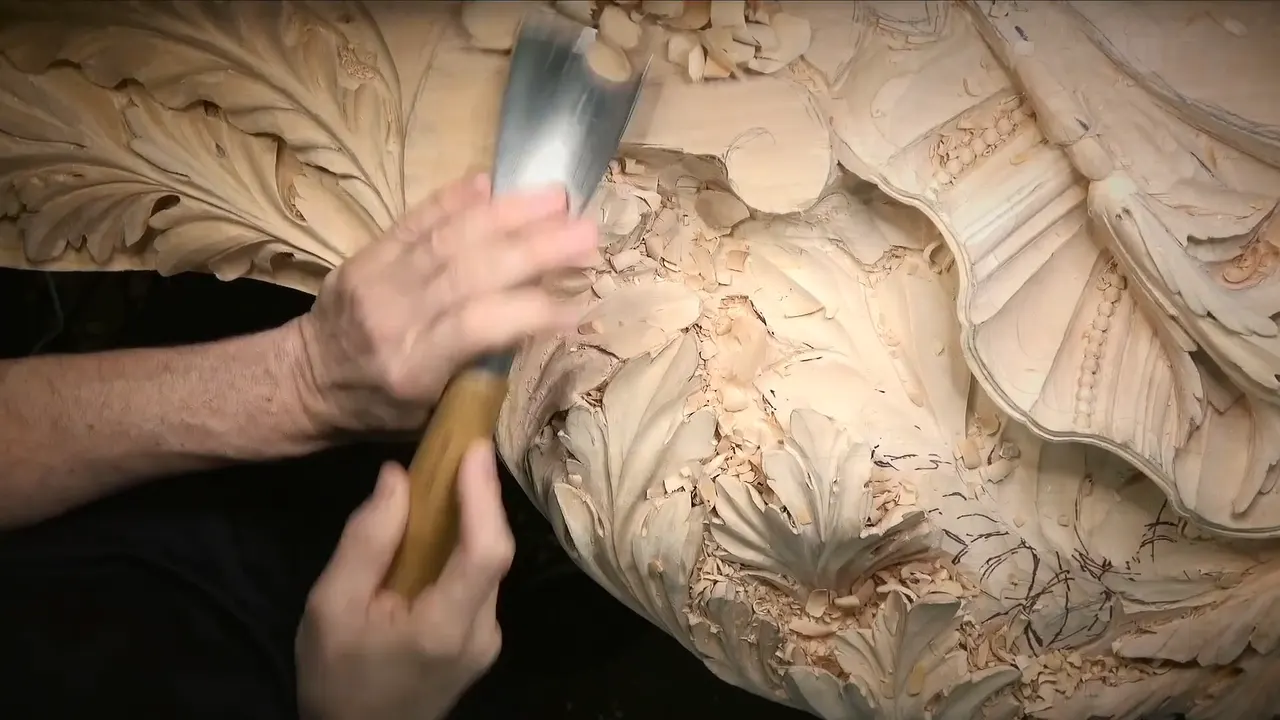

In Venice Room 69, part 4, I said I was leaning toward getting my point about 20 millimeters (about 0.8 in) below. The words come back in other lessons, some with a tool tipped over to one side. Each line is below.
Have you ever stood over a carving with two good ways to go and no way to test either one? Could you hold your tool for a minute and look from far away first? Then you are where I was in this video, and the lines below show what I said next.
What was I leaning toward in workshop 69?
Part 4 opens after some cleanup, and it was not final. A flower was still to come, one I would apply later. Then I moved to a new section: "on inside right here" would hold "a flower also, or a couple flowers, I don't know."
The movement there "still needs to be cleaned," and it was about the same as another area: "Just sticking out some leafage, like some leafs sticks out." I planned the same for this area and for another side. I also said "I am going all the way to the ceiling," and that maybe a nicer transition was a good idea, "little nicer than what I see right now."

My plan was to "take just a huge gouge again and chop some of it," because I wanted to see "gradual upward movement." Next I told you "that's good," and that a decision was due: "Couple ways I could develop it, and I need to make sure I'm doing the right thing."
I had "a big chunk on this side which you don't see." The detail would be the same. But my question was where the middle line should end. "Should I get my middle line ending somewhere about an inch (about 25 mm) below and wrap like this, okay, and just establish a head movement, okay? Or I could actually go down and then return this way, if it makes sense."
Of the second way I said "also legit." Then came "moving like that, like that," and "Also good." Next, what I had to consider. The part would be visible from the bottom, mostly. Yet at a far point, you are "still going to detect that movement also."

After that I told you "I've got to make sure I understand what I want to do," and the line this page is named for: "I'm leaning toward more getting my point somewhere about maybe 20 millimeters, I would say, below, okay? Twenty millimeters below. But not twisting up, okay?" After that, I said, it would be an established movement.
What came right after the lean in part 4?
A first shape. "I need to chop and create the first shape. All right? The first shape, how it's supposed to look." One section could wait, although I "could actually attack it right away with no problem."
For a tool I planned a number nine. "Maybe I can take 20 millimeters number nine or something like that, like 3/4 of an inch, and chop a little bit. Not much, because I don't want to rush it." "And maybe I need the mallet."

"Again, I don't worry about making final shape yet. All I need it's actually just access to this future head." My words were "let me establish the main movement," and I took that back, "the main shape, form, if you wish."
"In my hand, it's just the number nine. I just have to be more careful how I'm doing." For people without huge tools I said: "if you can find number seven and 14 millimeters (0.55 in), that is actually excellent tool to create the shape. Any shape, pretty much." The last lines of the part were "Let's not dig in too deep. Just little by little, you can establish that main form."

Part 5 opens with huge tools. They give me "a much quicker result," and "not all of you have exactly the same as what I have." I wanted you to be able to do what I was doing. Part 3 closes on "Number 11, seven millimeters (0.28 in)."
Where else did I lean a tool?
Part 4 was about a point. Elsewhere the word is about my hand and a tipped tool. A Furniture Panel part, working on a tiny detail: "I really don't have any space for undercutting because it's a really tiny detail." Then: "Let me use a knife. A small knife." I would "do my cuts on an angle a little bit toward inside. So I'm just leaning toward inside. Almost no pressure whatsoever."

In another panel part I said "I could use actually bigger right now, like 5 millimeters (about a fifth of an inch) number 11s," to create excavation, and then "Leaning towards the right little bit." A little later: "I need to switch to a smaller one, maybe two millimeters (about 5/64 in), and go a little bit underneath the previous one."
Workshop 41 offered two ways for a concave. "I'm probably going to use number 11 again and about 18 millimeters, closer to the three-quarter of an inch, little less than three-quarter." Next, "I'm leaning a little more to the right."

Workshop 52 had a number 11 of 3 millimeters, one-eighth of an inch, to "create my first cut." I leaned a little bit on inside, "so I'm not carving straight like this." So I was "slightly under-carving," and it would give me "a really nice movement pretty much right away."
Part 8 of that workshop starts "My first cut" with a lean to the right side. It "just gives me an idea that this is going to go underneath." With the same tool again I was "leaning toward this side now," and "creating a little motion, okay, just to go that direction."

One section of Venice Room 54 sat lower than the next, so the higher one "has to overlap little bit that part." Hence the lean: "I need to create that cut leaning toward the right like this." And: "Four millimeters (5/32 in), that's what I'm using." Later in that part I said a number 11 can lean over and make a U cut without making too big a concave, and that I can make "really beautiful shadow underneath of this rolling back detail."

Why did I lean toward the right-hand side?
In workshop 58 I planned "about half an inch (12.7 mm), number seven." My lean went to the right-hand side "because like I said before, gouge is always cutting on one side clean and another side is tearing out the grain. And in this case, it's the right-hand side that's clean."
My cut was not square to the line: "I'm actually creating almost 45-degree right now. That way, it slices much better and creates beautiful and clean cut without too much force." In part 2 of that workshop: "now it's the time to lean a little bit to the right because it's a cleaner side."
Workshop 57 gives the same reason with a bigger tool. My next tool, in my words, would be "three-quarter of an inch, 18 millimeters, number 11," still a veiner. I would "lean it to the right and create this ridge higher," and there would be "a lot less concave on the right-hand side." Only one of the sides is clean, I said, and the other is not clean "because you're working one side with the grain."
Roman acanthus lesson 15 has "leaning my tool on the left-hand side" for a U cut going inward. About attacking from two sides: "there is a reason. Because of the grain of the wood." One side, I said, is "always cleaner than another side," and that is why "sometimes I have to attack from two sides to make it look clean cut."
What does leaning a veiner do to the shadow?
Workshop 55 has me "leaning toward left side right now," in my own words. Then: "I'm not using tool straight, but I'm leaning like this." After "Hope it makes sense," I asked about the shadow: "But see how deep shadow it creates?" And: "It just creates that effect, just rolling effect." And: "Extra dimension. And I still did not lose my convex."
Later in that part came a veiner, and with it one more lean. "10 millimeters (about 3/8 in), by the way. It's a veiner number 11. It's a U shape, like letter U shape." That was not going straight, and I told you so: "I'm leaning little bit toward the right side." That pass "already created a raised part and extra shadow on this side." And I said it before: "wood carving is pretty much all about shadows and lights."

Venice Room 146 has "maybe I'll use a five millimeters (about a fifth of an inch) to create slightly deeper shadow and little more convincing folding effect. I am leaning toward my left, toward upper part. And see how deep that shadow is? I think it's awesome."

The April 2020 livestream has me saying I would take "the same tool, four millimeters (0.16 in) number 11," to create another eye. I was leaning left with my tool. "With the gouge, it wouldn't make any sense to lean, but with the veiner, it does make sense." On my school site I was explaining more, "why it is," and I said I was "just creating the feel that this section, the left side, going right underneath, okay?"

When did I choose not to lean?
Venice Room 54, part 6, has "I don't want to lean it. I want to make sure my cut is straight down like this, because I still have to create a really nice concave on inside." It was only outlining, and "that is really important for me not to make mistake."
In Hashemi Flowers 23 there was a choice: "I could actually lean my gouge on inside like this, and kind of undercut it." But in this case the piece was "already too fragile," and I did not want to risk it.
And in part 11 of workshop 55 a deep concave came with a lean to the left, a little bit. For the next one I planned to lean the same way, and then doubted it: "On the other hand, maybe I should not. Maybe I just have to create first just a straight down position cut and go that direction a little bit."

In my Grinling Gibbons class in Maine I said "when I'm positioning my tool I'm creating one cut. By leaning to the right" and then "left right left right left. So that way I can get through those fibers and create really really nice and tiny cuts." I added "Unfortunately, you don't see that. But it creates a really sharp point."

Two lines are short. The Lily Box has me making a movement, and "I'm leaning little bit to the right with my tool." The Grape Leaves vase has "Blend one side," and then "opposite side the same way, just leaning to the right."

When does a leaf lean toward one side?
A leaf can do the leaning too. The Greek acanthus lesson has "we'll take a V tool," and a wish that it be "going underneath, kind of." Then: "I hope it makes sense why I do that. If the leaf leaning toward this way, so I want to make sure that the shadow when you hit with the light is going to be on this side because this is going to be higher than this side." It is sometimes hard to explain, I added.
A middle line in Venice Room 34, part 7, was placed by marks: "I move this way because it has to feel like that leaning toward that way, and it's a six parts out of 10, which makes it like a golden ratio. Okay."
The same words turn up in a design lesson. In 10 Elements of Classical Wood Carving Design, part 4, I said "It's still going to lean toward the Classical, even without carving."

Where do those lines sit side by side?
Here is each line, and the words I said beside it.
| Lesson | What leaned over | The words right after it |
|---|---|---|
| Venice 69.4 | my point, 20 millimeters (0.8 in) below | an established movement |
| Furniture Panel 19.15 | a small knife, on an angle toward inside | almost no pressure whatsoever |
| Workshop 41.3 | number 11, about 18 millimeters (0.7 in) | a little more to the right |
| Room 58.1 | number seven, about half an inch (12.7 mm) | one side clean, the other tearing |
| Venice 52.2 | number 11, 3 millimeters (1/8 in) | slightly under-carving |
| Workshop 54.1 | 4 millimeters (about 0.16 in), leaning right | a lower section that has to overlap |
| Room 57.2 | number 11, 18 millimeters (0.7 in), to the right | a lot less concave on that side |
| Venice 55.2 | a veiner number 11, 10 millimeters (3/8 in) | a raised part and extra shadow |
| Workshop 54.6 | no lean, the tool straight down | a really nice concave still to create |
| Livestream April 2020 | a number 11, 4 millimeters (0.157 in), to the left | sense with a veiner, none with a gouge |
| Gibbons Maine 16.1 | right, then left, then right, then left | really nice and tiny cuts |
Where can you watch every lesson named on this page?
Each lesson named above is inside one of my courses. This workshop holds the part I started with, and workshops 62 to 73 are in Venice Room Part 6.
Other workshops sit in 41, 52, 54, 55, 57, 58, 146 and 34. The rest are Furniture Panel 19, Greek acanthus, lesson 7, Roman acanthus 15, Hashemi Flowers 23, design principles 4, the Grape Leaves vase, Lily Box 8, the April 2020 livestream and Gibbons class 16. To watch the full videos, start here.

How it's done
- Name the open question. Where should the middle line end: an inch (25 mm) down with a wrap, or down and then back?
- Say what the view shows. The part would be visible mostly from the bottom, and at a far point you still detect the movement.
- State your lean. My point, 20 mm (3/4 in) below, without twisting up.
- Plan the first shape. Number nine, 20 millimeters (3/4 in), maybe the mallet, and not much, so I do not rush.
- Tip the tool and say which way. Number 11 leaned to the right or to the left, in the lessons named above.
Frequently asked questions
Which way was I leaning about my point in workshop 69?
My lean was toward a point 20 mm (0.79 in) below. The other idea was a middle line ending about an inch (2.5 cm) down, with a wrap. Going down and returning I called also legit.
Why lean a number seven to the right-hand side?
The grain was my reason: a gouge cut clean on one side and tore out the grain on the other, and the right-hand side was the clean one. I made an almost 45-degree cut there, which slices much better.
What did I say about leaning a veiner?
At the livestream I said that with the gouge it wouldn't make any sense to lean, but with the veiner it does make sense. My plan was a number 11 of four millimeters (5/32 in), and I was creating the feel of a section going right underneath.
What to carve next
- Venice Room 69 lesson
- Venice Room Part 6 course
- Venice Room 41
- Venice Room 52
- Venice Room 54
- Venice Room 55
- Venice Room 58
- Venice Room 146
- Carving Furniture Panel 19
- Livestream April 2020
- Venice Room 57
- Carving Roman Acanthus 15
- Carving Hashemi Flowers 23
- Design principles for wood carving 4
- Grinling Gibbons Maine class 16