
Alexander Grabovetskiy, woodcarver, School of Woodcarving · Published 2020
What does a wood carver mean by "even better"?
Quick answer: I used the phrase three times in workshop 69, part 8: for a 30 mm gouge, for a skew and for a blend with a huge gouge. My Butterflies, Grape Onlay, Furniture Panel, Venice Room, Vase and Corinthian lessons carry it too, with a tool or a size beside it.
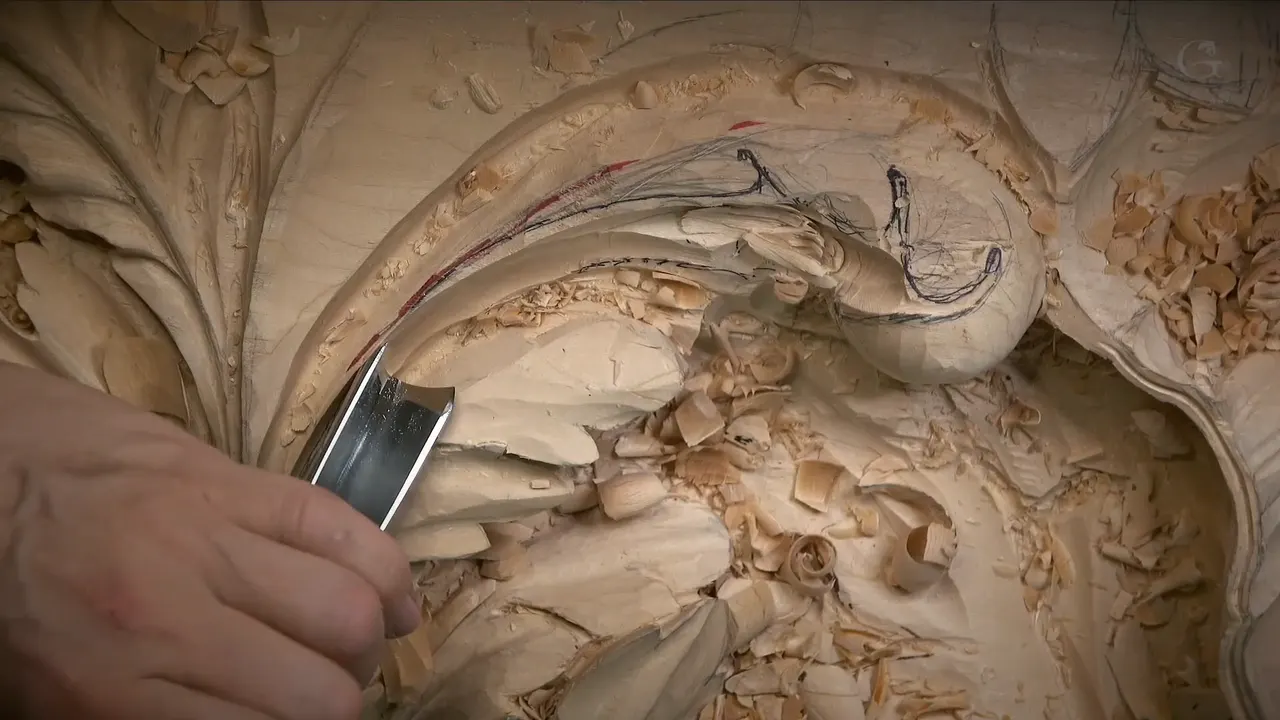

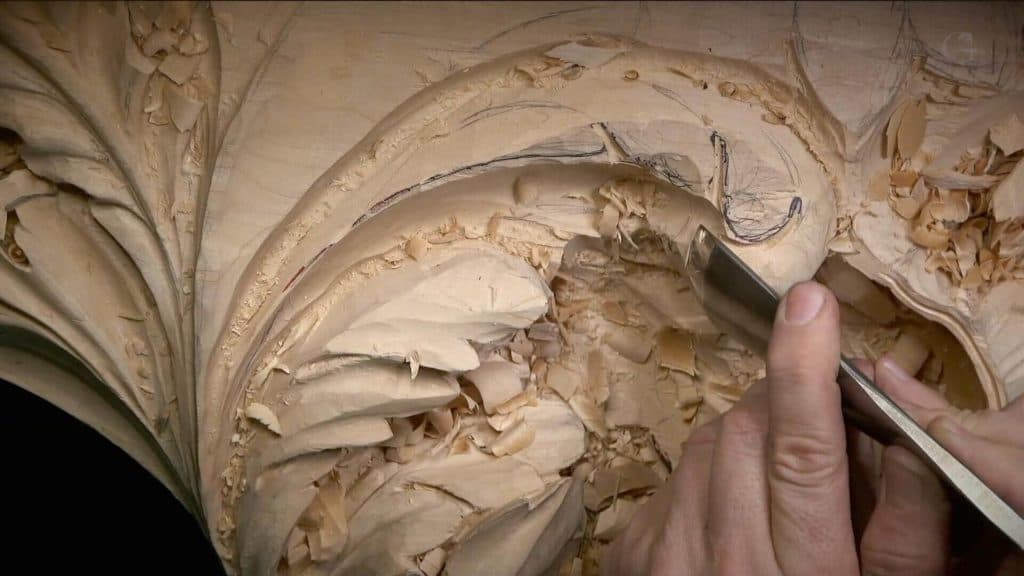
"Even better" is my phrase for the next step up from a tool, a size or a cut that already works. It came up in part 8 of Venice Room workshop 69 about a 30 millimeter gouge (1.18 in) and a skew. The phrase comes back in my Butterflies, Grape Onlay, Byzantine Acanthus, Furniture Panel, Venice Room, Vase, Corinthian and Lily Box lessons, and below you get each place with the tool in my hand.
Ever held a gouge that works and wondered if a bigger one would work a little better? Come along into part 8, where I carve the head of an acanthus in this Venice Room wood carving lesson.
What was in my hand when I said it in part 8?
Part 8 opens with "And maybe without the mallet now." Soon after: "Again, I'm not pushing too hard in this area because it's actually along the grain." Next: "I got to just take it step by step and really carefully approach my main ball, the head of an acanthus."

Next: "Really carefully, because I really don't want to place too many tool marks if I don't need to." And then the size: "And I'm using 20 millimeters, but I could use actually 30 millimeters easily, I would say" (0.79 in and 1.18 in). The line followed: "It would give me even better result."
Then: "And why don't I? 30 millimeters. I'll do it." After that: "20 millimeters is fine also. That's too big right now." Next on my list was a seven millimeter tool (0.28 in), to chop "a little bit this way, and take out whatever I don't need."
Then a need: "Okay, so now that is good, but I need more roundness in this area. Okay? I need a little more roundness, and I need something flatter. A little flatter gouge. Let me think which one I should use. Maybe just number three."
Why did a skew come up in the same part?
A little after the number three: "I could do exactly the same with actually just a knife or skew." Then the phrase returned: "I would do exactly the same probably with the knife or skew, even better."

On the shape: "I could establish much better shape. Not just any skew. I really like that 22 and a half degrees skew." Then: "Again, I'm constantly checking from all points of view."
A bit later: "Okay. Really good. And I think skew was a really good idea to use in this case. That is approximately what I want to see."
How did the pipes and the overlap change my tool?
About the pipes: "There is going to be a pipe in this region." Then "So multiple pipes." The plan: "let me use just a smaller number 11 first, like 3 millimeters, I would say. Number 11, 3 millimeters, like one-eighth of an inch."

Then a decision: "I have to make the decision if I want to do that part of an acanthus head overlapping this part or the opposite. And I think because it's going to be visible from the bottom, I think it's going to make more sense if I overlap the main body, the main structure."
On depth: "I'm not going to do too much overcut. I'm not going to do too deep, but still somewhat like about maybe 3 millimeters or so deep" (0.12 in). Then: "Otherwise, I'm going to lose my feel of a sphere, and I don't want to lose it."

At the end of part 8 came the blend: "And yes, the easiest way would be probably just to use a huge gouge like this, and around it even better like that. Okay? So which in this case works just perfectly. Or almost perfectly because I have other stuff in my way."
Then: "But it could be done with any tool pretty much. It's not the only way. Even like I said before, just skew works perfectly also. You can just do a lot of shaping with the skew."
Part 9 goes on with a bigger tool again: "And I can take a bigger number 11. In my case, it would be 20 millimeters" (0.8 in). "I think it's a good idea to use a little bigger because I really need to, again, to raise one of the parts of that movement up."
Do other lessons say a bigger tool helps?
Butterflies Plate 1, part 3: "I will use a number seven. Okay, and in my case and if just in case if you have a bigger number seven, that's always gonna help." Then: "You can get by with the smaller number seven. Let's say seven and fourteen millimeters, like half an inch." Next, a bigger size: "you can get 20 millimeters that would be even better."
The sizes went on with "7/8 or even one inch" (22 mm and 25 mm), and the phrase returned. For a set with only 14 millimeters: "It's still gonna be the same operation."
Grape Onlay 1, part 1: "we use the 20 millimeters number nine to just rough everything. That is what you're gonna need." It was "probably the tool number one for just get the shapes." Then: "If you have a big tool, it's actually even better, better than 20 millimeters I'm talking about." I named 25 and 30 millimeters too, number nine for roughing, which "saves so much time." Those sizes are 0.8 in, 1 in and 1.2 in.

Byzantine Acanthus 8, part 2: "we do have a number nine and 10 millimeters" (0.39 in), and for a bigger one the same phrase followed. Right after: "this ridge right here, this ridge and that ridge, they have to be like a high ridges."
The Blessing Tray, lesson 1, part 1: "Don't forget you always, you can flip it as many times as you wish and attack that from another side." Then my left hand: "to place the hand solidly and really important to create a motion of rotation or slicing how it's called." I called it the stage "roughing out," and added "if you do have a bigger tool," with the phrase after it.

Does a different gouge do it better in the Venice Room?
Workshop 27, part 5: "let me use a bigger number 11, like 10 millimeters right away" (0.39 in). "Kind of poke this straight down, just like that, from two sides." Next: "But number nine would be actually even better because with the number nine, you can rotate, and with the number eight also." Then: "Let's do number nine and 10 millimeters. And you can rotate and excavate, those blocks going to just pop out."

Workshop 29, part 8: I said "let me excavate" and named the number nine for "this twist." Then: "Or even actually number 11 will work. I think number 11 will be even better."

Over in workshop 30, part 4: "And yes, I am using number 11, but it doesn't have to be number 11. It could be number nine, number eight, number seven. That's absolutely doable. Even sometimes number seven will work even better, or even number three will work better because I undercut with the back bent." Just before that: "the only reason I'm doing it is just for the shadow," with "number 11 spoon" and "3 millimeters" (0.12 in).

Next, workshop 33, part 6: "let me hit that S shape with number six." I weighed number seven too: "I think number seven will give me even better definition, like 5/8 of an inch, about 16 millimeters."

From workshop 42, part 3: "need to get the right tools for the job, which is, in this case, I got to use a spoon or long bent. Long bent would probably be" and then the phrase, and "I don't have to use a long bent like number 11. I could use just a long bent. Let me see, maybe number four, no more than that. Because really, I don't need to do too much to it."
Further on, workshop 102, part 5: "And that's automatically going to give me a flowing line or surface that I'm after. Maybe even number four." The phrase followed for that number four, and then "Let me try."

Furniture Panel 22, part 12: "let me blend a little bit this side. The same idea. With the same tool, I could do that." Then: "But probably better would be to use a bigger tool, either number 11, but this one is a five millimeters" (0.2 in). "Or better yet, if I could use just probably number three or number four or number five," and the phrase closed it.

Later: "And I'm using number three, by the way, and that's a quarter-inch" (6.4 mm).
When do I say the finish could go further?
Vase with Grape Leaves 3, part 2: "We're going to take number 11 again, and one millimeter. It could be one millimeter, it could be half a millimeter. Half a millimeter would give an even better result." Those come to 1 mm (0.04 in) and 0.5 mm (0.02 in), and the cut was "only about a 16th of an inch deep" (1.6 mm).

A smaller size shows up in workshop 36, part 9: "I'll get probably about eighth of an inch down. Like three millimeters or so this way." I could "actually get a couple of millimeters, just two millimeters" (0.08 in) instead, and the phrase came with "3/32 then" (3/32 in is 2.4 mm).

And workshop 41, part 8: "One millimeter, of course, it was on number 11" (0.04 in). "Clean that with number seven. I'm not sure if I'll be able to or not." Then "Something like that. And now I can actually get even better. Just clean everything."

In workshop 38, part 2, my plan was number three again, for the clean-up pass. Then, in the first Venice Room course, workshop 12, part 4, I said about a shape "it's not as round as I want to see it. Use a back bent and just give that roundness. Or even, I can exaggerate this one and give even better roundness."

Floral and Molding 11, part 3: "And I can't go deeper than that. So let me get, again, number five spoon, and I'm going to clean that even better."

Lily Box 5, part 5: "the direction of my cut, I'm able to actually give really good excavation. Okay, that is good, and I can now give even better definition of that part."

What made me hold the finish back?
Back in workshop 64, part 5: "and clean it with one and a half millimeters" (0.06 in). "Dig out whatever mess I just created." Then: "And yes, again, I could spend much longer and clean it even better. But the question is, should I?" Next: "See? There is a nonstop process. So I really have to stop at some point."
Corinthian Acanthus 5, part 1: "Later on, I'll clean it even better. But for now, it should do." And in the Hazelnuts course, lesson 7, part 3, I said it looks pretty clean underneath and I can always get with my knife and clean it a step further, but "I still leave plenty of the material."
My own hold-back sits in part 8 of this lesson: "if I need to fix it, I'll fix it, but not too much. Not to the final line yet, because I still need to establish inner movements here."
How do those lessons line up?
| Lesson | Tool I named | My words close by, in the lesson |
|---|---|---|
| Venice Room 69.8 | Skew with the angle I really like | works perfectly |
| Butterflies Plate 1.3 | Number seven, 20 mm instead of 14 | same operation |
| Grape Onlay 1.1 | Roughing, number nine, 25 or 30 mm | number one |
| Byzantine Acanthus 8.2 | Number nine at 10 mm, or bigger | huge pipe |
| Blessing Tray 1.1 | Just a bigger tool, no number named | roughing out |
| Venice Room 27.5 | Number nine, 10 mm, rotate and excavate | pop out |
| 29.8 in Venice | Number 11 instead of a number nine | this twist |
| Room 30.4, Venice | Sometimes a number seven, or number three | absolutely doable |
| Room 33.6, Venice | Number seven, 16 mm, over number six | S shape |
| 42.3 in Venice | A long bent, maybe a number four | right tools |
| Venice workshop 102.5 | Maybe even a number four, I said | flowing line |
| Furniture Panel 22.12 | Number three, four or five, I said | bigger movement |
Where can you watch each of those lessons in full?
This part belongs to workshop 69, and the whole panel is in the Venice Room Part 6 course. The Butterflies course, the Grape Onlay course, the Byzantine Acanthus course, the Blessing Tray course, the Furniture Panel course, the Vase with Grape Leaves course, the Corinthian Acanthus course and the Floral and Molding course hold the rest.
How it's done
- Name the size in hand. "I'm using 20 millimeters" is the line in part 8, before a bigger one is named.
- Name a bigger one. About the gouge, I said "I could use actually 30 millimeters easily."
- Try a skew. A skew could shape it, I said, and later "skew was a really good idea."
- Keep the form. My plan was about 3 mm deep (about 1/8 in), to keep the feel of a sphere.
- Blend with a huge gouge. "The easiest way would be probably just to use a huge gouge like this," and "It's not the only way."
Frequently asked questions
Which sizes did I name in workshop 69, part 8?
20 mm (about 3/4 in) was in my hand, and 30 mm (1.2 in) could do it easily, I said. My plans were a 7 mm tool (0.28 in) and a smaller number 11 of 3 mm (1/8 in).
What angle was my skew in part 8?
22 and a half degrees, the angle I said I really like.
What did I say about stopping in Venice Room 64, part 5?
Cleaning it longer was possible, I said. "But the question is, should I?" After that: "I really have to stop at some point."
Which tool did the Furniture Panel lesson name?
What to carve next
- Venice Room workshop 69
- Venice Room Part 6 course
- Butterflies Plate 1
- Grape Onlay 1
- Byzantine Acanthus 8
- Blessing Tray lesson 1
- Venice Room workshop 27
- Venice Room workshop 29
- Venice Room workshop 30
- Venice Room workshop 33
- Venice Room workshop 42
- Venice Room workshop 102
- Furniture Panel 22
- Vase with Grape Leaves 3
- Venice Room workshop 36
- Venice Room workshop 41