

Alexander Grabovetskiy, woodcarver, School of Woodcarving · Published 2020
What does a wood carver mean by "harsh"?
Quick answer: In workshop 94, part 9, I say "any harsh" and the next line is "Ridges." The same part has "the gradual movement," The word sits in other lessons too. Acanthus over Moldings 7, part 1, puts a line against "those really harsh ridges", and Furniture Panel 33, part 3, reads "ridges really harsh, so I'm gonna soften".
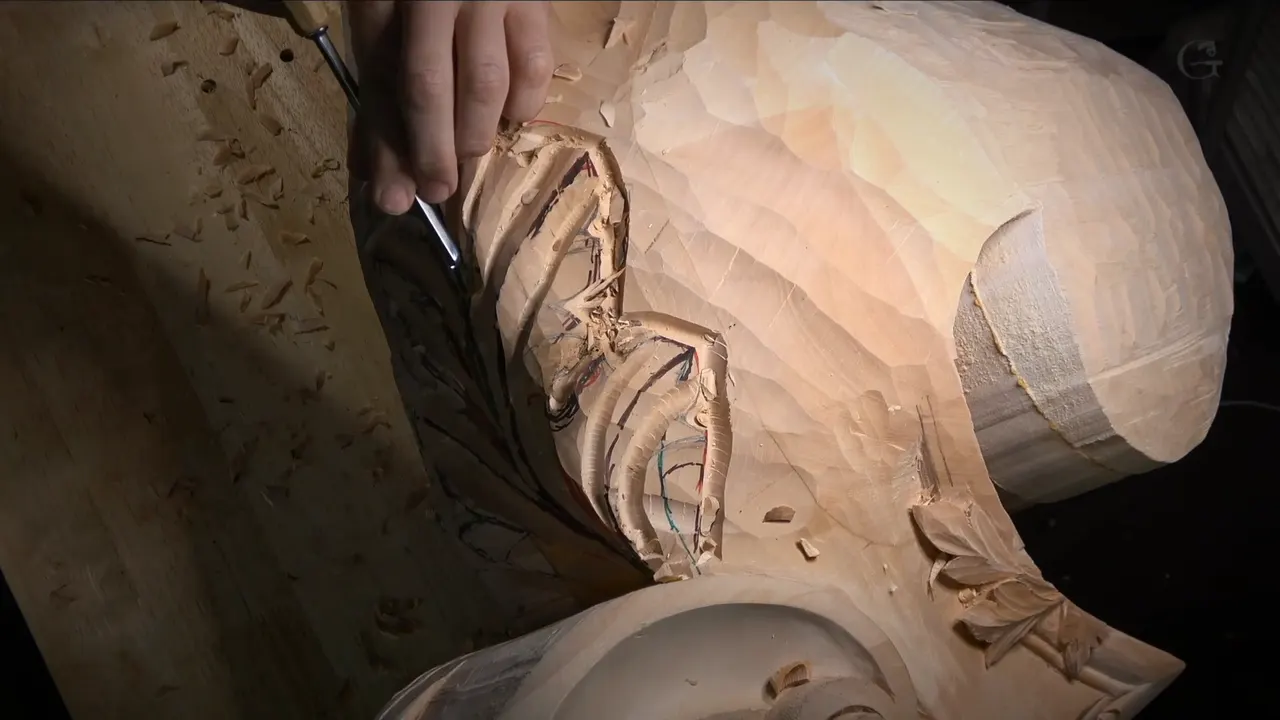

One short line in part 9 of workshop 94 holds the word "harsh", and several of my other wood carving lessons use it too. This page reads each of them, line by line, with the work around it.
Ever look at a ridge you just carved and wonder if it sits too hard against the wood beside it? This page starts with the lesson and then visits a long list of other lessons. Every size is given in millimeters and inches, my own figure first.
Where does part 9 use the word harsh?
"any harsh" is the line, and "Ridges" is the line that follows it. Plenty of work sits around that word, so the whole part follows, plan by plan.
Which tool and size come before that word?
It opens with "I'm happy with this part, except I still have to create" and a next line of "a smaller concave". "five millimeters" (about 0.2 in) is the size, and "Number 11" is the gouge. For control a mallet is planned: "I'll use Mallet because it's going to give me a lot more control."

Two lines then name the middle of the shape, "I really don't want to lose the middle line" and "I lose that feel", and "like arc movement or arch" comes after them.
Where is the rough spot in 94-9?
"I do have a somewhat rough spot," I say. Next come "so which means I need to create the much deeper cut" then "which also means that middle line" and "middle ridge is also going to change the movement a little bit." Then a plan for the spot, "Let me clean it slightly."
A skew is named with an inch figure in three short lines: "With the skew in one inch" then "twenty five millimeters or some" and then "Twenty five point four, to be exact." That checks out, since one inch is 25.4 mm. Two plans follow, "All right, let me recreate this middle movement with the line" and "I'm going to make a little deeper, Cut, this section."

How does part 9 talk about blending?
"OK," I say, and the blend is next, "blend and get rid of that" with "whatever the sharp detail I have" and "is, again, a skew." Blending is meant to be careful: "carefully blend everything" in "the same movement." One remark is about the tool, "This skew little too big."
The goal gets a line of its own, "But my goal is to blend that really nicely." A test of the result follows: "no matter from what position you look at, it still has to have a flow." Wikipedia has a page on the chisel.

Another need appears, "deepen this cut" and "and get a little deeper." Five millimeters comes back in "I'll use five millimeters again," (0.2 in) with "number 11." After it, "I don't really see, well," has a line of its own.

What does the hand tell 94-9 that the eye cannot?
"And I'm feeling with the hand," I say. Next come "because sometimes you don't really see what is going on and you really have" and "to use your hand, the hand can detect". Then "so you can get a small skew" and "about a quarter inch skew." That is a little over 6 mm. Three short lines follow: "I can feel" and "That shouldn't be there."

The wish for the surface is "So I really want the gradual movement" with "really gradual" right after it. A check comes next, "again, Check" and "feels good."

The part then says "All right, that's much better." Then come "any harsh" and "Ridges" and, as its last line, "I'm really happy with this pipe."

Do my other Venice Room lessons use harsh?
Yes, starting with workshop 74, part 2. Two options are named, "Of course, I could use just a knife or" and "Other way, I could do it with some kind of gouge." Then comes the wish: "really nice and smooth transitions, so" and "it's not that harsh."
One gouge gets tried, "Number six, let me try in the quarter inch" (6.35 mm). The verdict is "And yes, number six is actually excellent." Number six is named again in "Number six quarter inch, about six millimeters or so" and the result is "Okay. That gave me beautiful movement."

Over in workshop 93, part 10, the word sits beside a light. Tool talk is "just probably number" with "one" and "back bent". Then "don't need any sharp" and "ridges, although you do see those because the light source" then "just kind of harsh right now. And I use that" and "for I would see what I'm doing."

A gouge is named before the word in part 11 of that workshop, "Just use number five" and "do a movement like that." Then "It looks like my previous cut was too harsh." Next are "The knife cut. See that line? Which is okay, I guess, because" and "I can always kind of push" and "fibers together and it's going to be paint great." After that, "I wish I didn't" and "do that harsh cut,". The part also has "Okay, let me use again" and "one millimeter" (about 0.04 in) and "and excavate much deeper."

Which Furniture Panel lessons use harsh?
Furniture Panel 19, part 2, has the word as an adverb: "and I don't really want to harshly attack across the grain". It follows "See, the grain runs this way" and the reasons are in my words, "because I can catch the grain and" plus "rough cut." The plan is "Okay, I'll just use my point, just the corner of my tool," More about wood is on the grain page.

A request holds the word in part 7 of that lesson: "This is just the initial form. Please don't judge" and "me too" and "harsh. But what I'm going to do now,"

Lesson 33 of the Furniture Panel course, part 3, puts the word beside a blend. "that harsh" is the wording, and "I'm gonna blend that. Here you go" follows. Then "Center concave." The start is "Again, I just wanna make sure I'm starting from nothing" with "just blending in and slowly, slowly, slowly." The tool is named in "Number 11, two millimeters" (0.08 in)

Another place in that part has "ridges really harsh, so I'm gonna soften". The shape is described with "it's gonna be more simple" and "but the division is gonna be soft" and "It's gonna be more like a number 11 division, okay?"

Does the Moldings course use harsh too?
Three places say it. In lesson 9, part 3, a plan opens the stretch, "Okay, let me right now create the convex." A gouge is named: "number four and a quarter inch" (6.35 mm), "in my case little smaller than quarter inch." Then "I'm gonna attack" and "that Ridge all around and carefully" and "carefully just blend that together." After them come "Don't want" and "any harsh" with "facets".

A line against "those really harsh ridges" sits in part 1 of lesson 7. "Okay, number three and I'm gonna blend the" and "blend overall movement" come just before it, and "And let me put the tool upside down and I can" and "chop the sides" come after.

"Inside because right now all I see" and "it's just a really harsh" are from part 3 of that lesson, with "Hard edges" next. The gouge there is a small spoon: "a small" and "Spoon that's what I'm gonna use number three" with "I'm gonna give even more shadow." Wikipedia has pages on acanthus and on molding.

Which lessons carry the same sentence with the word sharp?
Many do, and each one keeps its own word, so this list keeps the words apart. Workshop 82, part 2, objects to "sharp ridges" with "It has to be more like transition to the" and "convex." The flatter tool is "With the flatter tool with number three." The size sits in "And in this case, I took about 10 millimeters number three" (about 0.4 in)

"a sharp ridge" is refused in part 10 of that workshop, right after "create a chamfer cut or a fillet cut or roll" and "this way because it's a part of a" and "pipe. Okay?"

One line in workshop 63, part 10, begins with "So essentially what I'm doing is just the cleaning up because I really don't want" and goes on with "to see those" then "sharp ridges." The next plan is "So let me give a separation cut right in this section also."

From part 1 of lesson 33 in the same panel course come "So we also gonna have another concave right inside" and "of the convex." Then "Then we're gonna smooth those ridges" and "We don't wanna see sharp ridges." A knife is the tool in Furniture Panel 20, part 2, with "use a knife again" and "and take care of those sharp ridges."

In part 3 of Furniture Panel 37 comes scraping, "and blend again with just a scraping" then "get rid of, uh, really sharp ridges" then "or are facets." The result is "it blends really nicely."

"Concave, convex, concave" sits in workshop 50, part 5, near "sharp ridges" with "but I'll use just a number three" plus "and upside down."
A clean-up starts in workshop 67, part 11, with "But before I do that, I have to clean up little bit" and "create my clean canvas." "three" is the gouge there, and "some sharp ridges" is the target.
Sizes are in part 2 of workshop 69, "But even 10 millimeters is too small" (about 0.4 in) and "15 millimeters," (about 0.6 in) before "because I don't need that sharp ridge on this side." Part 2 of workshop 70 adds "really sharp ridge,"
A soft edge gets a reason in Furniture Panel 22, part 9, "on a furniture especially because people are going to touch it by hand." Then "too sharp, and you can catch some parts." The fix is "So it's a good idea to just give a little chamfer to the cuts" and "for safety reason also. And it also looks good."
Who else says too sharp, and what stands beside it?
Venice Room 12, part 6, has "slightly. It's just a little too sharp, I'd say" with "number 5" and "and small one, it still gives me" and "just too sharp of a look."
"didn't like" and "how it looked. It was just a little too sharp" sit in workshop 93, part 12. Then workshop 90, part 1, has "I'm talking about the ridge" and "too sharp" with "ridges and all. Not in this case. Okay."
After "those rough cuts, they create too sharp" comes "of a shadow" in Hashemi Flowers lesson 48, part 6. The plan that follows is "blend those cuts" with "and soften".
On furniture, Furniture Panel 22, part 3, has "it's a furniture carving" then "ridges because it's used" and "daily and you can easily break it." The advice ends with "edges" after "So try not to do too sharp".
Where else does a hard spot get softened?
A line about the grain sits in workshop 65, part 6: "opposite direction, it did not give me a really nice" and "finish, and it has to do" and "with the grain, but there is no other way I could" and "attack it." Then "Now I don't need" and "that hard ridge," followed by "Just soften it little bit."
Two more Venice Room lessons use the same verb. "Soften it" is the phrase in workshop 72, part 6, and "let me soften" is the phrase in workshop 91, part 3, with "needs to be softened" and "ridge."
The Hashemi course has it too, in lesson 49, part 5, with "make it more smoother" and "Right now, just almost 90 degrees" and "movement right here." The tool comes in "I'll do just with the knife."
One more soft verb is in workshop 62, part 5, "That is going to be my middle ridge" with "I think I need to soften" and "it somehow, or I can actually concave it" and "completely and then just put micro cuts."
And workshop 94, part 12, uses it again: "soften it somehow" and "with the skew."

Lesson by lesson, what sits beside the word?
| Lesson | What sits beside the word |
|---|---|
| Venice Room 94-9 | A gradual movement and a check by hand |
| 74-2 in workshop 74 | Smooth transitions, and a number six |
| Panel 19-2 | The corner of the tool, and the grain |
| Panel course 33-3 | A blend that starts from nothing, then a soft division, with a number 11 |
| Acanthus over Moldings 7-1 | A tool upside down, to chop the sides of the center part of the flower |
| 82-2 in the Venice Room | A transition to the convex, with a flatter tool |
| Hashemi Flowers 49-5 | Almost 90 degrees, and a knife |
| Part 12 of this lesson | A skew |
Is there a ridge on your own piece that looks too hard? Everything in this lesson sits inside one tuition plan, and more Venice Room workshops wait on the Part 8 course page. For furniture work, start with the Furniture Panel course.
How it's done
- Name the plan. Part 9 starts with "I still have to create" a smaller concave.
- Pick the tool for the concave. A mallet is planned along with "Number 11."
- Check the surface by touch. "I can feel." follows the line about the hand.
- Ask for a gradual shape. The wish for the surface is "really gradual".
- Check by feel. "again, Check" is followed by "feels good."
Frequently asked questions
What gouge does 94-9 plan for the concave?
"Number 11."
How does the hand check the surface in 94-9?
By touch, after "And I'm feeling with the hand,"
What is planned for the ridges in lesson 20 of the panel course, second part?
A knife, in the words "use a knife again" from that same part, with the ridges named as the target.
Which gouge does workshop 74, part 2, call excellent?
What to carve next