

Alexander Grabovetskiy, woodcarver, School of Woodcarving · Published 2020
What does a wood carver mean by "free-handing"?
Quick answer: In part 4 of workshop 94 the word sits beside a line on movement and on how the piece will look. My other lessons put "freehand" beside pencil borders, rounds, V tools, knife grips and sharpening wheels. A line of mine sits at each stop, with a link to its lesson.
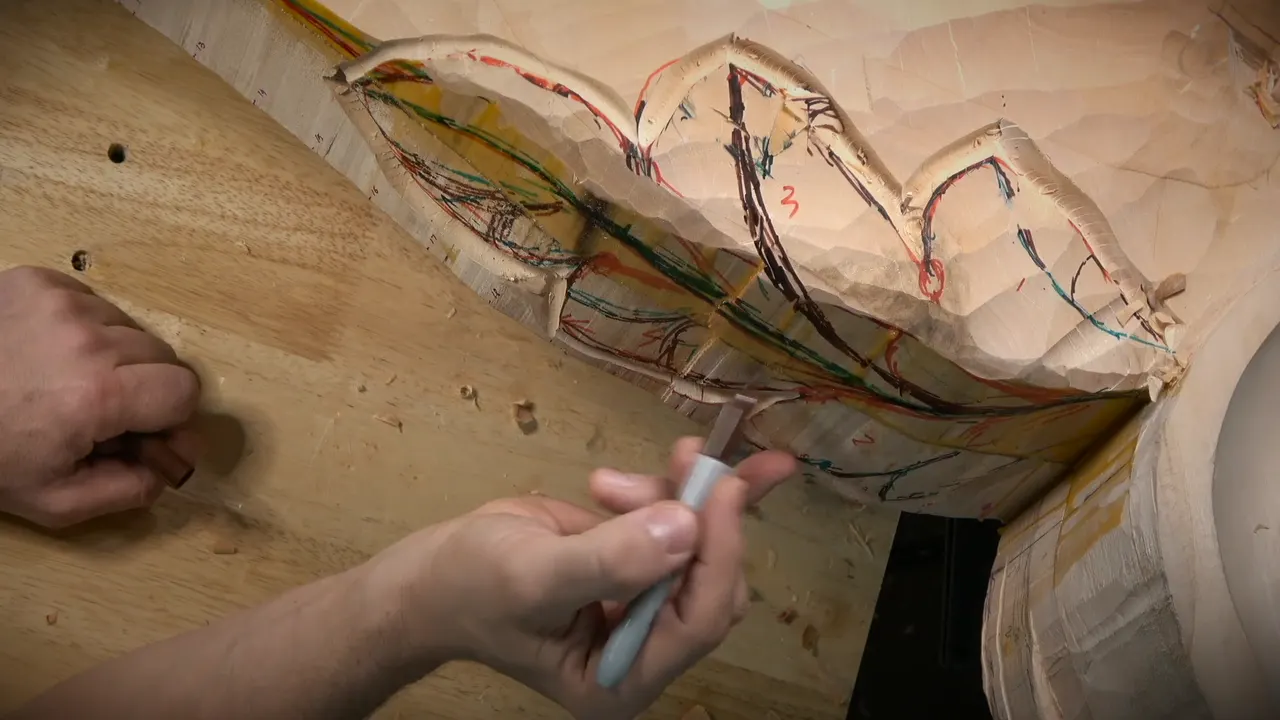

Part 4 of workshop 94 holds one line: "I am free-handing, but I'm still looking at that really nice movement". In my other wood carving lessons the word "freehand" sits beside pencil borders, rounds, V tools and knife grips, and at a sharpening wheel too, with a line of mine at each stop.
Ever drawn a line on a board with no ruler and watched it wander? Can you tell, with your eyes shut, when a curve under your hand feels right? Then this page will feel familiar. It starts in Venice Room 94, then visits Flower Rosette 6, Apron 6, Hashemi 6, Venetian Rosette 1, Butterflies 11, two beginner workshops and a sharpening lesson. Sizes come in millimeters and inch, with my own figure first.
What comes right before the word?
The part opens with "It has to feel all-natural out there." The line itself follows: "I am free-handing, but I'm still looking at that really nice movement, how it's going to look from the bottom, because it's really important".
Which view does the line point to?
The line goes on with "my customer and other people", then "it has to flow really nicely." Then a plan: "Now, I need to do exactly the same right here". A maybe sits beside it: "Maybe, in this case, I am going to just twist downhill like this." Close by: "I can go ahead and repeat that movement right here."

Then comes "less curvature, I should say." Later, "And maybe begin to change on this site, but that is good."
Where do the eyes and the pipes go?
One decision is spoken aloud: "I have to make the decision how far my eyes can be and then my pipes and around my pipes." Close by sits the golden ratio, as "golden ratio approach, if you wish". Then "I've got the meeting point right here". And a warning: "that's going to be a little too far". After it, "It's not going to look good."
Then comes "really, I have to just eyeball it". Next, a pick: "I think right here, is good", with "And I will do this direction right here" beside it, and later a need that reads "I really need to change that."
Over in part 3 sits "I don't worry about the separations yet. All I worry about the main points, I worry about where those going to land". Elsewhere in part 5: "just want to concentrate on exaggerating my pipes whenever I see an eye, I have a pipe." Last in that run: "I really want to establish curly movements, in each of those main five divisions".
Next: "a really open area. Which is also common". Over in part 5 comes "And yes, I just eyeballed that." and "it's not like really complicated stuff. If you used to golden ratio, it just comes naturally to you." Its Fibonacci run reads "one, one, two, three, five, eight and so on".
Does the pace of the work get an apology?
It does, in one sentence: "And I apologize if you don't like when I mumbling, but I'm just working and my normal pace trying to explain what I'm doing."
Plans for the eyes follow: "let me excavate this eye" and "and let me do this one".

Which tool and size does part 4 name?
The size comes as "10 mm, that's what I'm using" and "number 11 veiner, of course". Ten millimeters is 0.39 in. About the eyes: "those are the main eyes, but I'm going to have smaller probably eyes also" and "Those are the main five divisions and I'm Ok."
When does the skew chisel come in?
A wish comes first: "I want to make it that this side a little wider." The plan reads "And what I'll do, I'll take again my skew and blend that in just like that." Next: "looks good, except I have to do exactly the same on the opposite side, just blend it in."

The other side needs little: "I don't have to do anything". Workshop 94, part 3, sets a skew beside a word from this page: "It's going to give me really natural transition, not transition, but like natural movement, I should say."
What happens at the head of the acanthus?
The stage opens with "let's develop the Head part of this Acanthus." A plan for the pencil follows: "All right, I'll switch to my pencil."

The marks follow: "Secondary separation movements". Also "I want to make sure it looks good in the overall." Two jobs are spoken: "that is a triangle I have to remove." and "another triangle. I have to remove." The veiner is named again: "the same number, 11 and 10 millimeters." In inches that same 10 is about 0.4. The last words are "going re-establish that separation."
A word on style comes from part 5: "This is just more like Italian Venetian style." Ahead of that line: "it does not apply to all of acanthus in history there is lots of different acanthus." In that part a side stays alone, "I'm not going to touch this side, although I could", and the skew is named again: "I could use just the skew and land that little bit nicer."
In the Flower Rosette course, how does the word read?
Lesson 6 opens with "Now we're going to establish the border." A marking gauge comes next, in "I really like to use a marking gauge." The other way reads "you really don't have to use it."
The word itself: "but I like to use just a freehand pencil line." Also "I'll just mark my first point. Just the existing one. And I'll do it on all four sides." A finger comes in: "I'll place my finger against the edge, middle finger", then "and pull that finger toward myself." Then "Without anything else, just a pencil and a finger."

How does a round on an apron feel by hand?
Apron 6, part 1, starts the outline with a mallet: "just a small bronze mallet, and the way I'm holding it is just in my palm." Then "I'm not using the normal way, like most of the people use, but I'm kind of just helping my hand."
The distance reads "I'm staying away from the main design about 1/8 of an inch, about three millimeters." Next, "You can stay more, less, a little bit. It depends on the space where you're working it." And "No deeper than that."

The wood gets a line too: "The wood is really excellent. It's all dry. It's antique. It's an original piece of wood". After the round, "With the V tool, then you can always take just a normal gouge. And you can see it just cuts and leaves a really clean cut on this side."
The round follows: "It doesn't have to be a perfect round, although you could use something like that and find a pretty close diameter and use that. But I like freehand it. It feels more like a human being doing it, not like a machine."

Can a mallet work with free strokes?
In Apron 13, part 1, the line is "Of course, you could use just a freehand, but like I said before, when you're using a mallet, it gives you a lot more control." Next, "So you are actually more in control with the mallet." And "So that is my main V groove."

Which lines sit beside freehand in Hashemi 6?
Hashemi 6 starts with a smaller tool: "I will take a smaller number eight. Maybe half an inch." Half an inch is 12.7 mm. Then "I will need to find the middle line of the leaves, how I want to see it".
The rule of placement reads "I never put my line in the middle of the leaf." Plus "I still want to do toward one side or another." Beside it: "I'm doing just the eyeballing, really." And "it should not be a problem."

The word arrives here, as a plan: "freehand cuts, but still, I have to follow the law of flow." And "Maybe I can actually use a number nine." Then "And those ridges between, you can see those ridges, the tool marks, they actually look like veins of the leaf."

What has an iPad sketch to do with it?
Venetian Rosette 1, part 1, holds both words, "freehand" and "improvise". First: "Obviously, this oval is not perfect because like I said, it was done on iPad, just freehand sketching, and I need kind of little better version of it." And "It doesn't have to be perfect, but still it has to be somewhat nice."
The way to do it reads "it's probably the most ancient way to draw. It's by hand and by eye." Then "It's not necessarily going to give me a perfect oval like if you would use computer and just a true geometrical measurements and so on, and you can do a perfect oval." And "But still, you can do really accurate work."
A list of gear follows: "pretty much the oldest stuff, like some kind of twine." And "You're going to need some nails, small ones. Just the really tiny nails, like about 5/8 of an inch." Five-eighths of an inch is 15.9 mm. Also "that's number 18."

Later: "some of it is going to be somewhat eyeballing". Then "so I have to improvise." With calipers: "approximately eyeball it." And "Man, I was too perfect on this side. So that is a little too perfect." Then "Well, let me try not to be so perfect." And a second way: "If you want to be super, super perfect, you can always just get right on this line and try to attack that from opposite side, and looks like I'm right on the money." Then "So calipers worked."
How wide is a free-hand border?
In Butterflies 11, part 3: "I would just probably do no more than three millimeters and carefully, carefully, carefully just try to establish approximately the border." That is 0.12 in. And "I can probably just eyeball it, or I can just freehand approximately three millimeters."
Earlier in that stretch sits the other choice, "if you don't feel comfortable of just the eyeballing the position of the Gouge". The words that follow: "you can use edge of your plate, place the pencil, however how much you want to take it."

Then "But again, I don't need to try to be careful, you should be okay." About the angle: "Angle is really important. It's got to be no deeper than a one millimeter." One millimeter is 0.04 in, and the same stretch has "One millimeter deep cut, that's it." Right after: "And I like it."

Where does a beginner knife start?
In beginner workshop 2, part 3: "What I'll do, I'll just hold it freehand first, and I'll place my knife right on the first line, which is a quarter inch from the edge." A quarter inch is 6.35 mm. Then "Angle it, low angle, really low angle, and follow the line." And "Just follow this line all the way."
Further on: "If it's not easily removed, just repeat your cut until you have really clean point at this point right here." And "The idea is to train your hand to feel how deep you have to go with your knife."

Beginner workshop 1, part 4, has a drawing: "Let's do a stem, and let's say few leaves. Just freehand drawing, okay?" Next to that, "Just a really nice, clean chip." And "Right first, and left." Also "If I have to go back just to clean it, oh yeah, I'll just clean it."
A grip comes next: "And look how I'm holding my knife now", then "I'm holding it like a pencil because those leaves are tiny", and then "what we do, we actually train our hand."

Is there free work at the sharpening wheel?
Sharpening a large gouge, lesson 4, starts with a paste: "after that, the blue paste. The finer paste." Then "Now I'm going to just freehand. Remove that jig. And just find my bevel and let it buff it."


Which lesson holds which line, and what sits beside it?
| Lesson and part | The words that sit beside the phrase |
|---|---|
| Venice 94, part 4 | The bottom view, and a flowing movement. |
| Rosette 6 | A pencil line, a finger and no gauge. |
| Apron lesson 6 | A hand-drawn round with a human feel. |
| Apron lesson 13 | A V groove, a mallet and more control. |
| Hashemi 6 | Free strokes that still follow the law of flow. |
| Rosette 1, Venetian | An iPad sketch, twine, nails and a need to improvise. |
| Butterflies 11 | A border of approximately three millimeters. |
| Beginner 1 | A stem, a few leaves and a pencil grip. |
| Beginner 2 | A knife held free on the first line. |
| Sharpening gouge 4 | A wheel, a bevel and no jig. |
Is there a line of yours that came out better free than traced? Everything in workshop 94 sits inside one tuition plan. Other Venice Room workshops wait on the Part 8 course page, and every course named above sits in the same school.
How it's done
- Keep it flowing. "it has to flow really nicely." is the line in part 4, spoken after a look at the piece from the bottom.
- Place the eyes by eye. Part 4 places the eyes and pipes by eye, with "I think right here, is good".
- Name the veiner and its size. Part 4 names a #11 veiner at 10 mm (0.4 in).
- Plan the skew for a wide side. The plan reads "I'll take again my skew and blend that in just like that."
- Stay off the design on an apron. Apron 6 gives the distance as "about three millimeters" (0.12 in) from the main design.
- Hold a knife for tiny leaves. Workshop 1 of the beginner course holds "because those leaves are tiny."
Frequently asked questions
What are the first words in part 4?
"It has to feel all-natural out there." comes first. After it, the talk turns to "my customer and other people".
What size is the veiner in part 4?
A plan gives the figure: "11 and 10 millimeters." Ten millimeters is 0.39 in. The earlier size line reads "10 mm, that's what I'm using".
Which words in part 4 cover the pipes?
A decision comes first: "I have to make the decision how far my eyes can be and then my pipes and around my pipes."
How does the apron round feel?
What to carve next