
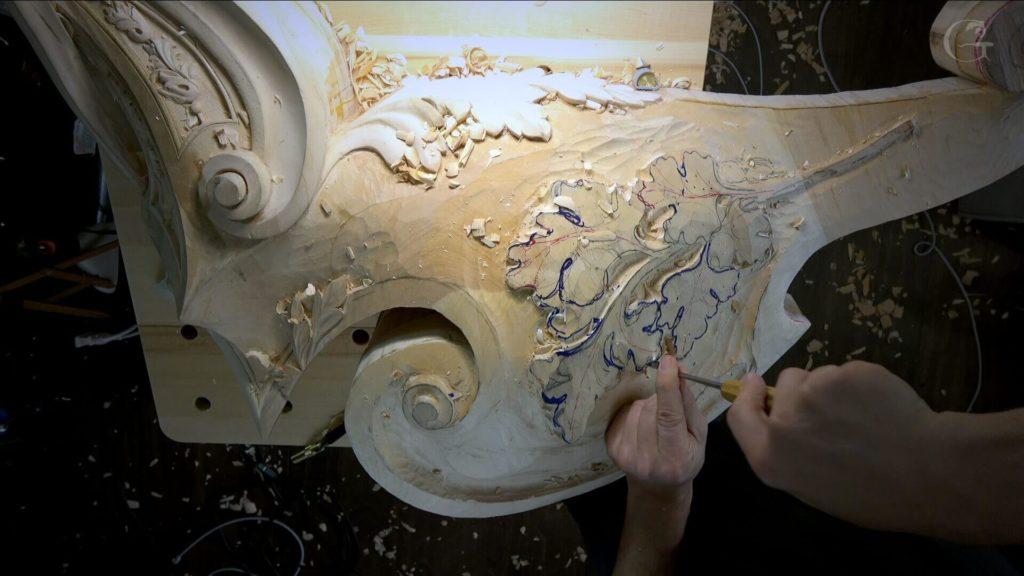
Alexander Grabovetskiy, woodcarver, School of Woodcarving · Published 2023
How do you hold a gouge to avoid undercutting?
Quick answer: The flute of a gouge points somewhere on a clock face, and where you aim it decides whether the wall of a cut stands up straight or leans back underneath. Straight up is twelve o'clock and leaves a vertical wall. Rotate that same tool clockwise and it begins to work under the edge.
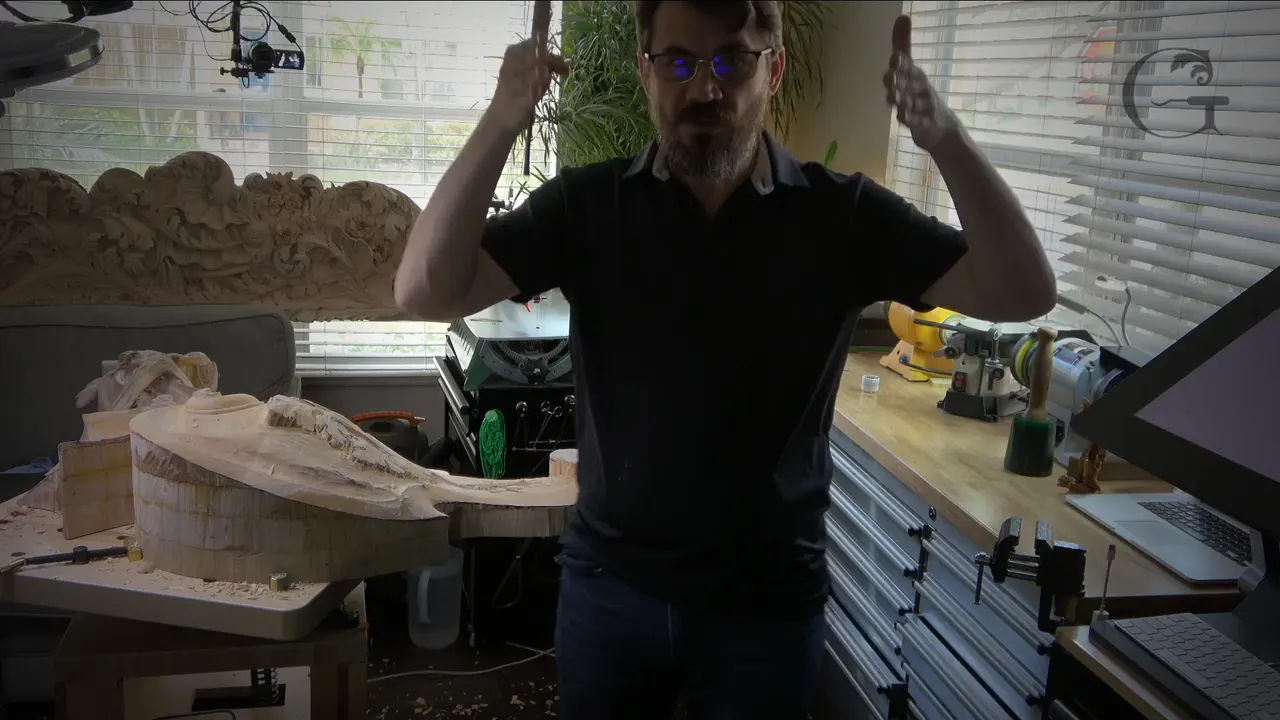
The flute of a gouge points somewhere on a clock face, and where you aim it decides whether the wall of a cut stands up straight or leans back underneath. Straight up is twelve o'clock and leaves a vertical wall. Rotate that same tool clockwise and it begins to work under the edge. One idea, and it keeps coming back in workshops 86 through 97.
Have you ever finished a leaf, stood back, and found the edge looking soft where you meant it to look sharp? Or the opposite, an edge that reads hard and mechanical when it should have folded? In these workshops, both come down to where the flute points.
The rest of this stretch is stranger. It is about carving things you cannot see while you carve them, because the light in my shop is not the light this piece will ever live under.
What decides whether an edge reads hard or soft
- Twelve o'clock, wall vertical, nothing undercut by accident.
- At two, the very same tool folds an edge back on itself.
- Ten or nine undercuts with the left wing.
- A ridge that is almost invisible under a floodlight can make a huge difference at night.
- Two lamps, warm and daylight, both dimmable. Move them until the shadow tells you something.
- A design that looked fine on a computer can come out too small in wood. Fix it and carry on.
Where does twelve o'clock come from?
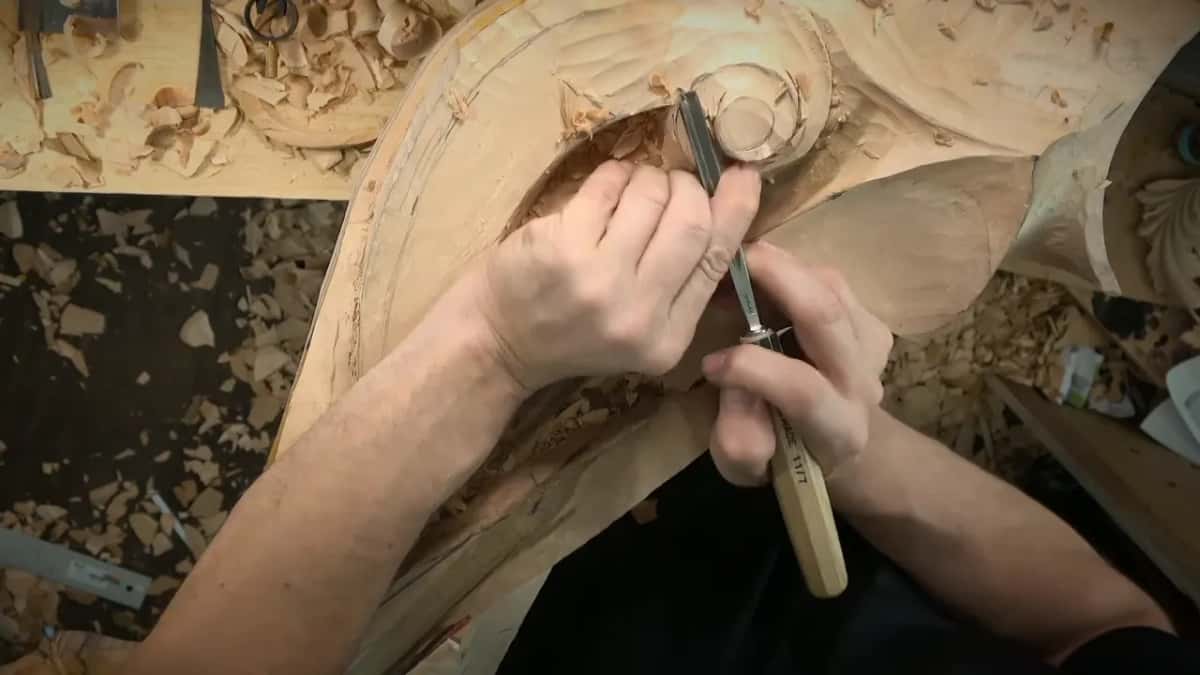
Look down at a gouge with the hollow facing up. That hollow is the flute, and it is the middle of the tool. Held with the flute aimed straight upward you are at twelve o'clock, near enough ninety degrees, and a push there leaves a wall standing vertical out of the ground.
That is what I want wherever a shape must stay crisp. Running a number 11 hard up against a rising edge, I hold twelve and the neighbouring surface survives. Lean it even slightly and the tool eats under the thing I am trying to protect.
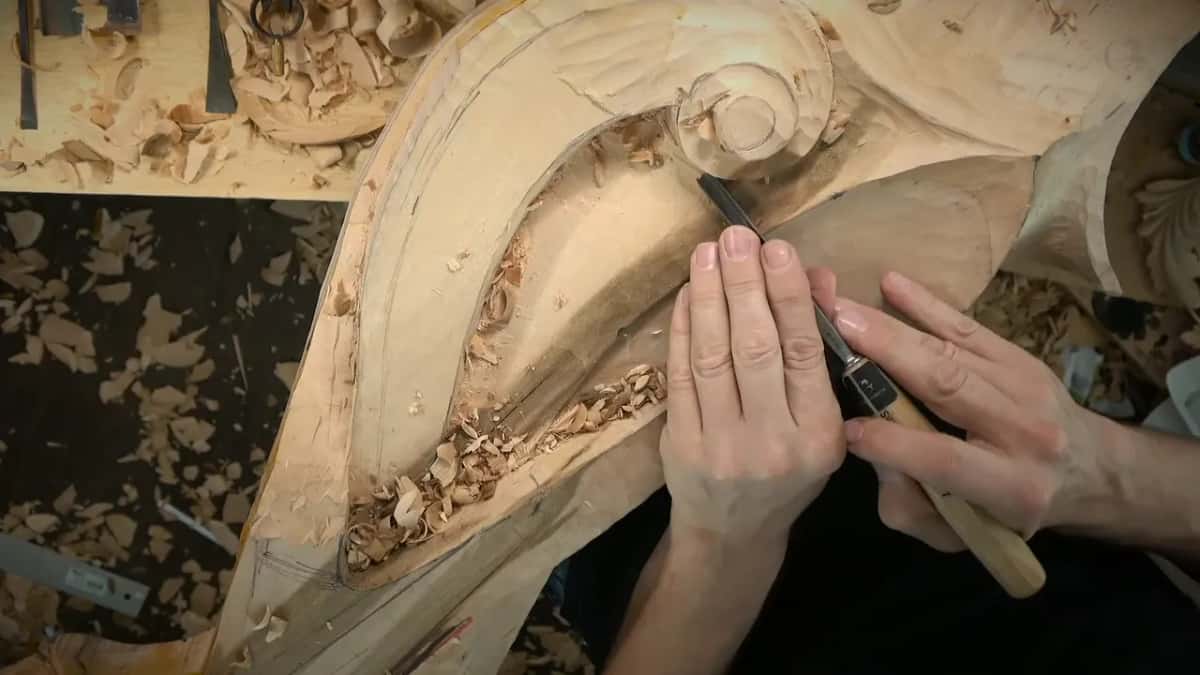
Undercutting is not a sin. It has its own moment, and an earlier stretch of this room has plenty of it. Doing it by accident, on an edge you were about to need, is the sin.
What happens when you rotate to two o'clock?
The edge starts folding. Take the flute round to two and the same push travels in under the line instead of down beside it, and what your eye reads afterward is a shape folding back rather than sitting flat on a ground.
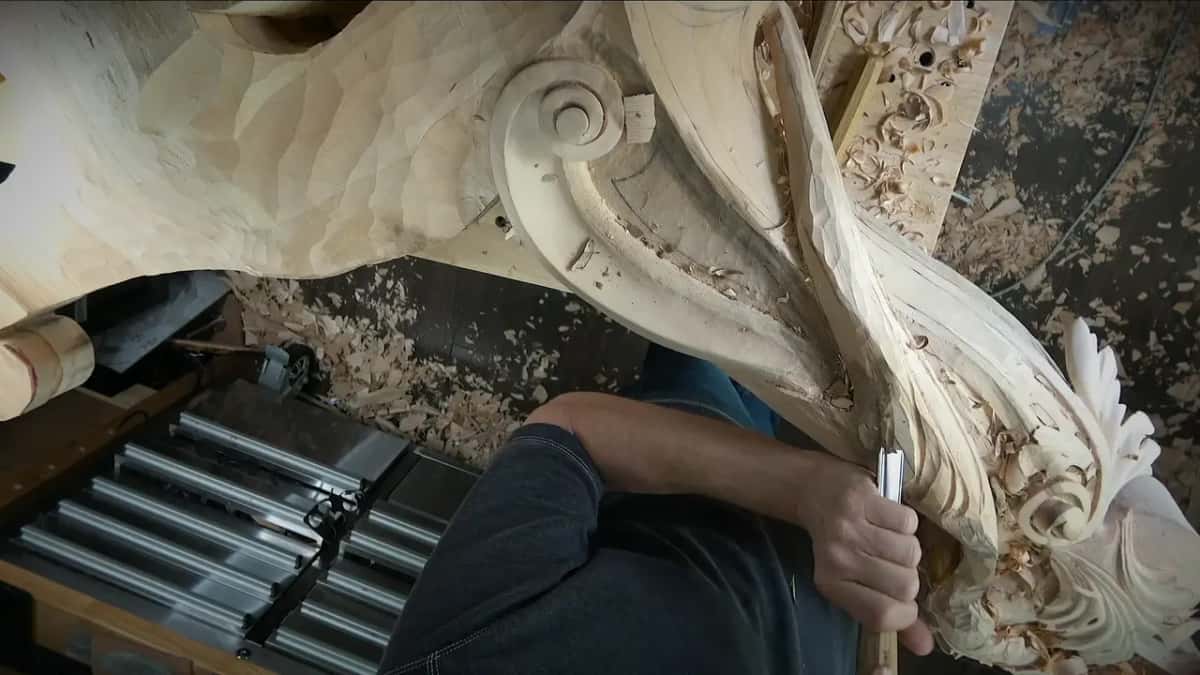
I do it carefully. But without that fold going back, it is not going to look as nice.
And rotating the other way?
Eleven, ten, sometimes nine. Same tool, mirrored, nothing else changes about it. Starting a concave I go one hour left of vertical. To undercut with the left wing of the tool, I go to about ten, or even nine.
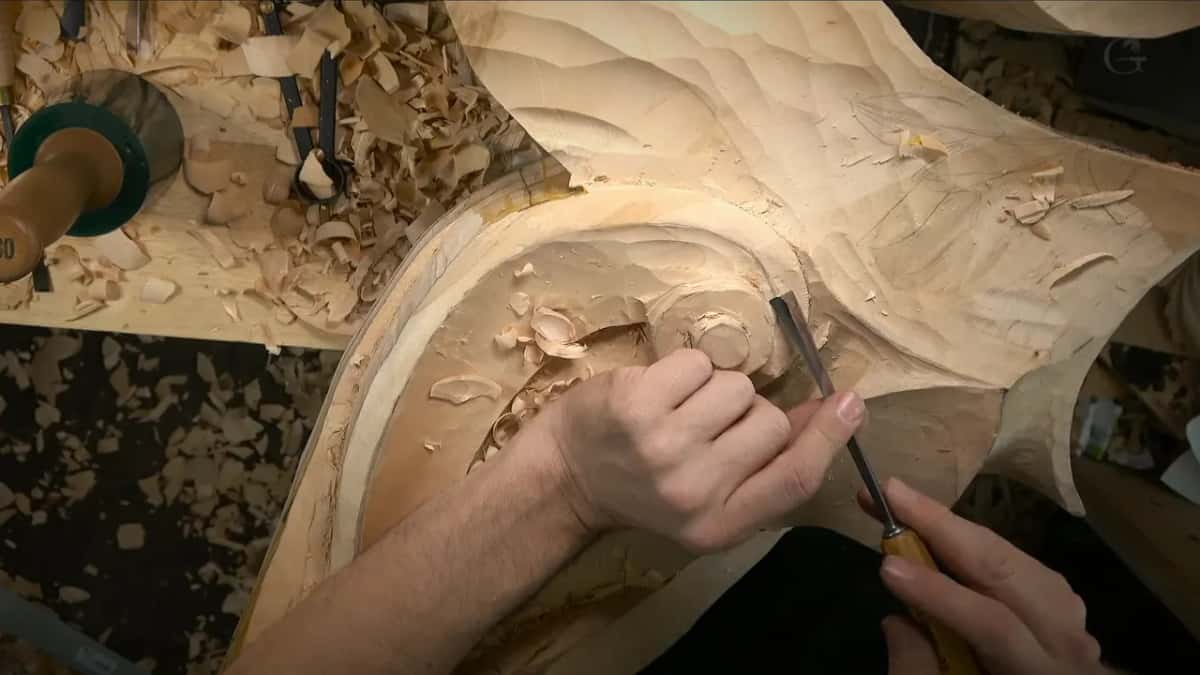
If you are in Europe, nine o'clock is twenty one o'clock. Or if you have been in the military, you already know exactly what I mean. Whichever numbers you grew up with, the point is the same: the flute is a dial, and you are choosing a setting rather than wrestling the tool.
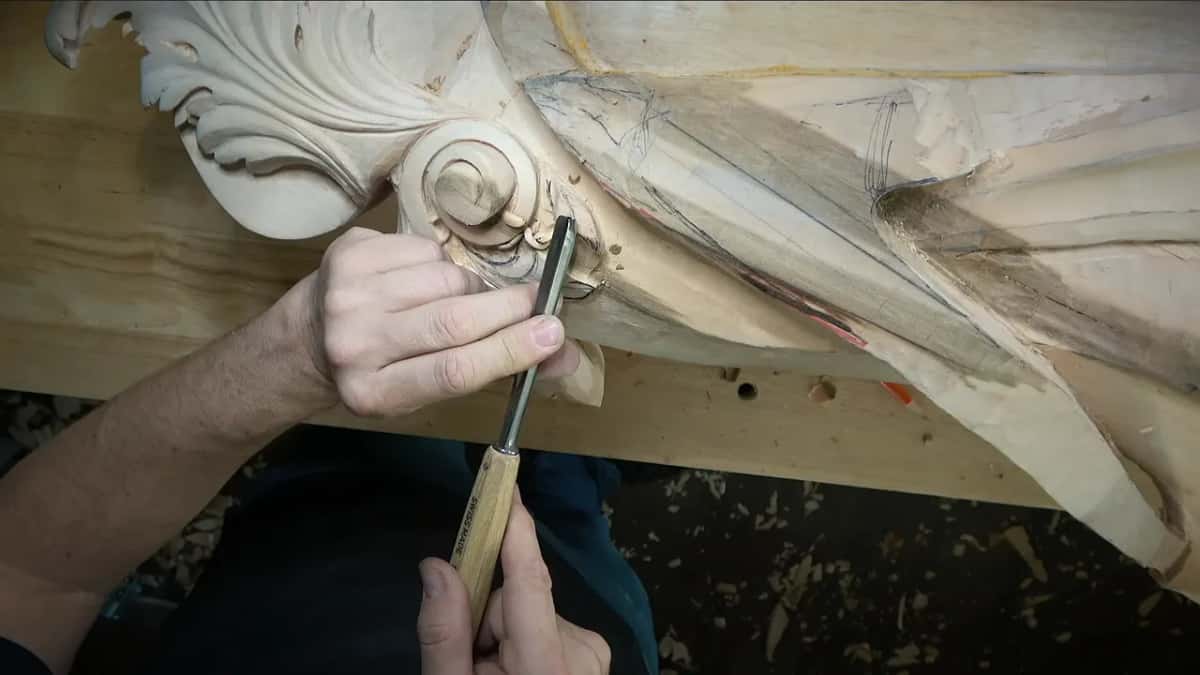
What is a macaroni tool for?
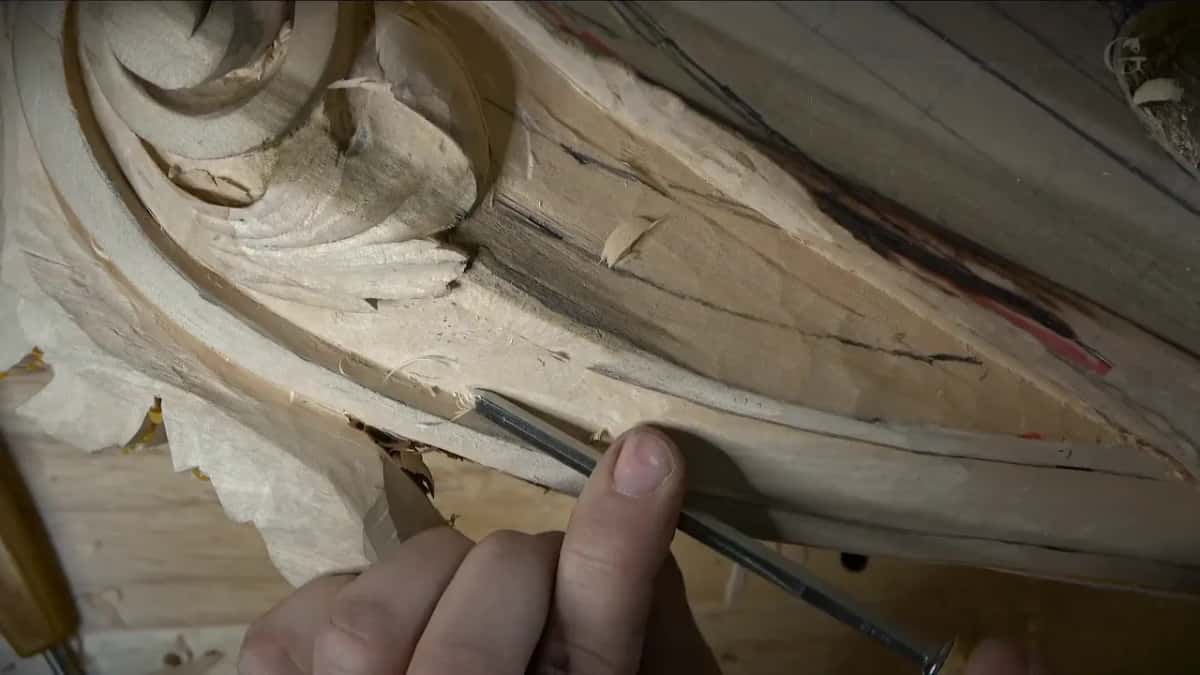
Getting really close to a design without undercutting. A number 23, the macaroni, is really three chisels in one iron. Three sides, three flat edges, and it leaves a wall of almost 90 degrees.
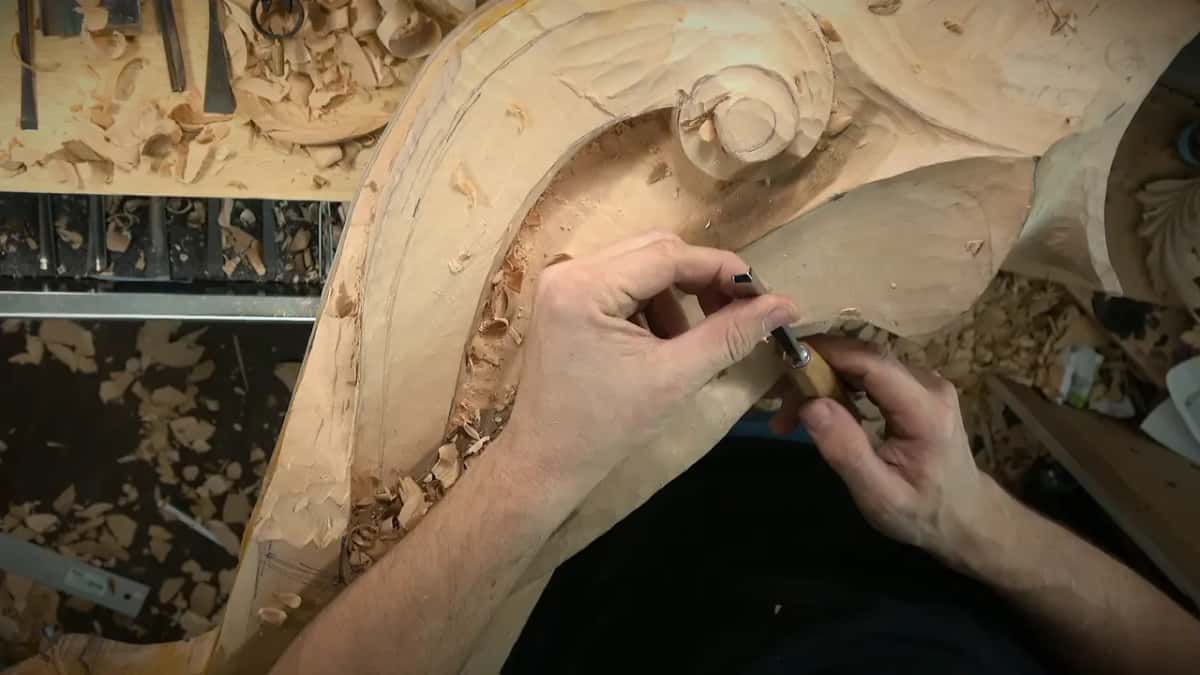
The one I used here is four millimeters, and the same tool can go around a volute without destroying its wall. There is a rounder cousin called the fluteroni, and both are really good tools to have if you are a furniture maker. Could you use a 90 degree V tool instead? Absolutely, you could. I just really like that tool.
Which sweeps to buy first is a question for the tools course.
What is a grounding tool, and what does 38 mean?
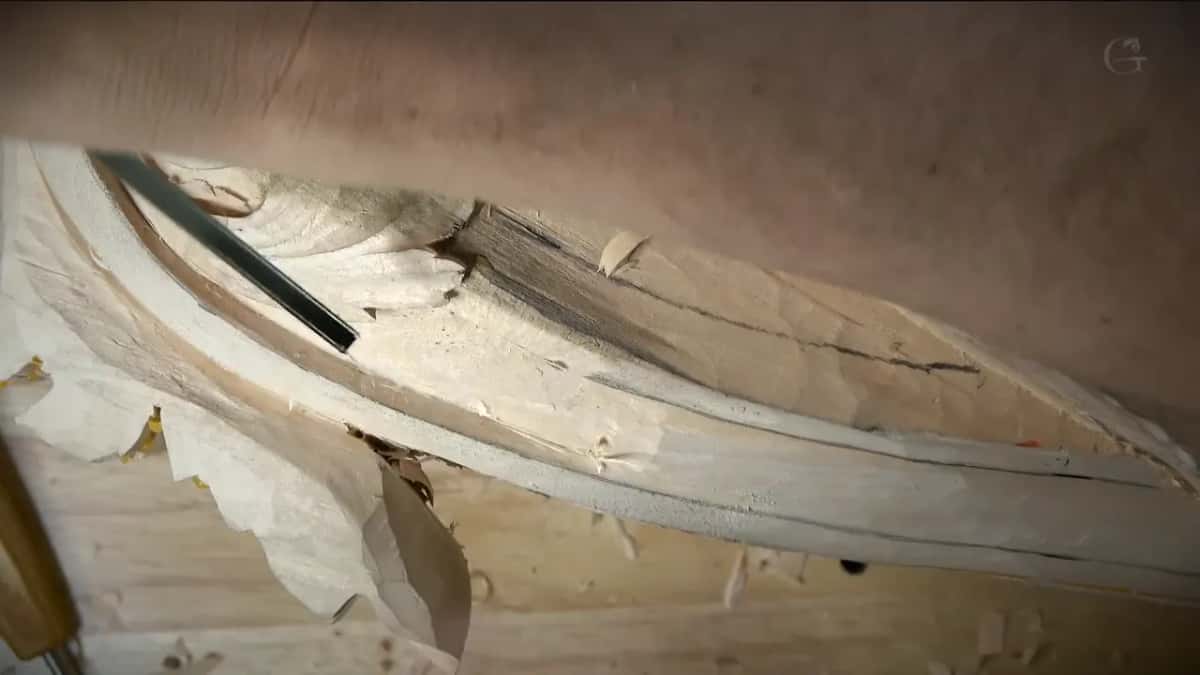
A grounding tool cleans out the background around a raised ornament, and mine have a little bit of curvature, a little bend. Mine are Ashley Iles. The small one measures a sixteenth of an inch, 1.5 millimeters, for getting in between two channel cuts. The bigger one is six millimeters, a quarter of an inch, and it goes right underneath and can undercut right away.
While we are on numbers, here is one more. A back bent gouge with a number 8 sweep comes stamped 38 by Ashley Iles: the 3 says back bent, the 8 says the sweep. Pfeil stamps the identical tool 28. Two makers, one shape, two numbers, and neither of them is wrong.
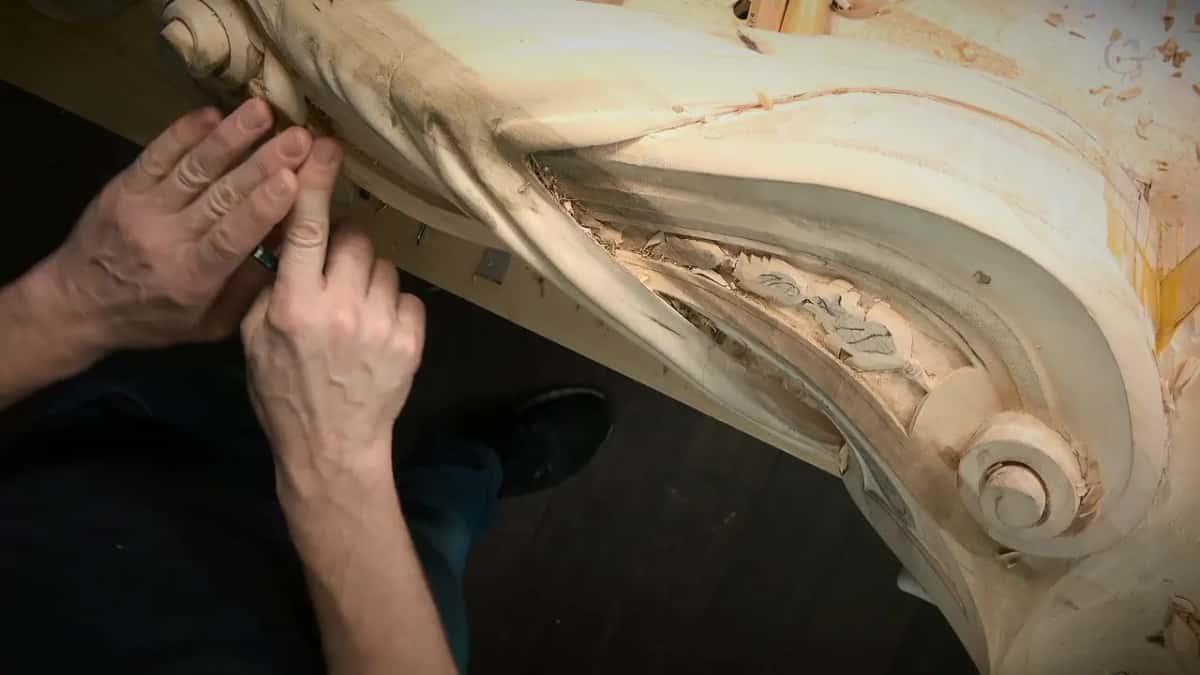
Mine is a little bigger than two millimeters, and it gives a really round result, almost like a bead molding set in. After that it wants stropping. Mirror Paste on a piece of leather, and I use the edge of the leather to get inside the hollow rather than the flat of it.
Why carve a ridge nobody can see?
In my shop, it is almost invisible. In the room where this piece ends up, it will do the work.
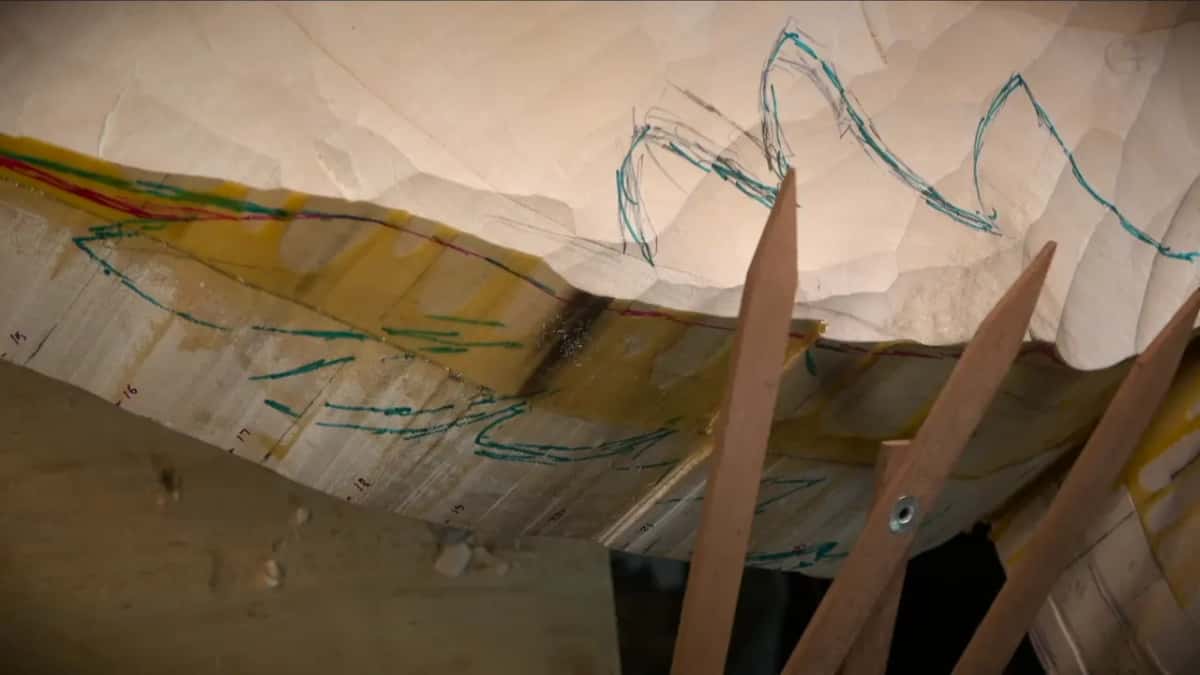
I raised a ridge here so small that under a floodlight it almost disappears. Play with the light and there it is. That little ridge is going to make a huge difference at night. Not a small one.
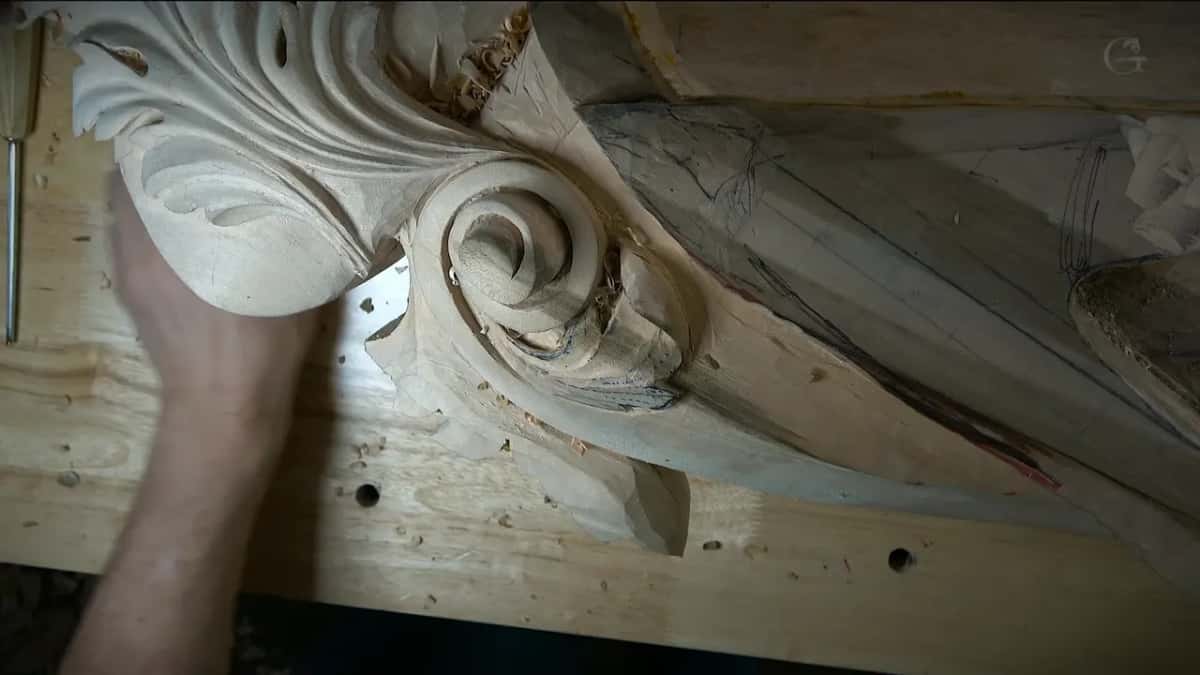
Then I did it again inside the next separation, and again in the one after. A micropipe in every separation, is how I think about them. Those separations are the only places I want to see a ridge. The ones down the middle lines get blended away.
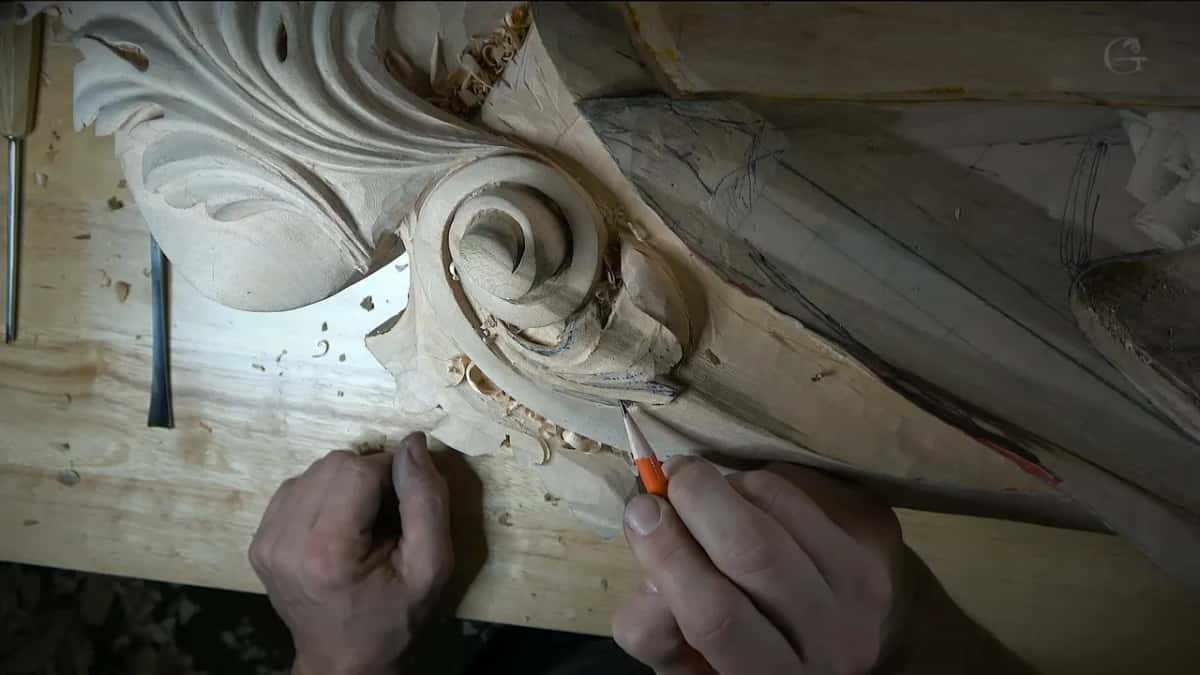
What light should you carve under?
Two lamps, and I really love them. Mine each carry two color temperatures, so I can put the bench under a warm evening light or a flat daylight, and dim either one down to almost nothing while still being able to see.
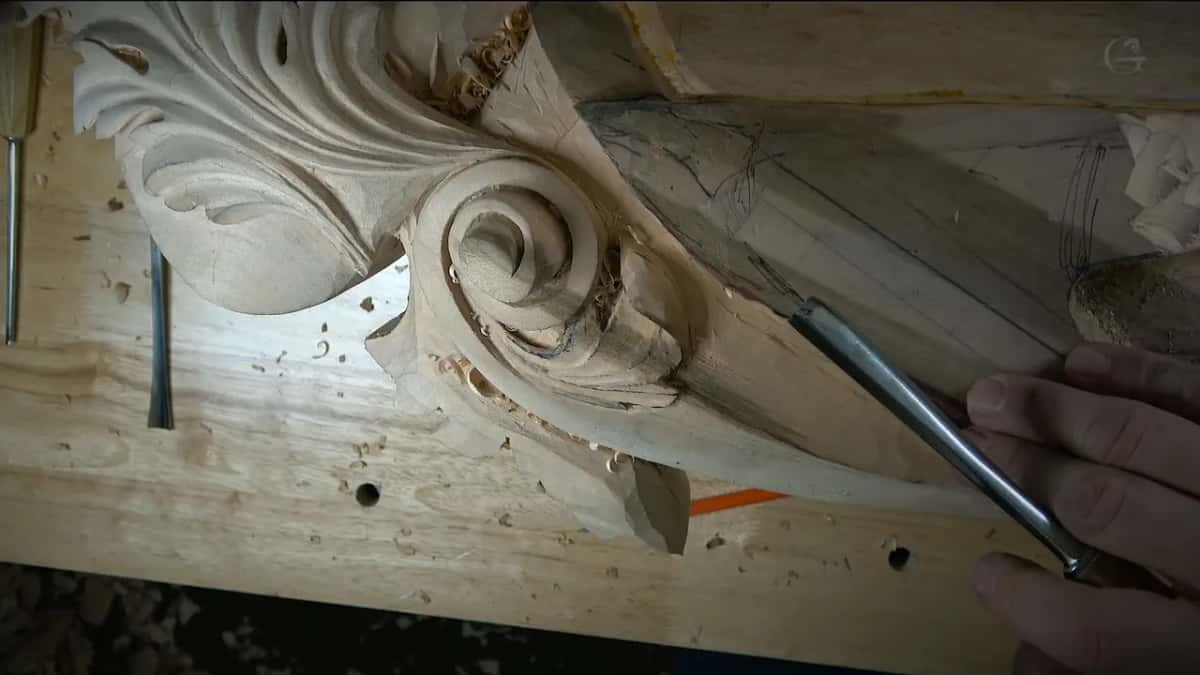
They come at the work from two different positions and both move. I dim one, raise it, and check which position gives me a better shadow, so I can see where to go with my tool. Nobody has to buy the same lamps, but for a carving bench they would be a really good investment.
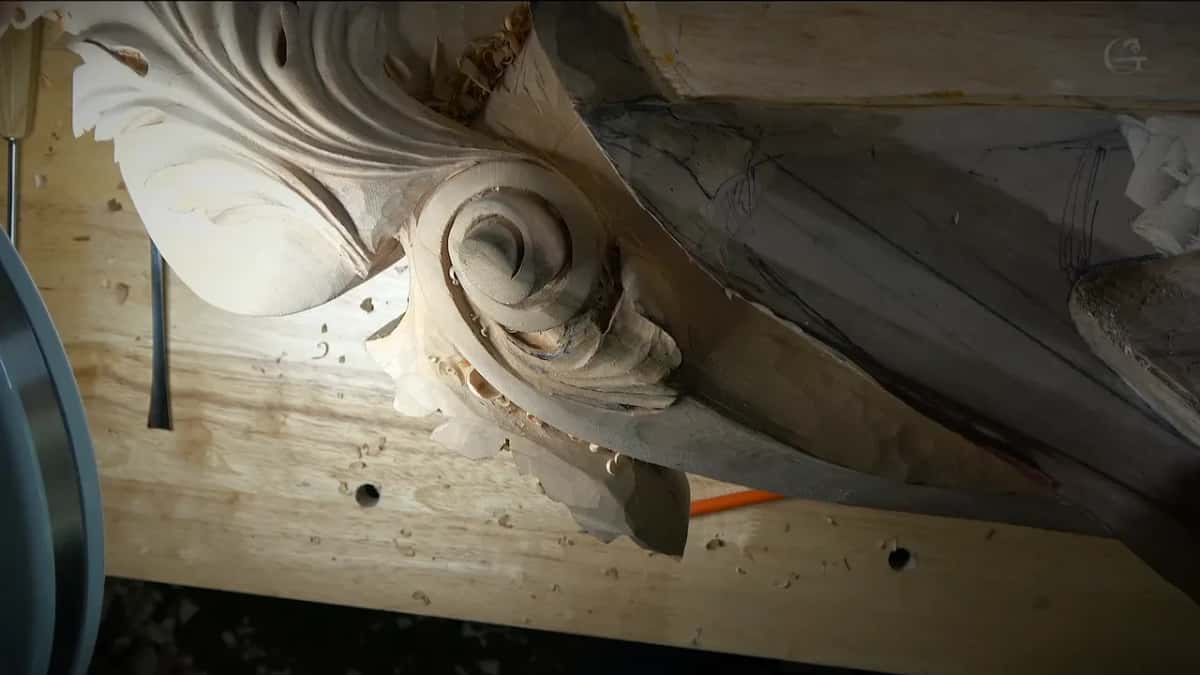
The habit runs right through this stretch. Rough the shape, then move the light and look again, because volute carving is all about light and shadow, not just the form.
What about daylight from a window?
Different problem, same question. At night the lamp is above and the shadow drops. During the day the light comes sideways out of a window, strikes the face of the ornament straight on, and it still casts some shadow.
Does it matter? I think every little bit matters.
So I went much deeper in that area, about half an inch, twelve millimeters, and it's going to give me a lot more movement.
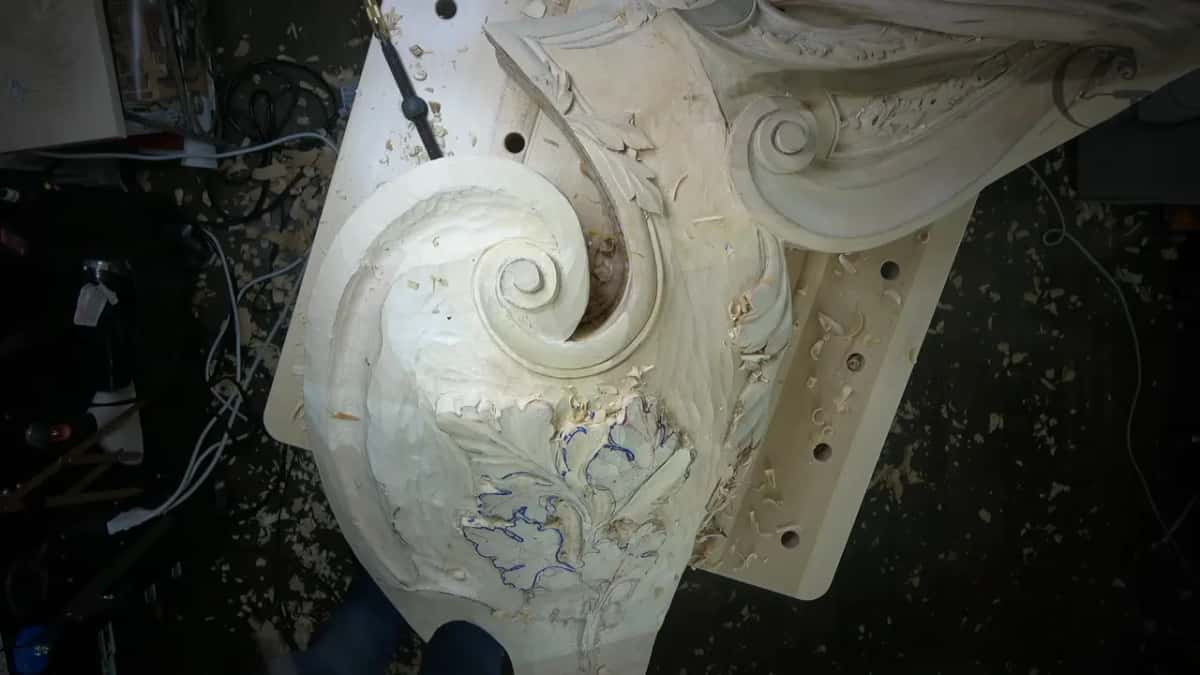
Why leave wood behind for the cleaning?
You are going to need it. On any of these shapes I come very close to the final line and then stop, and what I leave is for the cleaning operation. Always a good idea to leave a little. Here it was about a sixteenth of an inch, and at first I didn't even mention it. On another spot I left six or seven millimeters, and that was plenty.
It is not caution for its own sake. My number 5 was dragging a little of the material, so I took a number 3 and cleaned the sides a little nicer. That is what the wood I left was for.
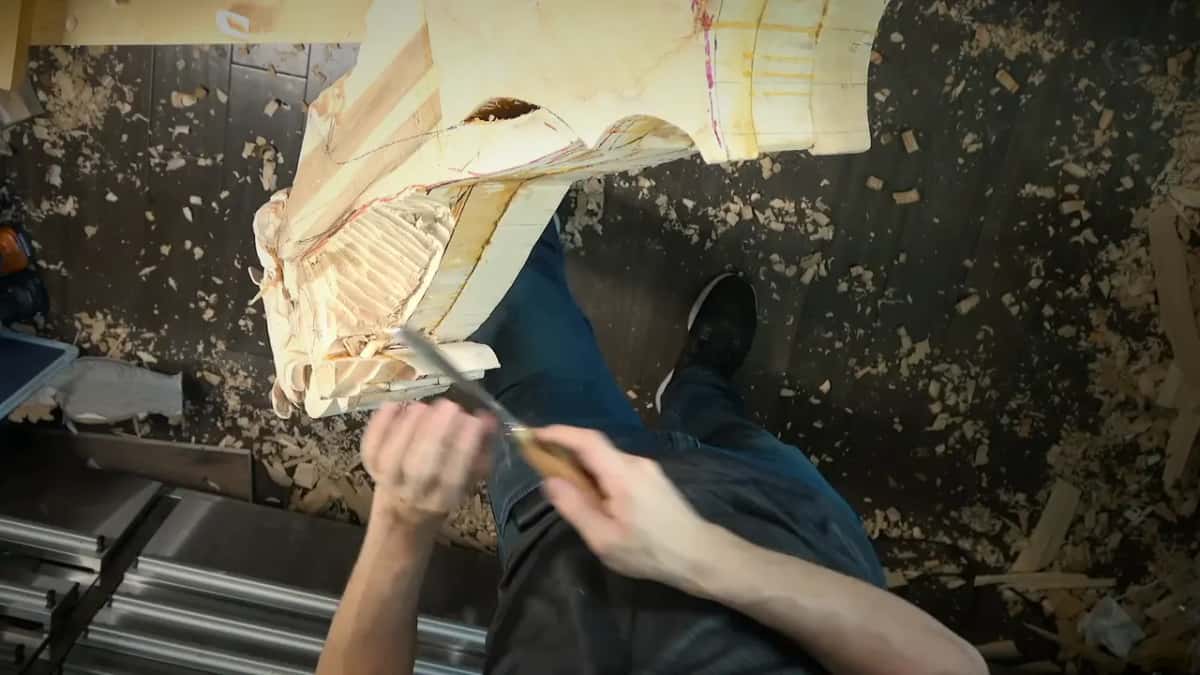
Cleaning also runs all through these twelve workshops. Count the words in these recordings and clean comes up more than two hundred times. Clean the sides, clean around it, clean it a little nicer. Cleaning is never the exciting part on video, and once I even said I'd take care of the cleaning off camera another time.
When does a scraper beat a gouge?
Anywhere a flat must stay flat. A skew laid almost level takes a shaving like a plane and leaves a hard clean corner behind it, and after that a small card scraper tells me the truth about whether the surface really is level.
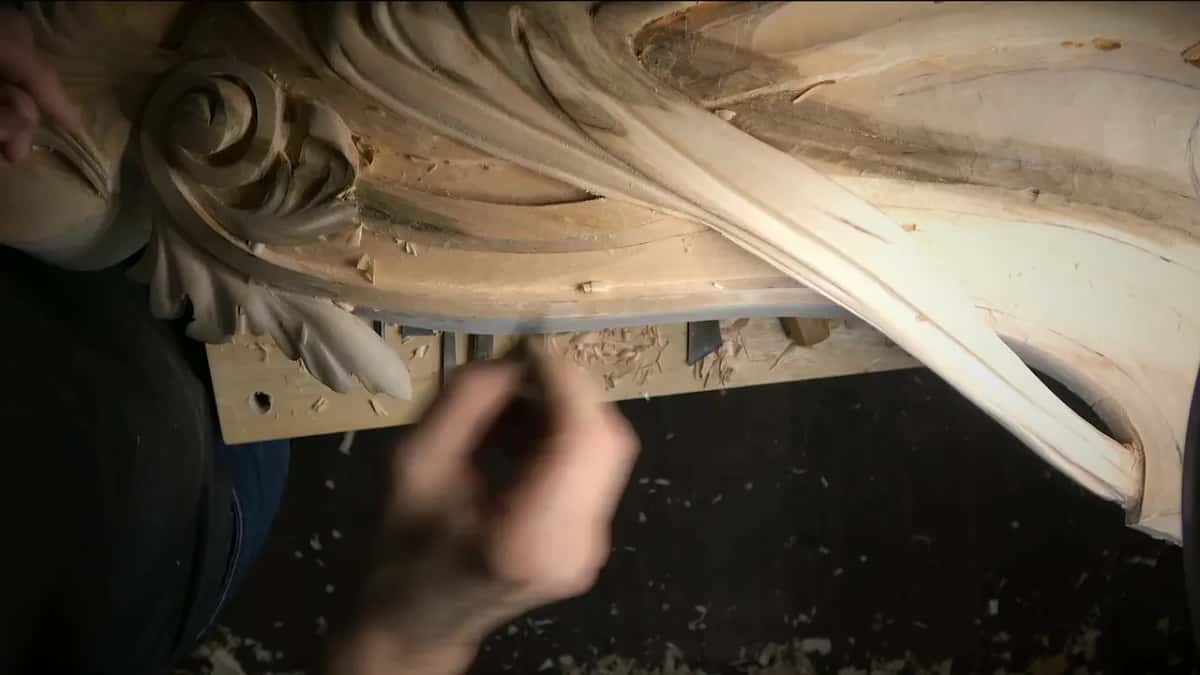
The other trick in this stretch has nothing to do with steel. Sometimes it is a good idea to work on something else for a while. You really get tired of one area. One part bugged me so much that I said I needed to walk away from it for a couple of days and come back.
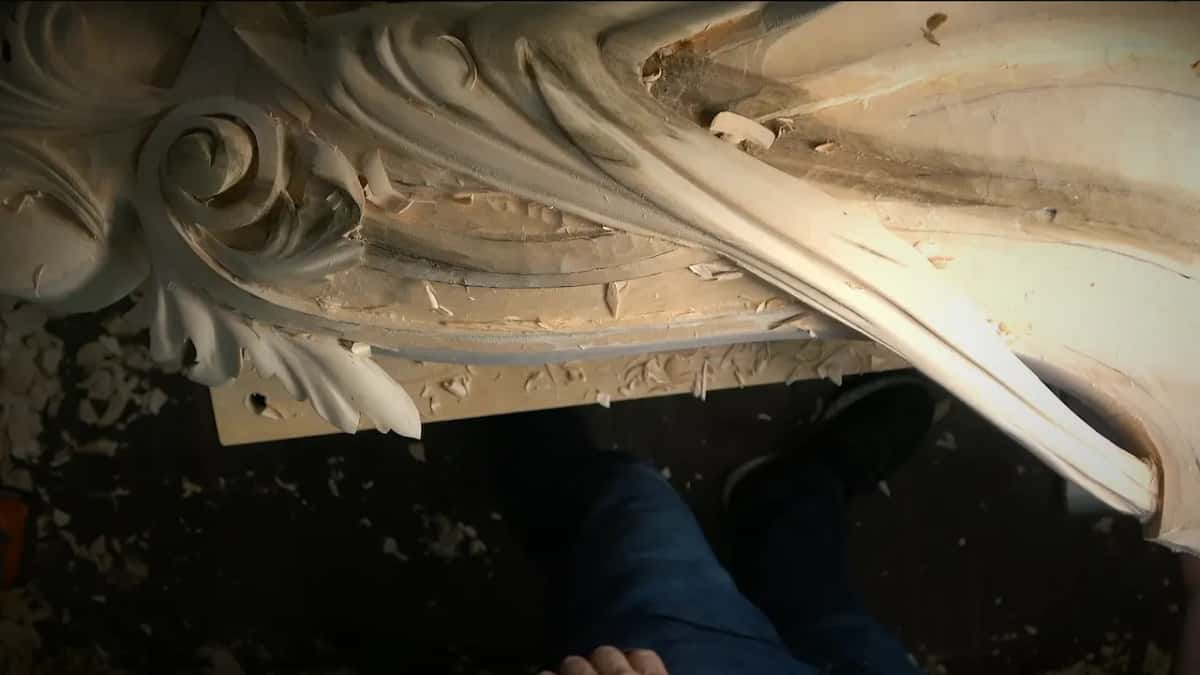
Why did the design fail once it was in wood?
It looked okay on the computer. In basswood, at full size, those small elements inside the panel areas were a little too small, and there is no argument to have with that. The wood wins.
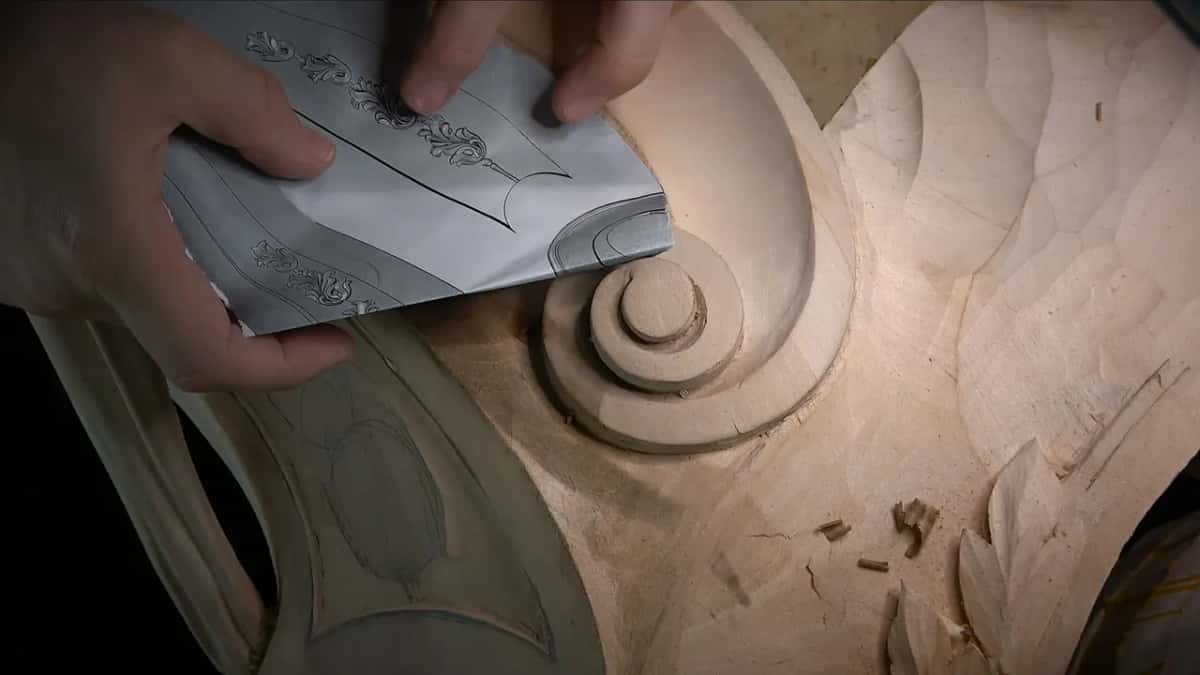
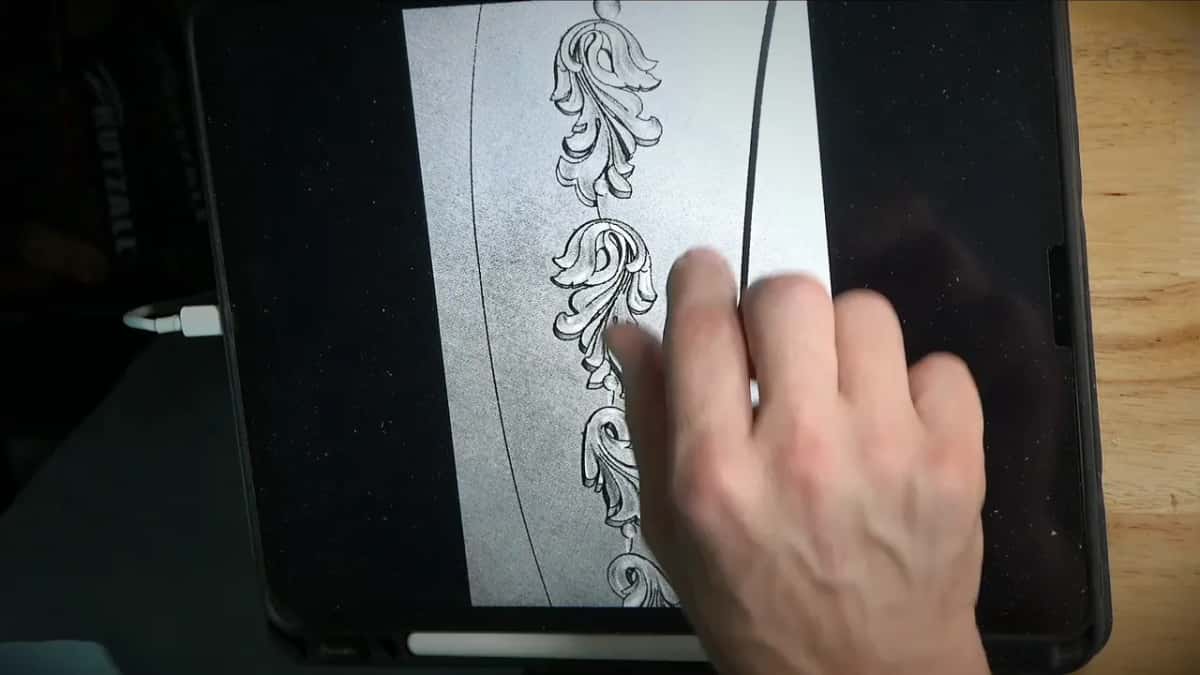
I could have redrawn it by hand on the spot. Instead I used the good tools I already had. A paper cutout, photographed with my phone, emailed to myself, opened on the iPad, and then pinched to fit the space I measured on the carving. Then plastic over the screen, a blue Sharpie, carbon paper, and carry on. I could have gone into 3D software, SketchUp or Rhino or Blender, and resized everything, but that would take time.
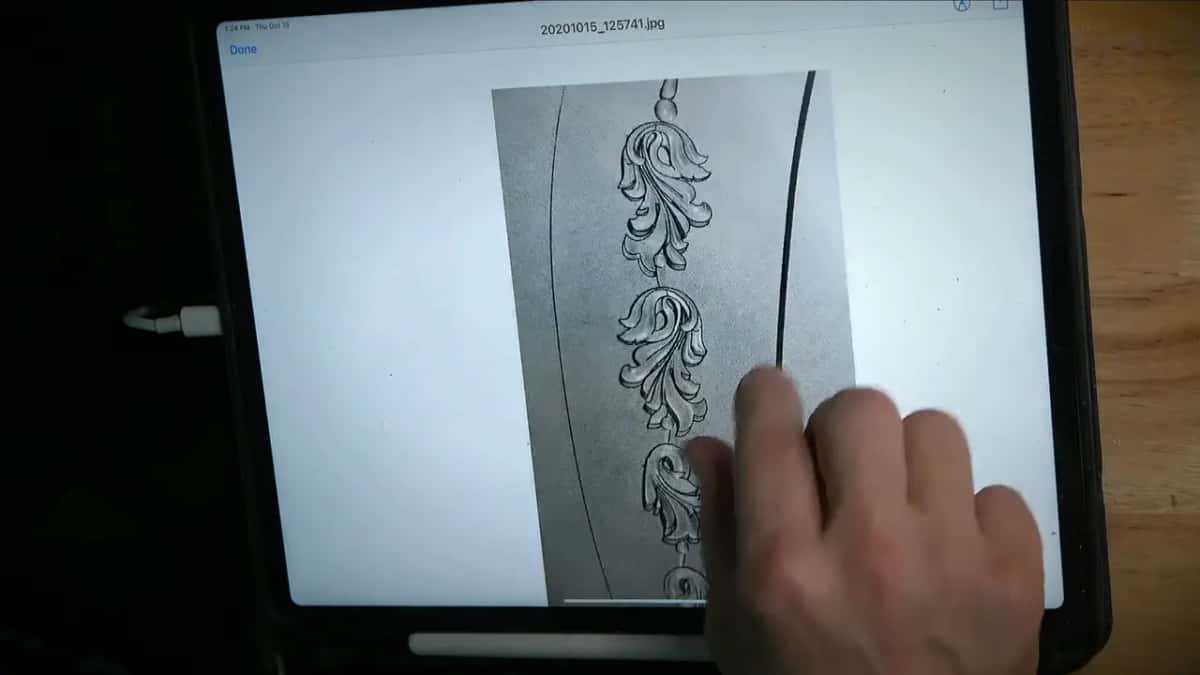
Originally that area was going to take four pieces. But some of those sections would be kind of hard for me to carve, so I changed the design a little.
What happens where two planes meet?
You have to be careful. A section that sits on two planes has the grain direction going all over.
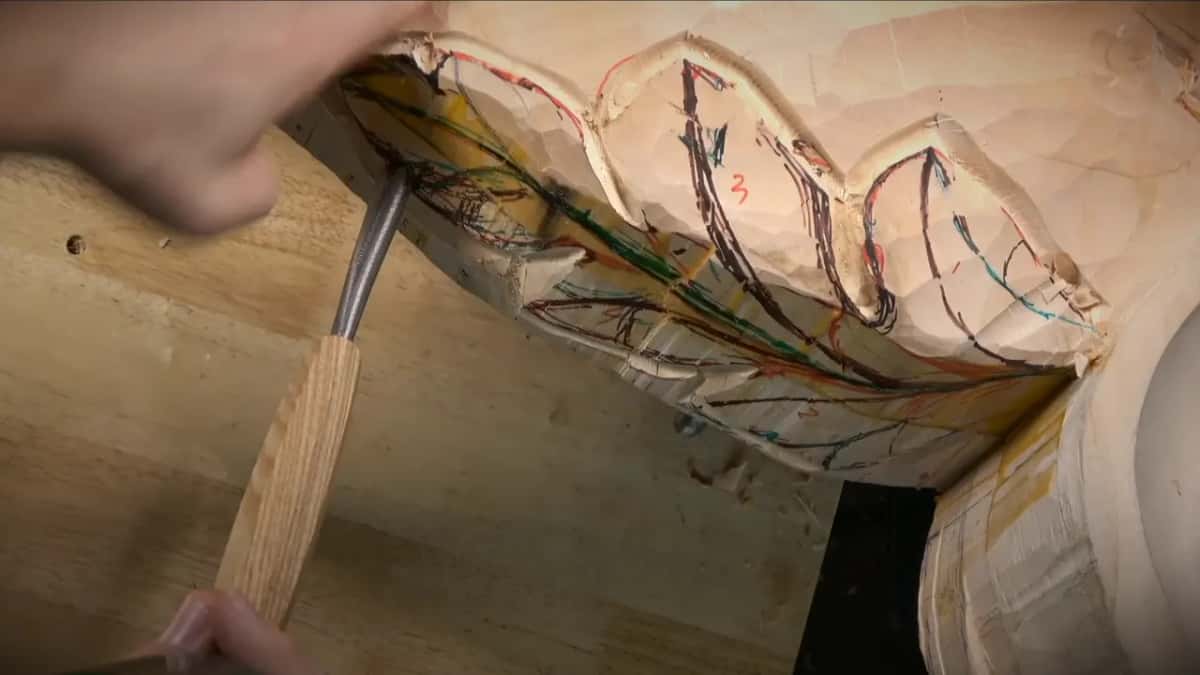
The proportion rule does not change. Middle line first, set by the golden ratio, exactly as in the twelve workshops before the corbel. On these two planes I set it with three leg golden ratio calipers.
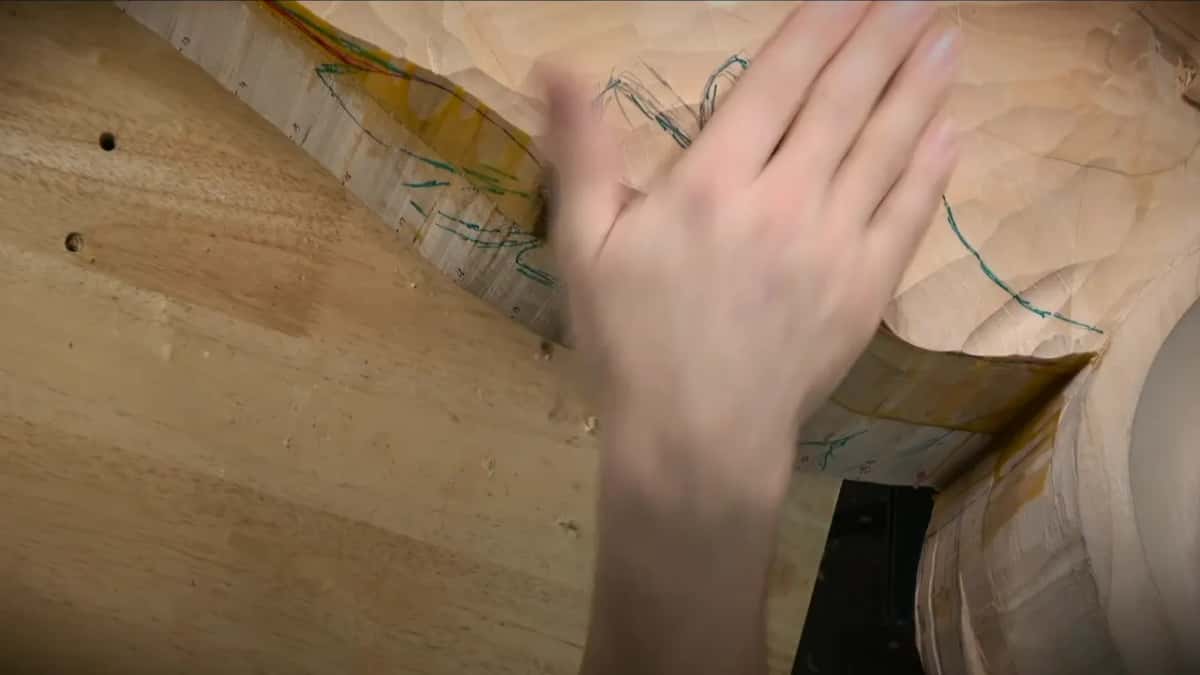
Then five main divisions, and five more inside each of those. This one is huge, and that is how I get the curly movements I want.
Which tools do this work?
Ordinary sweeps, plus three odd ones.
| Tool | Size | What it does | Where |
|---|---|---|---|
| Number 11 veiner | Small | Outlines and separates, held at twelve so nothing gets undercut by accident | Every separation on the piece |
| Number 5 | Medium | Fits the profile well, though here it dragged a little | Where its sweep matches the shape |
| Number 7 | Half inch | Blends | Between a concave and whatever sits above it |
| Number 3 | Medium | Cleans the sides after a coarser tool has been through | Everywhere |
| Macaroni, number 23 | 4 mm here | Three flat sides, for a nearly square wall by the design | Along the side of a volute |
| Fluteroni | Small | The rounded version | Making flutes |
| Skew | Wide | Planes a flat, hard corner along the edge, nothing rounded | Panel faces |
| Card scraper | Small | Proves a surface is actually flat | After the skew |
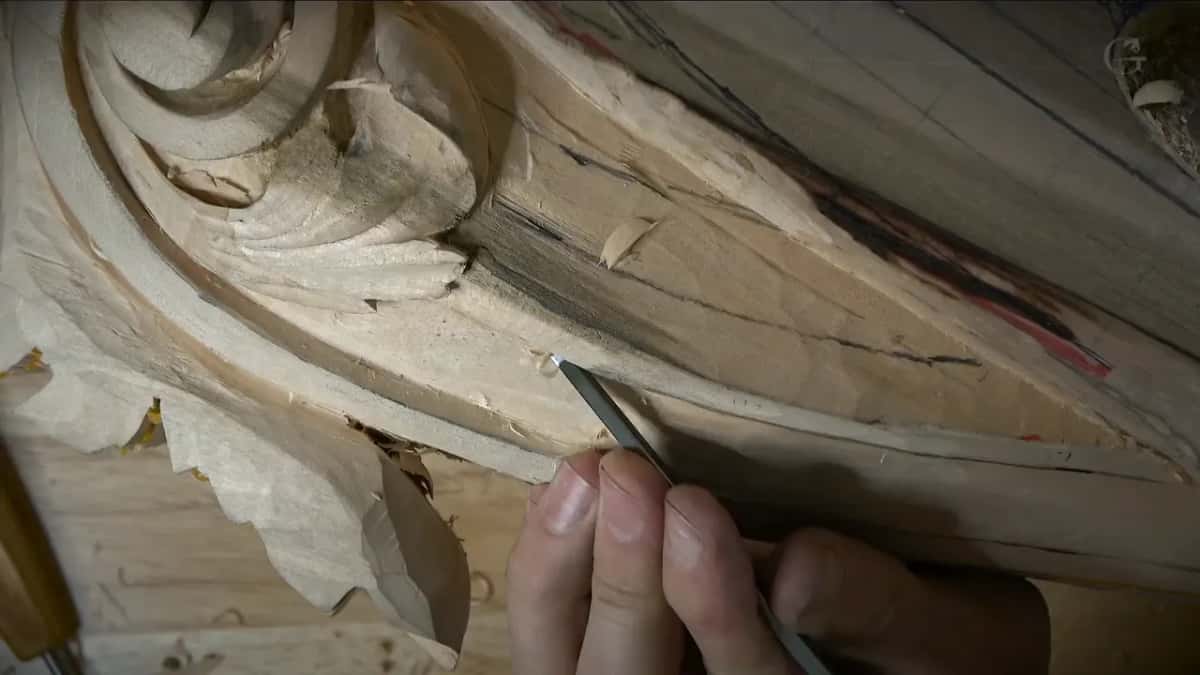
None of it works blunt. A tired bevel drags where a fresh one slices. Sharpening is its own subject, and it has a course to itself.
Who is this stretch of the room for?
This is the eighth block of one Venetian project, and the corbel that arrived in workshops 74 to 85 is still on the bench. It started back in workshops 1 through 12 and ran through 13 to 25 and 26 to 37 before that.
If the clock idea is new to you, that is the useful thing to take away. Even in workshop 97 I hold a number 11 at about eleven thirty and twist it slightly, and one wing gives me a wall pretty close to 90 degrees.
Do you want to know why a ridge you can hardly see on an acanthus matters at night? Would you rather understand the light than buy another chisel? Then the whole school is one door, and this room is one course behind it. Shall we carve?
Want a look around first, that is fine. The map of every lesson is open to anybody, the story of the school sits on one page, and the classes in Maine are there if you would rather stand at a bench next to mine. Start here if you have never held a gouge, and the design course is where I send anybody who wants to draw their own ornament first.
One more thing, and it has nothing to do with the clock. On the camera one of these dark hollows is just a black blur and you genuinely cannot see what is happening in there. I kept carving anyway and told you it looked good. It did.
How it's done
- Find the flute. Roll the gouge until the hollow faces up. That hollow is the middle of the tool, and every angle from here on is described by where it points.
- Point it at the ceiling. Twelve o'clock, near enough ninety degrees. Push there and the groove comes out with a vertical side, and whatever sits next to it survives.
- Turn toward two to fold an edge. Round to two, and the same push travels in under the line rather than down beside it. That way it is going to look like it's folding.
- The other way for the mirror. Eleven, ten, sometimes nine. Starting a concave I go one hour left of vertical. For an undercut on the left side, ten or even nine.
- Stop short of the line. Leave a little wood for the cleaning. Here I left a 16th of an inch, and a number 3 cleaned it up after the number 5 dragged.
- Raise the tiny ridges. A little ridge you hardly see under the floodlight. At night it is going to make a big difference.
- Move the light before you decide. Dim one lamp and move it. Keep the position with the better shadow, so you can see where the tool goes next.
- Walk away from a section. Work somewhere else for a while. If a part keeps bugging you, walk away for a couple of days and come back.
Frequently asked questions
What does twelve o'clock mean when carving?
It describes where the flute of the gouge points. Aimed straight upward it is twelve o'clock, roughly ninety degrees, and a push there leaves the groove with a vertical side. Use it whenever a neighbouring edge has to survive.
How do you stop a gouge from undercutting by accident?
Hold twelve, and watch it. Especially when you run right up against a rising edge, because leaning the tool even slightly makes it eat in under the shape you meant to protect. Undercutting has its place. Making it on purpose is the whole difference.
What does a macaroni tool do?
It gives you a wall of almost 90 degrees without undercutting. The number 23 is three chisels in a single iron, three flats and two corners, and it gets really close to a drawn line. I used a four millimeter one, and yes, the name is macaroni, same as what you eat. The rounded version is called a fluteroni.
What to carve next