
Alexander Grabovetskiy, woodcarver, School of Woodcarving · Published 2020
What does a wood carver mean by the "central line"?
Quick answer: Workshop 94, part 1, names the central line beside the main movement, in a line about what a carver needs to establish. My other lessons put the same words next to lobes and an eye, and next to a bulge and a V tool. Each has a link below.
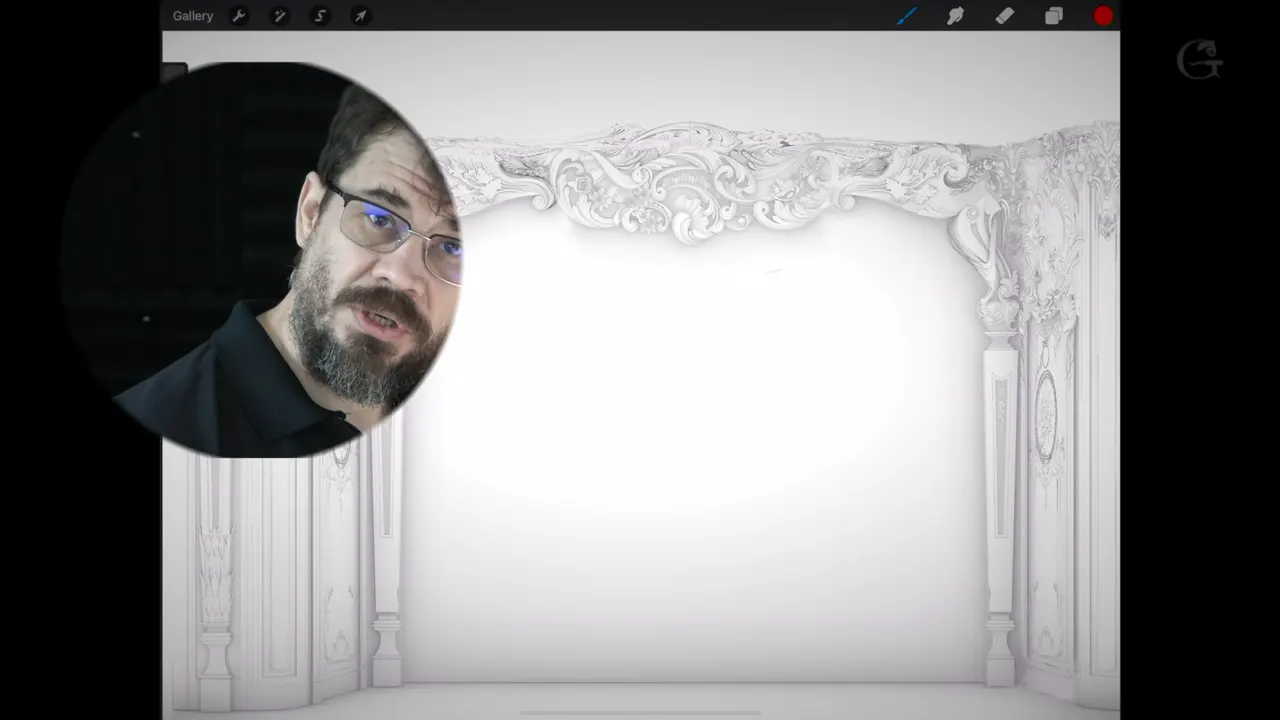

In my other lessons the same two words sit next to a lobe and an eye, and again beside a V tool or a bulge, with a line of my own at each stop. In part 1 of workshop 94, I say "they need to establish the main movement" and then "the main central line."
Ever drawn one line on a board and then not known where the next one belongs? Do you check a curve from more than one side before you pick up a gouge? Then these lessons will feel close to home. I start in Venice Room 94. After it I visit Grape Onlay, then Tray of Blessing, then the Greek and Byzantine acanthus leaf courses, and a few more. Sizes come in both systems, inches and millimeters, with my own figure first.
What do I say before the words in part 1?
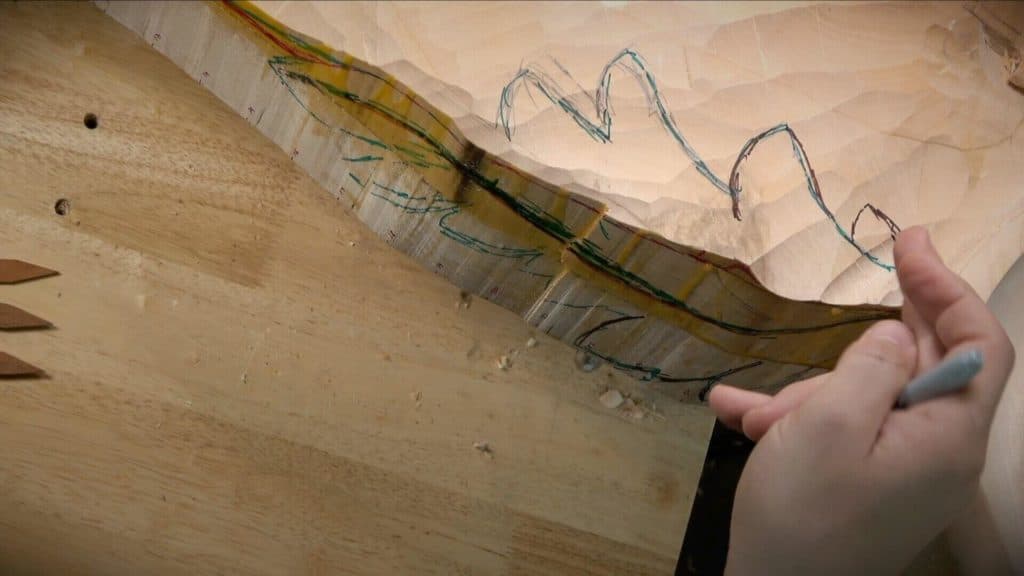
Part 1 starts with "I am ready to move on this section, and I know it's kind of confusing because you don't see in the overall how it looks, but it's actually has to be on the two planes." Then, about a picture: "this section right here."
The front view shows little: "you see only partial". Of my design on the computer, "I was looking either from this point of view or from that point of view, and it wasn't unified". Then "So it was kind of quick decision."

Which part names the line first?
The words sit in the quote at the top of this page, and a need comes next: "But anyway, so I have to create my middle movement first." Rule: "I still going to follow the golden ratio rule."

How do calipers meet the ridge?
My plan is "And if I would use the golden ratio calipers, three leg calipers". Next, "So my middle line goes right at the ridge." It closes with "So that is the ridge when those two surfaces meet." Then a doubt, in a question: "But my question is, do I like that idea or not?"
What happens when I flip the line?
First comes a plan: "So let me try to flip that." After that, "So let me let me try both ways and I'll see if I can like it." And "But I think I will be able to create a much nicer movement." Later, "I think I like it."
A note for you follows: "And I hope you see it, it's it's kinda hard, to see exactly what is going on from the points of view, but I'll try my best."

What shape does the line take?
Back at the board: "OK, let me draw a line and I'll see if it's going to make any sense or not." Then "And yes, it is going to make sense for sure". The shape is "almost like an S curvature". Also "So one arc going this direction and another one in this direction."
Further on, "That would be a really nice movement." And "Here's my arc. Well, arc number one." and "which is actually called the arabesque in the design world." A page on the arabesque is linked here. A color change follows: "Because I've got too many lines." And "And again, I'm using those markers just for the sake of showing."

How do I measure a smaller section?
Calipers again: "if you do have calipers and let's say you can see it's a it's a true golden ratio calipers." The numbers are "62 percent out of one 100" and "38 percent out of one hundred", "or 60-40 rule to be more simplified version." For more on the calipers, see the link.


What sits around the line in part 2?
A dislike opens part 2: "I kind of don't like what I see right here." Close by, "You've got kind of too many movements, too many separations, but we'll see if I don't like it or not." And "The only problem I see, I got too many divisions."
A third line: "this part is really important." Then "the central piece and what I have to place right there." "I can make this one as one movement" comes before the count, along with "I still not going to lose the separations".

How many divisions does part 2 count?
The count: "for me really important to see five separations". Right after, "Those are the main five divisions". Measuring them: "Well, usually I don't use those calliper, I'm actually just eyeballing it for me." And "but it's a good idea if you do have a callipers."

Where do the eyes land?
First, "Let me establish that Boat the front of the Boat shape first". Then "the main eyes and the pipes are going to fall between those separations. Those are going to be the main eyes and pipes going all the way, all the way to the central line."

A doubt sits near the end: "I'm not sure if I want to do it or not". My plan for a tool: "I'll take number 11, I'll use 10 mm. Number 11 Veiner." For depth, "it's only about 10 millimeters deep". Both tens are 0.39 in.

What are the main points in part 3?
The third part begins with "I don't worry about the separations yet." Then "All I worry about the main points, I worry about where those going to land". On the grain: "I'm actually working against the grain". Next, a need: "I really have to change the position and attack that from that side." Then "Here's another point." Then "I'll jump on this side the same idea pretty much."
An idea follows: "maybe I'll just walk around and back that from opposite direction." The depth is "about 10 millimeters" and also "about Three-eighths of an inch deep cut". Three-eighths of an inch is 9.5 mm. Later, "that's fine. That is enough."

Where does the skew chisel fit?
The slope first: "I don't want to lose the feel that this is a changing slope". Then "maybe maybe I should use just the skew." Next, "I think it's probably a good idea. One-inch skew skew chisel." The skew chisel is one inch, 25.4 mm.
Of the skew: "not transition, but like natural movement, I should say." Later, "that's good, that's plenty." The part ends on "a really nice and flowing line".

What is the line on a grape leaf?
Grape Onlay 5 shows a leaf that has "supposedly five lobes." Then "I've got 1, 2, 3, 4, 5. So that is the central line." About a lobe, "you're supposed to have an eye."

Close to it: "But I also don't wanna lose some overall shape." Also "I can take advantage of the natural movement, whatever I've got." The bulge: "and you can see it's bulging."

Later, "So, which means the eye is supposed to go to the direction of the center". And a plan: "get the smaller number nine and get quarter inch". A quarter inch is 6.35 mm.
Later, in the second part of that lesson, "Now the central line, it's gotta go from the center of the leaf". Also "ridge, which I don't need so I can take care of it." And "it's kinda scary. That's all right if you don't push it and if you have a really sharp tool, so should not have a problem."
Grape Onlay 8, part 2: "my bulging, my convex, it's kind of center right here." So "I need to kinda drive an eye", and a few lines on, "What I just made a decision. I mean, I made that twist." Then Grape Onlay 14, part 3: "I don't wanna go beyond my central line".

An offer sits near the end of that part: "I could introduce some kind of concave cut, just asking me for the concave cut to work the central line."
Can a central line be straight?
In lesson 3 of the Cabernet tray, part 2, "it cannot be straight line, it has to just bend a curve to the same motion." And "I'm gonna curve probably even more like this." Also "I have to do something to indicate the same movement."

Lesson 5 of the same tray, part 2: "I just place my number nine and just to cut toward the central line." Of a separation, "pretty much like a micro pipe". Then "Yeah, it just brings that life."
Greek Acanthus 5, part 4: "keep an eye the central line", and then "the central movement, and see how it's supposed to move." The V tool? "I'll take probably just the 45." That stays a plan. Also "right here is a center line, but I'm not going to do it in the center."

What joins the points of a leaf to one line?
In Byzantine Acanthus 3, part 1, "an invisible center line, right in the middle somewhere." Then "We've got points of those leaves, okay? They're supposed to be connected to that central line."
On T-stops: "What the T-stop in this case would be if you would take a line like this, and that becomes a T-stop, like letter T." And "Everything's supposed to flow to the same center line." In Byzantine Acanthus 8, part 2, "So draw a middle line of that pipe".

More from the Venice Room courses
Starting with part 12 of Venice Room 12: "Let me think." Then "central line going somewhere right here." Next, "And that doesn't look too good." Also "Maybe I should just take it down like that." Next stop, Venice Room 14, part 10: "Now I can create my line work, if you wish to call that way." Next, "I'm going to create the concave on both sides of that line. That way, I'll know exactly how to draw my eye".
Further on, Venice Room 21, part 4: "I need to draw that because I want to make sure it looks really good". Then "It's going to go down and maybe die closer to this side, just like that." Then, in part 5: "That's a central line. I have to just predetermine my eyes and pipes and how I want to see them." Then "because I want to create an illusion that has even more movement down."

Earlier, Venice Room 89, part 6: "especially in the Renaissance era, 15, 16th century, 17th century also, it was a big deal and they checked everything pretty much by the golden ratio." Also "So that would be the main central line."
Closer to home, Venice Room 93, part 10: "So pretty much my movement, the central line is going to go this way." Workshop 94, part 4: "I am free-handing, but I'm still looking at that really nice movement". Then "I have to make the decision how far my eyes can be". Last on this list, Venice Room 97, part 2: "So we are establishing just the main form."

What about panels, boards and moldings?
In Furniture Panel 9, part 2, "Now I can do micro-subdivisions. That is going to be my central line." Next, "I'll just make my parallel line to that, and I'll establish my eyes on the same line."

In Floral and Molding 9, part 3, "a central line, and what I'm after, just to try to continue this movement. Okay? Just to make it the same direction." For the slope: "number 7, 14 millimeters", which is 0.55 in.

In Curly Kitchen Cutting Board 6, part 2, "most logical this flower have to grow from the middle between those two lines." The close is "And supposedly I'm going to have a nice beautiful central line."

In Acanthus over Moldings 8, part 3, "central line gonna be about 60%". Then "I mean 62 38 approximately, of course."

Which lesson holds which line, and what sits beside it?
| Where | Next to the words |
|---|---|
| 94.1, this part | A middle movement to make first, then calipers, a ridge and an S curvature. |
| 94.2 | Five divisions. |
| 94.3 | Main points, a one-inch skew and middle lines. |
| Grape leaf, lesson 5 | Five lobes. |
| Same course, lessons 8 and 14 | One line I shifted, and a limit I do not want to pass. |
| Cabernet tray 3 and 5 | A curve, not a straight line. |
| Greek Acanthus 5 | A 45 V tool, and a center line to move a little to the left. |
| Byzantine Acanthus 3 and 8 | Points joined to one line, and a middle line of a pipe. |
| Lessons 12, 14 and 21 (Venice Room) | A line that does not look too good, and a concave planned on both sides. |
| Workshops 89, 93 and 97 | The golden ratio, and the main form. |
| Furniture Panel 9 | Micro-subdivisions, and eyes to put on the same line. |
| Floral and Molding 9 | A movement to continue, and a number 7, 14 millimeters, as a plan. |
| Acanthus over Moldings 8 | A 60 and 38 split. |
Is there a line on your own wood carving or woodworking that you drew once and then doubted? Everything in workshop 94 sits inside one tuition plan. Other workshops wait on the Part 8 course page, and more workshops carry on from there, all done with hand tools.
How it's done
- Name the two planes. The part "has to be on the two planes".
- Set the middle movement. A need in part 1: my middle movement comes first.
- Try the line both ways. I plan to try it flipped, and then judge it.
- Count the five divisions. Five main ones, counted one through five.
- Place the eyes. They are to fall between those separations, as the part says.
- Think about a skew. A maybe: use just the skew, which I think is probably a good idea.
Frequently asked questions
Where in workshop 94 do I name the central line first?
Beside the main movement, in part 1. A rule follows: "I still going to follow the golden ratio rule."
What does the middle line meet in part 1?
The ridge. "So my middle line goes right at the ridge." Then a question I ask myself: "do I like that idea or not?"
How many main divisions does part 2 count?
Five: "for me really important to see five separations." Right after, "the main five divisions".
How deep is the section in part 2?
What to carve next
- Venice Room 94
- Carving Grape Onlay
- Tray of Blessing
- Carving Greek Acanthus Leaf
- Carving Byzantine Acanthus
- Grape Onlay 5
- Grape Onlay 8
- Grape Onlay 14
- Cabernet tray 3
- Cabernet tray 5
- Greek Acanthus 5
- Byzantine Acanthus 3
- Byzantine Acanthus 8
- Venice Room 12
- Venice Room 14
- Venice Room 21
- Venice Room 89
- Venice Room 93
- Furniture Panel 9