

Alexander Grabovetskiy, woodcarver, School of Woodcarving · Published 2020
What does a wood carver mean by "much deeper"?
Quick answer: Part 7 of workshop 94 holds the words "much deeper" beside a middle line, a convex and a second side that is "not much deeper, a little deeper." In my other lessons the same words sit beside flowers, undercuts, shadows, stems and moldings. Each stop has a link, and a table sets them side by side.
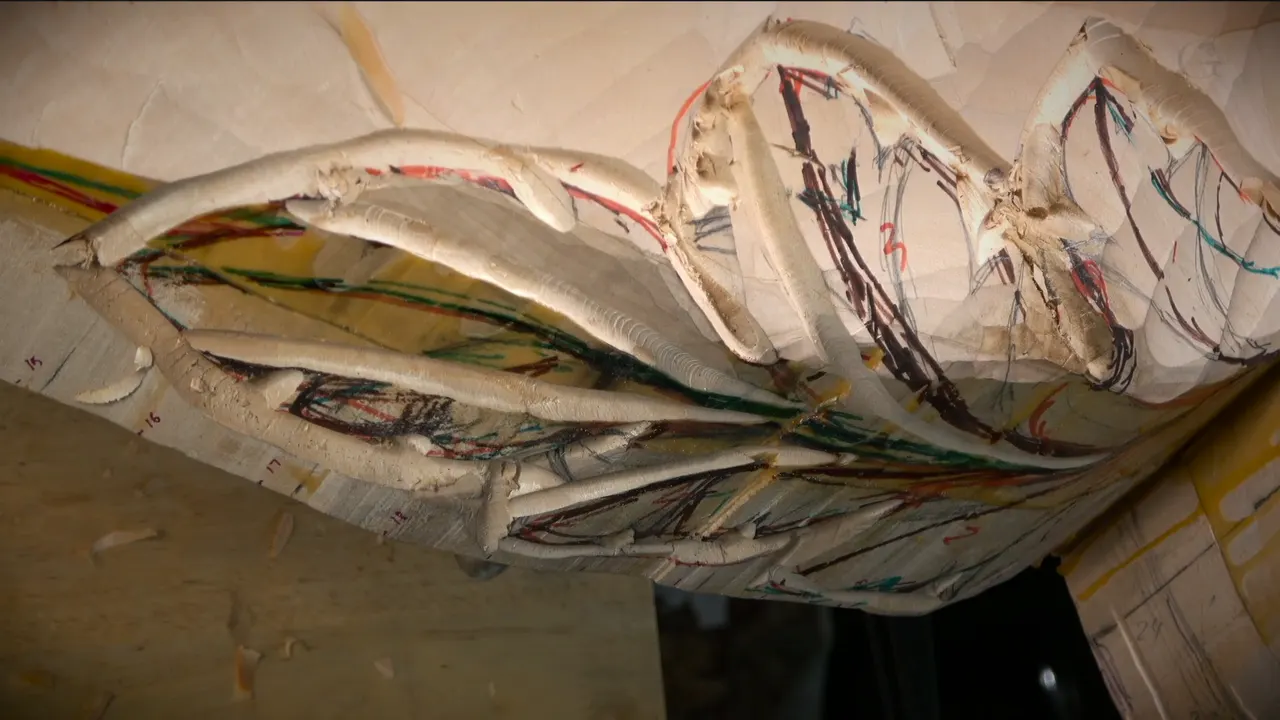

Workshop 94, part 7, holds the words "much deeper" beside a middle line and a convex. My other wood carving lessons carry those words beside flowers, undercuts, shadows, stems and moldings, with a line of mine at each stop.
Ever looked at a hollow and wondered how far down it should go? A light pass may do. Or the spot may ask for a lot more. This page starts in Venice Room 94 and visits sixteen more lessons, with each size given in millimeters and inches, my own figure first.
What comes before the much deeper dig in part 7?
The part opens with "Ok, it looks good, so now I need to blend it and of course, I mean, I could use a skew again." A verdict on the tool follows: "skew is actually a really quick way, but I have to be careful with the skew". The goal is a feel, in "I still want to give that the feel of like a convex." For the tool itself, the chisel page is a fair start.

Which line does it protect?
The middle one. "I don't want to destroy my middle line because it has a really nice arch or arc and I don't want to lose it." Both words, arch and arc, have pages of their own on Wikipedia.
Where does the dig itself go?
Into an area by that line. The plan reads "But you know what, I could actually do a much deeper cut right here in this area". A forecast sits further on: "we'll be able to create the nicer convex."

Blending takes the lines after it, all short: "blend that and also this." and "And blend it together." One more plan closes the stretch: "All right, that is good. So let me do also on this side."
What changes when the work moves to the other side of the piece?
"And I could probably do much deeper." The next line is "It's not much deeper, a little deeper."

Grain gets a line of its own: "And I am working against the grain because it's not too convenient for me to attack from this side." Close by, "but I can clean up a little later." and "I'm OK with that." The grain page covers the word.
One more shape appears in "I do have another pipe." The part ends on a plan: "OK, that's good, and I've got to do exactly the same on this one and that one Ok same thing, same idea. I'm not going to draw it anymore, I'll just do it eyeballing it".
What do parts 6 and 8 say around it?
Part 6 of the same lesson guards the same line: "not to hit my middle line". The movement gets a word too: "also a gradual movement."

In part 8 of the lesson, "OK, so that is only a rough shape yet." A skew returns: "And I'll take on just a skew chisel." Grain returns too, with "Yes, I am working against the grain." and "as long as I have my tool super sharp, I shouldn't have any problem." Then a roll: "And maybe I can roll slightly this section this way to the right just a little bit." The look gets a forecast: "It's going to give me a lot nicer, smoother look."
How does Furniture Panel 23 phrase much deeper?
Furniture Panel lesson 23, part 5, has "And yes, I need to go much deeper". Next in line, "Otherwise, it doesn't look too good." Then "I hope you're already starting to see the flower coming alive."

Gear is named in "number three, three millimeters, one-eighth of an inch." An undercut gets a warning: "Really carefully." A size comes with a pick: "And that's a one millimeter, and probably wiser would be to use a half a millimeter." Those are 0.04 in and 0.02 in.
The thinner tool is forecast to bring more: "and a much more three-dimensional feel, and deeper shadow casting." Another check sits near it: "And I can see that this one needs to be taken down a little more because it does not look right just like that."
What is the deeper undercut in Furniture Panel 28?
The same course, lesson 28, part 2, has the first line "And yes, I'm gonna need to do it much deeper, otherwise there is not gonna be any effect." After it, "You can get lost, you're not gonna be able to see what is going on."

Gear for it: "And let me get actually half a millimeter number 11" (about 1/50 in). The undercut follows in "And I gonna create much deeper undercut", with the aim in "what I'm after, I'm after shadow". Two depths sit side by side: "from almost nothing. Okay? Right here it's almost no cut" and "much deeper right underneath."
Rolling is the plan for a later step, in "So now the next step would be to roll it." A spoon tool is the likely pick, in "the same number three, spoon gouge". The gouge page lists the family.
Does Furniture Panel 30 call a downhill area much deeper?
Furniture Panel lesson 30, part 2, begins with "from this point downhill. So it's a much deeper area." A need sits beside it: "and get this cut much deeper."

Then comes a size with a pick: "And I'm gonna get number 11 and about five millimeters, maybe seven millimeters. I'll do seven millimeters." That is 0.2 in and 0.28 in. A reach follows, "Like I said, I can go almost all the way to the background." A limit closes it: "So this one is a overlay right on top, which means I can't mess up."
How much is not much in Floral and Molding?
In the Floral and Molding course, lesson 6, part 1 starts with "chop out some of that". A knife: "I'll just use a knife." After that comes "I'll use number 11 and 3mm" (0.12 in). The result is held back: "Not much, but still somewhat deeper."

Lesson 10 shows a spot with care around it: "work around that part", beside "which I do have flowers". Then "I'm safe, actually, to excavate much deeper". "I think that is enough with that tool." closes that stretch. For the tool after it: "I'm going to grab, let's see, number nine, and I'll attack the side of that future acanthus." Molding and acanthus each have an entry.
How far down is much deeper on the Venetian Rosette?
Venetian Rosette lesson 1, part 3, gives a depth: "it's only about a half an inch" (13 mm), then "Okay? Much deeper."

Number nine is next: "number nine and about 10 millimeters. It should be good." Ten millimeters is 0.39 in. Another option waits nearby: "Although, what I could do, I could actually remove some of the material that way first and then go deeper and clean it. So that is another option."
In lesson 3, part 1, the same words wait for another day: "Again, that is just a preliminary undercut. Later on, I'm going to go much deeper." Further down, "Attack it from two sides" and "And hopefully you can see a really pronounced letter S curvature." The last line reads "But it's not the end yet." More on that kind of ornament sits on the Wikipedia page for the rosette.
Does a stem change the dig in Hazelnuts 7?
Hazelnuts 7, part 1, offers two lines, the first being "I can actually excavate little deeper. I already started before, but now I can do it much deeper." Veiner talk follows, and the size is "five millimeters veiner number 11" (0.2 in), given in both systems.

The depth is told in "Yeah, you can see probably how deep I went. About maybe a half an inch" (13 mm). The stem arrives in part 2: "the stem going to be separated from the leaf", with "excavate much, much deeper right here." Next, a mallet: "I got to go from inside outward with the help of a mallet." A limit follows: "Just don't go too deep to the background, okay?" See the hazelnut and mallet pages for the words.
How careful is the shadow look in Roman Acanthus?
The Roman Acanthus course, lesson 14, part 1, starts with a warning: "And I already did on another ones, and I overdone some of it, but be careful not to overdo it." Then "Just take your time."

The look is described as "much deeper shadow look, and you can probably already see how it creates the shadow." Behind it, "Approach that from opposite side." Roman Acanthus 15, part 1, adds "And besides, it's going to look much deeper." and "I'll do it multiple times." Light and dark have a shadow entry.
How does a deeper concave serve the convex in Byzantine Acanthus?
Byzantine Acanthus, lesson 3, part 3, states the want: "I would like to see convex going uphill but not going backward." The answer is "which means, what I have to do, maybe even to excavate much deeper concave on that side."

Limits sit around it: "And I don't worry about, I can reestablish it. But also not going all the way, of course. I still have to have some space." Then comes "So we are blending it, but without going back." The Byzantine page on Wikipedia is a fair start for the style.
Where does a concave start in Acanthus over Moldings?
The Acanthus over Moldings course, lesson 7, part 1, asks "And what else I can do? I can actually create much deeper cut. On my concave I can start. Somewhere, right?" The spot is "not in the middle but closer to the edge."

The same tool returns, "the same number nine what I used previously", with a swap in "Or you know, whatever number eight." The path is "I'm gonna create a cut like this. It's gonna go downhill." A look follows: "I can see how it casts a shadow." Then "Maybe more exaggeration".
Is a spoon gouge another way down in Plate with Butterflies?
Plate with Butterflies puts a choice in lesson 5, part 3: "There's a couple ways actually you could attack." The spoon is one way: "to use a spoon in my case. It's just 1/8 of an inch" (3 mm), and the verdict is "Maybe it's actually a better way."

What makes the shadow deeper in the Lily Box lessons?
Lily Box lesson 5, part 1, has "Much deeper shadow."

Next up: "Let me use the same one millimeter, number 11" (0.04 in), with "kind of dig underneath little bit right here". A move follows: "start digging on the side right here." For that side, "I would probably use three millimeters at first" (0.12 in).
What does a hole add, in Hashemi Flowers, to much deeper?
Hashemi Flowers, lesson 45, part 5, has a line: "Now, definitely, my hole is much deeper." An option sits beside it: "I could use just a toothpick and just get inside of this hole." A reminder for you: "And you don't have to drill that deep as I do."

Further on come "Preliminary undercut." and "It's not the final undercut." Right behind them, a second tool: "And I'll use number four." with "approximately quarter inch" (6 mm).
Which parts of the Chamomile and Bow Rosette want much deeper?
Chamomile and Bow Rosette lesson 1, part 2, points to "closer to the inner part". It continues with "Okay? So those parts going to be much deeper cuts." The aim is "create the shape" and "I'm after shadow, deep shadow."

A small gouge is the likely pick: "And to do that" and "the small, tiny gouge I used previously. Like one and a half millimeters and go toward the center." One and a half millimeters is 0.06 in.
Lesson by lesson, what sits beside much deeper?
| Lesson and part | What sits beside much deeper |
|---|---|
| Workshop 94-7 | An area by a guarded line, then a lighter dig. |
| Flower, Panel 23-5 | A thinner tool, and deeper shadow casting. |
| Undercut, Panel 28-2 | Shadow, and a depth that starts from almost nothing. |
| Downhill, Panel 30-2 | Overlay on top, with number 11. |
| Knife, Molding 6-1 | Result held back, with number 11. |
| Leaves, Molding 10-1 | A spot to work around, with number nine as the next tool. |
| Low spot, Rosette 1-3 | Number nine, plus an option to try. |
| Later on, Rosette 3-1 | An early undercut, with the deeper dig left for another day. |
| Stem, Hazelnuts 7 | A veiner, a leaf to separate, and a mallet. |
| Shadow, Roman Acanthus 14-1 | A pass underneath, and a warning. |
| Convex, Byzantine 3-3 | A concave on one side so the convex runs uphill. |
| Edge, Moldings 7-1 | A concave begun near the edge, then number nine or eight. |
| Spoon, Butterflies 5-3 | A couple of ways to attack. |
| Thin tool, Lily Box 5-1 | Shadow, then a thicker tool at the side. |
| Hole, Hashemi 45-5 | A toothpick, and a number four. |
| Petals, Chamomile 1-2 | Shadow, and a tiny gouge toward the center. |
Is there a spot in your own carving that needs more than a light pass? Everything in workshop 94 sits inside one tuition plan. More Venice Room workshops wait on the Part 8 course page, and a ridge between two hollows has its own page in Venice Room 87. For furniture work, start with the Furniture Panel course.
How it's done
- Guard the middle line. Part 7 protects it, arch and all.
- Weigh the dig. Here the dig is an option, not a done pass.
- Plan the blend. Blending sits in "blend that and also this."
- Name the next area. The words for it are "let me do also on this side."
- Go lighter there. That area is described as a lighter dig, in the line quoted earlier.
Frequently asked questions
Which line does this part guard?
The middle one.
Which tool does this part mention?
A skew. Part 8 adds a skew chisel.
How deep is the other side here?
Only a little more.
Which tool does the Hashemi Flowers lesson 45 name after the undercut it mentions?
What to carve next
- Venice Room 94
- Furniture Panel 23
- Furniture Panel 28
- Furniture Panel 30
- Floral and Molding 6
- Floral and Molding 10
- Venetian Rosette 1
- Venetian Rosette 3
- Hazelnuts
- Roman Acanthus 14
- Byzantine Acanthus 3
- Acanthus over Moldings 7
- Plate with Butterflies 5
- Lily Box 5
- Hashemi Flowers 45
- Chamomile and Bow Rosette 1
- Venice Room 87
- Venice Room Part 8